-`._-`._-`._-`._-`._-`._-`._-`._-`._-`._-`._-`._-`._-`._-`._-`._-
``.~. r-. (O) -=~ .___ __. , ___ _ __
' ' / \ // `| R \\ / \\ /: ^ / / '. \\ \/ ====|
- | | ! || < :|. _ //.| 0 | /|: |*| | | A | || ||:
= \*/ + || / | =|\ |. 0 |. \ | : | | a || | V | >===
-= v \ || \==- | ^ |. \\ // \\/ \v/ \_ --, \'/ :
~-= |`. `" ~ `~ u ' V |__| V .====|
"It's all magic."
2022.05.30 - DHMIS #
What it is: Dark-humor Sesame Street
Main theme: Adults explaining things to children that they
themselves don't really understand.
The instructors are entirely condescending, but when faced with
questions about the subject matter, they respond with
tautological, evasive, or contradictory answers. This causes
despair in the children.
Examples:
* When the boy asks how creativity works, the notepad replies
that she "just tries to think creatively".
* When the children ask some natural questions about time, the
clock just responds, "Time is important, and I am a clock."
* The boy is told that we can all love one another, but also that
love must be dedicated to one partner for life.
* The computer explains that his mind contains a "digital mind".
* The nutrition advice is self-contradictory, much as in real
life.
Other themes:
* Creativity is often encouraged, but only within bounds set by
those encouraging it.
* The invasiveness of modern computing services (compared to
older personal computing).
^v^v^v^v^v^v^v^v^v^v^v^v^v^v^v^v^v^v^v^v^v^v^v^v^v^v^v^v^v^v^v^v^
2020.08.15 - The decade in Movies #
Another decade, another review
2010
True Grit (Coen Bros)
2011
Limitless (Burger)
2012
Chronicle (Trank)
Life of Pi (Lee)
Moonrise Kingdom (Anderson)
The Secret World of Arrietty (Yonebayashi)
2013
American Hustle (Russell)
Much Ado About Nothing (Whedon)
2014
Boyhood (Linklater)
Ex Machina (Garland)
Her (Jonze)
The Lego Movie (Lord, Miller)
The Wind Rises (Miyazaki)
2015
Tomorrowland (Bird)
2016
Angry Birds (Kaytis, Reilly)
Shin Godzilla (Anno, Higuchi)
2017
La La Land (Chazelle)
Wonder Woman (Jenkins)
2018
Paddington 2 (King)
2019
Knives Out (Johnson)
The decade started well but the second half was extremely weak
and we may be seeing the end of the medium as we've known it.
Then why are there 20 entries here, vs 17 in the previous decade?
I wanted at least one film for every year, and then I listed all
films at least as good in any year. In fact, almost none are as
strong as their counterparts ten years ago.
But they are all worth watching.
^v^v^v^v^v^v^v^v^v^v^v^v^v^v^v^v^v^v^v^v^v^v^v^v^v^v^v^v^v^v^v^v^
2018.08.18 - The Best of South Park cont. #
My previous post on this was too pessimistic...
0709- Christian Rock Hard
0710- Grey Dawn
0712- All About Mormons
0809- Something Wall-Mart This Way Comes
0904- Best Friends Forever
1010- Miss Teacher Bangs a Boy
1101- With Apologies to Jesse Jackson
1105- Fantastic Easter Special
1107- Night of the Living Homeless
1108- Le Petit Tourette
1307- Fatbeard
1310- W.T.F
1401- Sexual Healing
1404- You Have 0 Friends
1408- Poor and Stupid
1414- Creme Fraiche
1505- Crack Baby Athletic Association
1507- You're Getting Old
1508- Ass Burgers
1511- Broadway Bro Down
1602- Cash For Gold
1604- Jewpacabra
1803- The Cissy
1806- Freemium Isn't Free
1808- Cock Magic
1809- #REHASH
1810- #HappyHolograms
1902- Where My Country Gone
1908- Sponsored Content
2103- Holiday Special
^v^v^v^v^v^v^v^v^v^v^v^v^v^v^v^v^v^v^v^v^v^v^v^v^v^v^v^v^v^v^v^v^
2018.02.05 - Edge 2018 #
After 20 years, Edge.org is wrapping up their Annual Question.
Responses this year are short enough to include in full...
Sociology
Cesar Hidalgo: When will we replace governments with algorithms?
Laura Betzig: Will we ever live together in a hive?
Timothy Taylor: Why is Homo sapiens the sole non-extinct species
of hominin?
Yuri Milner: If we discover another intelligent civilization,
what should we ask them?
Gravity
Janna Levin: Is gravity a fundamental law of nature, or does
gravity – and thereby spacetime – emerge as a consequence of the
underlying quantum nature of reality?
Donald D. Hoffman: Why is it that the maximum information we can
pack into a region of space does not depend on the volume of the
region, but only on the area that bounds it?
Alexander Wissner-Gross: Can general-purpose computers be
constructed out of pure gravity?
Freeman Dyson: Is it ultimately possible for life to bend the
shape of the universe to fit life's purposes, as we are now
bending the shape of our environment here on earth?
Metaphysics
Lawrence Krauss: Is the universe like an onion that will require
science to keep peeling back new layers of reality and asking
questions forever?
Chiara Marletto: Is the number of interesting questions finite
or not?
Bruce Sterling: Do the laws of physics change with the passage
of time?
Keith Devlin: Can we develop a procedure that, in principle,
would tell us whether or not our universe is a simulation
(analogous to the way the now proven Poincare Conjecture can tell
us the universe's shape)?
Complexity
Dave Morin: Is the brain a computer or an antenna?
Danny Hillis: What is the principle that causes complex adaptive
systems (life, organisms, minds, societies) to spontaneously
emerge from the interaction of simpler elements (chemicals,
cells, neurons, individual humans)?
John C. Mather: What is the master principle governing the growth
and evolution of complex systems?
Biology
George Dyson: Why are there no trees in the ocean?
Economics
Sam Harris: Is the actual all that is possible?
^v^v^v^v^v^v^v^v^v^v^v^v^v^v^v^v^v^v^v^v^v^v^v^v^v^v^v^v^v^v^v^v^
2017.01.12.2 - Edge 2017 #
What Scientific Term Or Concept Ought To Be More Widely Known?
Seth Shostak - Fermi Problems
John Tooby - Coalitional Instincts
Steve Omohundro - Costly Signalling
Gregory Cochran - The Breeder's Equation
Robert Plomin - Polygenic Scores
Richard Nisbett - Fundamental Attribution Error
Cesar Hidalgo - Criticality
William Poundstone - Stigler's Law of Eponymy
George Dyson - Reynolds Number
Jeremy Bernstein - Unruh Radiation
Raphael Bousso - Cosmological Constant
Gino Segre - Gravitational Radiation
Max Tegmark - Substrate-Independence
^v^v^v^v^v^v^v^v^v^v^v^v^v^v^v^v^v^v^v^v^v^v^v^v^v^v^v^v^v^v^v^v^
2017.01.12.1 - Edge 2016 #
It's time for our decreasingly annual review of the Edge Annual
Question. First, we'll get caught up for 2016.
There were more responses than ever. CRISPR, the replication
crisis in psychology, and deep learning got the most mentions,
roughly in that order. Yuri Milner's Breakthrough Listen project
was mentioned more than once. Here are our picks:
~ social sciences ~
Jonathan Haidt - The Strongest Prejudice Was Identified
Michael McCullough - Religious Morality Is Mostly Below The Belt
Gloria Origgi - Antisocial Punishment
Steven Pinker - Human Progress Quantified
~ computer science ~
Steve Omohundro - Deep Learning, Semantics, And Society
John C. Mather - Bayesian Program Learning
David Dalrymple - Differentiable Programming
~ physics & astronomy ~
Amanda Gefter - Computation And The Nature Of Reality
Paul Steinhardt - The Big Bang Cannot Be What We Thought It Was
Yuri Milner - Tabby's Star
~ medicine & biology ~
Gary Klein - Blinded By Data
George Johnson - The Most Powerful Carcinogen May Be Entropy
Todd C. Sacktor - Cancer Drugs For Brain Diseases
David Haig - Human Chimeras
Simon Baron-Cohen - Growing A Brain In A Dish
Alun Anderson - Ace-mNeon
^v^v^v^v^v^v^v^v^v^v^v^v^v^v^v^v^v^v^v^v^v^v^v^v^v^v^v^v^v^v^v^v^
2016.12.08 - Ad astra #
To strive for happiness is to merge with your cover story.
Happiness is a signal life uses to survive. Like any binary
signal, it's maximally informative if it obtains about half the
time.
Trying to live in harmony with nature isn't even a thing --
nothing in nature does it.
A more enlightened goal is to take up the mantle of life itself:
to grow, to fight entropy, and to re-encounter the stars.
^v^v^v^v^v^v^v^v^v^v^v^v^v^v^v^v^v^v^v^v^v^v^v^v^v^v^v^v^v^v^v^v^
2016.10.29 - Map projections #
I made a page showing a few of my favorite world maps.
--> Update: But Kavrayskiy VII is probably the best general-
purpose world map.
^v^v^v^v^v^v^v^v^v^v^v^v^v^v^v^v^v^v^v^v^v^v^v^v^v^v^v^v^v^v^v^v^
2015.01.24 - What do you think about machines that think? #
It's time for the increasingly annual tradition of reading all
responses to the Edge Annual Question and listing the good ones.
Michael Shermer - Think Protopia, Not Utopia Or Dystopia
Neil Gershenfeld - Yes, But
Frank Tipler - AIs Will Save Us All
Freeman Dyson - I Could Be Wrong
Alexander Wissner-Gross - Engines Of Freedom
^v^v^v^v^v^v^v^v^v^v^v^v^v^v^v^v^v^v^v^v^v^v^v^v^v^v^v^v^v^v^v^v^
2014.01.19 - What scientific idea is ready for retirement? #
Continuing my quasi-annual tradition of reading all responses to
the Edge Annual Question and listing the good ones.
Obvious but probably worth stating
Grandmother Cells
The Input-Output Model of Perception and Action
Multiple Regression as a Means of Discovering Causality
Beauty is in the Eyes of the Beholder
Nature Versus Nurture
Malthusianism
Scientific Knowledge Should Be Structured as Literature
Calculus
Legit insights that are all in biology for some reason
One Genome Per Individual
Somatic Mutation Theory of Cancer (see also)
Natural Selection is the Only Engine of Evolution
Mouse Models
The LNT Hypothesis
Speculative
Spacetime
Geometry
^v^v^v^v^v^v^v^v^v^v^v^v^v^v^v^v^v^v^v^v^v^v^v^v^v^v^v^v^v^v^v^v^
2013.03.03 - Solar patio #
Back in 2002, Whole Foods Berkeley made a big stink about
installing solar panels on their roof. Largest PV system ever put
on a grocery store, or some such. I frequently saw signs about it
when shopping. There are apparently 33kW of panels, exclusively
used to run lights in the store.
In 2006 we moved to Los Gatos, where the Whole Foods has no solar
panels. In 2011 we moved back to Berkeley and I wondered how the
system was performing. I couldn't find any signs about it, so I
enquired at the customer service desk. Two fellows there were not
aware of any solar panels. They fetched a third, who said he
thought there were some.
I did notice they'd upgraded their outdoor seating area. There
are six small picnic benches that seem to seat 8-10 people when
it's busy. And two natgas-fired patio heaters overhead.

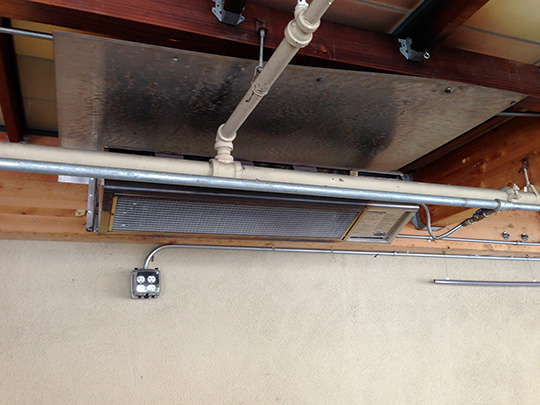 Today it's sunny and 70 degress in Berkeley. Denali and the kids
and I stopped at Whole Foods for lunch. I noticed the heaters are
going full tilt. Standing on one of the benches, I found that
they're Fisher & Paykel DCS DRH48Ns, rated at 56,000 BTU/hr.
That's 16kW each. There's no mention of a throttle in the user
manual, and none visible.
So this outdoor seating area consumes 32kW... about the same as
the maximum output of the solar panels. In North America,
trackerless rooftop PV systems make about 1/5 of their max power
on average. If the patio heaters are run more than 5 hours/day,
they'll use more energy (most of it lost to the wind) than the
solar panels produce.
When it comes to lighting the store, I'm sure there's a reason
to convert sunlight into electricity and use that electricity to
power artificial lights (a combination that is less than 4%
efficient) rather than just installing skylights. But I don't
know what it is.
^v^v^v^v^v^v^v^v^v^v^v^v^v^v^v^v^v^v^v^v^v^v^v^v^v^v^v^v^v^v^v^v^
2013.01.25 - The Edge Annual Question #
Each year John Brockman asks his correspondents a provocative
question and publishes the answers. There are usually over 150
responses of varying quality. Since 2004, I've often read them
and highlighted the most interesting and well-reasoned...
2004: WHAT IS YOUR LAW?
2006: WHAT IS YOUR DANGEROUS IDEA?
2008: WHAT HAVE YOU CHANGED YOUR MIND ABOUT?
2012: WHAT IS YOUR FAVORITE DEEP ... EXPLANATION?
2013: WHAT SHOULD WE BE WORRIED ABOUT?
2014: WHAT SCIENTIFIC IDEA IS READY FOR RETIREMENT?
2015: WHAT DO YOU THINK ABOUT MACHINES THAT THINK?
2016: WHAT DO YOU CONSIDER THE MOST INTERESTING RECENT NEWS?
2017: WHAT SCIENTIFIC CONCEPT OUGHT TO BE MORE WIDELY KNOWN?
2018: WHAT IS THE LAST QUESTION?
^v^v^v^v^v^v^v^v^v^v^v^v^v^v^v^v^v^v^v^v^v^v^v^v^v^v^v^v^v^v^v^v^
2012.09.19 - Nuking a cold sore from orbit with Ametop #
In order for an oral herpes outbreak to progress, virus particles
released from lytic neurons have to enter neighboring neurons
through their terminals on the skin's surface. The main way
topical treatments are thought to tame outbreaks is by
"preventing attachment" of these particles to quiescent neurons.
This is why treatment only works if you catch an outbreak early.
(The disease is most contagious during an outbreak, but
significant viral shedding can occur at any time. The lytic
phase may be vestigial, or may be periodically required to keep
the latent infection going.)
It's not clear what sort of things can prevent attachment.
Probably almost any volatile oil does to some extent (there are
studies for lots of them showing some effect). They evaporate
quickly, so Carmex et al put them in a cream.* Ionic zinc and
tin compounds may work modestly better. Docasonal ("Abreva") is
a surfactant (and common lipstick additive). The study that got
it approved showed outbreak duration reduced by something like
12 hours -- dubious clinical significance. In my own experience,
topical zinc oxide ("Novitra") is more effective than Abreva
(though in these few cases, variance in the timing of first
treatment could account for the difference). Newer OTC creams
contain benzalkonium chloride (another surfactant and common
household cleaner) or benzyl alcohol and are probably at least as
effective as Abreva.
Another kind of topical treatments contain antiviral drugs, and
are meant to block production of virus particles directly. I've
used penciclovir ("Denavir") on several occasions. But it works
no better than Abreva in trials. My Dad, who designed antiviral
drugs for a living, has expressed doubt that these drugs could
be effective topically.
Today, I propose that there's a 3rd kind of topical treatments:
anaesthetics. I've always avoided anaesthetic preparations
(Blistex etc) because I assumed they were only for symptomatic
relief. But the most effective topical of any kind studied is
actually the powerful anaesthetic tetracaine. Granted, the study
size was small, but it was enough generate an OTC product
("Viractin"). Online reviews of this now-discontinued product are
markedly better than those for Abreva and pretty much everything
else.
The tetracaine study authors hypothesized it prevents attachment.
That may be true, but they clearly hypothesized it because it's
what you hypothesize in papers about herpes labialis. I have a
different hypothesis: Anaesthetics block calcium channels and
literally shut down nerve cells. This is bound to disrupt DNA
synthesis in the nucleus and scuttle lytic production of the
virus. Even if this is wrong, a tetracaine cream ought to have
approximately the same 'preventing attachment action' as Abreva,
and you'll get symptomatic (pain) relief on top of it.
So why was Viractin discontinued? Because circa 2007, a couple of
idiots applied whole tubes of anesthetic cream to their legs and
then wrapped their legs in saran wrap, to prepare for laser hair
removal treatment. They died. The FDA issued warnings and as a
result, tetracaine is now completely unavailable in the US. The
max concentration of benzocaine and lidocaine has also been cut
in all kinds of products, apparently without exception. But after
an hour or so of trying, I was able to import 4% tetracaine cream
from the UK, where it is still OTC...
References:
Gaby - Natural Remedies for Herpes simplex
Alternative Medicine Review 2006
Savoy - What cold sore medication is most effective...
Evidence-Based Practice 2011
Worrall - Herpes labialis
Clinical Evidence 2009
* I had one clear case of total outbreak prevention with early
Carmex treatment in 1994.
^v^v^v^v^v^v^v^v^v^v^v^v^v^v^v^v^v^v^v^v^v^v^v^v^v^v^v^v^v^v^v^v^
2010.10.17 - Factors in employment, 1960-2009 #
Population: 1.7
Employed persons: 2.4
Persons employed in manufacturing: 0.8
Persons employed in services: 3.2
IT: 1.6
Government: 2.7
Finance: 3.1
Leisure & Hospitality: 3.8
Education & Health: 6.5
< Excel version >
ftp://ftp.bls.gov/pub/suppl/empsit.ceseeb1.txt
http://www.census.gov/popest/states/NST-ann-est.html
http://en.wikipedia.org/wiki/1960_United_States_Census
^v^v^v^v^v^v^v^v^v^v^v^v^v^v^v^v^v^v^v^v^v^v^v^v^v^v^v^v^v^v^v^v^
2010.10.15 - More sweetness #
1.75 fructose [monosaccharide]
1 sucrose [fructose + glucose]
0.9 tagatose [monosaccharide] †
0.8 erythritol [sugar alcohol] †
0.75 glucose [monosaccharide]
0.5 trehalose [2*glucose] †
0.4 oligofructose (FOS) [N*fructose] †
0.3 maltose [2*glucose]
0.3 galactose [monosaccharide]
0.2 lactose [glucose + galactose]
0.1 inulin [N*fructose]
See also.
† Use more of these
^v^v^v^v^v^v^v^v^v^v^v^v^v^v^v^v^v^v^v^v^v^v^v^v^v^v^v^v^v^v^v^v^
2010.08.14 - Translation #
web 1.0 -> web 2.0
software the web
the web wikipedia
magazine blog
utopia youtube
.com amazon.com
^v^v^v^v^v^v^v^v^v^v^v^v^v^v^v^v^v^v^v^v^v^v^v^v^v^v^v^v^v^v^v^v^
2010.07.18 - The myth of fiscal stimulus #
Promoted by Keynes & FDR and more recently by Krugman & Obama,
is the idea that the government can act countercyclically in a
recession. When private-sector spending ("aggregate demand")
contracts, government can buy stuff instead. It does this by
issuing debt (bonds). The problem with it is that it's
completely ineffective.
If the stimulus is truly temporary, the private sector will treat
it as such. Firms won't make investments in people or plant to
meet temporary demand. For example, construction firms know they
are on a stimulus job and hire workers only for the duration of
the contract. The workers, in turn, lack job security and
curtail their spending.
If the stimulus isn't temporary, it isn't countercyclical and
hence not a true stimulus. It just converts part of the economy
from private to public. Such activity must be funded by taxes
and again the private sector compensates accordingly. The net
result is likely to be under unity, since government agencies
lack the incentives and feedback mechanisms enjoyed by businesses
and are therefore apt to use funds less efficiently.
Despite all this, fiscal stimulus tends to be attractive to
people on the socialist side of the political spectrum -- and to
government in general, which gets to expand. Monetary policy,
where central banks influence interest rates and inflation
expectations in the private sector, can effectively boost
aggregate demand. When interest rates are at zero only the
latter effect is available, though it should be sufficient in
most cases. But it has an unfortunate champion in bankers, who
are lenders at heart and seemingly have no stomach for creating
inflation...
^v^v^v^v^v^v^v^v^v^v^v^v^v^v^v^v^v^v^v^v^v^v^v^v^v^v^v^v^v^v^v^v^
2010.02.25 - Four iPad mistakes #
1) I already have an iPhone
Here's something I've been seeing a lot of: "The iPad offers me
nothing that my iPhone doesn't, except a larger screen."
Cybernetics 101: A tool's power is proportional to the channel
capacity between it and its user. Though we use computers to
play and edit audio, such functions are controlled visually. So
until we have speech comprehension, the power of our computers
will be gated in terms of pixels/second (up to the limit of human
vision, which current computing devices are in no danger of
testing*). The iPad has 5 times as many pixels as the iPhone.
So that's quite an exception, even though physical size isn't the
relevant factor (however it should allow more precise control
over the accelerometer).
The Kindle 2 has fewer pixels than the iPad but is just as big,
thanks its anemic physical keyboard. The Kindle DX matches the
iPad on number of pixels, but like the Kindle 2, updates them 60
times more slowly. This is passable for a reading device but not
a general computer. Even panning around a large PDF is a non-
starter, and menu navigation is excruciating. Granted, the
Kindles' eInk offers far higher contrast than the iPad's LCD.
But it doesn't do color, so we'll call that a wash.
In short, you'll be buying an iPad soon after you first use one
that belongs to a friend.
2) I'll just carry my laptop
No, you won't. A laptop is a computer you bring, not a computer
you carry. Not in your hands, not for very long. You put it in
a bag. The hinge makes it fragile, and it's going to be bigger
and heavier than an iPad regardless. But the real difference is
how you use it along the way.
Laptops need to go on your lap, or a table. They use a lot of
power so you'll want to be near an outlet. And then the screen
comes up in front of your face. You might as well be at home
behind your desk. (Apple pioneered the widescreen display on
laptops partly to get pixels out of your face, and they continue
to use tall hinges to drop it below the keyboard when in-use.
This is non-ergonomic but pro-social.)
Desktop computers require you sit at a desk. Their use was so
advantageous, people actually started sitting longer at desks for
the opportunity. That's caused widespread problems with physical
and emotional health. And there were still things you could only
do up and about, where computing couldn't help you. Like in the
kitchen. Or googling something during a conversation. Catching
the morning news on the train, or working on the plane without
projecting it into the eyes of the people sitting next to you.
Standing at a patient's bedside, workbench, or lab bench?
Maybe you've had the experience of picking up a section of the
newspaper in a cafe over breakfast. Bel Forno in Berkeley
provides the Economist (among others) on newspaper sticks. The
iPad is a device that cafe owners could sprinkle around their
establishments in a similar fashion.
3) Past tablet computers have failed
They're not done failing, either -- several born losers are
launching this year. Bill Gates recently said he thinks netbooks
with a stylus will trump the iPad. It's a bit baffling how he
can stay so wrong about this for so long. Tablet PCs came out
in 2001. Nobody uses them. Why? Maybe we should go back further,
to Windows for Pen Computing. Was it 1993, the night I called
Tiger Direct to buy the first NEC Versa convertible? They had no
stock, but the salesman said I shouldn't be disapointed, because
it was "hokey". Bless him, that is probably the most accurate
description of the issue in the English language. But I was
disappointed.
I took Steve Jobs seriously when he spent such a large portion of
his keynote explaining the effort Apple put into the iPad's touch
experience. Over 15 minutes just on the touch version of iWork.
He said he approached the iWork team about it over a year prior,
and you can bet they worked on little else since. I also took
E.A., the NY Times, and the developer of Brushes seriously when
they spoke about the iPad-specific work they're doing.
4) It doesn't run existing OS X apps
Our fingers differ from mice in two critical respects: 1. they
come in sets of ten, and 2. they're not see-through.
Until now, almost all human-computer interaction has been
funneled through a single point: the cursor. This creates the
need for "context switching" the cursor between applications, and
the hands between devices that target the cursor. The channel
capacity impact is fairly obvious. Multitouch gestures are
necessarily limited on devices of the iPhone's stature. The
pinch is nice, but in reality, seldom-used. With its onscreen
keyboard, the iPad tells us it can occupy at least eight of our
sausage casings at a time.
Cursors do have one magical property: transparency. This is why
Wacom tablets are so widely adopted among artists and Tablet PCs
are not. When all input has to flow through a single pixel, your
hand had better not be covering it. In the iPad announce, we saw
various means of delivering visual feedback out from under the
fingers (e.g. the "page navigator"). You can bet there's plenty
of this throughout the UI.
It all adds up to the difference between an iPod and an mp3
player. Anyone can put touch in a PC. Only Apple seems to
realize that accomplishes nothing. OS X apps, designed for a
mouse, would be horrible on the iPad.
^v^v^v^v^v^v^v^v^v^v^v^v^v^v^v^v^v^v^v^v^v^v^v^v^v^v^v^v^v^v^v^v^
2010.01.11 - The decade in Movies #
Anyone who puts Minority Report, Juno, and Kill Bill on their
list of best aughties films is a moron. (Minority Report has
maybe the best chase scene ever filmed but was tripe otherwise;
Juno was decently charming at best; everyone will be better off
if I say nothing more about the Bills.)
Scanner Darkly > Waking Life and O Brother > No Country (if we're
going back to 2000; Burn After Reading otherwise). City of God
is probably worthy. The rest I haven't seen, and except for
Pan's Labyrinth they all look totally shite, though I'll go ahead
and rent "Synecdoche, New York" just to torture myself.
Here's my list:
The Life Aquatic with Steve Zissou (2004)
Spirited Away (2001)
The Incredibles (2004)
Finding Nemo (2003)
Wall-E (2008)
Ratatouille (2007)
O Brother, Where Art Thou? (2000)
Burn After Reading (2008)
Crouching Tiger, Hidden Dragon (2000)
A Mighty Wind (2003)
Best in Show (2000)
Children of Men (2006)
Avatar (2009)
A Scanner Darkly (2006)
Sin City (2005)
The 40 Year Old Virgin (2005)
Rivers and Tides (2001)
That gives you a top-12 if you see only one film from each shop,
and an approximate ordering either way. Note that it isn't
tailheavy like most other lists, reflecting the memory decay of
their authors... However, it probably does reflect the nostalgia
bias of me.
^v^v^v^v^v^v^v^v^v^v^v^v^v^v^v^v^v^v^v^v^v^v^v^v^v^v^v^v^v^v^v^v^
2009.12.04 - Thumb rule #
Rule of thumb for physical property: possession is half of
ownership.
Rule of thumb for IP: origination is half of ownership.
That is to say, legal protection may not be necessary for IP due
to the time it takes an imitator to learn the material. In
particular, when the economy exceeds some rate of innovation r,
imitators can no longer compete due to the (fixed or even
increasing) bring-up latency.
Therefore IP protection on things like designer handbags will be
last to fall, since little or no bring-up is needed to imitate a
handbag. This explains why fashion companies push a high rate of
innovation, with new products every season; because the bring-up
latency is low, r has to be high. At the other extreme, I can
share my source code and still retain control of it. In fact
I'll need to work hard to encourage people to invest in learning
it so they can contribute.
^v^v^v^v^v^v^v^v^v^v^v^v^v^v^v^v^v^v^v^v^v^v^v^v^v^v^v^v^v^v^v^v^
2009.11.20 - Where Am I? #
A pocket guide
Driving is ... makes me feel = I must be...
essential refreshed rural
necessary like ass suburban
optional endangered city slicking
^v^v^v^v^v^v^v^v^v^v^v^v^v^v^v^v^v^v^v^v^v^v^v^v^v^v^v^v^v^v^v^v^
2009.11.19 - Supersingular #
Almost 8 years ago, I traced a Kurzweil-like prediction for
human-level computational capacity in PCs. But supercomputer
performance seems more relevant -- presumably those PCs will be
designed by supercomputer AIs. And yesterday, the cognitive
computing group at IBM released a landmark report we can use.
Described are two simulations: one that updates every 0.1 ms and
one that updates every 1 ms, running 1/643 and 1/83 realtime,
respectively. They model different numbers of neurons and
synapses, but worst-case is about 4.5% of human capacity for
each. Significantly, they claim 1:1 scaling between memory and
units modeled, and roughly flat performance scaling as well.
Kurzweil claims the doubling period for supercomputer performance
is 1.2 years, and a visual inspection of the latest chart from
Top500.org does indeed show 4-year orders of magnitude since 1993
on each of the three series plotted. I don't have historical
data on supercomputer memory capacity, but the simulations are
apparently performance gated at 1/643 rather than memory-gated at
1/22. That would put a human-level simulation in 2021.
Though the simulations rely more on integer than floating-point
performance, and while a host of other issues threaten
supercomputer scaling, FLOPS-based projections seem reasonable.
Indeed, the authors use this very approach in their figure 8,
though apparently arriving at 2019 based on the 1/83 gap of the
1 ms simulation, which I consider a bit optimistic (they could
also stand temperance in the use of boldface, and language like,
"Our interdisciplinary result is a perfect showcase of the impact
of relentless innovation in supercomputing on science and
technology").
So I think 2021 is a good 'no later than' year for the hardware.
There are plenty of unconventional approaches that could land
sooner. To address some criticisms...
* We'll have the hardware but not the software.
-> As mentioned elsewhere on this blog, I think intelligence is
almost unavoidable in systems of sufficient complexity.
* The models aren't rich enough. Blue Brain is much slower.
-> I doubt patch-clamp detail (or even the level of detail in the
present models) is necessary for intelligence.
* It'll take several years after 2021 to train it.
-> I'm OK with that.
* We've already passed cat, but the thing isn't catlike
intelligent.
-> We're just beginning to study the simulations. Because of the
exponential, we hit meaningful (i.e. mouse scale) simulations on
the fastest machines only in the past couple years. But we
should expect monkey-level AI before 2021.
* Kurzweil gives 2013 for "functional brain simulation" and 2025
for "uploading". What gives?
-> He's insane.
^v^v^v^v^v^v^v^v^v^v^v^v^v^v^v^v^v^v^v^v^v^v^v^v^v^v^v^v^v^v^v^v^
2009.11.07 - Bubbles #
Keynesians - Money can be misallocated. Bubbles must be
allowed to pop. But governments and central banks should ease
the process.
Austrians - Tight money prevents bubbles. If bubbles form,
they must be allowed to pop. 'Now' is always the best time to
return to tight money, since loose money will create more
misallocation, even in a downturn, sewing the seeds for the next
bubble.
Monetarists - We shouldn't try to judge the worth of goods or
investments. "The real problem isn't real, it's nominal."
Control inflation by targeting nominal GDP growth.
Keynesians - Free markets suffer unacceptable instability.
Governments can help. They can even be seen as market players.
With monetary easing, they are simply investors in the economy,
leveraging their future tax receipts. The same with fiscal
stimulus. The latter is sometimes necessary, since reallocation
can cause so much pain that no amount of credit will cause people
to spend.
Austrians - The government has no role in free markets. Its
actions are distortionary by definition.
Monetarists - Keynesians underestimate the effectiveness of
monetary easing by focusing too much on interest rates and not
enough on the quantity of money in circulation. Liquidity traps
can be cured without fiscal stimulus, and prevented by a monetary
policy that targets nominal growth expectations.
Austrians ignore the necessity of fractional reserve banking.
Keynesians play god. The Monetarist approach is probably best,
but even infinite money can't make investment reallocation
painless, where what I call the information bandwidth of markets
is gating (time needed for people to retrain, etc).
The Austrians are right that misallocation is endemic to
fractional reserve banking, and while NGDP targeting can stop
aggregate hyperinflation, it can't prevent bubbles (e.g. tulips
instead of border patrols). If all transactions were digitally
tracked by payer/payee IDs and perhaps locations, it might be
possible to identify misallocation early and prevent it, maybe
even by something as innocuous as delaying transactions.
^v^v^v^v^v^v^v^v^v^v^v^v^v^v^v^v^v^v^v^v^v^v^v^v^v^v^v^v^v^v^v^v^
2009.10.07 - Dark heritability #
doi:/10.1038/nature08494
"...inadequate accounting for shared environment among relatives."
Indeed.
"There are no obvious differences between these two traits in
genetic architecture as predicted from clinical and
epidemiological data that would explain the differences observed
in their allelic architecture."
Wrong. Crohn's is an autoimmune disorder. The immune system
interacts with the environment in ways the retina does not.
"Estimates of heritability and number of loci for several complex
traits" [table]
Hypothesis: The portion of a trait's heritability explained by
genetics will tend to be inversely related to the number of loci
considered, when the optimal number are considered for each trait.
Nuclear DNA can explain only a small part of a phenotype. There
isn't enough information in the DNA. The information is generated
by algorithmic interactions in the organism and its environment
(of which "pleiotropic effects" are a consequence). Certain
traits (e.g. Huntington's disease) may be completely explained by
DNA, and when this occurs it is likely to involve fewer loci,
since multiple loci become involved via algorithmic interactions
where the environment can also play a role.
If true, the strongest genetic correlations are easiest to
sequence and identify, so our current data are probably skewed
optimistically already and we should be bearish on GWAS and
"common disease, common variant".
See also.
^v^v^v^v^v^v^v^v^v^v^v^v^v^v^v^v^v^v^v^v^v^v^v^v^v^v^v^v^v^v^v^v^
2009.05.23 - Wit #
One player poses a question, and all players try to answer it as
efficiently as possible. An efficient answer is short and
accurate. Answers are submitted to a central hub, where they are
anonymized and dispatched to the group. Players vote for the best
answer, and receive points according to the number of votes
garnered by their answers over one or more rounds. Players take
turns posing the question for each round. The game can end by
mutual agreement any time all players have posed the same number
of questions. Wit may be played by as few as two people and as
many as practical. The best answers from each game form a dialog
of possible philosophical value.
Example:
Q: What is cancer?
A: The failure of symbiosis.
^v^v^v^v^v^v^v^v^v^v^v^v^v^v^v^v^v^v^v^v^v^v^v^v^v^v^v^v^v^v^v^v^
2009.03.14 - Information investing #
Successful markets must be made of information-rich transactions.
This really shouldn't be debatable. Markets are often viewed as
tools for aggregating information. Nobel prizes have been
awarded for work on the problems of asymmetric information. But
I want to discuss two aspects of this thesis today: Buffett's
success, and the root cause of the current financial meltdown.
Warren Buffett has consistently outperformed markets for decades.
He gets a lot of notoriety and respect for that, but not nearly
enough. His performance clearly can't be due to chance, though
it certainly seems like it ought, considering the number of other
investors who can make comparable claims. And he's not stopping,
hasn't changed his strategy, and seems quite happy to explain the
strategy to anyone who asks. Interviewers sometimes seem baffled
at the simplicity of his answers, but if he's not completely
forthcoming he's the best con artist I've ever encountered.
Video of Madoff, by comparison, makes it completely obvious he
was full of shit -- I have no sympathy for his victims.
Even when folks take him at face value, they always seem to
distill his message down to classic value investing canards like
low price/book ratios and so on. But the thing that sticks out
to me in his dialog is a focus on information. Consider these
Buffett maxims:
1. Better to buy a great company at a fair price than a fair
company at a great price.
2. Buy entire companies, not shares.
3. Buy businesses with "management in place."
4. "We've got to understand the business."
5. 'Yes we do derivatives, but I'm the only one who does them.'
The first point highlights a departure from classic value
investing. To make money, one needs to be close to where value
is created -- and businesses create the lion's share of value in
our society. Getting in on a fantastic value-creator is more
fruitful than mechanically flipping undervalued stocks.
How do you identify great businesses? You need information about
them. Real information. More, in fact, than Buffett can study
on every companies he owns. So he delegates this somewhat,
partially judging companies by their management. "In place"
means they're either founders, or have been around long enough
that a judgement of them is bound to reflect on the company and
vice versa. And by buying the whole company, he doesn't have to
worry about sizing up other shareholders, too.
Point 5 is interesting. Buffett frequently explains derivative
disaster-cases like AIG in terms of 'teams of people writing
contracts without coordinating on things like their total
exposure'. Apparently, he doesn't think bureaucracies have the
information bandwidth to safely handle WMDs. By managing them
himself, Berkshire's modest 250 derivative contracts can be
"viewed as a group".
On to the root cause of the financial meltdown: also a lack of
information. In the days when commercial banks kept loans on
their books through term, they had some -- not much, but at
least some -- knowledge of the lender (a face-to-face meeting,
the lender's position in the community, and so on). When banks
package and sell these loans, how much of that information do
they pass on to the new owners? That agency ratings were so
heavily relied upon gives us a disappointing upper bound on the
answer: 2-3 bits for each security or firm (and we now know even
those few bits were meaningless).
On a much broader level, it seems absurd that all working
Americans should save for retirement via a few square blocks in
Manhattan. There are real constraints on human communication
bandwidth, and a real tendency for high concentrations of money
to cloud judgement. Most people seem to put their money in
mutual funds, and generally have only a half dozen or so to
choose from -- whatever's on offer from the firm managing their
401k. Those who own stocks rarely read balance sheets, attend
shareholder meetings, or vote. Or know how long management has
been in place.
^v^v^v^v^v^v^v^v^v^v^v^v^v^v^v^v^v^v^v^v^v^v^v^v^v^v^v^v^v^v^v^v^
2009.03.02 - Paper titles #
If I were a scientist, I'd be a Cosmo Scientist. And by that, I
mean I'd write the titles of my papers before starting the
studies.* Here are two awhile:
- Culture loss and genetic divergence in Ashkenazi Jews
- Facial hair and paternal imprinting in human neonates
The centerpiece of the first paper is a 2-D genetic divergence
graph such that Jewish subjects are Gaussian-distributed about
the origin. They take an inventory about whether they know
Hebrew, regularly attend temple, etc. Then you shade the points
on the graph by score on the inventory. The goal is to test an
underlying hypothesis about the role of genetics in human social
affairs. We pick on Jews only because of limitations in our
current understanding of genetics (having a genetic distance
would be a start).
The second study tests the speed at which infants can recognize
their fathers among photographs of other men, presumably in a
timed sequential presentation (slideshow). Expecting fathers
should be recruited in time for half of them to grow beards
before the birth. The hypothesis is that recognition will be
better for fathers with beards.
* Cosmopolitan and similar periodicals write their headlines each
month before the corresponding articles are started.
^v^v^v^v^v^v^v^v^v^v^v^v^v^v^v^v^v^v^v^v^v^v^v^v^v^v^v^v^v^v^v^v^
2009.02.09 - Connected? #
- Why do many spiders look vicious?
- How do we know we know when wild mammals are sad?
- Why do many flowers look like vulvae?
- Why do subjects consistently report that inanimate objects
appear to be "alive" under the influence of LSD?
^v^v^v^v^v^v^v^v^v^v^v^v^v^v^v^v^v^v^v^v^v^v^v^v^v^v^v^v^v^v^v^v^
2008.11.09.2 - Baldwin Effect Conjecture #
On average, an allele predicts a trait about as well as it
predicts its carriers will be found in an environment that is
also correlated with the trait among non-carriers.
doi:/10.1126/science.1133584
--> Update: doi:/10.1126/science.aan6877
^v^v^v^v^v^v^v^v^v^v^v^v^v^v^v^v^v^v^v^v^v^v^v^v^v^v^v^v^v^v^v^v^
2008.11.09 - Life Conjecture #
Everything is alive, intelligent, and conscious to a degree
commensurate with its complexity.
See also.
^v^v^v^v^v^v^v^v^v^v^v^v^v^v^v^v^v^v^v^v^v^v^v^v^v^v^v^v^v^v^v^v^
2008.10.18 - First born #
In many cultures, especially in antiquity, the first-born son is
the heir of the father's fortune. From this I predict that
either the first born baby or the first born son will tend to
inherit more genetically from its father than its siblings, in
some vague sense I can claim to have anticipated once it's
discovered.
^v^v^v^v^v^v^v^v^v^v^v^v^v^v^v^v^v^v^v^v^v^v^v^v^v^v^v^v^v^v^v^v^
2008.10.13 - Meltdown #
- The Fed has held interest rates too low for too long. This is
Greenspan's legacy.
- Asset inflation must be considered -- not just the CPI. In
this light, the past eight years have probably been the most
inflationary in American history.
- Regulation should focus on removing self-reinforcing cycles
from markets. As Soros says, banks make mortgages based on the
value of the houses, but the value of the houses also depends on
how much the banks are will to lend. How can cycles like this be
identified and broken, or prevented? Wherever they exist, a
bubble is inevitable.
- Our society does not have adequate investment vehicles. This
seems to be true on an international scale. Are there no
projects on which foreign investors can spend their money in
their own countries? Must every American retire via a certain
few blocks of office buildings in Manhattan? I believe
peer-to-peer lending can be a solution to this problem.
^v^v^v^v^v^v^v^v^v^v^v^v^v^v^v^v^v^v^v^v^v^v^v^v^v^v^v^v^v^v^v^v^
2008.10.11 - ChunkIt #
ChunkIt is getting close to 2002.02.17.
^v^v^v^v^v^v^v^v^v^v^v^v^v^v^v^v^v^v^v^v^v^v^v^v^v^v^v^v^v^v^v^v^
2008.09.28 - Plug me in #
Q: Many authors are now saying that an AI must be strongly
connected to its environment, and you yourself said this in 1995.
Why should we believe it?
A: Autonomous learners function in rich, computable environments.
To predict their environment they must in fact make many
predictions, test them against the environment, and use the
results to improve. One might call this Bayesian inference; I'll
assume it's a necessary practice for any intelligence.
The 'bandwidth' of the inference will largely determine the power
of the predictions made. More capable 'hands' and 'eyes' allow
richer predictions to be tested. Coordination between hands,
eyes, and brain limits the rate of iteration. Quick iterations
reduce the amount of change the environment can undergo between
tests (i.e. the sampling theorem applies).
Overfitting is well-known problem with offline learning, but even
creating good training corpii is hard. The optimal test to
perform at time t potentially depends on the tests and results
obtained at all previous times since learning began. In general
I doubt there's an easier way to come up with effective training
than by just recording an online learner in the first place. You
can put the hard stuff anywhere you want in the process, but
personally I'd have the AI do it.
In many cases it's probably intractable in practice to do the
hard stuff outside the AI, hence the claims. For instance, what
kind of training data should you use for still image recognition
in an unrestricted domain? Obviously still images. No: video!
^v^v^v^v^v^v^v^v^v^v^v^v^v^v^v^v^v^v^v^v^v^v^v^v^v^v^v^v^v^v^v^v^
2008.09.20 - Science tirades #
- Active controls are vastly underused in pharmaceutical trials.
- Comparative studies (e.g. for a class of drugs) are vastly
underrepresented in pharmaceutical trials.
- Patient data from every clinic in the U.S. should be available
for cohort studies.
- Peer reviews almost universally display strong biases and
should probably be abolished. Even if they could be made to
function without bias, the delay they introduce in the feedback
loop of the scientific method can hardly be justified given the
realities of instant publishing, unlimited journal space, instant
search, and instant reader feedback.
- All scientific literature exposing work done with any quantity
or form of public funding should be in the public domain.
^v^v^v^v^v^v^v^v^v^v^v^v^v^v^v^v^v^v^v^v^v^v^v^v^v^v^v^v^v^v^v^v^
2008.07.25.2 - Pareto spectrum #
There appears to be a spectrum of conditions we can place on
improvements in an evolving system:
- Libertarian: Nobody ever gets worse
- Republican: Everybody is better off in the end
- Democrat: The average person gets better
In the republican regime at least, it should be possible to
compensate people for any sacrifices. But I suspect the overhead
of running markets to do this is often prohibitive, or we'd see
more of it. Also, there's always some risk -- depending on how
far off "the end" is -- which is hard to price.
^v^v^v^v^v^v^v^v^v^v^v^v^v^v^v^v^v^v^v^v^v^v^v^v^v^v^v^v^v^v^v^v^
2008.07.25 - Cell phone risk #
Evidence that cell phone radiation has significant effects on
mammalian cells...
doi:10.1016/j.mrgentox.2005.03.006
doi:10.1016/j.febslet.2005.07.063
doi:10.1016/j.neulet.2006.01.004
doi:10.1016/j.neulet.2006.09.092
doi:10.1080/15368370802072208
Similar studies showing no effect seem to be in the majority.
^v^v^v^v^v^v^v^v^v^v^v^v^v^v^v^v^v^v^v^v^v^v^v^v^v^v^v^v^v^v^v^v^
2008.07.24.2 - The engineering problem #
Start fresh, or build on what you already have? Human engineering
relies on economics to answer this question: you do whichever is
cheaper, after discounting things like the expected lifetime of
each alternative and the risk of a totally new design failing.
The problem is, these discounts must be estimated. I call this
the "engineering problem".
People like Stuart Kauffman have sought to understand the process
of biological evolution in information-theoretic terms.* It's not
clear just how much there is to understand, but I'm going to be
bold and say that evolution does not have a globally optimal
solution to the engineering problem. And neither do markets.
Both systems seem to suffer from a lack of ways to garner the
cooperation of agents harmed by global improvements. Programmed
mortality (famously in C. elegans, but only because it was so
simply implemented there) is one mechanism used in biology, but
we still see huge leaps in progress after mass extinctions caused
by exogenous events. In markets, interest can discount temporary
losses (winners can lend to losers), but apparently not well
enough. Indeed, parliaments can be seen as markets for
discounting the spare unpleasantries -- the majority can coerce a
minority into taking one for the team, with vote trading helping
to grease the skids.
This is why I had such a hard time finding frozen accidents -- I
insisted no user could claim the thawed version was worse. Relax
that criterion a bit and frozen accidents surround us.
* Kurzweil says evolution aggregates information at a constant
rate, whereas Kauffman suggests a regime of "punctuated
equilibria".
--> Update: This related Math Exchange question.
^v^v^v^v^v^v^v^v^v^v^v^v^v^v^v^v^v^v^v^v^v^v^v^v^v^v^v^v^v^v^v^v^
2008.07.24 - Why I prefer dogs #
Some people prefer cats, others dogs. Some like both, and still
others don't like pets at all. But I like dogs (the roughly
wolf-shaped ones, anyway). I've met cats I've liked, but usually
I don't. And now I've hit on a good rationalization for it: we
domesticated dogs. Can you imagine a sweeter thing between two
species? Or at the very least, the pair of us are hanging our
heads at the same bar, while country music plays on the jukebox.
Cats, it is thought, domesticated themselves.
^v^v^v^v^v^v^v^v^v^v^v^v^v^v^v^v^v^v^v^v^v^v^v^v^v^v^v^v^v^v^v^v^
2008.07.22 - Abstract standards #
Standardization is often cited as a key element of the industrial
revolution. I think it's also one of the most important facets
of the information revolution.
Computing admits to standards more abstract than anything in the
industrial realm. If I standardize a rifle bolt, that's good for
field-servicing rifles. If I standardize a screwhead, that's
good for anything that's got screws, including rifles. But if I
standardize a network transport or a programming language...
So while the computer is often compared to the printing press, in
that it obliterated the cost of copying information, it is even
more significant. It compels us to standardize new languages,
and is thus comparable to the earliest development of writing in
scope and power.
^v^v^v^v^v^v^v^v^v^v^v^v^v^v^v^v^v^v^v^v^v^v^v^v^v^v^v^v^v^v^v^v^
2008.07.17 - Every bit her victim #
There's a common ideal that humanity has triumphed, or is
triumphing, over "nature". I think items like disease and
natural disasters are meant, though any such success is unknown
to me. But even if it were true, why do such things get to
qualify as "nature"?
It must often be assumed that the artifacts of our society belong
to us; e.g. that the free market is a human technology. I say
they do not. We are now and have always been captive to this
part of nature. A triumph over it will be a triumph of game
theory, not of engines. A triumph of nutrition, not immunology.
It will be a triumph of brains over bureaucracy.
^v^v^v^v^v^v^v^v^v^v^v^v^v^v^v^v^v^v^v^v^v^v^v^v^v^v^v^v^v^v^v^v^
2008.06.25 - Cognitive computing #
I'm back from the Numenta HTM Workshop. They're in what I would
call "machine learning hell". I'm unconvinced their approach is
different in any deep way from traditional Bayesian networks.
However, I think a startup like this is likely to do better than
the academic community when it comes to teasing results out of
such techniques. Especially I like the idea of commercializing a
platform for doing so.
While we're on the subject, I recently watched a whole bunch of
cognitive computing lectures on Google video. Here are my notes
on the notable ones.
^v^v^v^v^v^v^v^v^v^v^v^v^v^v^v^v^v^v^v^v^v^v^v^v^v^v^v^v^v^v^v^v^
2008.06.10 - White-collar unions #
I've been thinking for a while how excessive competition might be
controlled in the tech industry. The blue collar world began to
face this issue in the 19th century, and unions are a decidedly
19th-century solution.
But I noticed that already in IT we often see groups of employees
from one company make an exodus to a competing company over a
short period of time. Just two examples from my experience:
PayPal -> 23andMe
Apple -> Palm
Maybe this can be teased out... Employees in a company could
form teams under conditions that, when met, would result in
everyone on the team leaving the company (e.g. the average hours
worked per week in their department in any quarter > 50 ). There
could be multiple teams within a company, each with different
conditions, and a worker could belong to more than one. After
leaving, teams could perhaps even shop their combined employment
to new firms as a package. Though firms might worry about
bringing too much foreign culture in at a time, they might also
find turnkey, proven team dynamics valuable.
Maybe different sets of leavetaking conditions become
standardized, and you have 'chapters' of these at different
companies. In this variant, the conditions might even be kept
secret from nonmembers. New employees would "rush" in a process
akin to that used by college fraternities. This way, management
could not attempt to divide teams by implementing edge cases of
the leavetaking conditions.
In either scheme, only those practices that are both appealing
to employees and favorable to business can survive (compare to
typical union tactics). And leaving is a much better smackdown
than striking. But the labor market has to be efficient for it
to work. Our labor markets are still grossly inefficient (though
if our recent loss of job security has a silver lining, it's
greater labor-market efficiency). Also unlike unions, the
present proposal would seem to stimulate labor markets rather
than locking them down.
^v^v^v^v^v^v^v^v^v^v^v^v^v^v^v^v^v^v^v^v^v^v^v^v^v^v^v^v^v^v^v^v^
2008.06.05 - Benevolent AI #
A recent issue of IEEE Spectrum is devoted to the concept of the
singularity -- the notion that intelligence on Earth is evolving
at an exponential rate (mainly in the form of computers or some
other nanotechnology) and that we will soon be in the presence of
god-like intelligence.
One issue is what this would mean for the human race as we know
it. In a talk I attended in 2005, Ray Kurzweil said these
technologies will always be "human technologies" -- we'll either
peacefully coexist with them or willingly shed our current form
and become one with them. Others believe they will destroy us.
In fact there's a body of literature on the problem of how to
design "benevolent AI" stretching back at least to the 1980s.
But all these opinions and efforts are a bit puzzling in light of
the fact that once you get a superior intelligence, you cannot
predict its behavior (by definition). Nor can you do anything to
defy it.
Instead, it may be useful to ask what "benevolence" really means.
In Meno, Plato suggests that knowledge is virtuous. Our AI
wouldn't exterminate us without good reason, so if it does, it
must be out of benevolence in some sense. Christians must apply
similar reasoning if old testament accounts of Yahweh's horrific
acts are taken at face value.
While an approach like Asimov's laws of robotics seems naive, one
could argue that humans are remarkably constrained by primitive
drives despite being moderately intelligent. However, there are
still those humans, we think, who have endured torture for
principle or gone insane and murdered loved ones. So maybe it's
possible to constrain behavior proviso a failure rate.
The problem here is that the destructive cost of these failures
could be astronomical when they afflict a god. There is a
fundamental asymmetry in our universe between the effort required
to create and that required to destroy.
So I think we're left with faith.
^v^v^v^v^v^v^v^v^v^v^v^v^v^v^v^v^v^v^v^v^v^v^v^v^v^v^v^v^v^v^v^v^
2008.05.03 - Breaks #
Wikipedia describes the flare and butterfly kick as being
"borrowed" in breakdancing. Except that's wrong. They evolved
independently in several different disciplines (both also occur
in capoeira), given the constraints of the human body.
^v^v^v^v^v^v^v^v^v^v^v^v^v^v^v^v^v^v^v^v^v^v^v^v^v^v^v^v^v^v^v^v^
2008.04.27 - Not even wrong #
Chomsky's most famous thesis is, to quote Pauli, not even wrong.
Babies are exposed to language day in and out for 6 months, plus
several months prenatally, before even attempting to mimic a
phoneme. In general, the learning rate of everything from eye
tracking to hand coordination is the opposite of impressive. I
think it could be much faster (and my general impression of
babies is that they're bored) except their bodies are changing
too rapidly. Wire into it today, tomorrow it's a whole new hand.
I've seen several of Adric's skills erased only to be relearned a
few days or weeks later.
Though I've read neither Chomsky's original stuff nor his later
where he apparently reniges, there's no way to make any version
of 'grammar is innate' make sense. The sensitive period can be
explained by the fact that it probably happens as soon as it
can -- and if it doesn't for whatever reason the neurons do
something else.
If you listen to young children speaking, they make all kinds of
grammar mistakes. In the beginning they say single words or word
fragments. Then adjective-noun pairs, then simple sentences
(often without articles or other connective tissue). At every
step they make as many grammar mistakes as possible, including
number, gender, and tense disagreement. Their speech is also
minimally creative. At first it's verbatim only (of what's been
said to them many times by their parents or close caretakers).
Then they make sentences from patterns like
"I want my [noun representing an object which is nearby]."
It's so minimally creative that, when parents hear something
novel, they wonder "where he heard that". It all fits well with
a 'cortex as cortex, cortex as memory' view like Hawkins'.
I don't even think language learning is easier for children than
adults, in terms of time spent practicing or a need to be
immersed. It is more permanent and robust, but that may just be
because it's the first time they've learned one. My first
girlfriend left a huge impact on my love life, my first
instrument on my musical life, and so on.
The idea that we emerge from childhood with some huge language
benchmark behind us doesn't even seem true. I made vast inroads
with English into my early '20s, and continue to improve. I
would say it roughly follows the arc of all learning in my life,
and isn't far off my ability to heal cuts.
^v^v^v^v^v^v^v^v^v^v^v^v^v^v^v^v^v^v^v^v^v^v^v^v^v^v^v^v^v^v^v^v^
2008.04.01 - Police #
From knights in shining armor to the LAPD, I suppose little has
changed: women think of them as help and can't see all the fuss.
Men, on the other hand, fall into two groups: those who fear the
police, and those see think of the police as their thugs -- young
bulls whose aggression has been turned to reduce the access of
the fearful men to the gene pool.
^v^v^v^v^v^v^v^v^v^v^v^v^v^v^v^v^v^v^v^v^v^v^v^v^v^v^v^v^v^v^v^v^
2008.02.17 - In-ears #
Prepar' for the most comprehensive review of in-ear monitors in
the world!
^v^v^v^v^v^v^v^v^v^v^v^v^v^v^v^v^v^v^v^v^v^v^v^v^v^v^v^v^v^v^v^v^
2008.02.02.2 - Patent reform #
In 2004.04.10 I suggest that patent filing fees be proportional
to the number of patents filed per assignee per year. Here's
another patent reform idea:
Associate with every patent a public-domain buyout value. After
a patent is granted, any party may send money to the patent
office toward this buyout, and the office holds the money in a
fund. When the value is met, the patent is placed in the public
domain and the fund is disbursed to the patent's assignee(s).
One drawback of this proposal is that it must parry two seemingly
opposing factors -- it must discourage inventors from pricing the
buyout value arbitrarily high, and it must protect great ideas
which are had by little companies with rich competition.
^v^v^v^v^v^v^v^v^v^v^v^v^v^v^v^v^v^v^v^v^v^v^v^v^v^v^v^v^v^v^v^v^
2008.02.02 - Scientific consensus #
I'm so sick of religious fundamentalists who deny Newton's laws
of gravitation. The scientific consensus on these laws is so
overwhelming, they're basically not even up for debate. It isn't
as if the laws first appeared in the '80s or something. They're
over 300 -- with a capital "H" -- years old. If the scientific
consensus hasn't changed in that time it never will.
I mean, haven't they heard of the U.N. report on classical
mechanics? Yeah, it was authored by an international panel of
over 2,000 scientists. And let's not even mention the number of
people who agree we've successfully sent spacecraft around the
solar system using the laws.
It's like these people missed the enlightenment or something.
From 1686 through at least 1910, the physics literature is filled
with discussions of the consensus being built around Newton's
laws. You can read it for yourself.
'nuff said.
^v^v^v^v^v^v^v^v^v^v^v^v^v^v^v^v^v^v^v^v^v^v^v^v^v^v^v^v^v^v^v^v^
2008.01.18 - Googleideas #
Package tracking API for Checkout
As a card-carrying PayPal hater, I use Checkout every chance I
get. This feature would provide an API through which couriers
like UPS and FedEx could provide tracking information. So you
get your package tracking right on your Checkout receipt.
Maps, maps, maps
1. There are too many different views in Maps. Just take me
right to "View larger map". WTF.
2. I defy you to discover the difference between "Search the map"
and "Find Businesses".
3. The map should always show n results (with slider), regardless
of its scale. You'd think you could manually re-"Search the map"
after zooming to get a fixed number of results on it (as above),
but what you get instead is really weird behavior.
^v^v^v^v^v^v^v^v^v^v^v^v^v^v^v^v^v^v^v^v^v^v^v^v^v^v^v^v^v^v^v^v^
2008.01.02 - The Edge Annual Question 2008 #
I've read all of this year's responses so you don't have to.
Here are the ones worth reading:
Freeman Dyson Japan's decision to surrender
Stewart Brand Good old stuff sucks
Robert Sapolsky The adult brain does not make new neurons
Joseph LeDoux Memories are 'stored' in the brain
Stanislas Dehaene The brain's Schrodinger equation
Lera Boroditsky Do languages shape perception?
Tor Norretranders Permanent Reincarnation
Gregory Benford Evolving the laws of physics
Daniel Kahneman The sad tale of the aspiration treadmill
Alan Kruege I used to think labor markets were very competitive
Diane Halpern From a simple truth to "It all depends"
Helena Cronin More dumbbells but more Nobels
Mark Pagel We differ more than we thought
Nicholas Christakis Culture can change our genes
Linda Gottfredson The calculus of small but consistent effects
Gerd Gigerenzer The advent of health literacy
Beatrice Golomb Reasoning from evidence: A call for education
Bart Kosko The sample mean
^v^v^v^v^v^v^v^v^v^v^v^v^v^v^v^v^v^v^v^v^v^v^v^v^v^v^v^v^v^v^v^v^
2007.12.11 - Roundup #
This talk is one of the best treatments of the subject of gender
I've seen.
I highly recommend this Freeman Dyson essay on climate change.
An insightful post on woonerven.
The age of the oldest known animal was determined by killing it.
^v^v^v^v^v^v^v^v^v^v^v^v^v^v^v^v^v^v^v^v^v^v^v^v^v^v^v^v^v^v^v^v^
2007.12.08 - Labor markets #
A recent report claims the U.S. produces more qualified science
and engineering graduates than we can employ. Yet corporations
claim their technical positions are impossible to fill with
domestic talent, and are even quite hard to fill from the global
labor market. Are they just making a play for more visas and
lower labor prices?
Not just, I'd say. There's something more serious at work: gross
inefficiencies in the way skilled labor is bought and sold. Just
a couple possible reasons why:
- Interview customs haven't changed much in 50 years, though the
average term of employment and buying power of salaries have, by
an order of magnitude in that time.
- Skill and job fit are quantified in useless or even counter-
productive ways (see Malcolm Gladwell's Blink for some evidence
of this). The specialization of recruiting (read: HR) moves
hiring decisions away from people who know the work.
^v^v^v^v^v^v^v^v^v^v^v^v^v^v^v^v^v^v^v^v^v^v^v^v^v^v^v^v^v^v^v^v^
2007.12.06 - Climate change #
That something is wrong with the weather is not new. That it is
our fault is also not new.
^v^v^v^v^v^v^v^v^v^v^v^v^v^v^v^v^v^v^v^v^v^v^v^v^v^v^v^v^v^v^v^v^
2007.09.06 - George Washington's Money #
Just how wealthy was our first President? These two sources...
http://www.raken.com/American_Wealth/
http://www.scottwinslow.com/2002/wealthy.asp
...give his net worth (at the time of his death in 1799) as
$890,000 and $530,000, respectively. OK, Winslow doesn't say
he's measuring in 1799, but whatever.
In order to give context to these numbers, let's get some
historical population and GDP data...
year GDP ($B) Pop. (T) GDP/Cap. ($)
1799 0.44 5,141 86
2006 13,194.70 299,398 44,071
These yield...
Raken Winslow
% of GDP 0.20% 0.12%
...in today's $ $27B $16B
years per cap income 10,400 6,200
...in today's $ $460M $275M
< Excel version >
These results match up with the "(relative share of) GDP" and
"GDP Per Capita" indicators at...
http://www.measuringworth.com/uscompare/
^v^v^v^v^v^v^v^v^v^v^v^v^v^v^v^v^v^v^v^v^v^v^v^v^v^v^v^v^v^v^v^v^
2007.08.04 - Big company #
Over four years ago I did a list of big corporations and their
market caps. Here's what it looks like today:
Exxon Mobil....462B
GE.............390B
Microsoft......272B
Shell..........239B
Walmart........187B
Chevron........174B
Google.........157B
IBM............152B
Altria.........140B
Intel..........139B
Coca-Cola......123B
Apple..........115B
PepsiCo........107B
Time Warner.....70B
Disney..........66B
News Corp.......65B
There are some new players here, but just following the members
of the original list, we find the combined value of this
'Microwave index' has gone from 1.6T to 2T; an increase of 28%,
or about 6% per year. The only loser on the list is Walmart.
The big winners were Altria and Exxon, doubling in value.
^v^v^v^v^v^v^v^v^v^v^v^v^v^v^v^v^v^v^v^v^v^v^v^v^v^v^v^v^v^v^v^v^
2007.07.31 - Digital camera buying guide Mk.3 #
cost | thick | raw | sensor | zoom wide
Canon 5D........2570 n/a Y 36x24mm @ 12.7mp n/a
Sigma SD14......1200 n/a Y 21x14mm @ 4.6mp n/a
Sigma DP1........TBA 2" Y 21x14mm @ 4.6mp 28mm
Fuji F50fd.......TBA 0.9" N 1/1.6" @ 12.0mp 35mm
Panasonic FX100..400 1" N 1/1.72" @ 12.0mp 28mm
Panasonic FX33...TBA 0.9" N 1/2.5" @ 8.1mp 28mm
Sigma cameras use Foveon sensors. Prices via B&H, rounded to the
nearest $10. See also.
^v^v^v^v^v^v^v^v^v^v^v^v^v^v^v^v^v^v^v^v^v^v^v^v^v^v^v^v^v^v^v^v^
2007.07.30 - Like a baby #
Adric is especially cute when he's sleeping. Then it hit me: how
often do you get the chance to watch someone sleep? Humans are
so cool. This sort of voyeurism has to be one of the major perks
of parenthood.
^v^v^v^v^v^v^v^v^v^v^v^v^v^v^v^v^v^v^v^v^v^v^v^v^v^v^v^v^v^v^v^v^
2007.07.29.2 - Sugar #
Common compound sugars:
lactose = 1 glucose + 1 galactose
maltose = 2 glucose
sucrose = 1 glucose + 1 fructose
High-sugar foods suitable for use as sweeteners:
agave syrup: mostly fructose, some glucose
brown rice syrup: mostly maltose
corn syrup: nearly 100% glucose
high-fructose corn syrup: 50-90% fructose, rest glucose
honey: 40% fructose, 30% glucose, various other
maple syrup: mostly sucrose
sugarcane juice: mostly sucrose
Compound sugars get broken down into simple sugars in the body.
So if you want to avoid fructose, your only options are brown
rice syrup and regular corn syrup. Neither are very palatable,
but at least brown rice syrup has _some_ flavor. It looks like
maltose is broken down to glucose in the small intestine by
maltase. This is probably slower than the sucrose breakdown,
which happens in the stomach by acid.
Honey deserves honorable mention because it has the highest
nutritional value of any of these. And I think it's one of the
best tasting sweeteners, along with maple syrup.
The thing about fructose is that it's terribly sweet. It's the
sweetest sugar, and sucrose second. Glucose isn't all that
sweet, and it's very thick, which makes it hard to work with.
Note that fructose itself has a low glycemic index, so looking
for low glycemic index isn't going to help you avoid it.
Incidentally, glycemic load is a better indicator of overall food
quality than glycemic index.
The principal carbohydrate of raw agave nectar is supposed to be
inulin, which is apparently good for you. But it's hydrolyzed
either by heating or with an enzyme to turn it into the syrup.
It's not clear how sweet the raw nectar is... probably not very.
^v^v^v^v^v^v^v^v^v^v^v^v^v^v^v^v^v^v^v^v^v^v^v^v^v^v^v^v^v^v^v^v^
2007.07.29 - Checkers is solved #
Checkers is solved, but poker is not.
^v^v^v^v^v^v^v^v^v^v^v^v^v^v^v^v^v^v^v^v^v^v^v^v^v^v^v^v^v^v^v^v^
2007.07.19.2 - Boss dollars #
I'm of the belief that traditional management hierarchy is an
inappropriate and money-losing practice in the information
economy. It may have made sense when workers weren't doing
anything that required brains, but now that they are, they ought
to be allowed to use them. Why should I be anyone's slave? The
business ought to be a marketplace of ideas.
Not all jobs are one-man jobs, however, and that shouldn't count
against them. So here's a way to help lubricate everything using
the power of capitalism!
First, fire all middle management, sales, marketing, and PR
personnel, and generally anyone with an MBA. Come on, you've
been wanting to do this anyway.
Next, give all employees a standard monthly allotment of 'boss
dollars'. Be creative with names here, like "Altria Fiats",
"Netflix Scrip", "AMD Specie", "Lucent Lucre"... ok, I'll stop.
The currency should be units of time, good to buy anyone's help
for that long. They must put up an equal sum to refuse, in which
case both sums are destroyed. To hold a meeting, you must buy
the invitees' time (at a 25% of cost for the first 4 people, 50%
of cost for the next 4, and full price thereafter). Anyone who
doesn't show has to pay the caller of the meeting for their time
at full price.
All transactions are logged against a project -- buyer and seller
agree on a project name for each transaction. Employees review
projects at regular all-hands meetings. With some restrictions
they may individually fund projects; e.g. per project per review
meeting, they can give one hour of Cisco Dough or do nothing.
Project income is proportionally disbursed to the project's
spenders up to their break-even point, and equally to all project
transactors thereafter.
In an ideal corporate culture (how Google was legend to be in its
early days), such a scheme would probably just be unnecessary
complication. In many companies I think it could work miracles.
^v^v^v^v^v^v^v^v^v^v^v^v^v^v^v^v^v^v^v^v^v^v^v^v^v^v^v^v^v^v^v^v^
2007.07.19 - Excluded middle #
I think this fallacy does a lot of harm in science. A lack of
evidence for something isn't necessarily evidence against it, yet
such reasoning often passes for healthy skepticism.
Noncoding DNA isn't functional
Was there ever a reason to believe this? I first heard about
"junk DNA" in 9th or 10th grade, and I didn't believe it then.
In 2004, I noticed even the lyricist of the reggae band Midnight
didn't believe it either. Recently, I supposed the whole thing
must have been an invention of the press. But apparently
scientists were actually saying it.
No extraterrestrial life in our solar system
I first heard this one on a film loop in 1st grade. The
reason given was the "extreme" conditions on other planets. I
called B.S. immediately. That film loop was probably made in
the early '60s, but I still read this kind of stuff now and then.
When I was in 6th grade, I saw an episode of Star Trek TNG
where scientists intent on terraforming a desert planet hide
evidence of silicon-based life there (which would be destroyed in
the process), until Picard steps in. At the end, the red-handed
scientists say they didn't believe it was life at first because
it wasn't carbon-based, but gee, they shouldn't have been so
anthrocentric. I was stoked.
The next year, while vacationing in North Carolina, I saw a
documentary -- I think it was Cosmos by Carl Sagan -- that showed
what Jovian life might be like. Got stoked again, until I found
out the documentary had been around since I was a baby. Why were
those ancient film loops still in my elementary school?
See also.
^v^v^v^v^v^v^v^v^v^v^v^v^v^v^v^v^v^v^v^v^v^v^v^v^v^v^v^v^v^v^v^v^
2007.07.16.2 - Tabsinterface #
Firefox 2, like many tabbed browsers, adds new tabs to the end of
a list. The active tab is denoted by a visible close button (or
coloring difference). These two innocent-sounding features make
for some interface... unpleasantness.
To fix it, spawn new tabs to the right of the last tab spawned
from that source tab, or immediately to the right of the source
if there are no previous children. And, keep the active tab
centered above the browser window. On tab close, move the tab
list a click right (left neighbor of closed tab becomes active).
Result: users never have to search for the active tab, and the
tab list becomes a hierarchical timeline with the past to the
left and future to the right. I can't be bothered to mock this
up, but it's provably better than anything on the market today.
This is just another example of the common HCI faux pas of making
making users hunt through lists.
^v^v^v^v^v^v^v^v^v^v^v^v^v^v^v^v^v^v^v^v^v^v^v^v^v^v^v^v^v^v^v^v^
2007.07.16 - iPhone #
- The display and touch interface work as advertised, which is
saying a lot. No buttons makes the phone easy to slide in and
out of pocket, and for an effective 'hold' function. The real
glass surface is a joy to touch. However, it's hard to use with
one hand / without looking, and thus, hard to use in the car.
- No storage class (disk mode) functionality. There's a damning
sort of irony in carrying 8GB of flash everywhere you go and not
being able to use it without installing iTunes. Even with
iTunes, I can't get PDFs on the phone and point Safari at them,
to read while I'm waiting in line and such (and thus probably out
of WiFi range).
- We need at least a three-position ringer switch: no ringer,
vibrate, and audio ringer. Two positions aren't enough.
- We were promised better voice quality. We didn't get it.
- Visual voicemail is the killer feature for me (I'd gladly pay
another $600 just to never again have to dial into a voice menu
to get my messages), but the quality of the recorded messages is
even lower than a 2-way cell call. AT&T must be downsampling
them like the bastards they are.
- The battery is fantastic.
- Only Safari and the photo viewer rotate. Why not everything?
And, the accelerometer misses a fair number of rotations. And on
those that do register, there's just a bit too much lag before
the screen does its thing.
- A little too much animation in the UI. Especially the camera
'shutter', which is confusingly used to indicate both that a
photo has been taken AND that the camera app has started or quit.
I could do without the 'flocking' home-screen icons as well.
- There isn't a generic beep-like ringtone. We really want a
synthesized ringer here, people. Recorded ringtones are laame.
You just can't get the dynamics out of the speaker/amp.
- Audio jack should be on the bottom, like the nano. Yes I know
this is a hotly debated issue.
- The Apple bluetooth earpiece is really nice, except its
antenna is criminally weak. I get nasty dropouts with the phone
in the front pocket on my jeans, and I'm not the only one to
notice this.
- I'm not using the iPhone for e-mail. Why? Because if I'm
going to have X hours per day to do e-mail, I can handle a lot
more messages behind a real keyboard.
^v^v^v^v^v^v^v^v^v^v^v^v^v^v^v^v^v^v^v^v^v^v^v^v^v^v^v^v^v^v^v^v^
2007.07.12.2 - Language bandwidth #
hardwriting
About 30 WPM. [Wikipedia]
SMS, 9-key
Claims for 58 and 44 seconds exist for the following
phrase (the latter claim works out to about 35 WPM):
"The razor-toothed piranhas of the genera Serrasalmus and
Pygocentrus are the most ferocious freshwater fish in the
world. In reality they seldom attack a human." [various]
telegraph, straight-key (Morse code)
The fastest speed ever sent by a straight key was
achieved in 1942 by Harry Turner W9YZE (d. 1992), who
reached 35 WPM in a demonstration at a U.S. Army base.
[Wikipedia]
smartphone (QWERTY with predictive text)
In the Dom Perignon III PDA speed-entry contest by
Fitaly, a thumb touchtypist achieved 84 WPM on a
monochrome Treo.
[http://www.fitaly.com/domperignon/domperignon3.htm]
telegraph, "bug" (Morse code)
In his online book on high-speed sending, William
Pierpont N0HFF notes that some operators may have passed
100 WPM. [Wikipedia]
full keyboard (Dvorak layout)
As of 2005, Barbara Blackburn is the fastest typist in
the world, according to The Guinness Book of World
Records. Using the Dvorak Simplified Keyboard, she has
sustained 150 WPM for 50 minutes, 170 WPM for shorter
periods of time, and has been clocked at a peak speed of
212 WPM. Blackburn failed her typing class in high
school, first encountered the Dvorak keyboard in 1938,
quickly learned to achieve very high speeds, and
occasionally toured giving speed-typing demonstrations
during her secretarial career. [Wikipedia]
speech
200-300 WPM. [Wikipedia]
^v^v^v^v^v^v^v^v^v^v^v^v^v^v^v^v^v^v^v^v^v^v^v^v^v^v^v^v^v^v^v^v^
2007.07.12 - Open letter to Steve Jobs #
When I'm leaving a voice message on someone else's phone from my
iPhone, one thing that's annoying is having to touch to expose
the "old fashioned" keypad, and then touch again to send the
# or * that will skip their outgoing message.
What's even more annoying is, with any phone, you have to know
whether it's # or *. Get it wrong, and you get prompted for the
person's password; you'll have to call them back to leave your
message. Unfortunately, there's no industry standard here -- it
varies by carrier.
But if there were a way for the iPhone to learn the carrier on
the other end, it could present an intelligent "skip outgoing
message" button that always worked.
Just a thought,
-Carl
^v^v^v^v^v^v^v^v^v^v^v^v^v^v^v^v^v^v^v^v^v^v^v^v^v^v^v^v^v^v^v^v^
2007.05.22 - Human population becomes more urban than rural #
http://news.ncsu.edu/releases/2007/may/104.html
^v^v^v^v^v^v^v^v^v^v^v^v^v^v^v^v^v^v^v^v^v^v^v^v^v^v^v^v^v^v^v^v^
2007.03.31.3 - Rest of World enters Microwave #
Ether is a work-for-hire portal I think I'll check out tomorrow.
Not quite what I describe in 2004.10.06, but hopefully one better
than the likes of Google or Yahoo! Answers.
--> Update: 1-800-GOOG-411 launches.
Confirmation of my assertion in Free as in Microsoft.
Brace for the coming shingles epidemic. Or lots of shots.
^v^v^v^v^v^v^v^v^v^v^v^v^v^v^v^v^v^v^v^v^v^v^v^v^v^v^v^v^v^v^v^v^
2007.03.31.2 - MLP v.3 #
Newsworthy in Q1 07...
http://www.mapsofwar.com
http://www.mapofhappiness.com
Two interesting maps sites.
https://www3.nationalgeographic.com/genographic/
Denali got me the kit for Christmas. I'm making a note to send
in my sample next weekend.
http://www.solixbiofuels.com
Michael Pollan argues convincingly (in my opinion) that corn and
soy are not good fuel sources. But this looks like a win.
http://www.scholarpedia.org
Good idea. I see Marcus Hutter is the editor of the Algorithmic
Information Theory article.
http://www.sciencedaily.com/releases/2007/01/070124115529.htm
A genuine milestone in medicine.
http://www.rosettacode.org
A wiki for algorithms in different languages.
--> Update: Also en.literateprograms.org
http://www.freymartin.de/en/projects/jitwatch/
Finally, a gadget that could really improve my quality of life!
Actually, to hell with the watch; just bulid this functionality
into my phone.
--> Update: Dash takes a step in this direction.
http://www.wired.com/politics/security/news/2007/03/72846
First national vote-by-internet elections called a success. And
in the country of my fathers, no less (or was that Finland?)...
http://www.numenta.com
Jeff Hawkins' company has finally released some software. It
seems to work pretty well.
http://news.ufl.edu/2007/03/07/net-neutrality/
Game theory supports net neutrality. And this story even manages
to explain it in a way that makes sense.
^v^v^v^v^v^v^v^v^v^v^v^v^v^v^v^v^v^v^v^v^v^v^v^v^v^v^v^v^v^v^v^v^
2007.03.31 - Adric's first words #
There's nothing more thrilling than hanging out with my son. His
first lexicon is primarily made of: "this?", "da-du", and
"ut-oh". "This?" when he wants something, "da-du" when you give
it to him, and "ut-oh" when he drops it. It's the best bit this
side of the Mississippi.
^v^v^v^v^v^v^v^v^v^v^v^v^v^v^v^v^v^v^v^v^v^v^v^v^v^v^v^v^v^v^v^v^
2007.01.22 - Apple + Fingerworks #
Looks like the iPhone's multitouch technology was acquired from
Fingerworks, along with that company's founders. And the
original Fingerworks keyboard is selling for ~ $1500 on ebay!
Should have kept mine instead of returning it for the $250 minus
shipping. :(
^v^v^v^v^v^v^v^v^v^v^v^v^v^v^v^v^v^v^v^v^v^v^v^v^v^v^v^v^v^v^v^v^
2007.01.18 - Eminem #
I've been listening almost exclusively to Eminem for the last two
months. He's still the best-selling recording artist this
decade, with over 70M records sold since the year 2000, and sales
well split over his four main albums. He's won nine Grammy
awards and one Academy Award (for a song from the 8 Mile
soundtrack). Former professor of poetry at Oxford and Nobel
laureate Seamus Heaney has spoken highly of him. . .
^v^v^v^v^v^v^v^v^v^v^v^v^v^v^v^v^v^v^v^v^v^v^v^v^v^v^v^v^v^v^v^v^
2007.01.17 - Band names #
Antikythera Mechanism
Balsam Specific
Congreve's Inflammable Powder
Perigean Tide
Stuffed Animal Repair
Oobleck
^v^v^v^v^v^v^v^v^v^v^v^v^v^v^v^v^v^v^v^v^v^v^v^v^v^v^v^v^v^v^v^v^
2007.01.16 - Mac OS X #
The good:
. Unix
. Columns view (Finder)
. Application bundles
. Global dictionary lookup / spell check
. Input language selection can apply to entire environment
. Finder lists can be copied as text (by BBEdit, at least)
The bad:
. Slow as molasses
. Shared menu bar makes users switch focus to access features
. Associations by file instance instead of file type
. Window size controls limited, may be off-screen
. Dock only shows minimized windows
. Dock holds too many different kinds of things
How to improve* columns view:
. Always show three columns, current folder always center
. Automatic column widths (e.g. show longest name shorter than
twice the mean length)
. Entire leftward hierarchy always available
. << < > arrows above center column
. Spotlight in upper right, searches recursively to the right
. Desktop and home buttons in upper left
. Two sort modes...
1. alpha: folders and files sorted separately
2. date: folders and files sorted together
* Some of these are addressed by hiding the 'brushed metal' skin.
^v^v^v^v^v^v^v^v^v^v^v^v^v^v^v^v^v^v^v^v^v^v^v^v^v^v^v^v^v^v^v^v^
2007.01.03 - A useful view #
Most browsers have a 'turn off images' mode -- or you can use
Lynx -- but do any have a 'turn off everything but images' mode?
^v^v^v^v^v^v^v^v^v^v^v^v^v^v^v^v^v^v^v^v^v^v^v^v^v^v^v^v^v^v^v^v^
2007.01.02 - No secret sources #
There's a romantic theme of secret or lost knowledge... a lost
Sumerian tablet with a technique to cure old age, a grand unified
theory of physics stuck in some monk's palimpsest... but it isn't
realistic. Human knowledge is built through aggregation. People
with useful knowledge are inevitably rewarded to share it. The
best sources of information are the ones everybody knows about,
because they've probably contributed. It's why the best source
of information on the planet is Wikipedia. There's never a need
to read the 841st Google result -- in fact, this is the last
result of the 13M for "codex" that Google will even return.
A related and interesting observation is that our knowledge of
Rome surpasses that of the Elizabethans, despite that we're
removed from her an additional 500 years. This occurred to me
while reading notes on Shakespeare's Caesar. More generally,
history is better today than it ever has been (it's even good
enough that we know this).
^v^v^v^v^v^v^v^v^v^v^v^v^v^v^v^v^v^v^v^v^v^v^v^v^v^v^v^v^v^v^v^v^
2006.12.15 - MD clinical practice #
One of the most encouraging trends in medicine is the so-called
"evidence-based" approach. Makes you wonder what they were using
before...
In fact, despite the white coats, most clinical interventions
have no basis in science. The "evidence" that promises to change
this is usually meta-analysis of published studies. However, the
selection of available studies isn't terribly good. Why not use
clinical data directly? Because it doesn't exist. Doctors'
offices are the black holes of medicine.
Even within a clinic, the scientific method should be used. The
best MDs do this by intuition, but most MDs seem to merely be
going through the paces. And aside from going to conferences
or publishing a paper (which few doctors seem to do), there is no
standard interface for sharing anything they've discovered.
Part of the problem may be that in the current clinical market,
patients are like raw materials, with little control over their
own records, little ability to shop for the best care, and
compelled to buy insurance that further restricts their choice.
Doctors are the consumers, with advertisements as their primary
source of information.
In hospital care the situation is somewhat different. Surgery
will not tolerate those marking time until retirement. Surgeons
are well-paid and subject to competitive peer review. Patients
can often choose a surgeon. Despite the more acute nature of the
illnesses and the increasing conglomeration of local hospitals,
patients seem to have more choice in this market than they do in
routine care! And the result is a rate of innovation that makes
clinics look like leech ponds. My mom is getting an artificial
hip this year -- her second in three years. Same surgeon, same
hospital, totally new procedure that cuts recovery time in half.
^v^v^v^v^v^v^v^v^v^v^v^v^v^v^v^v^v^v^v^v^v^v^v^v^v^v^v^v^v^v^v^v^
2006.12.13 - One man's advice on bipolar disorder #
Read ->
^v^v^v^v^v^v^v^v^v^v^v^v^v^v^v^v^v^v^v^v^v^v^v^v^v^v^v^v^v^v^v^v^
2006.12.12 - Our gift #
For a species so obsessed with its eyes, humans cannot claim as
theirs the most impressive sights of their world. But they can
surely claim as such the sounds.
^v^v^v^v^v^v^v^v^v^v^v^v^v^v^v^v^v^v^v^v^v^v^v^v^v^v^v^v^v^v^v^v^
2006.12.03 - Renaming files #
A common task: renaming multiple files
Enter key should cycle through files in rename mode
Focus change, rather than Enter, should exit
A common task: change a file's name but not its extension
In Windows XP, we:
Select the file for renaming
Either:
Make a secondary selection for name only
Retype everything, including extension
If we make typo in the extension, we are asked:
Apply the typo?
Throw out our work and start again?
Simple solution:
Extension not selected when entering rename mode
^v^v^v^v^v^v^v^v^v^v^v^v^v^v^v^v^v^v^v^v^v^v^v^v^v^v^v^v^v^v^v^v^
2006.12.02 - Improvisation Engine #
A feedback loop between a piano and realtime audio transcription
software (or a Disklavier and something like Sibelius). You play
something at the keyboard, and after n bars its transcription
is displayed on a screen at the music desk, which you then attempt
to read. Transcription/human error will accumulate and result in
novel musical material, as well as a great sightreading exercise.
^v^v^v^v^v^v^v^v^v^v^v^v^v^v^v^v^v^v^v^v^v^v^v^v^v^v^v^v^v^v^v^v^
2006.11.28 - Spam v. junk #
Spam gets a lot of attention. Far more, it seems, than junk
postal mail. But junk mail is a far worse problem in terms of
resource waste (and to top it off the lions share of it is
apparently made from old-growth swaths of Boreal forest). Why
isn't it reigned in? Why no CAN-JUNK or Do Not Mail list?
Turns out it's because the post office uses bulk mail revenue to
keep first-class postage rates low. Only in America: junk mail
subsidizes the post.
^v^v^v^v^v^v^v^v^v^v^v^v^v^v^v^v^v^v^v^v^v^v^v^v^v^v^v^v^v^v^v^v^
2006.11.25.2 - Reheating leftovers #
. Iridigm was the subject of one of the first links posted here.
Their MEMS-based display tech looked very promising, but after
four years of silence I assumed it didn't pan out. But they've
been acquired. Suspense regained.
. In the 'obvious but related to 2006.08.23' department:
different online social networks draw different age groups.
. Turns out I wasn't watching as many layers of IP infringement
as I thought in 2006.08.23.2, as ILM itself participated in the
Colbert Greenscreen Challenge. But I maintain that infringement
is more tolerated in video than in music.
^v^v^v^v^v^v^v^v^v^v^v^v^v^v^v^v^v^v^v^v^v^v^v^v^v^v^v^v^v^v^v^v^
2006.11.25 - Abstract algebra glossary #
monoid - set closed under an associative binary operator with an
identity element
group - monoid whose elements all have inverses
abelian group - group whose operator is commutative
cyclic group - group which has a generator
ring - set with two binary operators, one satisfying conditions
of a monoid on the set and the other of an abelian group, with
the former distributing over the latter
field - ring whose monoid is an abelian group save that its
identity element has no inverse
^v^v^v^v^v^v^v^v^v^v^v^v^v^v^v^v^v^v^v^v^v^v^v^v^v^v^v^v^v^v^v^v^
2006.11.24 - Gadgets of 2006 #
For here in the boudoir, the ideologue metamorphosizes into...
the consumerist!
- E-ink arrives via iRex, Sony, and Panasonic.
- The Dell 2407WFP is, cost considered, the best display ever
brought to market.
- Lego finally upgrades Mindstorms, is worth the wait.
- The technology of the 3rd World surpasses that of the 1st in
the motofone.
- A PDA I actually considered buying was brought to us (a year
late, like all Motorola products) by the letter Q.
- But OQO still reigns supreme with the 01+.
- This Christmas, I'm asking for Pleo.
- Segway continues to kick ass, introduces the lithium-ion i2.
- Sony gets at least one thing right: the VPL-VW50 projector.
See also.
^v^v^v^v^v^v^v^v^v^v^v^v^v^v^v^v^v^v^v^v^v^v^v^v^v^v^v^v^v^v^v^v^
2006.11.16 - "Unsafe is safe" #
It's why Burning Man doesn't have massive casualties. Now, some
European cities are finding that street signs are (surprise!)
unnecessary.
^v^v^v^v^v^v^v^v^v^v^v^v^v^v^v^v^v^v^v^v^v^v^v^v^v^v^v^v^v^v^v^v^
2006.10.15 - Why We Fight #
This is one of the best political documentaries I've seen. One
quote I will particularly remember:
"The world has changed, and we're not going back to where we
were. I find one of the sillier ideas is the notion -- and you
hear it all the time -- American policy has been hijacked by a
handful of people, and 'as soon as they're out of there, we're
going to go back to the way it was'. They're wrong about that,
because we are not the same people we were before."
-Richard Perle
Another excellent interviewee (who happens to not be a total
dick) was Chalmers Johnson.
^v^v^v^v^v^v^v^v^v^v^v^v^v^v^v^v^v^v^v^v^v^v^v^v^v^v^v^v^v^v^v^v^
2006.10.12 - Assist Sketch Understanding System #
http://www.youtube.com/watch?v=NZNTgglPbUA
^v^v^v^v^v^v^v^v^v^v^v^v^v^v^v^v^v^v^v^v^v^v^v^v^v^v^v^v^v^v^v^v^
2006.10.08 - Choose Reality #
Spotted on a guard rail near 280 / Lawrence Expressway:
"Choose Reality
Church of Reality .org"
Yes, it's an official religion according to the IRS.
Another site by the same author has lots of info, including a
discussion of my favorite Festinger and Carlsmith experiment.
^v^v^v^v^v^v^v^v^v^v^v^v^v^v^v^v^v^v^v^v^v^v^v^v^v^v^v^v^v^v^v^v^
2006.10.04 - How to fix the world #
Make sure education is in the hands of the educated. It's a
formula so deep, it took a billionaire mathematician to
understand it.
^v^v^v^v^v^v^v^v^v^v^v^v^v^v^v^v^v^v^v^v^v^v^v^v^v^v^v^v^v^v^v^v^
2006.10.02 - Lights out in Reykjavik #
http://simnet.is/andri/
^v^v^v^v^v^v^v^v^v^v^v^v^v^v^v^v^v^v^v^v^v^v^v^v^v^v^v^v^v^v^v^v^
2006.10.01.3 - Wide aspect #
I'm not aware of any experiments showing improved performance
from widescreen or side-by-side dual displays that control for
total pixels. That is: I think extra pixels are important and
their placement mostly irrelevant. But if you want to pick a
fight, higher is better.
In motion pictures and television, subjects are most often lined
up or moving along the surface of the Earth, so wideness makes
sense. Still photography is usually rectangular ("medium format"
film offers squares), but portraits are taken vertically. Unless
you like paying $2000 for a 15" DVD player, the primary 'subject'
of computing is text. And for text higher is better, because
narrow columns speed reading up (it's why newspapers employ them)
and scrolling slows it down.
When it comes to looking at more than one thing at once, we can
take a cue from a field in which usability testing is a matter of
cash at the end of the day: retail. The maxim is to stripe store
shelves vertically rather than horizontally. This is often
difficult because store shelves are, well, shelves. But any
inventory clerk with a peg wall who's worth his salt will arrange
products column-wise.
Laptops make an additional call for tall displays: one generally
wants keyboards near fingers and displays near eyes, but on a
laptop they're hinged together. So taller displays put pixels
closer to eyes. Though wider displays are less socially
isolating in public, I can't see this justifying Apple's push for
widescreen laptops, or their bizarre insistence on mounting
displays on an L-shaped hinge which brings the screen even lower.
See also.
^v^v^v^v^v^v^v^v^v^v^v^v^v^v^v^v^v^v^v^v^v^v^v^v^v^v^v^v^v^v^v^v^
2006.10.01.2 - Lightning rod improvement studies #
I love it!
^v^v^v^v^v^v^v^v^v^v^v^v^v^v^v^v^v^v^v^v^v^v^v^v^v^v^v^v^v^v^v^v^
2006.10.01 - Usability testing #
What can users tell you about your software? Can they tell you
how hard it is to learn? Yes. Can they tell you if it's as easy
to learn as possible? Perhaps, with an outrageously-wasteful
Monte Carlo protocol (in science, we exhaust all hope for a model
before resorting to such techniques). Can they tell you what
your software is? Surprisingly, requirements are often changed
based on usability testing. Iterate this enough and you end up
with whatever the subjects already know, halting innovation.
A creative act must educate its participants, or it wouldn't be
creative. Can't the participants educate the creator? No, the
creator is also a participant. In fact it is a misnomer to speak
of creative acts. Rather, all truth is the color of discovery.
What if Beethoven had focus-grouped his "Hammerklavier" sonata
before it was finished? He would likely have been deprived of
his discovery along with us. What if Einstein had taken a poll
on his ideas about relativity before he had worked out their
implications? He quite possibly would have been deprived his
discoveries along with us. This seems obvious in the case of
physics, if not music, if not software design.
^v^v^v^v^v^v^v^v^v^v^v^v^v^v^v^v^v^v^v^v^v^v^v^v^v^v^v^v^v^v^v^v^
2006.09.23 - Kramnik wins! #
The first game of the long-awaited world chess championship title
unification match is a perfect example of what I was expecting:
Topalov refuses a draw, tries too hard to win, blunders, and
loses.
Why is everyone underestimating Kramnik in this event? Topalov's
chess isn't error-free enough to win. Like Kasparov, he's an
aggressive player. And even Kasparov could not beat Kramnik in a
championship match.
Kramnik is one of the best players the game has known. He is
often criticized for making draws, but chess is probably drawn in
theory. If you want a blood bath, play shogi.
^v^v^v^v^v^v^v^v^v^v^v^v^v^v^v^v^v^v^v^v^v^v^v^v^v^v^v^v^v^v^v^v^
2006.09.22 - A brief history of software #
Microsoft's amazing innovation was that software can be sold.
The open-source community's innovation was that it can be given
away (without being attached to hardware or support contracts).
Google's innovation is that it can be advertiser-supported.
...And Google's way is likely the middle-ground that will win
out. Only trouble is, ads are a degenerate form of human
discourse, even when you are as smart about them as Google.
^v^v^v^v^v^v^v^v^v^v^v^v^v^v^v^v^v^v^v^v^v^v^v^v^v^v^v^v^v^v^v^v^
2006.09.20.2 - More arrows! #
To start us off, here's a screenshot from Windows Vista (from a
beta back in June, but I don't think things have changed much)...
Today it's sunny and 70 degress in Berkeley. Denali and the kids
and I stopped at Whole Foods for lunch. I noticed the heaters are
going full tilt. Standing on one of the benches, I found that
they're Fisher & Paykel DCS DRH48Ns, rated at 56,000 BTU/hr.
That's 16kW each. There's no mention of a throttle in the user
manual, and none visible.
So this outdoor seating area consumes 32kW... about the same as
the maximum output of the solar panels. In North America,
trackerless rooftop PV systems make about 1/5 of their max power
on average. If the patio heaters are run more than 5 hours/day,
they'll use more energy (most of it lost to the wind) than the
solar panels produce.
When it comes to lighting the store, I'm sure there's a reason
to convert sunlight into electricity and use that electricity to
power artificial lights (a combination that is less than 4%
efficient) rather than just installing skylights. But I don't
know what it is.
^v^v^v^v^v^v^v^v^v^v^v^v^v^v^v^v^v^v^v^v^v^v^v^v^v^v^v^v^v^v^v^v^
2013.01.25 - The Edge Annual Question #
Each year John Brockman asks his correspondents a provocative
question and publishes the answers. There are usually over 150
responses of varying quality. Since 2004, I've often read them
and highlighted the most interesting and well-reasoned...
2004: WHAT IS YOUR LAW?
2006: WHAT IS YOUR DANGEROUS IDEA?
2008: WHAT HAVE YOU CHANGED YOUR MIND ABOUT?
2012: WHAT IS YOUR FAVORITE DEEP ... EXPLANATION?
2013: WHAT SHOULD WE BE WORRIED ABOUT?
2014: WHAT SCIENTIFIC IDEA IS READY FOR RETIREMENT?
2015: WHAT DO YOU THINK ABOUT MACHINES THAT THINK?
2016: WHAT DO YOU CONSIDER THE MOST INTERESTING RECENT NEWS?
2017: WHAT SCIENTIFIC CONCEPT OUGHT TO BE MORE WIDELY KNOWN?
2018: WHAT IS THE LAST QUESTION?
^v^v^v^v^v^v^v^v^v^v^v^v^v^v^v^v^v^v^v^v^v^v^v^v^v^v^v^v^v^v^v^v^
2012.09.19 - Nuking a cold sore from orbit with Ametop #
In order for an oral herpes outbreak to progress, virus particles
released from lytic neurons have to enter neighboring neurons
through their terminals on the skin's surface. The main way
topical treatments are thought to tame outbreaks is by
"preventing attachment" of these particles to quiescent neurons.
This is why treatment only works if you catch an outbreak early.
(The disease is most contagious during an outbreak, but
significant viral shedding can occur at any time. The lytic
phase may be vestigial, or may be periodically required to keep
the latent infection going.)
It's not clear what sort of things can prevent attachment.
Probably almost any volatile oil does to some extent (there are
studies for lots of them showing some effect). They evaporate
quickly, so Carmex et al put them in a cream.* Ionic zinc and
tin compounds may work modestly better. Docasonal ("Abreva") is
a surfactant (and common lipstick additive). The study that got
it approved showed outbreak duration reduced by something like
12 hours -- dubious clinical significance. In my own experience,
topical zinc oxide ("Novitra") is more effective than Abreva
(though in these few cases, variance in the timing of first
treatment could account for the difference). Newer OTC creams
contain benzalkonium chloride (another surfactant and common
household cleaner) or benzyl alcohol and are probably at least as
effective as Abreva.
Another kind of topical treatments contain antiviral drugs, and
are meant to block production of virus particles directly. I've
used penciclovir ("Denavir") on several occasions. But it works
no better than Abreva in trials. My Dad, who designed antiviral
drugs for a living, has expressed doubt that these drugs could
be effective topically.
Today, I propose that there's a 3rd kind of topical treatments:
anaesthetics. I've always avoided anaesthetic preparations
(Blistex etc) because I assumed they were only for symptomatic
relief. But the most effective topical of any kind studied is
actually the powerful anaesthetic tetracaine. Granted, the study
size was small, but it was enough generate an OTC product
("Viractin"). Online reviews of this now-discontinued product are
markedly better than those for Abreva and pretty much everything
else.
The tetracaine study authors hypothesized it prevents attachment.
That may be true, but they clearly hypothesized it because it's
what you hypothesize in papers about herpes labialis. I have a
different hypothesis: Anaesthetics block calcium channels and
literally shut down nerve cells. This is bound to disrupt DNA
synthesis in the nucleus and scuttle lytic production of the
virus. Even if this is wrong, a tetracaine cream ought to have
approximately the same 'preventing attachment action' as Abreva,
and you'll get symptomatic (pain) relief on top of it.
So why was Viractin discontinued? Because circa 2007, a couple of
idiots applied whole tubes of anesthetic cream to their legs and
then wrapped their legs in saran wrap, to prepare for laser hair
removal treatment. They died. The FDA issued warnings and as a
result, tetracaine is now completely unavailable in the US. The
max concentration of benzocaine and lidocaine has also been cut
in all kinds of products, apparently without exception. But after
an hour or so of trying, I was able to import 4% tetracaine cream
from the UK, where it is still OTC...
References:
Gaby - Natural Remedies for Herpes simplex
Alternative Medicine Review 2006
Savoy - What cold sore medication is most effective...
Evidence-Based Practice 2011
Worrall - Herpes labialis
Clinical Evidence 2009
* I had one clear case of total outbreak prevention with early
Carmex treatment in 1994.
^v^v^v^v^v^v^v^v^v^v^v^v^v^v^v^v^v^v^v^v^v^v^v^v^v^v^v^v^v^v^v^v^
2010.10.17 - Factors in employment, 1960-2009 #
Population: 1.7
Employed persons: 2.4
Persons employed in manufacturing: 0.8
Persons employed in services: 3.2
IT: 1.6
Government: 2.7
Finance: 3.1
Leisure & Hospitality: 3.8
Education & Health: 6.5
< Excel version >
ftp://ftp.bls.gov/pub/suppl/empsit.ceseeb1.txt
http://www.census.gov/popest/states/NST-ann-est.html
http://en.wikipedia.org/wiki/1960_United_States_Census
^v^v^v^v^v^v^v^v^v^v^v^v^v^v^v^v^v^v^v^v^v^v^v^v^v^v^v^v^v^v^v^v^
2010.10.15 - More sweetness #
1.75 fructose [monosaccharide]
1 sucrose [fructose + glucose]
0.9 tagatose [monosaccharide] †
0.8 erythritol [sugar alcohol] †
0.75 glucose [monosaccharide]
0.5 trehalose [2*glucose] †
0.4 oligofructose (FOS) [N*fructose] †
0.3 maltose [2*glucose]
0.3 galactose [monosaccharide]
0.2 lactose [glucose + galactose]
0.1 inulin [N*fructose]
See also.
† Use more of these
^v^v^v^v^v^v^v^v^v^v^v^v^v^v^v^v^v^v^v^v^v^v^v^v^v^v^v^v^v^v^v^v^
2010.08.14 - Translation #
web 1.0 -> web 2.0
software the web
the web wikipedia
magazine blog
utopia youtube
.com amazon.com
^v^v^v^v^v^v^v^v^v^v^v^v^v^v^v^v^v^v^v^v^v^v^v^v^v^v^v^v^v^v^v^v^
2010.07.18 - The myth of fiscal stimulus #
Promoted by Keynes & FDR and more recently by Krugman & Obama,
is the idea that the government can act countercyclically in a
recession. When private-sector spending ("aggregate demand")
contracts, government can buy stuff instead. It does this by
issuing debt (bonds). The problem with it is that it's
completely ineffective.
If the stimulus is truly temporary, the private sector will treat
it as such. Firms won't make investments in people or plant to
meet temporary demand. For example, construction firms know they
are on a stimulus job and hire workers only for the duration of
the contract. The workers, in turn, lack job security and
curtail their spending.
If the stimulus isn't temporary, it isn't countercyclical and
hence not a true stimulus. It just converts part of the economy
from private to public. Such activity must be funded by taxes
and again the private sector compensates accordingly. The net
result is likely to be under unity, since government agencies
lack the incentives and feedback mechanisms enjoyed by businesses
and are therefore apt to use funds less efficiently.
Despite all this, fiscal stimulus tends to be attractive to
people on the socialist side of the political spectrum -- and to
government in general, which gets to expand. Monetary policy,
where central banks influence interest rates and inflation
expectations in the private sector, can effectively boost
aggregate demand. When interest rates are at zero only the
latter effect is available, though it should be sufficient in
most cases. But it has an unfortunate champion in bankers, who
are lenders at heart and seemingly have no stomach for creating
inflation...
^v^v^v^v^v^v^v^v^v^v^v^v^v^v^v^v^v^v^v^v^v^v^v^v^v^v^v^v^v^v^v^v^
2010.02.25 - Four iPad mistakes #
1) I already have an iPhone
Here's something I've been seeing a lot of: "The iPad offers me
nothing that my iPhone doesn't, except a larger screen."
Cybernetics 101: A tool's power is proportional to the channel
capacity between it and its user. Though we use computers to
play and edit audio, such functions are controlled visually. So
until we have speech comprehension, the power of our computers
will be gated in terms of pixels/second (up to the limit of human
vision, which current computing devices are in no danger of
testing*). The iPad has 5 times as many pixels as the iPhone.
So that's quite an exception, even though physical size isn't the
relevant factor (however it should allow more precise control
over the accelerometer).
The Kindle 2 has fewer pixels than the iPad but is just as big,
thanks its anemic physical keyboard. The Kindle DX matches the
iPad on number of pixels, but like the Kindle 2, updates them 60
times more slowly. This is passable for a reading device but not
a general computer. Even panning around a large PDF is a non-
starter, and menu navigation is excruciating. Granted, the
Kindles' eInk offers far higher contrast than the iPad's LCD.
But it doesn't do color, so we'll call that a wash.
In short, you'll be buying an iPad soon after you first use one
that belongs to a friend.
2) I'll just carry my laptop
No, you won't. A laptop is a computer you bring, not a computer
you carry. Not in your hands, not for very long. You put it in
a bag. The hinge makes it fragile, and it's going to be bigger
and heavier than an iPad regardless. But the real difference is
how you use it along the way.
Laptops need to go on your lap, or a table. They use a lot of
power so you'll want to be near an outlet. And then the screen
comes up in front of your face. You might as well be at home
behind your desk. (Apple pioneered the widescreen display on
laptops partly to get pixels out of your face, and they continue
to use tall hinges to drop it below the keyboard when in-use.
This is non-ergonomic but pro-social.)
Desktop computers require you sit at a desk. Their use was so
advantageous, people actually started sitting longer at desks for
the opportunity. That's caused widespread problems with physical
and emotional health. And there were still things you could only
do up and about, where computing couldn't help you. Like in the
kitchen. Or googling something during a conversation. Catching
the morning news on the train, or working on the plane without
projecting it into the eyes of the people sitting next to you.
Standing at a patient's bedside, workbench, or lab bench?
Maybe you've had the experience of picking up a section of the
newspaper in a cafe over breakfast. Bel Forno in Berkeley
provides the Economist (among others) on newspaper sticks. The
iPad is a device that cafe owners could sprinkle around their
establishments in a similar fashion.
3) Past tablet computers have failed
They're not done failing, either -- several born losers are
launching this year. Bill Gates recently said he thinks netbooks
with a stylus will trump the iPad. It's a bit baffling how he
can stay so wrong about this for so long. Tablet PCs came out
in 2001. Nobody uses them. Why? Maybe we should go back further,
to Windows for Pen Computing. Was it 1993, the night I called
Tiger Direct to buy the first NEC Versa convertible? They had no
stock, but the salesman said I shouldn't be disapointed, because
it was "hokey". Bless him, that is probably the most accurate
description of the issue in the English language. But I was
disappointed.
I took Steve Jobs seriously when he spent such a large portion of
his keynote explaining the effort Apple put into the iPad's touch
experience. Over 15 minutes just on the touch version of iWork.
He said he approached the iWork team about it over a year prior,
and you can bet they worked on little else since. I also took
E.A., the NY Times, and the developer of Brushes seriously when
they spoke about the iPad-specific work they're doing.
4) It doesn't run existing OS X apps
Our fingers differ from mice in two critical respects: 1. they
come in sets of ten, and 2. they're not see-through.
Until now, almost all human-computer interaction has been
funneled through a single point: the cursor. This creates the
need for "context switching" the cursor between applications, and
the hands between devices that target the cursor. The channel
capacity impact is fairly obvious. Multitouch gestures are
necessarily limited on devices of the iPhone's stature. The
pinch is nice, but in reality, seldom-used. With its onscreen
keyboard, the iPad tells us it can occupy at least eight of our
sausage casings at a time.
Cursors do have one magical property: transparency. This is why
Wacom tablets are so widely adopted among artists and Tablet PCs
are not. When all input has to flow through a single pixel, your
hand had better not be covering it. In the iPad announce, we saw
various means of delivering visual feedback out from under the
fingers (e.g. the "page navigator"). You can bet there's plenty
of this throughout the UI.
It all adds up to the difference between an iPod and an mp3
player. Anyone can put touch in a PC. Only Apple seems to
realize that accomplishes nothing. OS X apps, designed for a
mouse, would be horrible on the iPad.
^v^v^v^v^v^v^v^v^v^v^v^v^v^v^v^v^v^v^v^v^v^v^v^v^v^v^v^v^v^v^v^v^
2010.01.11 - The decade in Movies #
Anyone who puts Minority Report, Juno, and Kill Bill on their
list of best aughties films is a moron. (Minority Report has
maybe the best chase scene ever filmed but was tripe otherwise;
Juno was decently charming at best; everyone will be better off
if I say nothing more about the Bills.)
Scanner Darkly > Waking Life and O Brother > No Country (if we're
going back to 2000; Burn After Reading otherwise). City of God
is probably worthy. The rest I haven't seen, and except for
Pan's Labyrinth they all look totally shite, though I'll go ahead
and rent "Synecdoche, New York" just to torture myself.
Here's my list:
The Life Aquatic with Steve Zissou (2004)
Spirited Away (2001)
The Incredibles (2004)
Finding Nemo (2003)
Wall-E (2008)
Ratatouille (2007)
O Brother, Where Art Thou? (2000)
Burn After Reading (2008)
Crouching Tiger, Hidden Dragon (2000)
A Mighty Wind (2003)
Best in Show (2000)
Children of Men (2006)
Avatar (2009)
A Scanner Darkly (2006)
Sin City (2005)
The 40 Year Old Virgin (2005)
Rivers and Tides (2001)
That gives you a top-12 if you see only one film from each shop,
and an approximate ordering either way. Note that it isn't
tailheavy like most other lists, reflecting the memory decay of
their authors... However, it probably does reflect the nostalgia
bias of me.
^v^v^v^v^v^v^v^v^v^v^v^v^v^v^v^v^v^v^v^v^v^v^v^v^v^v^v^v^v^v^v^v^
2009.12.04 - Thumb rule #
Rule of thumb for physical property: possession is half of
ownership.
Rule of thumb for IP: origination is half of ownership.
That is to say, legal protection may not be necessary for IP due
to the time it takes an imitator to learn the material. In
particular, when the economy exceeds some rate of innovation r,
imitators can no longer compete due to the (fixed or even
increasing) bring-up latency.
Therefore IP protection on things like designer handbags will be
last to fall, since little or no bring-up is needed to imitate a
handbag. This explains why fashion companies push a high rate of
innovation, with new products every season; because the bring-up
latency is low, r has to be high. At the other extreme, I can
share my source code and still retain control of it. In fact
I'll need to work hard to encourage people to invest in learning
it so they can contribute.
^v^v^v^v^v^v^v^v^v^v^v^v^v^v^v^v^v^v^v^v^v^v^v^v^v^v^v^v^v^v^v^v^
2009.11.20 - Where Am I? #
A pocket guide
Driving is ... makes me feel = I must be...
essential refreshed rural
necessary like ass suburban
optional endangered city slicking
^v^v^v^v^v^v^v^v^v^v^v^v^v^v^v^v^v^v^v^v^v^v^v^v^v^v^v^v^v^v^v^v^
2009.11.19 - Supersingular #
Almost 8 years ago, I traced a Kurzweil-like prediction for
human-level computational capacity in PCs. But supercomputer
performance seems more relevant -- presumably those PCs will be
designed by supercomputer AIs. And yesterday, the cognitive
computing group at IBM released a landmark report we can use.
Described are two simulations: one that updates every 0.1 ms and
one that updates every 1 ms, running 1/643 and 1/83 realtime,
respectively. They model different numbers of neurons and
synapses, but worst-case is about 4.5% of human capacity for
each. Significantly, they claim 1:1 scaling between memory and
units modeled, and roughly flat performance scaling as well.
Kurzweil claims the doubling period for supercomputer performance
is 1.2 years, and a visual inspection of the latest chart from
Top500.org does indeed show 4-year orders of magnitude since 1993
on each of the three series plotted. I don't have historical
data on supercomputer memory capacity, but the simulations are
apparently performance gated at 1/643 rather than memory-gated at
1/22. That would put a human-level simulation in 2021.
Though the simulations rely more on integer than floating-point
performance, and while a host of other issues threaten
supercomputer scaling, FLOPS-based projections seem reasonable.
Indeed, the authors use this very approach in their figure 8,
though apparently arriving at 2019 based on the 1/83 gap of the
1 ms simulation, which I consider a bit optimistic (they could
also stand temperance in the use of boldface, and language like,
"Our interdisciplinary result is a perfect showcase of the impact
of relentless innovation in supercomputing on science and
technology").
So I think 2021 is a good 'no later than' year for the hardware.
There are plenty of unconventional approaches that could land
sooner. To address some criticisms...
* We'll have the hardware but not the software.
-> As mentioned elsewhere on this blog, I think intelligence is
almost unavoidable in systems of sufficient complexity.
* The models aren't rich enough. Blue Brain is much slower.
-> I doubt patch-clamp detail (or even the level of detail in the
present models) is necessary for intelligence.
* It'll take several years after 2021 to train it.
-> I'm OK with that.
* We've already passed cat, but the thing isn't catlike
intelligent.
-> We're just beginning to study the simulations. Because of the
exponential, we hit meaningful (i.e. mouse scale) simulations on
the fastest machines only in the past couple years. But we
should expect monkey-level AI before 2021.
* Kurzweil gives 2013 for "functional brain simulation" and 2025
for "uploading". What gives?
-> He's insane.
^v^v^v^v^v^v^v^v^v^v^v^v^v^v^v^v^v^v^v^v^v^v^v^v^v^v^v^v^v^v^v^v^
2009.11.07 - Bubbles #
Keynesians - Money can be misallocated. Bubbles must be
allowed to pop. But governments and central banks should ease
the process.
Austrians - Tight money prevents bubbles. If bubbles form,
they must be allowed to pop. 'Now' is always the best time to
return to tight money, since loose money will create more
misallocation, even in a downturn, sewing the seeds for the next
bubble.
Monetarists - We shouldn't try to judge the worth of goods or
investments. "The real problem isn't real, it's nominal."
Control inflation by targeting nominal GDP growth.
Keynesians - Free markets suffer unacceptable instability.
Governments can help. They can even be seen as market players.
With monetary easing, they are simply investors in the economy,
leveraging their future tax receipts. The same with fiscal
stimulus. The latter is sometimes necessary, since reallocation
can cause so much pain that no amount of credit will cause people
to spend.
Austrians - The government has no role in free markets. Its
actions are distortionary by definition.
Monetarists - Keynesians underestimate the effectiveness of
monetary easing by focusing too much on interest rates and not
enough on the quantity of money in circulation. Liquidity traps
can be cured without fiscal stimulus, and prevented by a monetary
policy that targets nominal growth expectations.
Austrians ignore the necessity of fractional reserve banking.
Keynesians play god. The Monetarist approach is probably best,
but even infinite money can't make investment reallocation
painless, where what I call the information bandwidth of markets
is gating (time needed for people to retrain, etc).
The Austrians are right that misallocation is endemic to
fractional reserve banking, and while NGDP targeting can stop
aggregate hyperinflation, it can't prevent bubbles (e.g. tulips
instead of border patrols). If all transactions were digitally
tracked by payer/payee IDs and perhaps locations, it might be
possible to identify misallocation early and prevent it, maybe
even by something as innocuous as delaying transactions.
^v^v^v^v^v^v^v^v^v^v^v^v^v^v^v^v^v^v^v^v^v^v^v^v^v^v^v^v^v^v^v^v^
2009.10.07 - Dark heritability #
doi:/10.1038/nature08494
"...inadequate accounting for shared environment among relatives."
Indeed.
"There are no obvious differences between these two traits in
genetic architecture as predicted from clinical and
epidemiological data that would explain the differences observed
in their allelic architecture."
Wrong. Crohn's is an autoimmune disorder. The immune system
interacts with the environment in ways the retina does not.
"Estimates of heritability and number of loci for several complex
traits" [table]
Hypothesis: The portion of a trait's heritability explained by
genetics will tend to be inversely related to the number of loci
considered, when the optimal number are considered for each trait.
Nuclear DNA can explain only a small part of a phenotype. There
isn't enough information in the DNA. The information is generated
by algorithmic interactions in the organism and its environment
(of which "pleiotropic effects" are a consequence). Certain
traits (e.g. Huntington's disease) may be completely explained by
DNA, and when this occurs it is likely to involve fewer loci,
since multiple loci become involved via algorithmic interactions
where the environment can also play a role.
If true, the strongest genetic correlations are easiest to
sequence and identify, so our current data are probably skewed
optimistically already and we should be bearish on GWAS and
"common disease, common variant".
See also.
^v^v^v^v^v^v^v^v^v^v^v^v^v^v^v^v^v^v^v^v^v^v^v^v^v^v^v^v^v^v^v^v^
2009.05.23 - Wit #
One player poses a question, and all players try to answer it as
efficiently as possible. An efficient answer is short and
accurate. Answers are submitted to a central hub, where they are
anonymized and dispatched to the group. Players vote for the best
answer, and receive points according to the number of votes
garnered by their answers over one or more rounds. Players take
turns posing the question for each round. The game can end by
mutual agreement any time all players have posed the same number
of questions. Wit may be played by as few as two people and as
many as practical. The best answers from each game form a dialog
of possible philosophical value.
Example:
Q: What is cancer?
A: The failure of symbiosis.
^v^v^v^v^v^v^v^v^v^v^v^v^v^v^v^v^v^v^v^v^v^v^v^v^v^v^v^v^v^v^v^v^
2009.03.14 - Information investing #
Successful markets must be made of information-rich transactions.
This really shouldn't be debatable. Markets are often viewed as
tools for aggregating information. Nobel prizes have been
awarded for work on the problems of asymmetric information. But
I want to discuss two aspects of this thesis today: Buffett's
success, and the root cause of the current financial meltdown.
Warren Buffett has consistently outperformed markets for decades.
He gets a lot of notoriety and respect for that, but not nearly
enough. His performance clearly can't be due to chance, though
it certainly seems like it ought, considering the number of other
investors who can make comparable claims. And he's not stopping,
hasn't changed his strategy, and seems quite happy to explain the
strategy to anyone who asks. Interviewers sometimes seem baffled
at the simplicity of his answers, but if he's not completely
forthcoming he's the best con artist I've ever encountered.
Video of Madoff, by comparison, makes it completely obvious he
was full of shit -- I have no sympathy for his victims.
Even when folks take him at face value, they always seem to
distill his message down to classic value investing canards like
low price/book ratios and so on. But the thing that sticks out
to me in his dialog is a focus on information. Consider these
Buffett maxims:
1. Better to buy a great company at a fair price than a fair
company at a great price.
2. Buy entire companies, not shares.
3. Buy businesses with "management in place."
4. "We've got to understand the business."
5. 'Yes we do derivatives, but I'm the only one who does them.'
The first point highlights a departure from classic value
investing. To make money, one needs to be close to where value
is created -- and businesses create the lion's share of value in
our society. Getting in on a fantastic value-creator is more
fruitful than mechanically flipping undervalued stocks.
How do you identify great businesses? You need information about
them. Real information. More, in fact, than Buffett can study
on every companies he owns. So he delegates this somewhat,
partially judging companies by their management. "In place"
means they're either founders, or have been around long enough
that a judgement of them is bound to reflect on the company and
vice versa. And by buying the whole company, he doesn't have to
worry about sizing up other shareholders, too.
Point 5 is interesting. Buffett frequently explains derivative
disaster-cases like AIG in terms of 'teams of people writing
contracts without coordinating on things like their total
exposure'. Apparently, he doesn't think bureaucracies have the
information bandwidth to safely handle WMDs. By managing them
himself, Berkshire's modest 250 derivative contracts can be
"viewed as a group".
On to the root cause of the financial meltdown: also a lack of
information. In the days when commercial banks kept loans on
their books through term, they had some -- not much, but at
least some -- knowledge of the lender (a face-to-face meeting,
the lender's position in the community, and so on). When banks
package and sell these loans, how much of that information do
they pass on to the new owners? That agency ratings were so
heavily relied upon gives us a disappointing upper bound on the
answer: 2-3 bits for each security or firm (and we now know even
those few bits were meaningless).
On a much broader level, it seems absurd that all working
Americans should save for retirement via a few square blocks in
Manhattan. There are real constraints on human communication
bandwidth, and a real tendency for high concentrations of money
to cloud judgement. Most people seem to put their money in
mutual funds, and generally have only a half dozen or so to
choose from -- whatever's on offer from the firm managing their
401k. Those who own stocks rarely read balance sheets, attend
shareholder meetings, or vote. Or know how long management has
been in place.
^v^v^v^v^v^v^v^v^v^v^v^v^v^v^v^v^v^v^v^v^v^v^v^v^v^v^v^v^v^v^v^v^
2009.03.02 - Paper titles #
If I were a scientist, I'd be a Cosmo Scientist. And by that, I
mean I'd write the titles of my papers before starting the
studies.* Here are two awhile:
- Culture loss and genetic divergence in Ashkenazi Jews
- Facial hair and paternal imprinting in human neonates
The centerpiece of the first paper is a 2-D genetic divergence
graph such that Jewish subjects are Gaussian-distributed about
the origin. They take an inventory about whether they know
Hebrew, regularly attend temple, etc. Then you shade the points
on the graph by score on the inventory. The goal is to test an
underlying hypothesis about the role of genetics in human social
affairs. We pick on Jews only because of limitations in our
current understanding of genetics (having a genetic distance
would be a start).
The second study tests the speed at which infants can recognize
their fathers among photographs of other men, presumably in a
timed sequential presentation (slideshow). Expecting fathers
should be recruited in time for half of them to grow beards
before the birth. The hypothesis is that recognition will be
better for fathers with beards.
* Cosmopolitan and similar periodicals write their headlines each
month before the corresponding articles are started.
^v^v^v^v^v^v^v^v^v^v^v^v^v^v^v^v^v^v^v^v^v^v^v^v^v^v^v^v^v^v^v^v^
2009.02.09 - Connected? #
- Why do many spiders look vicious?
- How do we know we know when wild mammals are sad?
- Why do many flowers look like vulvae?
- Why do subjects consistently report that inanimate objects
appear to be "alive" under the influence of LSD?
^v^v^v^v^v^v^v^v^v^v^v^v^v^v^v^v^v^v^v^v^v^v^v^v^v^v^v^v^v^v^v^v^
2008.11.09.2 - Baldwin Effect Conjecture #
On average, an allele predicts a trait about as well as it
predicts its carriers will be found in an environment that is
also correlated with the trait among non-carriers.
doi:/10.1126/science.1133584
--> Update: doi:/10.1126/science.aan6877
^v^v^v^v^v^v^v^v^v^v^v^v^v^v^v^v^v^v^v^v^v^v^v^v^v^v^v^v^v^v^v^v^
2008.11.09 - Life Conjecture #
Everything is alive, intelligent, and conscious to a degree
commensurate with its complexity.
See also.
^v^v^v^v^v^v^v^v^v^v^v^v^v^v^v^v^v^v^v^v^v^v^v^v^v^v^v^v^v^v^v^v^
2008.10.18 - First born #
In many cultures, especially in antiquity, the first-born son is
the heir of the father's fortune. From this I predict that
either the first born baby or the first born son will tend to
inherit more genetically from its father than its siblings, in
some vague sense I can claim to have anticipated once it's
discovered.
^v^v^v^v^v^v^v^v^v^v^v^v^v^v^v^v^v^v^v^v^v^v^v^v^v^v^v^v^v^v^v^v^
2008.10.13 - Meltdown #
- The Fed has held interest rates too low for too long. This is
Greenspan's legacy.
- Asset inflation must be considered -- not just the CPI. In
this light, the past eight years have probably been the most
inflationary in American history.
- Regulation should focus on removing self-reinforcing cycles
from markets. As Soros says, banks make mortgages based on the
value of the houses, but the value of the houses also depends on
how much the banks are will to lend. How can cycles like this be
identified and broken, or prevented? Wherever they exist, a
bubble is inevitable.
- Our society does not have adequate investment vehicles. This
seems to be true on an international scale. Are there no
projects on which foreign investors can spend their money in
their own countries? Must every American retire via a certain
few blocks of office buildings in Manhattan? I believe
peer-to-peer lending can be a solution to this problem.
^v^v^v^v^v^v^v^v^v^v^v^v^v^v^v^v^v^v^v^v^v^v^v^v^v^v^v^v^v^v^v^v^
2008.10.11 - ChunkIt #
ChunkIt is getting close to 2002.02.17.
^v^v^v^v^v^v^v^v^v^v^v^v^v^v^v^v^v^v^v^v^v^v^v^v^v^v^v^v^v^v^v^v^
2008.09.28 - Plug me in #
Q: Many authors are now saying that an AI must be strongly
connected to its environment, and you yourself said this in 1995.
Why should we believe it?
A: Autonomous learners function in rich, computable environments.
To predict their environment they must in fact make many
predictions, test them against the environment, and use the
results to improve. One might call this Bayesian inference; I'll
assume it's a necessary practice for any intelligence.
The 'bandwidth' of the inference will largely determine the power
of the predictions made. More capable 'hands' and 'eyes' allow
richer predictions to be tested. Coordination between hands,
eyes, and brain limits the rate of iteration. Quick iterations
reduce the amount of change the environment can undergo between
tests (i.e. the sampling theorem applies).
Overfitting is well-known problem with offline learning, but even
creating good training corpii is hard. The optimal test to
perform at time t potentially depends on the tests and results
obtained at all previous times since learning began. In general
I doubt there's an easier way to come up with effective training
than by just recording an online learner in the first place. You
can put the hard stuff anywhere you want in the process, but
personally I'd have the AI do it.
In many cases it's probably intractable in practice to do the
hard stuff outside the AI, hence the claims. For instance, what
kind of training data should you use for still image recognition
in an unrestricted domain? Obviously still images. No: video!
^v^v^v^v^v^v^v^v^v^v^v^v^v^v^v^v^v^v^v^v^v^v^v^v^v^v^v^v^v^v^v^v^
2008.09.20 - Science tirades #
- Active controls are vastly underused in pharmaceutical trials.
- Comparative studies (e.g. for a class of drugs) are vastly
underrepresented in pharmaceutical trials.
- Patient data from every clinic in the U.S. should be available
for cohort studies.
- Peer reviews almost universally display strong biases and
should probably be abolished. Even if they could be made to
function without bias, the delay they introduce in the feedback
loop of the scientific method can hardly be justified given the
realities of instant publishing, unlimited journal space, instant
search, and instant reader feedback.
- All scientific literature exposing work done with any quantity
or form of public funding should be in the public domain.
^v^v^v^v^v^v^v^v^v^v^v^v^v^v^v^v^v^v^v^v^v^v^v^v^v^v^v^v^v^v^v^v^
2008.07.25.2 - Pareto spectrum #
There appears to be a spectrum of conditions we can place on
improvements in an evolving system:
- Libertarian: Nobody ever gets worse
- Republican: Everybody is better off in the end
- Democrat: The average person gets better
In the republican regime at least, it should be possible to
compensate people for any sacrifices. But I suspect the overhead
of running markets to do this is often prohibitive, or we'd see
more of it. Also, there's always some risk -- depending on how
far off "the end" is -- which is hard to price.
^v^v^v^v^v^v^v^v^v^v^v^v^v^v^v^v^v^v^v^v^v^v^v^v^v^v^v^v^v^v^v^v^
2008.07.25 - Cell phone risk #
Evidence that cell phone radiation has significant effects on
mammalian cells...
doi:10.1016/j.mrgentox.2005.03.006
doi:10.1016/j.febslet.2005.07.063
doi:10.1016/j.neulet.2006.01.004
doi:10.1016/j.neulet.2006.09.092
doi:10.1080/15368370802072208
Similar studies showing no effect seem to be in the majority.
^v^v^v^v^v^v^v^v^v^v^v^v^v^v^v^v^v^v^v^v^v^v^v^v^v^v^v^v^v^v^v^v^
2008.07.24.2 - The engineering problem #
Start fresh, or build on what you already have? Human engineering
relies on economics to answer this question: you do whichever is
cheaper, after discounting things like the expected lifetime of
each alternative and the risk of a totally new design failing.
The problem is, these discounts must be estimated. I call this
the "engineering problem".
People like Stuart Kauffman have sought to understand the process
of biological evolution in information-theoretic terms.* It's not
clear just how much there is to understand, but I'm going to be
bold and say that evolution does not have a globally optimal
solution to the engineering problem. And neither do markets.
Both systems seem to suffer from a lack of ways to garner the
cooperation of agents harmed by global improvements. Programmed
mortality (famously in C. elegans, but only because it was so
simply implemented there) is one mechanism used in biology, but
we still see huge leaps in progress after mass extinctions caused
by exogenous events. In markets, interest can discount temporary
losses (winners can lend to losers), but apparently not well
enough. Indeed, parliaments can be seen as markets for
discounting the spare unpleasantries -- the majority can coerce a
minority into taking one for the team, with vote trading helping
to grease the skids.
This is why I had such a hard time finding frozen accidents -- I
insisted no user could claim the thawed version was worse. Relax
that criterion a bit and frozen accidents surround us.
* Kurzweil says evolution aggregates information at a constant
rate, whereas Kauffman suggests a regime of "punctuated
equilibria".
--> Update: This related Math Exchange question.
^v^v^v^v^v^v^v^v^v^v^v^v^v^v^v^v^v^v^v^v^v^v^v^v^v^v^v^v^v^v^v^v^
2008.07.24 - Why I prefer dogs #
Some people prefer cats, others dogs. Some like both, and still
others don't like pets at all. But I like dogs (the roughly
wolf-shaped ones, anyway). I've met cats I've liked, but usually
I don't. And now I've hit on a good rationalization for it: we
domesticated dogs. Can you imagine a sweeter thing between two
species? Or at the very least, the pair of us are hanging our
heads at the same bar, while country music plays on the jukebox.
Cats, it is thought, domesticated themselves.
^v^v^v^v^v^v^v^v^v^v^v^v^v^v^v^v^v^v^v^v^v^v^v^v^v^v^v^v^v^v^v^v^
2008.07.22 - Abstract standards #
Standardization is often cited as a key element of the industrial
revolution. I think it's also one of the most important facets
of the information revolution.
Computing admits to standards more abstract than anything in the
industrial realm. If I standardize a rifle bolt, that's good for
field-servicing rifles. If I standardize a screwhead, that's
good for anything that's got screws, including rifles. But if I
standardize a network transport or a programming language...
So while the computer is often compared to the printing press, in
that it obliterated the cost of copying information, it is even
more significant. It compels us to standardize new languages,
and is thus comparable to the earliest development of writing in
scope and power.
^v^v^v^v^v^v^v^v^v^v^v^v^v^v^v^v^v^v^v^v^v^v^v^v^v^v^v^v^v^v^v^v^
2008.07.17 - Every bit her victim #
There's a common ideal that humanity has triumphed, or is
triumphing, over "nature". I think items like disease and
natural disasters are meant, though any such success is unknown
to me. But even if it were true, why do such things get to
qualify as "nature"?
It must often be assumed that the artifacts of our society belong
to us; e.g. that the free market is a human technology. I say
they do not. We are now and have always been captive to this
part of nature. A triumph over it will be a triumph of game
theory, not of engines. A triumph of nutrition, not immunology.
It will be a triumph of brains over bureaucracy.
^v^v^v^v^v^v^v^v^v^v^v^v^v^v^v^v^v^v^v^v^v^v^v^v^v^v^v^v^v^v^v^v^
2008.06.25 - Cognitive computing #
I'm back from the Numenta HTM Workshop. They're in what I would
call "machine learning hell". I'm unconvinced their approach is
different in any deep way from traditional Bayesian networks.
However, I think a startup like this is likely to do better than
the academic community when it comes to teasing results out of
such techniques. Especially I like the idea of commercializing a
platform for doing so.
While we're on the subject, I recently watched a whole bunch of
cognitive computing lectures on Google video. Here are my notes
on the notable ones.
^v^v^v^v^v^v^v^v^v^v^v^v^v^v^v^v^v^v^v^v^v^v^v^v^v^v^v^v^v^v^v^v^
2008.06.10 - White-collar unions #
I've been thinking for a while how excessive competition might be
controlled in the tech industry. The blue collar world began to
face this issue in the 19th century, and unions are a decidedly
19th-century solution.
But I noticed that already in IT we often see groups of employees
from one company make an exodus to a competing company over a
short period of time. Just two examples from my experience:
PayPal -> 23andMe
Apple -> Palm
Maybe this can be teased out... Employees in a company could
form teams under conditions that, when met, would result in
everyone on the team leaving the company (e.g. the average hours
worked per week in their department in any quarter > 50 ). There
could be multiple teams within a company, each with different
conditions, and a worker could belong to more than one. After
leaving, teams could perhaps even shop their combined employment
to new firms as a package. Though firms might worry about
bringing too much foreign culture in at a time, they might also
find turnkey, proven team dynamics valuable.
Maybe different sets of leavetaking conditions become
standardized, and you have 'chapters' of these at different
companies. In this variant, the conditions might even be kept
secret from nonmembers. New employees would "rush" in a process
akin to that used by college fraternities. This way, management
could not attempt to divide teams by implementing edge cases of
the leavetaking conditions.
In either scheme, only those practices that are both appealing
to employees and favorable to business can survive (compare to
typical union tactics). And leaving is a much better smackdown
than striking. But the labor market has to be efficient for it
to work. Our labor markets are still grossly inefficient (though
if our recent loss of job security has a silver lining, it's
greater labor-market efficiency). Also unlike unions, the
present proposal would seem to stimulate labor markets rather
than locking them down.
^v^v^v^v^v^v^v^v^v^v^v^v^v^v^v^v^v^v^v^v^v^v^v^v^v^v^v^v^v^v^v^v^
2008.06.05 - Benevolent AI #
A recent issue of IEEE Spectrum is devoted to the concept of the
singularity -- the notion that intelligence on Earth is evolving
at an exponential rate (mainly in the form of computers or some
other nanotechnology) and that we will soon be in the presence of
god-like intelligence.
One issue is what this would mean for the human race as we know
it. In a talk I attended in 2005, Ray Kurzweil said these
technologies will always be "human technologies" -- we'll either
peacefully coexist with them or willingly shed our current form
and become one with them. Others believe they will destroy us.
In fact there's a body of literature on the problem of how to
design "benevolent AI" stretching back at least to the 1980s.
But all these opinions and efforts are a bit puzzling in light of
the fact that once you get a superior intelligence, you cannot
predict its behavior (by definition). Nor can you do anything to
defy it.
Instead, it may be useful to ask what "benevolence" really means.
In Meno, Plato suggests that knowledge is virtuous. Our AI
wouldn't exterminate us without good reason, so if it does, it
must be out of benevolence in some sense. Christians must apply
similar reasoning if old testament accounts of Yahweh's horrific
acts are taken at face value.
While an approach like Asimov's laws of robotics seems naive, one
could argue that humans are remarkably constrained by primitive
drives despite being moderately intelligent. However, there are
still those humans, we think, who have endured torture for
principle or gone insane and murdered loved ones. So maybe it's
possible to constrain behavior proviso a failure rate.
The problem here is that the destructive cost of these failures
could be astronomical when they afflict a god. There is a
fundamental asymmetry in our universe between the effort required
to create and that required to destroy.
So I think we're left with faith.
^v^v^v^v^v^v^v^v^v^v^v^v^v^v^v^v^v^v^v^v^v^v^v^v^v^v^v^v^v^v^v^v^
2008.05.03 - Breaks #
Wikipedia describes the flare and butterfly kick as being
"borrowed" in breakdancing. Except that's wrong. They evolved
independently in several different disciplines (both also occur
in capoeira), given the constraints of the human body.
^v^v^v^v^v^v^v^v^v^v^v^v^v^v^v^v^v^v^v^v^v^v^v^v^v^v^v^v^v^v^v^v^
2008.04.27 - Not even wrong #
Chomsky's most famous thesis is, to quote Pauli, not even wrong.
Babies are exposed to language day in and out for 6 months, plus
several months prenatally, before even attempting to mimic a
phoneme. In general, the learning rate of everything from eye
tracking to hand coordination is the opposite of impressive. I
think it could be much faster (and my general impression of
babies is that they're bored) except their bodies are changing
too rapidly. Wire into it today, tomorrow it's a whole new hand.
I've seen several of Adric's skills erased only to be relearned a
few days or weeks later.
Though I've read neither Chomsky's original stuff nor his later
where he apparently reniges, there's no way to make any version
of 'grammar is innate' make sense. The sensitive period can be
explained by the fact that it probably happens as soon as it
can -- and if it doesn't for whatever reason the neurons do
something else.
If you listen to young children speaking, they make all kinds of
grammar mistakes. In the beginning they say single words or word
fragments. Then adjective-noun pairs, then simple sentences
(often without articles or other connective tissue). At every
step they make as many grammar mistakes as possible, including
number, gender, and tense disagreement. Their speech is also
minimally creative. At first it's verbatim only (of what's been
said to them many times by their parents or close caretakers).
Then they make sentences from patterns like
"I want my [noun representing an object which is nearby]."
It's so minimally creative that, when parents hear something
novel, they wonder "where he heard that". It all fits well with
a 'cortex as cortex, cortex as memory' view like Hawkins'.
I don't even think language learning is easier for children than
adults, in terms of time spent practicing or a need to be
immersed. It is more permanent and robust, but that may just be
because it's the first time they've learned one. My first
girlfriend left a huge impact on my love life, my first
instrument on my musical life, and so on.
The idea that we emerge from childhood with some huge language
benchmark behind us doesn't even seem true. I made vast inroads
with English into my early '20s, and continue to improve. I
would say it roughly follows the arc of all learning in my life,
and isn't far off my ability to heal cuts.
^v^v^v^v^v^v^v^v^v^v^v^v^v^v^v^v^v^v^v^v^v^v^v^v^v^v^v^v^v^v^v^v^
2008.04.01 - Police #
From knights in shining armor to the LAPD, I suppose little has
changed: women think of them as help and can't see all the fuss.
Men, on the other hand, fall into two groups: those who fear the
police, and those see think of the police as their thugs -- young
bulls whose aggression has been turned to reduce the access of
the fearful men to the gene pool.
^v^v^v^v^v^v^v^v^v^v^v^v^v^v^v^v^v^v^v^v^v^v^v^v^v^v^v^v^v^v^v^v^
2008.02.17 - In-ears #
Prepar' for the most comprehensive review of in-ear monitors in
the world!
^v^v^v^v^v^v^v^v^v^v^v^v^v^v^v^v^v^v^v^v^v^v^v^v^v^v^v^v^v^v^v^v^
2008.02.02.2 - Patent reform #
In 2004.04.10 I suggest that patent filing fees be proportional
to the number of patents filed per assignee per year. Here's
another patent reform idea:
Associate with every patent a public-domain buyout value. After
a patent is granted, any party may send money to the patent
office toward this buyout, and the office holds the money in a
fund. When the value is met, the patent is placed in the public
domain and the fund is disbursed to the patent's assignee(s).
One drawback of this proposal is that it must parry two seemingly
opposing factors -- it must discourage inventors from pricing the
buyout value arbitrarily high, and it must protect great ideas
which are had by little companies with rich competition.
^v^v^v^v^v^v^v^v^v^v^v^v^v^v^v^v^v^v^v^v^v^v^v^v^v^v^v^v^v^v^v^v^
2008.02.02 - Scientific consensus #
I'm so sick of religious fundamentalists who deny Newton's laws
of gravitation. The scientific consensus on these laws is so
overwhelming, they're basically not even up for debate. It isn't
as if the laws first appeared in the '80s or something. They're
over 300 -- with a capital "H" -- years old. If the scientific
consensus hasn't changed in that time it never will.
I mean, haven't they heard of the U.N. report on classical
mechanics? Yeah, it was authored by an international panel of
over 2,000 scientists. And let's not even mention the number of
people who agree we've successfully sent spacecraft around the
solar system using the laws.
It's like these people missed the enlightenment or something.
From 1686 through at least 1910, the physics literature is filled
with discussions of the consensus being built around Newton's
laws. You can read it for yourself.
'nuff said.
^v^v^v^v^v^v^v^v^v^v^v^v^v^v^v^v^v^v^v^v^v^v^v^v^v^v^v^v^v^v^v^v^
2008.01.18 - Googleideas #
Package tracking API for Checkout
As a card-carrying PayPal hater, I use Checkout every chance I
get. This feature would provide an API through which couriers
like UPS and FedEx could provide tracking information. So you
get your package tracking right on your Checkout receipt.
Maps, maps, maps
1. There are too many different views in Maps. Just take me
right to "View larger map". WTF.
2. I defy you to discover the difference between "Search the map"
and "Find Businesses".
3. The map should always show n results (with slider), regardless
of its scale. You'd think you could manually re-"Search the map"
after zooming to get a fixed number of results on it (as above),
but what you get instead is really weird behavior.
^v^v^v^v^v^v^v^v^v^v^v^v^v^v^v^v^v^v^v^v^v^v^v^v^v^v^v^v^v^v^v^v^
2008.01.02 - The Edge Annual Question 2008 #
I've read all of this year's responses so you don't have to.
Here are the ones worth reading:
Freeman Dyson Japan's decision to surrender
Stewart Brand Good old stuff sucks
Robert Sapolsky The adult brain does not make new neurons
Joseph LeDoux Memories are 'stored' in the brain
Stanislas Dehaene The brain's Schrodinger equation
Lera Boroditsky Do languages shape perception?
Tor Norretranders Permanent Reincarnation
Gregory Benford Evolving the laws of physics
Daniel Kahneman The sad tale of the aspiration treadmill
Alan Kruege I used to think labor markets were very competitive
Diane Halpern From a simple truth to "It all depends"
Helena Cronin More dumbbells but more Nobels
Mark Pagel We differ more than we thought
Nicholas Christakis Culture can change our genes
Linda Gottfredson The calculus of small but consistent effects
Gerd Gigerenzer The advent of health literacy
Beatrice Golomb Reasoning from evidence: A call for education
Bart Kosko The sample mean
^v^v^v^v^v^v^v^v^v^v^v^v^v^v^v^v^v^v^v^v^v^v^v^v^v^v^v^v^v^v^v^v^
2007.12.11 - Roundup #
This talk is one of the best treatments of the subject of gender
I've seen.
I highly recommend this Freeman Dyson essay on climate change.
An insightful post on woonerven.
The age of the oldest known animal was determined by killing it.
^v^v^v^v^v^v^v^v^v^v^v^v^v^v^v^v^v^v^v^v^v^v^v^v^v^v^v^v^v^v^v^v^
2007.12.08 - Labor markets #
A recent report claims the U.S. produces more qualified science
and engineering graduates than we can employ. Yet corporations
claim their technical positions are impossible to fill with
domestic talent, and are even quite hard to fill from the global
labor market. Are they just making a play for more visas and
lower labor prices?
Not just, I'd say. There's something more serious at work: gross
inefficiencies in the way skilled labor is bought and sold. Just
a couple possible reasons why:
- Interview customs haven't changed much in 50 years, though the
average term of employment and buying power of salaries have, by
an order of magnitude in that time.
- Skill and job fit are quantified in useless or even counter-
productive ways (see Malcolm Gladwell's Blink for some evidence
of this). The specialization of recruiting (read: HR) moves
hiring decisions away from people who know the work.
^v^v^v^v^v^v^v^v^v^v^v^v^v^v^v^v^v^v^v^v^v^v^v^v^v^v^v^v^v^v^v^v^
2007.12.06 - Climate change #
That something is wrong with the weather is not new. That it is
our fault is also not new.
^v^v^v^v^v^v^v^v^v^v^v^v^v^v^v^v^v^v^v^v^v^v^v^v^v^v^v^v^v^v^v^v^
2007.09.06 - George Washington's Money #
Just how wealthy was our first President? These two sources...
http://www.raken.com/American_Wealth/
http://www.scottwinslow.com/2002/wealthy.asp
...give his net worth (at the time of his death in 1799) as
$890,000 and $530,000, respectively. OK, Winslow doesn't say
he's measuring in 1799, but whatever.
In order to give context to these numbers, let's get some
historical population and GDP data...
year GDP ($B) Pop. (T) GDP/Cap. ($)
1799 0.44 5,141 86
2006 13,194.70 299,398 44,071
These yield...
Raken Winslow
% of GDP 0.20% 0.12%
...in today's $ $27B $16B
years per cap income 10,400 6,200
...in today's $ $460M $275M
< Excel version >
These results match up with the "(relative share of) GDP" and
"GDP Per Capita" indicators at...
http://www.measuringworth.com/uscompare/
^v^v^v^v^v^v^v^v^v^v^v^v^v^v^v^v^v^v^v^v^v^v^v^v^v^v^v^v^v^v^v^v^
2007.08.04 - Big company #
Over four years ago I did a list of big corporations and their
market caps. Here's what it looks like today:
Exxon Mobil....462B
GE.............390B
Microsoft......272B
Shell..........239B
Walmart........187B
Chevron........174B
Google.........157B
IBM............152B
Altria.........140B
Intel..........139B
Coca-Cola......123B
Apple..........115B
PepsiCo........107B
Time Warner.....70B
Disney..........66B
News Corp.......65B
There are some new players here, but just following the members
of the original list, we find the combined value of this
'Microwave index' has gone from 1.6T to 2T; an increase of 28%,
or about 6% per year. The only loser on the list is Walmart.
The big winners were Altria and Exxon, doubling in value.
^v^v^v^v^v^v^v^v^v^v^v^v^v^v^v^v^v^v^v^v^v^v^v^v^v^v^v^v^v^v^v^v^
2007.07.31 - Digital camera buying guide Mk.3 #
cost | thick | raw | sensor | zoom wide
Canon 5D........2570 n/a Y 36x24mm @ 12.7mp n/a
Sigma SD14......1200 n/a Y 21x14mm @ 4.6mp n/a
Sigma DP1........TBA 2" Y 21x14mm @ 4.6mp 28mm
Fuji F50fd.......TBA 0.9" N 1/1.6" @ 12.0mp 35mm
Panasonic FX100..400 1" N 1/1.72" @ 12.0mp 28mm
Panasonic FX33...TBA 0.9" N 1/2.5" @ 8.1mp 28mm
Sigma cameras use Foveon sensors. Prices via B&H, rounded to the
nearest $10. See also.
^v^v^v^v^v^v^v^v^v^v^v^v^v^v^v^v^v^v^v^v^v^v^v^v^v^v^v^v^v^v^v^v^
2007.07.30 - Like a baby #
Adric is especially cute when he's sleeping. Then it hit me: how
often do you get the chance to watch someone sleep? Humans are
so cool. This sort of voyeurism has to be one of the major perks
of parenthood.
^v^v^v^v^v^v^v^v^v^v^v^v^v^v^v^v^v^v^v^v^v^v^v^v^v^v^v^v^v^v^v^v^
2007.07.29.2 - Sugar #
Common compound sugars:
lactose = 1 glucose + 1 galactose
maltose = 2 glucose
sucrose = 1 glucose + 1 fructose
High-sugar foods suitable for use as sweeteners:
agave syrup: mostly fructose, some glucose
brown rice syrup: mostly maltose
corn syrup: nearly 100% glucose
high-fructose corn syrup: 50-90% fructose, rest glucose
honey: 40% fructose, 30% glucose, various other
maple syrup: mostly sucrose
sugarcane juice: mostly sucrose
Compound sugars get broken down into simple sugars in the body.
So if you want to avoid fructose, your only options are brown
rice syrup and regular corn syrup. Neither are very palatable,
but at least brown rice syrup has _some_ flavor. It looks like
maltose is broken down to glucose in the small intestine by
maltase. This is probably slower than the sucrose breakdown,
which happens in the stomach by acid.
Honey deserves honorable mention because it has the highest
nutritional value of any of these. And I think it's one of the
best tasting sweeteners, along with maple syrup.
The thing about fructose is that it's terribly sweet. It's the
sweetest sugar, and sucrose second. Glucose isn't all that
sweet, and it's very thick, which makes it hard to work with.
Note that fructose itself has a low glycemic index, so looking
for low glycemic index isn't going to help you avoid it.
Incidentally, glycemic load is a better indicator of overall food
quality than glycemic index.
The principal carbohydrate of raw agave nectar is supposed to be
inulin, which is apparently good for you. But it's hydrolyzed
either by heating or with an enzyme to turn it into the syrup.
It's not clear how sweet the raw nectar is... probably not very.
^v^v^v^v^v^v^v^v^v^v^v^v^v^v^v^v^v^v^v^v^v^v^v^v^v^v^v^v^v^v^v^v^
2007.07.29 - Checkers is solved #
Checkers is solved, but poker is not.
^v^v^v^v^v^v^v^v^v^v^v^v^v^v^v^v^v^v^v^v^v^v^v^v^v^v^v^v^v^v^v^v^
2007.07.19.2 - Boss dollars #
I'm of the belief that traditional management hierarchy is an
inappropriate and money-losing practice in the information
economy. It may have made sense when workers weren't doing
anything that required brains, but now that they are, they ought
to be allowed to use them. Why should I be anyone's slave? The
business ought to be a marketplace of ideas.
Not all jobs are one-man jobs, however, and that shouldn't count
against them. So here's a way to help lubricate everything using
the power of capitalism!
First, fire all middle management, sales, marketing, and PR
personnel, and generally anyone with an MBA. Come on, you've
been wanting to do this anyway.
Next, give all employees a standard monthly allotment of 'boss
dollars'. Be creative with names here, like "Altria Fiats",
"Netflix Scrip", "AMD Specie", "Lucent Lucre"... ok, I'll stop.
The currency should be units of time, good to buy anyone's help
for that long. They must put up an equal sum to refuse, in which
case both sums are destroyed. To hold a meeting, you must buy
the invitees' time (at a 25% of cost for the first 4 people, 50%
of cost for the next 4, and full price thereafter). Anyone who
doesn't show has to pay the caller of the meeting for their time
at full price.
All transactions are logged against a project -- buyer and seller
agree on a project name for each transaction. Employees review
projects at regular all-hands meetings. With some restrictions
they may individually fund projects; e.g. per project per review
meeting, they can give one hour of Cisco Dough or do nothing.
Project income is proportionally disbursed to the project's
spenders up to their break-even point, and equally to all project
transactors thereafter.
In an ideal corporate culture (how Google was legend to be in its
early days), such a scheme would probably just be unnecessary
complication. In many companies I think it could work miracles.
^v^v^v^v^v^v^v^v^v^v^v^v^v^v^v^v^v^v^v^v^v^v^v^v^v^v^v^v^v^v^v^v^
2007.07.19 - Excluded middle #
I think this fallacy does a lot of harm in science. A lack of
evidence for something isn't necessarily evidence against it, yet
such reasoning often passes for healthy skepticism.
Noncoding DNA isn't functional
Was there ever a reason to believe this? I first heard about
"junk DNA" in 9th or 10th grade, and I didn't believe it then.
In 2004, I noticed even the lyricist of the reggae band Midnight
didn't believe it either. Recently, I supposed the whole thing
must have been an invention of the press. But apparently
scientists were actually saying it.
No extraterrestrial life in our solar system
I first heard this one on a film loop in 1st grade. The
reason given was the "extreme" conditions on other planets. I
called B.S. immediately. That film loop was probably made in
the early '60s, but I still read this kind of stuff now and then.
When I was in 6th grade, I saw an episode of Star Trek TNG
where scientists intent on terraforming a desert planet hide
evidence of silicon-based life there (which would be destroyed in
the process), until Picard steps in. At the end, the red-handed
scientists say they didn't believe it was life at first because
it wasn't carbon-based, but gee, they shouldn't have been so
anthrocentric. I was stoked.
The next year, while vacationing in North Carolina, I saw a
documentary -- I think it was Cosmos by Carl Sagan -- that showed
what Jovian life might be like. Got stoked again, until I found
out the documentary had been around since I was a baby. Why were
those ancient film loops still in my elementary school?
See also.
^v^v^v^v^v^v^v^v^v^v^v^v^v^v^v^v^v^v^v^v^v^v^v^v^v^v^v^v^v^v^v^v^
2007.07.16.2 - Tabsinterface #
Firefox 2, like many tabbed browsers, adds new tabs to the end of
a list. The active tab is denoted by a visible close button (or
coloring difference). These two innocent-sounding features make
for some interface... unpleasantness.
To fix it, spawn new tabs to the right of the last tab spawned
from that source tab, or immediately to the right of the source
if there are no previous children. And, keep the active tab
centered above the browser window. On tab close, move the tab
list a click right (left neighbor of closed tab becomes active).
Result: users never have to search for the active tab, and the
tab list becomes a hierarchical timeline with the past to the
left and future to the right. I can't be bothered to mock this
up, but it's provably better than anything on the market today.
This is just another example of the common HCI faux pas of making
making users hunt through lists.
^v^v^v^v^v^v^v^v^v^v^v^v^v^v^v^v^v^v^v^v^v^v^v^v^v^v^v^v^v^v^v^v^
2007.07.16 - iPhone #
- The display and touch interface work as advertised, which is
saying a lot. No buttons makes the phone easy to slide in and
out of pocket, and for an effective 'hold' function. The real
glass surface is a joy to touch. However, it's hard to use with
one hand / without looking, and thus, hard to use in the car.
- No storage class (disk mode) functionality. There's a damning
sort of irony in carrying 8GB of flash everywhere you go and not
being able to use it without installing iTunes. Even with
iTunes, I can't get PDFs on the phone and point Safari at them,
to read while I'm waiting in line and such (and thus probably out
of WiFi range).
- We need at least a three-position ringer switch: no ringer,
vibrate, and audio ringer. Two positions aren't enough.
- We were promised better voice quality. We didn't get it.
- Visual voicemail is the killer feature for me (I'd gladly pay
another $600 just to never again have to dial into a voice menu
to get my messages), but the quality of the recorded messages is
even lower than a 2-way cell call. AT&T must be downsampling
them like the bastards they are.
- The battery is fantastic.
- Only Safari and the photo viewer rotate. Why not everything?
And, the accelerometer misses a fair number of rotations. And on
those that do register, there's just a bit too much lag before
the screen does its thing.
- A little too much animation in the UI. Especially the camera
'shutter', which is confusingly used to indicate both that a
photo has been taken AND that the camera app has started or quit.
I could do without the 'flocking' home-screen icons as well.
- There isn't a generic beep-like ringtone. We really want a
synthesized ringer here, people. Recorded ringtones are laame.
You just can't get the dynamics out of the speaker/amp.
- Audio jack should be on the bottom, like the nano. Yes I know
this is a hotly debated issue.
- The Apple bluetooth earpiece is really nice, except its
antenna is criminally weak. I get nasty dropouts with the phone
in the front pocket on my jeans, and I'm not the only one to
notice this.
- I'm not using the iPhone for e-mail. Why? Because if I'm
going to have X hours per day to do e-mail, I can handle a lot
more messages behind a real keyboard.
^v^v^v^v^v^v^v^v^v^v^v^v^v^v^v^v^v^v^v^v^v^v^v^v^v^v^v^v^v^v^v^v^
2007.07.12.2 - Language bandwidth #
hardwriting
About 30 WPM. [Wikipedia]
SMS, 9-key
Claims for 58 and 44 seconds exist for the following
phrase (the latter claim works out to about 35 WPM):
"The razor-toothed piranhas of the genera Serrasalmus and
Pygocentrus are the most ferocious freshwater fish in the
world. In reality they seldom attack a human." [various]
telegraph, straight-key (Morse code)
The fastest speed ever sent by a straight key was
achieved in 1942 by Harry Turner W9YZE (d. 1992), who
reached 35 WPM in a demonstration at a U.S. Army base.
[Wikipedia]
smartphone (QWERTY with predictive text)
In the Dom Perignon III PDA speed-entry contest by
Fitaly, a thumb touchtypist achieved 84 WPM on a
monochrome Treo.
[http://www.fitaly.com/domperignon/domperignon3.htm]
telegraph, "bug" (Morse code)
In his online book on high-speed sending, William
Pierpont N0HFF notes that some operators may have passed
100 WPM. [Wikipedia]
full keyboard (Dvorak layout)
As of 2005, Barbara Blackburn is the fastest typist in
the world, according to The Guinness Book of World
Records. Using the Dvorak Simplified Keyboard, she has
sustained 150 WPM for 50 minutes, 170 WPM for shorter
periods of time, and has been clocked at a peak speed of
212 WPM. Blackburn failed her typing class in high
school, first encountered the Dvorak keyboard in 1938,
quickly learned to achieve very high speeds, and
occasionally toured giving speed-typing demonstrations
during her secretarial career. [Wikipedia]
speech
200-300 WPM. [Wikipedia]
^v^v^v^v^v^v^v^v^v^v^v^v^v^v^v^v^v^v^v^v^v^v^v^v^v^v^v^v^v^v^v^v^
2007.07.12 - Open letter to Steve Jobs #
When I'm leaving a voice message on someone else's phone from my
iPhone, one thing that's annoying is having to touch to expose
the "old fashioned" keypad, and then touch again to send the
# or * that will skip their outgoing message.
What's even more annoying is, with any phone, you have to know
whether it's # or *. Get it wrong, and you get prompted for the
person's password; you'll have to call them back to leave your
message. Unfortunately, there's no industry standard here -- it
varies by carrier.
But if there were a way for the iPhone to learn the carrier on
the other end, it could present an intelligent "skip outgoing
message" button that always worked.
Just a thought,
-Carl
^v^v^v^v^v^v^v^v^v^v^v^v^v^v^v^v^v^v^v^v^v^v^v^v^v^v^v^v^v^v^v^v^
2007.05.22 - Human population becomes more urban than rural #
http://news.ncsu.edu/releases/2007/may/104.html
^v^v^v^v^v^v^v^v^v^v^v^v^v^v^v^v^v^v^v^v^v^v^v^v^v^v^v^v^v^v^v^v^
2007.03.31.3 - Rest of World enters Microwave #
Ether is a work-for-hire portal I think I'll check out tomorrow.
Not quite what I describe in 2004.10.06, but hopefully one better
than the likes of Google or Yahoo! Answers.
--> Update: 1-800-GOOG-411 launches.
Confirmation of my assertion in Free as in Microsoft.
Brace for the coming shingles epidemic. Or lots of shots.
^v^v^v^v^v^v^v^v^v^v^v^v^v^v^v^v^v^v^v^v^v^v^v^v^v^v^v^v^v^v^v^v^
2007.03.31.2 - MLP v.3 #
Newsworthy in Q1 07...
http://www.mapsofwar.com
http://www.mapofhappiness.com
Two interesting maps sites.
https://www3.nationalgeographic.com/genographic/
Denali got me the kit for Christmas. I'm making a note to send
in my sample next weekend.
http://www.solixbiofuels.com
Michael Pollan argues convincingly (in my opinion) that corn and
soy are not good fuel sources. But this looks like a win.
http://www.scholarpedia.org
Good idea. I see Marcus Hutter is the editor of the Algorithmic
Information Theory article.
http://www.sciencedaily.com/releases/2007/01/070124115529.htm
A genuine milestone in medicine.
http://www.rosettacode.org
A wiki for algorithms in different languages.
--> Update: Also en.literateprograms.org
http://www.freymartin.de/en/projects/jitwatch/
Finally, a gadget that could really improve my quality of life!
Actually, to hell with the watch; just bulid this functionality
into my phone.
--> Update: Dash takes a step in this direction.
http://www.wired.com/politics/security/news/2007/03/72846
First national vote-by-internet elections called a success. And
in the country of my fathers, no less (or was that Finland?)...
http://www.numenta.com
Jeff Hawkins' company has finally released some software. It
seems to work pretty well.
http://news.ufl.edu/2007/03/07/net-neutrality/
Game theory supports net neutrality. And this story even manages
to explain it in a way that makes sense.
^v^v^v^v^v^v^v^v^v^v^v^v^v^v^v^v^v^v^v^v^v^v^v^v^v^v^v^v^v^v^v^v^
2007.03.31 - Adric's first words #
There's nothing more thrilling than hanging out with my son. His
first lexicon is primarily made of: "this?", "da-du", and
"ut-oh". "This?" when he wants something, "da-du" when you give
it to him, and "ut-oh" when he drops it. It's the best bit this
side of the Mississippi.
^v^v^v^v^v^v^v^v^v^v^v^v^v^v^v^v^v^v^v^v^v^v^v^v^v^v^v^v^v^v^v^v^
2007.01.22 - Apple + Fingerworks #
Looks like the iPhone's multitouch technology was acquired from
Fingerworks, along with that company's founders. And the
original Fingerworks keyboard is selling for ~ $1500 on ebay!
Should have kept mine instead of returning it for the $250 minus
shipping. :(
^v^v^v^v^v^v^v^v^v^v^v^v^v^v^v^v^v^v^v^v^v^v^v^v^v^v^v^v^v^v^v^v^
2007.01.18 - Eminem #
I've been listening almost exclusively to Eminem for the last two
months. He's still the best-selling recording artist this
decade, with over 70M records sold since the year 2000, and sales
well split over his four main albums. He's won nine Grammy
awards and one Academy Award (for a song from the 8 Mile
soundtrack). Former professor of poetry at Oxford and Nobel
laureate Seamus Heaney has spoken highly of him. . .
^v^v^v^v^v^v^v^v^v^v^v^v^v^v^v^v^v^v^v^v^v^v^v^v^v^v^v^v^v^v^v^v^
2007.01.17 - Band names #
Antikythera Mechanism
Balsam Specific
Congreve's Inflammable Powder
Perigean Tide
Stuffed Animal Repair
Oobleck
^v^v^v^v^v^v^v^v^v^v^v^v^v^v^v^v^v^v^v^v^v^v^v^v^v^v^v^v^v^v^v^v^
2007.01.16 - Mac OS X #
The good:
. Unix
. Columns view (Finder)
. Application bundles
. Global dictionary lookup / spell check
. Input language selection can apply to entire environment
. Finder lists can be copied as text (by BBEdit, at least)
The bad:
. Slow as molasses
. Shared menu bar makes users switch focus to access features
. Associations by file instance instead of file type
. Window size controls limited, may be off-screen
. Dock only shows minimized windows
. Dock holds too many different kinds of things
How to improve* columns view:
. Always show three columns, current folder always center
. Automatic column widths (e.g. show longest name shorter than
twice the mean length)
. Entire leftward hierarchy always available
. << < > arrows above center column
. Spotlight in upper right, searches recursively to the right
. Desktop and home buttons in upper left
. Two sort modes...
1. alpha: folders and files sorted separately
2. date: folders and files sorted together
* Some of these are addressed by hiding the 'brushed metal' skin.
^v^v^v^v^v^v^v^v^v^v^v^v^v^v^v^v^v^v^v^v^v^v^v^v^v^v^v^v^v^v^v^v^
2007.01.03 - A useful view #
Most browsers have a 'turn off images' mode -- or you can use
Lynx -- but do any have a 'turn off everything but images' mode?
^v^v^v^v^v^v^v^v^v^v^v^v^v^v^v^v^v^v^v^v^v^v^v^v^v^v^v^v^v^v^v^v^
2007.01.02 - No secret sources #
There's a romantic theme of secret or lost knowledge... a lost
Sumerian tablet with a technique to cure old age, a grand unified
theory of physics stuck in some monk's palimpsest... but it isn't
realistic. Human knowledge is built through aggregation. People
with useful knowledge are inevitably rewarded to share it. The
best sources of information are the ones everybody knows about,
because they've probably contributed. It's why the best source
of information on the planet is Wikipedia. There's never a need
to read the 841st Google result -- in fact, this is the last
result of the 13M for "codex" that Google will even return.
A related and interesting observation is that our knowledge of
Rome surpasses that of the Elizabethans, despite that we're
removed from her an additional 500 years. This occurred to me
while reading notes on Shakespeare's Caesar. More generally,
history is better today than it ever has been (it's even good
enough that we know this).
^v^v^v^v^v^v^v^v^v^v^v^v^v^v^v^v^v^v^v^v^v^v^v^v^v^v^v^v^v^v^v^v^
2006.12.15 - MD clinical practice #
One of the most encouraging trends in medicine is the so-called
"evidence-based" approach. Makes you wonder what they were using
before...
In fact, despite the white coats, most clinical interventions
have no basis in science. The "evidence" that promises to change
this is usually meta-analysis of published studies. However, the
selection of available studies isn't terribly good. Why not use
clinical data directly? Because it doesn't exist. Doctors'
offices are the black holes of medicine.
Even within a clinic, the scientific method should be used. The
best MDs do this by intuition, but most MDs seem to merely be
going through the paces. And aside from going to conferences
or publishing a paper (which few doctors seem to do), there is no
standard interface for sharing anything they've discovered.
Part of the problem may be that in the current clinical market,
patients are like raw materials, with little control over their
own records, little ability to shop for the best care, and
compelled to buy insurance that further restricts their choice.
Doctors are the consumers, with advertisements as their primary
source of information.
In hospital care the situation is somewhat different. Surgery
will not tolerate those marking time until retirement. Surgeons
are well-paid and subject to competitive peer review. Patients
can often choose a surgeon. Despite the more acute nature of the
illnesses and the increasing conglomeration of local hospitals,
patients seem to have more choice in this market than they do in
routine care! And the result is a rate of innovation that makes
clinics look like leech ponds. My mom is getting an artificial
hip this year -- her second in three years. Same surgeon, same
hospital, totally new procedure that cuts recovery time in half.
^v^v^v^v^v^v^v^v^v^v^v^v^v^v^v^v^v^v^v^v^v^v^v^v^v^v^v^v^v^v^v^v^
2006.12.13 - One man's advice on bipolar disorder #
Read ->
^v^v^v^v^v^v^v^v^v^v^v^v^v^v^v^v^v^v^v^v^v^v^v^v^v^v^v^v^v^v^v^v^
2006.12.12 - Our gift #
For a species so obsessed with its eyes, humans cannot claim as
theirs the most impressive sights of their world. But they can
surely claim as such the sounds.
^v^v^v^v^v^v^v^v^v^v^v^v^v^v^v^v^v^v^v^v^v^v^v^v^v^v^v^v^v^v^v^v^
2006.12.03 - Renaming files #
A common task: renaming multiple files
Enter key should cycle through files in rename mode
Focus change, rather than Enter, should exit
A common task: change a file's name but not its extension
In Windows XP, we:
Select the file for renaming
Either:
Make a secondary selection for name only
Retype everything, including extension
If we make typo in the extension, we are asked:
Apply the typo?
Throw out our work and start again?
Simple solution:
Extension not selected when entering rename mode
^v^v^v^v^v^v^v^v^v^v^v^v^v^v^v^v^v^v^v^v^v^v^v^v^v^v^v^v^v^v^v^v^
2006.12.02 - Improvisation Engine #
A feedback loop between a piano and realtime audio transcription
software (or a Disklavier and something like Sibelius). You play
something at the keyboard, and after n bars its transcription
is displayed on a screen at the music desk, which you then attempt
to read. Transcription/human error will accumulate and result in
novel musical material, as well as a great sightreading exercise.
^v^v^v^v^v^v^v^v^v^v^v^v^v^v^v^v^v^v^v^v^v^v^v^v^v^v^v^v^v^v^v^v^
2006.11.28 - Spam v. junk #
Spam gets a lot of attention. Far more, it seems, than junk
postal mail. But junk mail is a far worse problem in terms of
resource waste (and to top it off the lions share of it is
apparently made from old-growth swaths of Boreal forest). Why
isn't it reigned in? Why no CAN-JUNK or Do Not Mail list?
Turns out it's because the post office uses bulk mail revenue to
keep first-class postage rates low. Only in America: junk mail
subsidizes the post.
^v^v^v^v^v^v^v^v^v^v^v^v^v^v^v^v^v^v^v^v^v^v^v^v^v^v^v^v^v^v^v^v^
2006.11.25.2 - Reheating leftovers #
. Iridigm was the subject of one of the first links posted here.
Their MEMS-based display tech looked very promising, but after
four years of silence I assumed it didn't pan out. But they've
been acquired. Suspense regained.
. In the 'obvious but related to 2006.08.23' department:
different online social networks draw different age groups.
. Turns out I wasn't watching as many layers of IP infringement
as I thought in 2006.08.23.2, as ILM itself participated in the
Colbert Greenscreen Challenge. But I maintain that infringement
is more tolerated in video than in music.
^v^v^v^v^v^v^v^v^v^v^v^v^v^v^v^v^v^v^v^v^v^v^v^v^v^v^v^v^v^v^v^v^
2006.11.25 - Abstract algebra glossary #
monoid - set closed under an associative binary operator with an
identity element
group - monoid whose elements all have inverses
abelian group - group whose operator is commutative
cyclic group - group which has a generator
ring - set with two binary operators, one satisfying conditions
of a monoid on the set and the other of an abelian group, with
the former distributing over the latter
field - ring whose monoid is an abelian group save that its
identity element has no inverse
^v^v^v^v^v^v^v^v^v^v^v^v^v^v^v^v^v^v^v^v^v^v^v^v^v^v^v^v^v^v^v^v^
2006.11.24 - Gadgets of 2006 #
For here in the boudoir, the ideologue metamorphosizes into...
the consumerist!
- E-ink arrives via iRex, Sony, and Panasonic.
- The Dell 2407WFP is, cost considered, the best display ever
brought to market.
- Lego finally upgrades Mindstorms, is worth the wait.
- The technology of the 3rd World surpasses that of the 1st in
the motofone.
- A PDA I actually considered buying was brought to us (a year
late, like all Motorola products) by the letter Q.
- But OQO still reigns supreme with the 01+.
- This Christmas, I'm asking for Pleo.
- Segway continues to kick ass, introduces the lithium-ion i2.
- Sony gets at least one thing right: the VPL-VW50 projector.
See also.
^v^v^v^v^v^v^v^v^v^v^v^v^v^v^v^v^v^v^v^v^v^v^v^v^v^v^v^v^v^v^v^v^
2006.11.16 - "Unsafe is safe" #
It's why Burning Man doesn't have massive casualties. Now, some
European cities are finding that street signs are (surprise!)
unnecessary.
^v^v^v^v^v^v^v^v^v^v^v^v^v^v^v^v^v^v^v^v^v^v^v^v^v^v^v^v^v^v^v^v^
2006.10.15 - Why We Fight #
This is one of the best political documentaries I've seen. One
quote I will particularly remember:
"The world has changed, and we're not going back to where we
were. I find one of the sillier ideas is the notion -- and you
hear it all the time -- American policy has been hijacked by a
handful of people, and 'as soon as they're out of there, we're
going to go back to the way it was'. They're wrong about that,
because we are not the same people we were before."
-Richard Perle
Another excellent interviewee (who happens to not be a total
dick) was Chalmers Johnson.
^v^v^v^v^v^v^v^v^v^v^v^v^v^v^v^v^v^v^v^v^v^v^v^v^v^v^v^v^v^v^v^v^
2006.10.12 - Assist Sketch Understanding System #
http://www.youtube.com/watch?v=NZNTgglPbUA
^v^v^v^v^v^v^v^v^v^v^v^v^v^v^v^v^v^v^v^v^v^v^v^v^v^v^v^v^v^v^v^v^
2006.10.08 - Choose Reality #
Spotted on a guard rail near 280 / Lawrence Expressway:
"Choose Reality
Church of Reality .org"
Yes, it's an official religion according to the IRS.
Another site by the same author has lots of info, including a
discussion of my favorite Festinger and Carlsmith experiment.
^v^v^v^v^v^v^v^v^v^v^v^v^v^v^v^v^v^v^v^v^v^v^v^v^v^v^v^v^v^v^v^v^
2006.10.04 - How to fix the world #
Make sure education is in the hands of the educated. It's a
formula so deep, it took a billionaire mathematician to
understand it.
^v^v^v^v^v^v^v^v^v^v^v^v^v^v^v^v^v^v^v^v^v^v^v^v^v^v^v^v^v^v^v^v^
2006.10.02 - Lights out in Reykjavik #
http://simnet.is/andri/
^v^v^v^v^v^v^v^v^v^v^v^v^v^v^v^v^v^v^v^v^v^v^v^v^v^v^v^v^v^v^v^v^
2006.10.01.3 - Wide aspect #
I'm not aware of any experiments showing improved performance
from widescreen or side-by-side dual displays that control for
total pixels. That is: I think extra pixels are important and
their placement mostly irrelevant. But if you want to pick a
fight, higher is better.
In motion pictures and television, subjects are most often lined
up or moving along the surface of the Earth, so wideness makes
sense. Still photography is usually rectangular ("medium format"
film offers squares), but portraits are taken vertically. Unless
you like paying $2000 for a 15" DVD player, the primary 'subject'
of computing is text. And for text higher is better, because
narrow columns speed reading up (it's why newspapers employ them)
and scrolling slows it down.
When it comes to looking at more than one thing at once, we can
take a cue from a field in which usability testing is a matter of
cash at the end of the day: retail. The maxim is to stripe store
shelves vertically rather than horizontally. This is often
difficult because store shelves are, well, shelves. But any
inventory clerk with a peg wall who's worth his salt will arrange
products column-wise.
Laptops make an additional call for tall displays: one generally
wants keyboards near fingers and displays near eyes, but on a
laptop they're hinged together. So taller displays put pixels
closer to eyes. Though wider displays are less socially
isolating in public, I can't see this justifying Apple's push for
widescreen laptops, or their bizarre insistence on mounting
displays on an L-shaped hinge which brings the screen even lower.
See also.
^v^v^v^v^v^v^v^v^v^v^v^v^v^v^v^v^v^v^v^v^v^v^v^v^v^v^v^v^v^v^v^v^
2006.10.01.2 - Lightning rod improvement studies #
I love it!
^v^v^v^v^v^v^v^v^v^v^v^v^v^v^v^v^v^v^v^v^v^v^v^v^v^v^v^v^v^v^v^v^
2006.10.01 - Usability testing #
What can users tell you about your software? Can they tell you
how hard it is to learn? Yes. Can they tell you if it's as easy
to learn as possible? Perhaps, with an outrageously-wasteful
Monte Carlo protocol (in science, we exhaust all hope for a model
before resorting to such techniques). Can they tell you what
your software is? Surprisingly, requirements are often changed
based on usability testing. Iterate this enough and you end up
with whatever the subjects already know, halting innovation.
A creative act must educate its participants, or it wouldn't be
creative. Can't the participants educate the creator? No, the
creator is also a participant. In fact it is a misnomer to speak
of creative acts. Rather, all truth is the color of discovery.
What if Beethoven had focus-grouped his "Hammerklavier" sonata
before it was finished? He would likely have been deprived of
his discovery along with us. What if Einstein had taken a poll
on his ideas about relativity before he had worked out their
implications? He quite possibly would have been deprived his
discoveries along with us. This seems obvious in the case of
physics, if not music, if not software design.
^v^v^v^v^v^v^v^v^v^v^v^v^v^v^v^v^v^v^v^v^v^v^v^v^v^v^v^v^v^v^v^v^
2006.09.23 - Kramnik wins! #
The first game of the long-awaited world chess championship title
unification match is a perfect example of what I was expecting:
Topalov refuses a draw, tries too hard to win, blunders, and
loses.
Why is everyone underestimating Kramnik in this event? Topalov's
chess isn't error-free enough to win. Like Kasparov, he's an
aggressive player. And even Kasparov could not beat Kramnik in a
championship match.
Kramnik is one of the best players the game has known. He is
often criticized for making draws, but chess is probably drawn in
theory. If you want a blood bath, play shogi.
^v^v^v^v^v^v^v^v^v^v^v^v^v^v^v^v^v^v^v^v^v^v^v^v^v^v^v^v^v^v^v^v^
2006.09.22 - A brief history of software #
Microsoft's amazing innovation was that software can be sold.
The open-source community's innovation was that it can be given
away (without being attached to hardware or support contracts).
Google's innovation is that it can be advertiser-supported.
...And Google's way is likely the middle-ground that will win
out. Only trouble is, ads are a degenerate form of human
discourse, even when you are as smart about them as Google.
^v^v^v^v^v^v^v^v^v^v^v^v^v^v^v^v^v^v^v^v^v^v^v^v^v^v^v^v^v^v^v^v^
2006.09.20.2 - More arrows! #
To start us off, here's a screenshot from Windows Vista (from a
beta back in June, but I don't think things have changed much)...
 C'mon guys, this needs more arrows! How many times do I have to
tell you, 14 pointy things in a window just isn't enough!
Next up, the brilliancy prize...
"our usability research told us that most people dislike
horizontal scrollbars"
I say, Watson, that's a bit of asymmetry, isn't it? No matter,
we're just going to design around whatever results come back from
whatever tests Usability Research decide to perform. But maybe
it has something to do with the fact that...
"every other view mode in Windows Vista scrolls vertically"
Oh, right -- we designed the asymmetry into the thing. We should
really follow our own design here, shouldn't we? I mean, if
Usability Research say so. Good thing they've discovered that
people have it out for horizontal scrolling. I wonder why
cognitive psychologists never noticed. . .
Right, well, enough of that! On to the next must-have from the
old U.R. Tally-ho!
See also.
^v^v^v^v^v^v^v^v^v^v^v^v^v^v^v^v^v^v^v^v^v^v^v^v^v^v^v^v^v^v^v^v^
2006.09.20 - Follow-up #
Gaze detector relates to 2005.06.23.3
Link within Google video was requested in 2006.03.27.2
Aging vs. cancer was suggested in 2002.10.11
Wikipedia's timeline of CGI compares to 2001.07.18
Yahoo! Music blog echoes 2006.02.24
^v^v^v^v^v^v^v^v^v^v^v^v^v^v^v^v^v^v^v^v^v^v^v^v^v^v^v^v^v^v^v^v^
2006.09.15 - Tree Cross #
In the spirit of such sports of recent origin as "free" rock
climbing, extreme walking, et cetera, I suggest Tree Cross, a
competitive route-traversal sport involving man-made, indoor
structures resembling tree branches in a forest canopy (think
gnarly jungle gym).
I came up with this in 2000, inspired by the gymnastics of
monkeys and other primates in the tree tops, and the nagging
feeling that the posture of my upper back was being adversely
affected by working with my hands almost exclusively at stomach-
level.
Handholds would perhaps rotate freely, or be made of a smooth,
supple material like leather. Routes of varying difficulty would
be marked with colored flags. A safety net would mitigate
against falls.
^v^v^v^v^v^v^v^v^v^v^v^v^v^v^v^v^v^v^v^v^v^v^v^v^v^v^v^v^v^v^v^v^
2006.09.14.3 - Five significant video games #
Tetris - Gameboy
Quake - PC
Super Bomber Man - Super Nintendo
The Legend of Zelda: Ocarina of Time - Nintendo 64
Halo - Xbox
^v^v^v^v^v^v^v^v^v^v^v^v^v^v^v^v^v^v^v^v^v^v^v^v^v^v^v^v^v^v^v^v^
2006.09.14.2 - My favorite music videos #
Chemical Brothers - Let Forever Be
Madvillain - All Caps
Radiohead - Just
Royksopp - Remind Me
They Might Be Giants - Ana Ng
The White Stripes - Fell in Love with a Girl
^v^v^v^v^v^v^v^v^v^v^v^v^v^v^v^v^v^v^v^v^v^v^v^v^v^v^v^v^v^v^v^v^
2006.09.14 - Namesake #
Dear ever-loving developers of our future marketplaces,
When next you find yourself profitably constructing a faceless
strip mall of the kind transforming our countryside into an
isotropic, pedestrian-terminating parking lot littered by window-
less structures with 20-year lifespans, please refrain from
exercising the final ounce of gal required to name it after the
thing you paved over.
Near North Wales, Pennsylvania (where my Mom was raised) lies
"Gwynedd Commons". Wait a minute, this isn't a shared lawn, or a
shared anything... it's a privately-owned structure filled with
privately-owned shops and obviously lacking anything at all green
in color.
On my frequent trips between Berkeley and Los Gatos
California, I pass "McCarthy's Ranch" on 880. I don't know what
used to be there... perhaps it was more ranch-like than what's
there now.
Further examples abound, I'm sure,
-Carl
^v^v^v^v^v^v^v^v^v^v^v^v^v^v^v^v^v^v^v^v^v^v^v^v^v^v^v^v^v^v^v^v^
2006.09.13 - Opera 9 #
My first outing with Opera this decade, and it's looking very
good indeed. It's the only browser I've tested that doesn't fail
to navigate to anchors on large pages. It's noticeably faster
than IE 6 or Firefox, from startup to page rendering, and unlike
those browsers it passes the Acid 2 test.
Other than its speed, I'd say its coolest feature is its ability
to perform different searches from the address bar with single-
letter prefixes (like "g fun" for Google "fun" or "w fun" for
Wikipedia "fun"). You can create these bindings from a context
menu in any web form field ("create search").
And:
() Tabs are above the nav toolbar, which makes some sense.
() It knows to put the focus in the address bar of the active
tab when it gets the focus from the OS.
() All bookmarks in a folder can be opened at once.
() Autocomplete is not quite what I want, but "Find in page"
is pretty close, interactively highlighting all matches
instead of just the next one (as Firefox does).
() Unfortunately, tab closure buttons are located on the tabs
themselves, instead of at the right end of the tab bar. This
adds 'find the active tab' to the list of things you have to
do to close a tab (with the mouse, anyway) and wastes space
on the tab bar (double-click should suffice to close an
inactive tab).
() Ctrl+z reopens the last closed tab, as it should.
() Some XMLHttpRequest stuff doesn't work -- the only thing
I've noticed so far is Quick Contacts in Gmail.
() You can specify page loading behavior. For example, you
can force pages to completely load before being displayed, so
you can keep reading the page you're on rather than watching
the new one load.
() The animated popup blocker notifications are nice.
All in all, a very strong browser.
^v^v^v^v^v^v^v^v^v^v^v^v^v^v^v^v^v^v^v^v^v^v^v^v^v^v^v^v^v^v^v^v^
2006.09.12 - Three fatal iPod flaws #
. Requires iTunes / no storage class support
. Lacks standard USB connector
. Doesn't play Ogg vorbis or FLAC
^v^v^v^v^v^v^v^v^v^v^v^v^v^v^v^v^v^v^v^v^v^v^v^v^v^v^v^v^v^v^v^v^
2006.09.08 - Beyond Carbon #
Scientific American is running a "special issue" this month
devoted to "Energy's Future: Beyond Carbon". Some notes...
() pp.46-49: "The debate over global warming is over. Present
levels of carbon dioxide -- nearing 400ppm -- are higher than at
any time in the past 650,000 years and could easily surpass
500ppm by the year 2050 without radical intervention. ... Worries
over fossil-fuel supplies reach crisis only when safe-guarding
the climate is taken into account. Even if oil peaks soon -- a
debatable contention given Canada's oil sands, Venezuela's heavy
oil, and other reserves -- coal and its derivatives could tide
the earth over for more than a century. But fossil fuels, which
account for 80% of the world's energy usage, become a liability
if a global carbon budget has to be set. ...
The U.S. holds less than 5% of the world's population but
produces nearly 25% of carbon emissions ..."
() pp.60-71: "Coal is cheap and will remain abundant long after
oil and natural gas have become scarce. U.S. providers are
expected to build the equivalent of 280 500-megawatt, coal-fired
electricity plants between 2003 and 2030. Meanwhile, China is
already constructing the equivalent of one large coal-fueled
power station a week. Over their ~ 60-year life spans, these new
facilities could collectively introduce as much CO2 into the
atmosphere as was released by all the coal burned since the
Industrial Revolution. ...
To slow climate change, the authors urge power providers to build
integrated gasification combined cycle (IGCC) coal plants with
CO2 capture and storage (CCS) capabilities rather than
conventional steam-electric facilities. Conventional coal plants
burn the fuel to transform water to steam to turn a
turbine-generator. If CCS technology were applied to a steam
plant, CO2 would be extracted from the flue exhaust. An IGCC
plant, in contrast, employs a partial oxidation reaction using
limited oxygen to convert the coal into syngas (mostly hydrogen
and CO). It is much easier and less costly to remove CO2 from
syngas than from the flue gases of a steam plant. ... The world's
first commercial IGCC project that will sequester CO2 underground
is being planned near Long Beach, Calif."
() pg.38: "Ethanol from corn produces 25% more energy than the
energy invested to produce it, whereas biodiesel from soybeans
returns 93% more. Compared with fossil fuels, ethanol produces
12% fewer greenhouse gas emissions, whereas biodiesel produces
41% fewer. Soybeans also generate significantly less nitrogen,
phosphorus, and pesticide pollution."
() Article starting on pg.60 is poorly written, uselessly vague,
and doesn't mention the Tesla roadster.
() pg.66: "Almost 35% of greenhouse gas emissions come from
buildings"
() pg.76: I was disappointed that this article (on the future of
nuclear power) doesn't mention pebble bed reactors or other
advanced reactor designs.
() Disappointed that I didn't see microgeneration mentioned
anywhere in the issue.
() Article starting on pg.102 discusses 'pipe dream' energy tech
like fusion, wind, etc. It looks like physicists are pretty sure
the ITER fusion reactor will generate more energy than it
consumes when it comes online in 2016. In the meantime, the
ARIES project aims to show that "stellarators" are better fusion
reactors than tokamaks (like ITER). High-altitude wind is
interesting -- tap right into the jet stream. Two companies are
currently working on prototypes for that.
^v^v^v^v^v^v^v^v^v^v^v^v^v^v^v^v^v^v^v^v^v^v^v^v^v^v^v^v^v^v^v^v^
2006.09.07.2 - The best of Sealab 2021 #
3- Radio Free Sealab
4- Chickmate
5- Lost In Time
6- Predator
8- Waking Quinn
9- All That Jazz
10- Murphy Murph And The Feng Shui Bunch
12- Stimutacs
22- Brainswitch
23- Vacation
24- Fusebox
32- Frozen Dinner
34- ASHDTV
39- Neptunati
40- Isla de Chupacabra
41- Joy of Grief
42- Green Fever
48- Shrabster
50- Moby Sick
0- Pitch Pilot
^v^v^v^v^v^v^v^v^v^v^v^v^v^v^v^v^v^v^v^v^v^v^v^v^v^v^v^v^v^v^v^v^
2006.09.07 - Douglas Engelbart's Hyperscope #
http://hyperscope.org
See also.
^v^v^v^v^v^v^v^v^v^v^v^v^v^v^v^v^v^v^v^v^v^v^v^v^v^v^v^v^v^v^v^v^
2006.08.25 - No more money? #
There are two sources of value:
. the environment (raw materials)
. human effort
Existing markets already assign almost no money to value derived
from the environment. That leaves human effort.
Money is a form of exchange. Even considering that some humans
are more productive than others, there seems little incentive to
exchange one man-hour for another. That incentive comes from
collaboration: two men are more productive than the sum of their
man-hours. The simplest collaboration effect is specialization:
productivity tends to go up when the work domain is shrunk.
Labor markets like assembly lines and military hierarchies
capture this.
Newer 'corporate' labor markets are better because they also
capture information-sharing effects. To do so, they had to
manage the considerable transaction costs of sharing information.
Communications technology that lowers these costs opens the door
to new kinds of labor markets, including ones which don't use
money at all.
Collaboration can never be truly free, since finite bandwidth is
a physical law: you can send x or y but not both, so it pays to
know their relative value. However, in practice the difference
in value may be small, and it must be larger than the cost of the
value-assigning transaction to justify a valuation. Given the
efficiency of the current banking system, we're probably already
in the red, but the cost of converting the labor market itself is
the stumbling block. Without this stumbling block, the money
system would be forced to become competitive, and we would
finally see an adequate test of its utility.
Are there jobs (like working in a sweat shop) that can't benefit
from information-sharing? I don't think so. Automation is the
proof of that, and there is no known bound on its utility that
doesn't also apply to humans.
^v^v^v^v^v^v^v^v^v^v^v^v^v^v^v^v^v^v^v^v^v^v^v^v^v^v^v^v^v^v^v^v^
2006.08.24 - This user approves of approval voting #
The subject of voting systems is thankfully booming, maybe even
reaching critical mass. There's no one system that's obviously
better than all others -- it depends on what you consider
important. And since the subject is so new, there are many open
questions. After spending several hours on the topic, I'm
finally comfortable endorsing approval voting. Here's why:
Unfortunately, what I say in 2004.01.07 isn't true -- no system
is completely invulnerable to strategic voting. And the exact
degree of vulnerability won't be known without new experiments.
So the best we can do for now is choose our tradeoffs, and the
best resource for doing so seems to be this chart.
It seems clear that the choice is between approval / range and
Schulze / ranked pairs. Three questions arise:
1. Would you rather have IA independence or clone independence?
2. Consistency or majority?
3. Can you do without Condorcet winner / loser?
1. These are both ways of defining the spoiler effect (think
Ralph Nader). The issue isn't clear-cut, but IA is apparently
stronger, and ranked systems like Schulze ought to be more
susceptible to spoilers in general than rated methods like
approval.
2. This is the kicker. I got onboard with a bit of text that has
no citation, but which makes too much sense to be wrong:
""Operations research has shown that the effectiveness of a
policy and thereby a leader who sets several policies will be
sigmoidally related to the level of approval associated with that
policy or leader. There is an acceptance level below which
effectiveness is very low and above which it is very high. More
than one candidate may be in the effective region, or all
candidates may be in the ineffective region. Approval voting
attempts to ensure that the most-approved candidate is selected,
maximizing the chance that the resulting policies will be
effective.""
The candidate a majority of voters favor is not as desirable as
the one with the widest minimum level of approval. This makes
perfect sense in terms of something like Metcalfe's law.
Meanwhile, a lack of consistency seems nasty, rolling out the red
carpet for gerrymandering and generally feeling wrong.
3. These would seem to yield to the same reasoning as the
majority criterion.
So approval / range voting win. Which of these is better? A
fanatical but endearing argument by Warren D. Smith shows that
with strategic voters range degenerates into approval, while for
honest voters it's more expressive. But is the extra expression
useful? Monte carlo simulations by Smith aside, I doubt it. Is
it worth the extra complexity of the ballot? Nope.
This brings up a very important point -- approval voting also has
the benefit of simplicity. All systems involving ranked ballots
are harder to implement on voting machinery and harder for voters
to understand. Let's face it: accurately reflecting (an often
'gut') preference about five candidates using a score out-of-100
is beyond the quantitative capacity of 95% of the population.
What about ye olden plurality voting? In 2004.01.07 I speculate
that it's good for coalition forming. Well, the block of text
with no citation strikes again. It seems highly unlikely that
anything good about plurality voting could justify not trying
something else, given the paradoxes it's known support.
Coalitions will form if they need to -- maybe even more easily,
if the text with no cite is true.
^v^v^v^v^v^v^v^v^v^v^v^v^v^v^v^v^v^v^v^v^v^v^v^v^v^v^v^v^v^v^v^v^
2006.08.23.2 - How odd #
I'm watching an excerpt of the Colbert Report on YouTube. In it,
Colbert shows a home video submitted by a viewer, in which
footage of Colbert has been mixed into footage from a recent
Star Wars movie.
It seems video remixing is more tolerated in our culture than
audio remixing. Perhaps it's because home video recording has
long been more popular than home audio recording. From 8mm film
to VHS tape, the technology of recording and playback has been
better integrated in the video than the audio domain -- LP vs.
open reel tape, CD vs. cassette, and the iPod is playback-
centric. There's always been a major market for camcorders.
Audio recorders have been a niche, and portable digital recorders
with full digital I/O have only just become available.
--->> UPDATE <<---
And now this. Wow.
^v^v^v^v^v^v^v^v^v^v^v^v^v^v^v^v^v^v^v^v^v^v^v^v^v^v^v^v^v^v^v^v^
2006.08.23 - Clique capture #
These guys claim the value of a network with n users is about
n log(n). But Reed claims logistic returns and makes an
interesting prediction...
""although the total value of optional transactions that involve
pairs and groups grows faster than linearly, the total price that
can be paid cannot grow that fast ... consumers of the value have
money and attention resources that scale linearly ... supply and
demand will kick in, lowering prices until the available
resources ... are saturated ... this saturation process affects
all types of optional transactions ... Group Forming Network
value, peer transaction value, and broadcast content value all
compete for the same resources. Once n grows ... large, GFN
transactions create more value per unit of network investment
than peer transactions, and peer transactions create more value
per unit of network investment than do broadcast transactions ...
as networks grow, peer transactions out-compete broadcast content
in the arena of attention and return on investment ...
remarkably, once n gets sufficiently large, GFN transactions will
out-compete both of the other categories.""
Given recent events involving Myspace, maybe he's right. I've
noticed I tend to read more articles when I'm participating less
on mailing lists, but I always put lists first if they're active.
And since I've gotten into Wikipedia, I've been putting it ahead
of either lists or articles. I practically quit print in 1995,
TV in 1992, and I never really listened to radio.
It's worth noting that there's nothing inherently 'broadcasty'
about radio or TV. I realized this while DJing for an evening
on Berkeley Liberation Radio a few years ago. If Reed is right,
why isn't CB more popular than FM?
Brainstorming, I'd suggest another version of the story is clique
capture. Everyone I want to e-mail uses e-mail, so new users
aren't valuable to me. But that's because I'm part of a clique
of e-mail early-adopters. Only 1/2 of the U.S. population uses
e-mail (yes, about 1/3 use Myspace). For whatever reason, some
cliques will fail to catch, and this makes it less likely they'll
catch later. One might explain demographics with this... The
network's value per user goes up quadratically (ala Metcalfe)
for new users in their clique until it is exhausted. So the
network's value is the sum of the squares of the cliques it
captures, which is equal to the power law decomposition of the
largest clique captured
V = Sum c_i^2 = max(c_i)^2 + (max(c_i)^2)/4 + (max(c_i)^2)/9...
...which is a constant factor times the square of the largest
clique; in this case
1.645 * max(c_i)^2
And the number of members of the largest clique is
max(c_i) = total users / log(number of cliques captured)
So...
V ~ (total users/log(number of cliques captured))^2
...Pretty close to Metcalfe, but perhaps the observed failure of
small networks to merge can be explained, since the number of
cliques will tend to increase maximally after such mergers (?).
^v^v^v^v^v^v^v^v^v^v^v^v^v^v^v^v^v^v^v^v^v^v^v^v^v^v^v^v^v^v^v^v^
2006.08.22.2 - HCI stuff #
- Why most software sucks -
() It wasn't designed.
() Aspects of it were designed, but not the overall form.
() Everything was designed; the design was then subjected to
focus groups.
() The functional spec was written in English.
() Only something at least as much like an application as a
well-done paper model can adequately describe an application.
() Let's have a look at wiki.mozilla.org/Places.
() "Goals: Improve access to History and Bookmarks"
Beginning in this way, we can make it completely obvious
we don't have any good ideas for software features.
Unless we wrote this after coming up them, in which
case we're OK but wasting time.
() "Use Cases"
The 'What kind of person are you?' error. See dell.com.
Software design need not make assumptions about users.
- The 'function mapping' school of design -
"Software design need not make assumptions about users."
The idea is, UIs just map the state spaces of computer programs,
and HCI is just a straightforward application of Cog Psych 101.
In the liner notes to _Switched-On Bach 2000_, Wendy Carlos
mentions her "First Law"...
(1) Every parameter you CAN control, you MUST control.
This is applicable not only to musical instruments, but to UI
design in general...
(2) Users must understand the current state of the system in
order to steer it.
(3) If the system maps different internal states to the same
output, it places an unnecessary burden on the user.
The growing popularity (Yahoo!, Windows XP) of 'task oriented'
UIs denies (2). It says, 'the user can steer without knowing
exactly where he is in state space, if at each node a short list
of guesses has a good chance of containing the node he wants to
visit next'. This might work for fixed state spaces, but if we
expect users to combine tools to build complex behaviors (unix
shell) then we indeed should be following Carlos' Law.
See also.
^v^v^v^v^v^v^v^v^v^v^v^v^v^v^v^v^v^v^v^v^v^v^v^v^v^v^v^v^v^v^v^v^
2006.08.22 - Baby stuff #
Diapers and diapering
Seventh Generation diapers
honorable mention: Tushies, Tender Care, Pampers Cruisers
Lansinoh wipes
honorable mention: Canus Lil Goat's Milk Wipes
Avalon Organics Protective A, D & E Ointment
solves 90% of diaper rash problems
Avalon Organics Soothing Zinc Diaper Balm
for the other 10%
Bedding and transportation
SwaddleDesigns Ultimate Receiving Blanket
both for swaddling and sleeping covers
Bumbo Baby Seat
another miracle brought to you by polyurethane foam
Peanut Shell baby sling
honorable mention: Moby Wrap, BabyBjorn
Sushine Kids Radian car seat
honorable mention: Britax Roundabout
Stokke Xplory stroller
pretty much everything Stokke makes is awesome
Amby Baby Hammock
great for daytime sleeping; night too if not cosleeping
Bottles and stuff
Nuk First Choice Glass bottles with silicone teats
honorable mention: Adiri Breastbottle Nurser
^v^v^v^v^v^v^v^v^v^v^v^v^v^v^v^v^v^v^v^v^v^v^v^v^v^v^v^v^v^v^v^v^
2006.08.21.2 - The best lighter in the world #
The Prometheus Avatar.
^v^v^v^v^v^v^v^v^v^v^v^v^v^v^v^v^v^v^v^v^v^v^v^v^v^v^v^v^v^v^v^v^
2006.08.21 - Tesla roadster! #
The internal combustion engine is dead.
http://teslamotors.com
0-60 in 3.9 sec, 250 miles per charge, no maintenance for 100,000
miles (not even oil), plugs into an ordinary outlet (no more
pumping gas!), more than twice as efficient as a hybrid (and more
efficient than prototype hydrogen cars), and quiet. It's Lotus-
designed and looks awesome. Two gears, but you can just leave it
in 2nd if you want. A bargain among high-performance cars at
$100,000.
Rumor has it that a mass-produced (and hence more affordable)
sedan will be financed with profits from the roadster (the first
batch of which is already sold out).
My ex-neighbor in Berkeley was one of the proud owners of a tzero
prototype from AC Propulsion, which pioneered the technology that
makes the Tesla possible. That car had a higher specific energy
than the battery of a Toyota electric Rav 4! He never let me
test-drive it, though. :( But I did get to drive a Honda EV,
which, even as the dog of electric cars, was one of the most fun
vehicles I've ever driven. I'm sure could have given my VR-6
Jetta a serious problem off the line.
Tesla's white paper makes the excellent point that EVs use the
grid as an abstraction layer on top of fuel sources. So fusion
or hydrogen or [insert your favorite fuel] can be used to power
all the cars on the road as soon as it's available, without
having to update the filling station infrastructure, or even the
cars themselves.
^v^v^v^v^v^v^v^v^v^v^v^v^v^v^v^v^v^v^v^v^v^v^v^v^v^v^v^v^v^v^v^v^
2006.08.19 - Subways of the world #
http://www.mic-ro.com/metro/metroart.html
^v^v^v^v^v^v^v^v^v^v^v^v^v^v^v^v^v^v^v^v^v^v^v^v^v^v^v^v^v^v^v^v^
2006.07.31 - American Express to the max! #
http://www.youtube.com/watch?v=hRIMje5VKC0
Wes Anderson is a god.
^v^v^v^v^v^v^v^v^v^v^v^v^v^v^v^v^v^v^v^v^v^v^v^v^v^v^v^v^v^v^v^v^
2006.07.26 - Thank you Shawn Hogan #
http://wired.com/wired/archive/14.08/start.html?pg=3
^v^v^v^v^v^v^v^v^v^v^v^v^v^v^v^v^v^v^v^v^v^v^v^v^v^v^v^v^v^v^v^v^
2006.05.11.1 - Serious gestural controllers arrive #
The Novint Falcon is a 3-D tactile gestural controller, which is
expected to retail for under $100 (!). Check the hands-on video.
Here's a video of a non-tactile (camera-based) setup.
^v^v^v^v^v^v^v^v^v^v^v^v^v^v^v^v^v^v^v^v^v^v^v^v^v^v^v^v^v^v^v^v^
2006.05.10 - Sparco 00606! #
Sparco 00606 transparent file folders. Use them.
^v^v^v^v^v^v^v^v^v^v^v^v^v^v^v^v^v^v^v^v^v^v^v^v^v^v^v^v^v^v^v^v^
2006.04.24 - Self-foaming #
There's a quiet revolution afoot in soap...
http://www.homemadesimple.com/sites/en_US/dawn/direct_foam.shtml
http://www.kissmyface.com/Category/Kiss+My+Face/Sudz+Liquid+Soap/
^v^v^v^v^v^v^v^v^v^v^v^v^v^v^v^v^v^v^v^v^v^v^v^v^v^v^v^v^v^v^v^v^
2006.04.22 - The Cocoon infant car seat #
Chair-like car restraints are completely inappropriate for
'fourth trimester' infants (0-3 months). At this age, humans do
not know a sitting posture, do not have the neck control to make
chair restraints safe, have no interest in looking out the window
of a moving vehicle, grow too fast to use a restraint that would
also be appropriate for an older infant... Why is their no
reclining-position car restraint available?
Well, turns out there was. And there still is. But you really
have to look, and I'm sure this scant selection could be improved
upon.
^v^v^v^v^v^v^v^v^v^v^v^v^v^v^v^v^v^v^v^v^v^v^v^v^v^v^v^v^v^v^v^v^
2006.04.21 - Epigenetic inheritance #
In 9th-grade biology we learned that before Darwin, a fellow
named Lamarck said that if a giraffe stretched to reach food in a
tall tree, its offspring would have longer necks as a result.
Darwin said such adaptations arose from variation already present
in giraffe populations. And for much of the interval since,
Darwin's idea has been accepted while Lamarck's very name has
taken the color of an insult. But the two ideas are not mutually
exclusive. And without any other information, it is clearly the
more natural assumption that both mechanisms are at work. And lo
and behold, we now have epigenetic inheritance.
A similar, though less glaring error was made in psychoacoustics
for much of the 20th century, in the assumption that "place" and
"periodicity" models of pitch perception were mutually exclusive.
As it happens, the adaptive significance of giraffe necks isn't
understood. And this touches on another sort of error -- that
all traits are adaptive (which Wolfram addresses in his book).
^v^v^v^v^v^v^v^v^v^v^v^v^v^v^v^v^v^v^v^v^v^v^v^v^v^v^v^v^v^v^v^v^
2006.04.19 - The best boxes in the world #
Something you (sadly) won't find when googling for boxes...
http://theboxcompany.com/boxes.html
^v^v^v^v^v^v^v^v^v^v^v^v^v^v^v^v^v^v^v^v^v^v^v^v^v^v^v^v^v^v^v^v^
2006.04.17 - Robot Birth Simulator #
I think this is currently top on my Absurd and Ironic Evidence Of
An Ongoing Apocalypse list.
^v^v^v^v^v^v^v^v^v^v^v^v^v^v^v^v^v^v^v^v^v^v^v^v^v^v^v^v^v^v^v^v^
2006.04.11 - Google buys Aussie invention #
http://www.unsw.edu.au/news/pad/articles/2005/sep/Orion.html
See also.
^v^v^v^v^v^v^v^v^v^v^v^v^v^v^v^v^v^v^v^v^v^v^v^v^v^v^v^v^v^v^v^v^
2006.04.08 - Multiple streams for mind expansion #
I always wanted a picture-in-picture TV, so I could practice
paying attention to two+ things at once. But when I finally got
ahold of one, I discovered there was no audio mixing, and this
seemed like the standard implementation. Sadly, Windows Media
Player 9+ has no option for multiple instances. But true to
form, MS leaves us the previous version, mplayer2.exe, which
typically lives in Program Files / Windows Media Player.
Multiple instances can be enabled under View | Options | Player.
Then grab some torrents, drop some acid,* and get ready for
expanded consciousness.
* Dropping acid not strictly necessary.
^v^v^v^v^v^v^v^v^v^v^v^v^v^v^v^v^v^v^v^v^v^v^v^v^v^v^v^v^v^v^v^v^
2006.04.07 - Public patent auction #
First live public patent auction held in San Francisco
^v^v^v^v^v^v^v^v^v^v^v^v^v^v^v^v^v^v^v^v^v^v^v^v^v^v^v^v^v^v^v^v^
2006.03.29 - The Bad Plus at Yoshi's #
David King plays the drums like a foley artist. Iverson plays
the kind of piano I've always wanted to, but could never quite
manage. Anderson's bass isn't anything special to my ear, but
his contribution to the writing and direction of the group is
apparently substantial. The latest album, Suspicious Activity,
is at least as good as its best forerunner.
See also.
^v^v^v^v^v^v^v^v^v^v^v^v^v^v^v^v^v^v^v^v^v^v^v^v^v^v^v^v^v^v^v^v^
2006.03.27.2 - Anchors in Google Video #
The frame-grabs at the right are nice, but what would be nicer is
a URL interface into the videos. For example, the following URL
would queue the video "foo" at 24.7 seconds; a marker would
appear on the timeline labeled "Dancing Starts"...
http://video.google.com/videoplay?docid=foo&j=24.7DancingStarts
...And it would be cool if they also showed, say, the last four
requested anchors on the timeline.
^v^v^v^v^v^v^v^v^v^v^v^v^v^v^v^v^v^v^v^v^v^v^v^v^v^v^v^v^v^v^v^v^
2006.03.27 - Second Life #
A great example of a great idea implemented greatly...
http://video.google.com/videoplay?docid=-5182759758975402950
^v^v^v^v^v^v^v^v^v^v^v^v^v^v^v^v^v^v^v^v^v^v^v^v^v^v^v^v^v^v^v^v^
2006.03.22 - Synful #
http://www.synful.com
http://www.popmodernism.org/scrambledhackz/
Both use a similar technique (database-driven synthesis) in the
audio and video domains, respectively. The former is a bit more
clever, since it is actually a synth (one of the most impressive
I've ever heard, in fact), but both are well worth checking out.
^v^v^v^v^v^v^v^v^v^v^v^v^v^v^v^v^v^v^v^v^v^v^v^v^v^v^v^v^v^v^v^v^
2006.03.21 - Google Finance #
This looks "quickly hacked together"? WTF, peoplez expectations
are impossibly high.
"Stocks from your personalized Google homepage have been
imported."
Sweet dude!
^v^v^v^v^v^v^v^v^v^v^v^v^v^v^v^v^v^v^v^v^v^v^v^v^v^v^v^v^v^v^v^v^
2006.03.20 - V for... #
Well, maybe not vomit, but this was gawdawful. The first half-
hour was cool, but it didn't go anywhere after that. Except as
the most heavy-handed allegory I could possibly imagine. It was
worth seeing, in a way, just for that. Makes Fahrenheit 9/11
look like a republican propaganda film. The production was
completely unconvincing. As in, it failed to make you think
events were happening. And 80% of the film seems to have been
shot in the one-room set of V's basement. I did get a kick out
of the English Bill O'Reilly, however.
^v^v^v^v^v^v^v^v^v^v^v^v^v^v^v^v^v^v^v^v^v^v^v^v^v^v^v^v^v^v^v^v^
2006.03.09 - Curing the Cold #
For almost any sickness, I advise a steady diet of ibuprofen.
It's just an unbeatable way to reduce inflammation. My preferred
method is Advil liqui-gels, 2 at a time as needed, not on a
completely empty stomach and not to exceed 3 such doses in 24
hours. For really bad body aches, sprains, etc., naproxen sodium
is stronger than ibuprofen, and it lasts around 12 hours. The
major-label brand is Aleve. I wouldn't combine it with
ibuprofen.
Some swear by NyQuil, but I think taking things individually is
the way to go. Aside from acetaminophen, I think it just
contains DXM and an antihistamine. Nothing really helpful there.
The antihistamine usually just makes me feel worse, and the idea
of DXM as a cough suppressant is really primitive. But vitamin C
is a mild antihistamine, and it's generally good for you. A
glass of Emer'gen-C usually helps my head feel clearer for about
an hour. I wouldn't recommend more than 2 glasses a day, due to
risk of diarrhea and/or stomach upset.
I haven't found Echinacea to be worth a damn. Elderberry syrup
is supposed to reduce the duration of the flu. Problem is, it
can be hard to distinguish the symptoms of the flu from those of
a cold. And as with Tamiflu, by the time you do, it's probably
too late to get the benefits of the treatment (though the
apparent safety and low cost of elderberries may justify
speculative treatment). The good news is that zinc works on
both. I think Zicam nasal gel swabs are good -- just be careful
not to get the gel too far up your nose. If nasal gel isn't your
thing, take 30mg of zinc picolinate 3 times/day -- with food, or
you may get nausea.
Despite the jokes, marijuana therapy is effective against colds.
It dries out mucous, stimulates appetite, and may have systemic
antioxidant and anti-inflammatory action.
Like other forms of inflammation, nasal congestion can be self-
perpetuating. Just clearing it out for a few hours can give your
nasal tissue a chance to get a handle on things. OTC
decongestants like Sudafed don't help this way because they don't
turn off mucous -- they just turn it to water. Plus they make
you jittery, and systemically downregulate immune response.
You have to eat the pot to get enough of it in your blood for
long enough to get benefits of mucous-clearing, and to avoid
adding smoke to your list of respiratory insults. You also have
to be sure to eat a fantastic meal just as the pot is wearing
off. Pot ramps up digestion and really gets food's nutrients
into you, which is otherwise hard to do when sick. As the 'feed
a cold' folk wisdom suggests, you need nutrition to get better.
Due to the possibility of mucous-drying making coughs turn nasty,
marijuana therapy is contraindicated for cough, pending further
testing.
Click to read more.
^v^v^v^v^v^v^v^v^v^v^v^v^v^v^v^v^v^v^v^v^v^v^v^v^v^v^v^v^v^v^v^v^
2006.03.05.2 - Fatherhood dreams #
Growing up, I made great plans for my fatherhood. The right
things for it were, as always, fairly obvious. But in less than
three months, the experience already makes it clear such plans
were mere fancy. One cannot make a baby alone. What the child
experiences is not solely under your control, but is rather the
product of a relationship. Given that relationships are not
predictable from a study of their constituents nor static over
time, such plans must bend in the wind. And more, neither is the
child a fixed object to be parented. Even in the first week of
Adric's life, the overwhelming feeling was that of having met
someone new. Again the relationship has its own life and will
not submit to preconceptions. Of course it would have to be
this way -- what a fool I was -- and how much better it is.
^v^v^v^v^v^v^v^v^v^v^v^v^v^v^v^v^v^v^v^v^v^v^v^v^v^v^v^v^v^v^v^v^
2006.03.05 - Vaccines #
Vaccination policy in the United States does not reflect an
understanding of viruses or their role in evolution. While most
disease is probably virus-related, vaccination only makes sense
against the minority of it -- where the virulence is very high.
That is likely to be the portion to which it has already been
applied. Standard models of herd immunity fail to take into
account that virulence is not constant.
With varicella, for example, attempting herd immunity against
what is essentially a glorified part of the genome is insane.
And for what? Pre-vaccine morbidity was 1 in 40,000 cases
according to a CDC pamphlet meant to induce parents to vaccinate
their children. Missed school (and hence, work) days are another
dire reason to shoot up. The Europeans are not having it.
^v^v^v^v^v^v^v^v^v^v^v^v^v^v^v^v^v^v^v^v^v^v^v^v^v^v^v^v^v^v^v^v^
2006.03.01.2 - Great Zorb! #
http://www.zorb.com/media/videos/zorb_prmo.mov
^v^v^v^v^v^v^v^v^v^v^v^v^v^v^v^v^v^v^v^v^v^v^v^v^v^v^v^v^v^v^v^v^
2006.03.01 - Wrong on CROX #
Regarding 2006.02.08, it turns out there are closer to 40M
outstanding shares, and they did $80M in the last 12 months,
making their P/S ~ 13. That's an unlucky number.
^v^v^v^v^v^v^v^v^v^v^v^v^v^v^v^v^v^v^v^v^v^v^v^v^v^v^v^v^v^v^v^v^
2006.02.24.3 - Anchor bugs #
Both Firefox 1.5 and IE 6 will fail to directly navigate to an
anchor link if the page it's on is long. Looks like a race
condition with page loading. Does anyone actually use these
browsers before shipping them?
Too, browsers have always done the wrong thing with anchors
located on the bottom view of a page -- the bottom of the page is
stuck to the bottom of the view, leaving the reader to skim and
guess the anchor's location. Correct would be to deliver the
anchor at the top of the view (as always), allowing the bottom of
the page to scroll up above the bottom of the view.
^v^v^v^v^v^v^v^v^v^v^v^v^v^v^v^v^v^v^v^v^v^v^v^v^v^v^v^v^v^v^v^v^
2006.02.24.2 - Google Local not so local #
Is it just me, or does Google local have no ability to remember
your location? I've been using it for a while, and I'm not not
in Kansas anymore (compare to yp.yahoo.com). My workaround has
been to enter my zip with each and every search.
Maps has "Make this my default location", but it doesn't seem to
effect business searches.
^v^v^v^v^v^v^v^v^v^v^v^v^v^v^v^v^v^v^v^v^v^v^v^v^v^v^v^v^v^v^v^v^
2006.02.24 - Yahoo music chief suggests DRM-less tunes #
After getting an almost-fatal dose of money-grubbing businesspeak
at Play, I'm relieved to hear about Dave Goldberg's suggestion at
Music 2.0.
Click for my notes from Play.
^v^v^v^v^v^v^v^v^v^v^v^v^v^v^v^v^v^v^v^v^v^v^v^v^v^v^v^v^v^v^v^v^
2006.02.19.2 - Compact #
Ricoh GR Digital | Kodak V570 | Fuji F30 | Panasonic FX01
zoom wide 28mm 23mm 36mm 28mm
pixels 8.0M 5.0M 6.3M 6.0M
sensor size 1/1.8" ? 1/1.7" 1/2.5"
max ISO 1600 800 3200 1600
RAW ? Y N N N
thickness 1.0" 0.8" 1.1" 0.95"
If Ricoh had the Fuji sensor, we'd have das Ubercam.
^v^v^v^v^v^v^v^v^v^v^v^v^v^v^v^v^v^v^v^v^v^v^v^v^v^v^v^v^v^v^v^v^
2006.02.19 - Interesting guitars #
Make me wish I could play...
Frame Works Guitars
Mervyn Davis' Smoothtalkers
^v^v^v^v^v^v^v^v^v^v^v^v^v^v^v^v^v^v^v^v^v^v^v^v^v^v^v^v^v^v^v^v^
2006.02.18.2 - In law... #
French court rules in favor of private P2P use
This is huge.
DOJ Ordered to release spying records
The plot thickens...
Google's official response to the DOJ motion
Three cheers for Google!
^v^v^v^v^v^v^v^v^v^v^v^v^v^v^v^v^v^v^v^v^v^v^v^v^v^v^v^v^v^v^v^v^
2006.02.18 - Better than Pandora #
http://www.gnoosic.com
http://www.music-map.com
This uses collaborative filtering, unlike Pandora, which uses a
database of human-entered attributes.
I like They Might Be Giants. Pandora thinks that means I'll like
the Lackloves, because they both feature "electric rock
instrumentation and a subtle use of vocal harmony". Music-map
suggests Cake, Ween, and the Magnetic Fields. You be the judge.
Unlike Pandora, it doesn't play music, but hell, it's free.
^v^v^v^v^v^v^v^v^v^v^v^v^v^v^v^v^v^v^v^v^v^v^v^v^v^v^v^v^v^v^v^v^
2006.02.12 - Haystack #
Thanks to Adam for pointing me to this. If they get it to work
well, it'll be the closest thing yet to what they, um, had at
PARC thirty years ago.
^v^v^v^v^v^v^v^v^v^v^v^v^v^v^v^v^v^v^v^v^v^v^v^v^v^v^v^v^v^v^v^v^
2006.02.09.2 - Linkdump #
Ophthonix
"iZon Spectacle Lenses are the only lenses in the market that ...
include the wavefront measurement of the eye itself."
Pleo
I finally tracked down video of the amazing life-like robot
dinosaur from the creator of Furby.
StressEraser
FDA-approved biofeedback now shipping. I think their slogan is a
bit ironic, though: "You Can Feel Calm in 15 Minutes A Day".
THE HANGMAN Guitar Stand
Now that's a good idea!
The Wisdom of Parasites
Roaches check in, they DON'T check out.
^v^v^v^v^v^v^v^v^v^v^v^v^v^v^v^v^v^v^v^v^v^v^v^v^v^v^v^v^v^v^v^v^
2006.02.09 - ID #
http://news.com.com/2102-7348_3-6031936.html
When I saw Gilmore speak at MindStates IV, I remember thinking he
was being a bit ridiculous by expecting to fly without an ID.
I'm still not sure exactly how to understand the issue of
anonymity, but I've had a change of heart.
I think it happened recently, when I was speaking to Norman Henry
on the phone about his recent move to Colorado. He had his stuff
packed on a moving truck, got a cab to the train station,
presented his ticket, and discovered that he'd lost his wallet
and couldn't board without an ID. He had to spend days dealing
with the DMV before he could move.
Fortunately, his daughter's family was already in Colorado to
meet the movers. But his remark was, 'It never occurred to me
I'd need an ID. How strange. It was never like that. When I
was a kid you just bought your ticket and got on.'
Click to read more.
^v^v^v^v^v^v^v^v^v^v^v^v^v^v^v^v^v^v^v^v^v^v^v^v^v^v^v^v^v^v^v^v^
2006.02.08 - CROX #
Eek! Yahoo doesn't have detailed stats yet, but I note from
their SEC filing they prob. did at least $100M in 2005 (75M in
the first three Qs; 100M is conservative given the Q4 Christmas
rush).
Since there are ~ 10M shares circulating at ~ $30 each, their
market cap is apparently ~ $300M. Making a good bet their P/S is
less than 3.
""With 9.9 million shares in the deal, Crocs raised $208 million
as the richest U.S. footwear IPO ever...""
Awesome!
See also.
^v^v^v^v^v^v^v^v^v^v^v^v^v^v^v^v^v^v^v^v^v^v^v^v^v^v^v^v^v^v^v^v^
2006.02.06 - Never watch the superbowl again #
Now I never have to regret not having watched the super bowl, or
not having known that it was taking place while I was out getting
high in the sweet California sun...
http://video.google.com/superbowl.html
And here's the best of 'em:
Full Throttle
Hummer
United Airlines
Thank you, Google!
^v^v^v^v^v^v^v^v^v^v^v^v^v^v^v^v^v^v^v^v^v^v^v^v^v^v^v^v^v^v^v^v^
2006.01.15 - Misleading questions #
Is language acquisition 'hard wired'?
Is suckling hard wired? Walking? The behavior of macrophages?
Erotic attraction to secondary sexual characteristics (which
doesn't show itself until puberty, but which still isn't
experienced as a "choice")? There aren't enough base pairs to
account for it all, in the sense the 'hard wiring' of early
analog electronics accounted for their behavior.
A more precise question is: At what point in the growth of an
organism does the physiology of language processing first appear,
and on what environmental criteria does this depend? Answering
such a question can be hard, not in the least because each stage
of growth depends upon previous stages.
Wolfram (probably inspired by Turing) compares epigenesis to the
evolution of cellular automata. In particular, functions whose
codomains are subsets of their domains rapidly create information
when iterated (by throwing out evidence of their initial
conditions). The patterns produced are characteristic and
repeatable, however, and can be recognized in a wide variety of
natural phenomena, to the extent that the simplest of these
functions are bound to be enacted at some level of generalization
by a wide variety of systems. It's the only mechanism I know of
that could account for the characteristic phenotypes of species,
from basic morphology all the way up to a sensitive period for
language acquisition.
Which evolved first: music or speech?
My guess is that they evolved together. I have a pet theory
which states that the appearance of completely new features in an
evolving system is rare -- most features can be traced back very
far to something recognizable. I came up with this when I
noticed how much revision anthropology has had to cope with
recently. For a long time, it placed human accomplishments in a
linear or hierarchical mold, pinpointing the invention of things
like sailing only several thousand years ago. Usually such dates
were based on assumptions that some other invention had to come
first. But features of evolving systems tend to co-evolve, and
we now know that humans were navigating the globe in boats 40,000
years ago.
^v^v^v^v^v^v^v^v^v^v^v^v^v^v^v^v^v^v^v^v^v^v^v^v^v^v^v^v^v^v^v^v^
2006.01.08 - Design woes #
Looking into UI design jobs, I've seen a lot of 'eye-tracking
experience required' stuff. Ugh. No wonder most UIs are as bad
as they are. (There are other reasons too... such as that user
markets can select for bad interfaces over time.*)
It's hard to underestimate the utility of things like eye
tracking or (god forbid) focus groups in UI design.
Design isn't rocket science. There are a few first principles to
observe when presenting functionality, and within the constraints
of a given widget system they should allow the removal of all but
trivial degrees of freedom from an interface in, dare I say,
every case. Once you have a 1:1 mapping between interaction and
functionality, someone can start picking colors, and your
product will be as difficult to use as its functionality is to
understand. Which is to say: minimally difficult.
'Usability testing can at best show that non-trivial degrees of
freedom are still present.' This leads to a kind of iterated
bottom-up design that is extremely expensive and mind-numbingly
wrong. Microsoft, the great champion of such studies, have given
us many great examples of the mind-numbing failure that can
result. (See also; thankfully, word on the street is they're
recently changing their ways.)
But it's even worse. The above assumes there's some originating
"functionality" that must be "presented" through a UI. But
there's no such thing. There's no such functionality as a 'grid
that automates business calculations'. It may be a great idea
for functionality, but until you have an image of how a person
could use it, you really don't know what that functionality is.
User experiences are the atomic units of functionality. 'A grid
of cells containing pointers' is NOT an engineering idea; it's an
interface construct. I can write a spreadsheet without using
pointers, but I can't use one without understanding them.
* Since most work involves some degree of collaboration, a few
software systems will tend to entertain a majority of users in
any mature application at a time (for example: music sequencers).
It behooves such systems to be quirky, so migration is hard for
users. It behooves them to take on new features regularly, to
monetize users regularly. And it behooves them that interfaces
to existing features remain unchanged, to avoid disenfranchising
users. Apple are perhaps the most notable haters of this last
trend -- horizontal control over a platform affords many
luxuries. See also.
^v^v^v^v^v^v^v^v^v^v^v^v^v^v^v^v^v^v^v^v^v^v^v^v^v^v^v^v^v^v^v^v^
2006.01.04.5 - Miracle #
Denali delivered a beautiful baby boy on Christmas day, right
in our apartment. We named him Adric.
^v^v^v^v^v^v^v^v^v^v^v^v^v^v^v^v^v^v^v^v^v^v^v^v^v^v^v^v^v^v^v^v^
2006.01.04.4 - Bounty County #
http://bountycounty.org
See also.
^v^v^v^v^v^v^v^v^v^v^v^v^v^v^v^v^v^v^v^v^v^v^v^v^v^v^v^v^v^v^v^v^
2006.01.04.3 - MicroTrack update #
This is to adjust my comparative assessment of the M-Audio
MicroTrack and Edirol R-1. After working with both units, I've
sold the R-1 and, uh, kept the MicroTrack.
As it turns out, the 'Track has all the advantages I said it
might (except note the phantom power is 30V instead of 48V),
while the "possible drawbacks" didn't materialize:
>() How hard is it to replace the lithium battery when it dies?
Turns out M-Audio will do it for you for free.
>() No internal mics?
>For me, this // is a possible deal-breaker. If I need to tote
>mic(s), I might as well tote my laptop... and TRS = yuck.
It's true that TRS sucks the puck, and that real mics are big
enough that I'd also tote my laptop and audio interface, but I
was overlooking the fact there are small mics that are every
bit as good as the R-1's internal mics. Indeed, M-Audio includes
a 1/8" plug-in mic that's quite good.
The only unseen MicroTrack drawbacks are a long boot time and
some missing file management functionality. M-Audio is busy on
the firmware, however, as I learned from this O'Reilly review.
And, the 'Track's bottom edge isn't quite flat, so when recording
with a plug-in mic, you'll need something to prop it up.
^v^v^v^v^v^v^v^v^v^v^v^v^v^v^v^v^v^v^v^v^v^v^v^v^v^v^v^v^v^v^v^v^
2006.01.04.2 - Excel woes #
So I decided that I'd run afoul of that Excel feature, what
automagically reformats dates and such into their One True forms,
for the last time (no apparent way to turn it off, no answer in
Excel's help, no answer on the web or usenet). I uninstalled
Office.
Abykus and Gnumeric failed to open even fairly basic Excel sheets
correctly. OpenOffice Calc didn't open my admittedly exotic
Excel sheets correctly, and that may be acceptable, but!
Calc is already half the size of Excel at 200 MB. And it has the
same frickin' AutoFormat "feature"! And after running afoul of
it, and trying to edit around it, a little pop-up light bulb
asked me if I wanted help!!
"Ok, I'll bite." [click]
"D'oh! You found a bug..."
The open source movement seems to say, "You don't have to pay
money for crap software. We'll give you that for free!"
Back to Excel (2003). I'm paying sandwiches and ice cream for a
workaround that doesn't suck.
^v^v^v^v^v^v^v^v^v^v^v^v^v^v^v^v^v^v^v^v^v^v^v^v^v^v^v^v^v^v^v^v^
2006.01.04 - Dangerous ideas #
Every year, the Edge asks dozens of popular science authors to
answer a question. This years question, "What is your dangerous
idea?" provoked a number of interesting responses...
Simon Baron-Cohen
Stewart Brand
Paul Ewald
Brian Goodwin
Sam Harris
Geoffrey Miller
Irene Pepperberg
Steven Pinker
Lee Smolin
Frank Tipler
The Tipler response is included for dark comedy. Re. Paul
Ewald's answer, see also.
^v^v^v^v^v^v^v^v^v^v^v^v^v^v^v^v^v^v^v^v^v^v^v^v^v^v^v^v^v^v^v^v^
2005.12.24.2 - Childbirth in the West #
I've scarcely encountered a field more riddled with nonsense than
obstetrics. Topics like labor pain analgesia, premature cord
clamping, and routine circumcision all deserve attention. But
let's start with caesarean abuse.
According to Surgeon General Reports, 5.5% of all births in the
US in 1970 were c-sections.
According to the National Center for Health Statistics...
""The primary cesarean rate for 2003 (19.1 per 100 live births to
women who had no previous cesarean) was 6 percent higher than in
2002 (18.0). This rate has increased by an average of 5 percent
each year during 1998-2003 ... The rates for low-risk women
(i.e., primiparous women with full-term, singleton deliveries,
with vertex presentations) have also increased by an average of
five percent per year since 1998.""
Then, this just in, c-sections were 29.1% of births in 2004.
The Bandolier institute is a cutting-edge group that does
statistical meta-analysis of medical studies.
""A systematic review of the influence of epidural analgesia
during labour and the caesarean section rate ... answers the
question: "how much extra risk is there of a woman having a
caesarean if she has an epidural?" ... The authors (from
California) ... read 230 manuscripts before settling on six for
inclusion. Four of these were retrospective design -- three
reviewing all women delivered during a specified period, and one
with a matched case control design. The other two were
randomised controlled trials (RCTs). ... There was a consistent
increase in caesarean section rate in women having epidural
analgesia. The overall weighted difference was 10%, generating
an NNT of 10 ... This means that for every 10 women in labour
having epidural analgesia, one more will have a caesarean
section, who would not have done had they had another form of
analgesia.""
Here's a study involving 5,418 home births in the US and Canada
in the year 2000, published in the British Medical Journal...
""655 (12.1%) of women who intended to deliver at home when
labour began were transferred to hospital. Medical intervention
rates included epidural (4.7%), episiotomy (2.1%), forceps
(1.0%), vacuum extraction (0.6%), and caesarean section (3.7%);
substantially lower than for low risk US women having hospital
births. The intrapartum and neonatal mortality ... was 1.7 deaths
per 1000 planned home births, similar to risks in other studies
of low risk home and hospital births in North America. No
mothers died.""
In other words, for low-risk mothers, the chance of going to the
hospital with a home birth is 12% (compared to 100% for a planned
hosp. birth), the chance of c-section is 4% (compared to 18%),
the chance of the baby dying is 0.17% (about the same), and the
chance of the mother dying is 0% (about the same).
Backing up, your odds of having a caesarean if you plan to
deliver in a hospital are greater than your odds of ever going to
a hospital if you plan to deliver at home. Think about that long
enough and (to quote Lewis Black) blood will start shootin' out
your nose.
The only reasonable author I could find on the subject is Michel
Odent. His web presence isn't great, but there's good info at...
http://www.birthworks.org/bwodent.html
^v^v^v^v^v^v^v^v^v^v^v^v^v^v^v^v^v^v^v^v^v^v^v^v^v^v^v^v^v^v^v^v^
2005.12.24 - Meghan Daum's modest proposal #
Daum is either less obvious or more sincere than Swift, and the
result is more practical (despite her apologies) but just as
shocking to all parties (perhaps even herself). Splendid!
^v^v^v^v^v^v^v^v^v^v^v^v^v^v^v^v^v^v^v^v^v^v^v^v^v^v^v^v^v^v^v^v^
2005.12.22.3 - Google's future #
At the rate Google is growing, we are obliged to expect real
magic. And indeed, they are rapidly building an infrastructure
of slick applications. Slick, but not quite magic, and the
infrastructure remains less complete than Yahoo's. One of
Google's most popular products is Orkut, which is overrun by
pornography, has no domestic growth, and is plagued by design and
scaling problems. Apps like Gmail start showing age before
they're even launched. Yahoo obtains Flickr and delicious while
Google shells out for AOL...
In advertising Google magic is more evident, but advertising is
just advertising, and it happens to make up 100% of Google's
revenue model. Even in its golden age, TV did not enjoy the kind
of growth expected of Google based on its September value...
http://www.lifgroup.com/Internet_Advertising_9_07.pdf
...which was only two-thirds of its current value. And selling
discourse is ultimately not how we would like non-evil objectives
to be funded, though Google's contribution to making advertising
less obnoxious is certainly appreciated.
On the plus side, if APIs are the real gold, as conjectured in
this Tech Review piece, Google is indeed making good progress,
capturing the imagination of the Valley. And who knows: maybe
Google will be the largest ISP in the US in three years. Though
the prevalence of rumors like this (and the "Google PC") smacks
of dot-com bust, if anyone can pull it off, it must be Google.
See also.
^v^v^v^v^v^v^v^v^v^v^v^v^v^v^v^v^v^v^v^v^v^v^v^v^v^v^v^v^v^v^v^v^
2005.12.22.2 - I stopped using Gtalk #
Google Talk updates itself without notice, and there's no way to
turn this off. Besides obvious security considerations, this is
an unacceptable intrusion on the user's mental space. "Am I
going crazy, or was that button on the left last night when I
went to bed..." Worse, it doesn't report a version number
anywhere, so the user can't verify if an update happened, or log
a bug. I see they've added a "diagnostic logging" mode as a
remedy to this latter shortcoming. Whatever. If it saved my
chats locally, I might reconsider.
See also.
^v^v^v^v^v^v^v^v^v^v^v^v^v^v^v^v^v^v^v^v^v^v^v^v^v^v^v^v^v^v^v^v^
2005.12.22 - Hospital error #
On visits to hospitals, I can't escape the impression that nobody
knows what the hell is going on. Recent trends in hospital
consolidation can't have helped (I thought that perhaps
Metcalfe's law should apply where patients are nodes, but I've no
time to flesh this out). And indeed...
http://www.kron.com/Global/story.asp?S=4101848
^v^v^v^v^v^v^v^v^v^v^v^v^v^v^v^v^v^v^v^v^v^v^v^v^v^v^v^v^v^v^v^v^
2005.12.04 - Letter to Future Systems Solutions #
Dear fssdev.com,
Writing to say what a positive experience I just had with
Casper XP 3.0.
Upgrading the drive on my laptop, I wanted to clone my main
partition to a partition on the new drive (over USB), then switch
the drives. I did not want to copy the entire drive, only the
main partition (I didn't want to keep the EISA partition on the
new drive, but I did want to create a small FAT32 partition there
for my swap file).
I could probably do this with Windows setup and/or the recovery
console, but I thought a utility that ran inside of Windows would
be much more convenient.
I bought Norton Ghost 10 assuming this operation would be
possible. Wrong I was. First, there was simply no documentation
on even the few options provided by their wizard interface. Not
in the help file, not on their site, and not even on the web or
usenet. So I tried them all, at 2 hours a shot. But nothing
made the new drive boot.
I tried fussing with the mbr with various utilities. It seemed
fine. The boot.ini file seemed to be fine. But no luck.
Bought Casper XP and 1.5 hours later everything was working just
as I wanted. The docs were complete and accurate. The software
provided both a wizard and an "explorer" interface, which was
great. I didn't want to keep my EISA partition, but Casper
recognized it and gave me numerous options on how to fit it onto
the new drive. Casper was faster than Ghost, to boot (pun
intended). The only drawback: the time remaining estimate was
less accurate than Ghost's.
There was one problem with the operation: one file was locked and
couldn't be copied. And which file was that? That's right, it
belonged to Ghost! I took care of it as soon as I was booted on
the new drive...
Casper XP cost about $20 less than Ghost. And it didn't install
numerous obnoxious services on my PC. Such as Norton LiveUpdate,
which apparently downloads and runs code on your machine without
telling you. And it didn't require activation over the network.
It didn't even require an obnoxious reg. code. Norton Ghost 10.0
download size = 165MB. That's right, 165MB. Casper download
size = 4MB.
Bravo, three cheers. Casper XP rocks. This is software as it
should be.
-Carl
^v^v^v^v^v^v^v^v^v^v^v^v^v^v^v^v^v^v^v^v^v^v^v^v^v^v^v^v^v^v^v^v^
2005.11.19.3 - Narcotics #
Criminal law is an inappropriate way to address narcotics abuse.
While many users are not dysfunctional (and far fewer would be if
criminal law and attitudes were revised), narcotics addiction is
at worst a health problem that requires medical intervention.
One can argue that insurance and/or the State should not pay for
this intervention since the user is a victim of his own behavior.
However, there's some evidence to suggest that only a certain
fraction of the population is at risk for dysfunctional narcotics
addiction -- many who try them don't like them. This is true of
alcoholism also. So perhaps it really is just another genetic
health problem. Meanwhile, many other health problems currently
covered by insurance are completely preventable through lifestyle
choices -- type II diabetes most glaringly. And indeed, why
should I pay for your drugs if you fail to follow the dietary
and exercise recommendations of your doctor?
In the end, I tend to feel a cut-your-losses approach is best for
health care. Everyone needs it, a lack of it is not commensurate
with a civilized or humane society, and nickel-and-diming it to
death doesn't work. Remove the obscene bureaucratic overhead
that private insurance has created, use the "evidence-based"
approach to make treatment guidelines more efficient, attempt to
calculate the total cost of problems like narcotics abuse, mental
illness, and hypochondria and just write them off, and charge
everyone a flat fee in their taxes. Then get on to making
society more pleasant and maybe fewer people will get sick. Sin
taxes on things like cigarettes, alcohol, and high glycemic index
foods are a good idea. Mandatory labeling of glycemic index and
caffeine content, for sure.
^v^v^v^v^v^v^v^v^v^v^v^v^v^v^v^v^v^v^v^v^v^v^v^v^v^v^v^v^v^v^v^v^
2005.11.19.2 - Anarchy with police #
One argument against anarchy is that the police would be let
loose on society without any safeguards. Anarcho-capitalists
reply that there would be more safeguards, since the police would
no longer have a monopoly. That is, when in trouble you would
call your favorite police service, which market forces would keep
in line.
I think this argument is better suited to schools, though.
Deadly force is the kind of thing that naturally tends toward
monopoly. In some ways it is better to have no disagreement
over such matters... "Cops-R-Us wouldn't have shot her!"
On the other hand, the police are far from free of market forces
today. How many local newspaper articles (at least in the
Eastern US) have I read where the DA or Sheriff or Police Chief
argues that since drug busts are up lately, more money for drug
busts is required! The busts are simultaneously the problem and
solution. On Peter Jennings' Pot of Gold special, an Oregon
drug buster was asked point-blank if drug seizures were
profitable. He replied that without them his program could not
afford to function. These seizures are of course a stretch by
any interpretation of the Constitution. An internet Classic on
the subject is...
http://deoxy.org/lawenfor.htm
^v^v^v^v^v^v^v^v^v^v^v^v^v^v^v^v^v^v^v^v^v^v^v^v^v^v^v^v^v^v^v^v^
2005.11.19 - Of religion and war #
The viral nature of the God-of-Abraham religions is interesting.
Many interpretations of Christianity involve a requirement to
proselytize. Islam forbids its followers to even discuss matters
of faith with anyone who might convince them otherwise. As I
think Richard Dawkins says, most people subscribe to the religion
of their parents. This is made explicit in Judaism. Yet all
three of these religions have some degree or other of 'you're
screwed unless you're with us' action. But the notion of someone
being screwed simply because they were born in a place where
their parents were likely to believe something else doesn't jive
with the supposed fairness of the supposed God...
Insofar as religions are implementations of 'software' that is an
inseparable part of the human phenotype, they tend to be
competitive where differentiated. As good a reason for fighting
a war as a difference in genes (race). Surely, the only two
causes in the history of war.
It has been said (even by myself, in a past life) that all war is
economic in nature. But this is incorrect. Those who share a
common race/culture tend to share resources; those who don't,
don't. So all war does aim for profit (in the long term), but
the existence of resources does not explain contention over them.
^v^v^v^v^v^v^v^v^v^v^v^v^v^v^v^v^v^v^v^v^v^v^v^v^v^v^v^v^v^v^v^v^
2005.11.18 - Drug patents #
Now here's a good idea: start drug patent timeouts from the time
of approval instead of from the time of discovery...
http://www.forbes.com/2002/05/02/0502patents.html
...and consequently shorten their duration from 20 to 15 years.
(I think 10 years would be even better.)
^v^v^v^v^v^v^v^v^v^v^v^v^v^v^v^v^v^v^v^v^v^v^v^v^v^v^v^v^v^v^v^v^
2005.11.16 - Alternate input #
A survey of new and unusual input devices, in answer to a
question from Kurt...
Ergodex
User-configurable keyboard. A review at Tom's Hardware was
glowing, and revealed its 'polyphony' to be 6. Possible music
applications. $150.
Gyration
A whole line of gyroscope-enable mice that can be used normally
or in mid-air. $80 for the standard wireless model.
NaturalPoint
Head-tracking for as little as $200.
JazzMutant Lemur
Programmable multitouch LCD display, which I featured in the
Feb. '05 New Gear section of Keyboard magazine. Didn't have very
good response time at Winter NAMM. $2500.
Haken Audio Continuum
3-dimensional MIDI controller that I reviewed for the Aug. '04
issue of Keyboard. Did have quick response time. $5300.
See also...
2005.06.23.2
2005.06.22.6
2002.07.09
^v^v^v^v^v^v^v^v^v^v^v^v^v^v^v^v^v^v^v^v^v^v^v^v^v^v^v^v^v^v^v^v^
2005.11.15 - My favorite movies of the decade to date #
This seems like a good time to take inventory...
-2005-
Star Wars Episode 3
Sin City
-2004-
The Life Aquatic with Steve Zissou
The Incredibles
Lemony Snicket's A Series of Unfortunate Events
Spider-Man 2
-2003-
A Mighty Wind
X2
-2002-
Spider Man
Star Wars Episode 2
-2001-
Rivers and Tides
Spirited Away
-2000-
Crouching Tiger, Hidden Dragon
O Brother, Where Art Thou?
X-Men
Best in Show
^v^v^v^v^v^v^v^v^v^v^v^v^v^v^v^v^v^v^v^v^v^v^v^v^v^v^v^v^v^v^v^v^
2005.11.14 - Ultracompact update #
The thing that really seems to set the Sony T7, Casio S500, and
Pentax S6 apart is responsiveness: focus speed, zoom control
dynamic range, startup time. The Sony wins here hands down, as
it does on image quality and thickness. Its only drawbacks are
higher cost, poor battery life, and reliance on memory stick
media. Lack of mpeg4 video isn't a problem, since it turns out
that format is too highly compressed to survive editing.
The Pentax S6 feels particularly sluggish. It doesn't allow
digital zoom during video recording, and it's CIPA is 130 shots.
See also.
^v^v^v^v^v^v^v^v^v^v^v^v^v^v^v^v^v^v^v^v^v^v^v^v^v^v^v^v^v^v^v^v^
2005.11.11 - WINNU #
Windows Is Not Not Unix.
Not only is Windows Unix, Unix is now Windows. If immitation is
the sincerest form of flattery, Linux desktop users have little
business complaining about Microsoft's OS.
Whence a dynamically-compiled markup OS?
^v^v^v^v^v^v^v^v^v^v^v^v^v^v^v^v^v^v^v^v^v^v^v^v^v^v^v^v^v^v^v^v^
2005.11.03 - Zimbrafunding #
I asked, Slashdot answers.
^v^v^v^v^v^v^v^v^v^v^v^v^v^v^v^v^v^v^v^v^v^v^v^v^v^v^v^v^v^v^v^v^
2005.10.31 - Freeman Dyson's Law of Obsolescence #
http://www.edge.org/q2004/page7.html#dysonf
"If you are writing history and try to keep it up-to-date up to a
time T before the present, it will be out-of-date within a time T
after the present."
^v^v^v^v^v^v^v^v^v^v^v^v^v^v^v^v^v^v^v^v^v^v^v^v^v^v^v^v^v^v^v^v^
2005.10.28 - Hallowed Eve #
I inhabit a place, I turn to face
And what I see: reminds of me
Over, under, around, through --
the way to tie your shoe
The dawning of a new happiness
Pouring itself down like the rain
Rivers, insane; disdain, refrain, obtain
But can't yet explain
Wash, wash away this cherished fray
Soak dry rot
Wring out until taught
Bring drought again
Swim fish until then
It starts small, reaches besides you
Smarts in the caul
But still the room through its endless forms
Remains unchanged
So sing and dance all you merry men
The Autumn comes again
Chance to bring sweet surprise
For our next tomorrow
^v^v^v^v^v^v^v^v^v^v^v^v^v^v^v^v^v^v^v^v^v^v^v^v^v^v^v^v^v^v^v^v^
2005.10.19.3 - TRE #
Here's a library that can do fuzzy find...
http://laurikari.net/tre
^v^v^v^v^v^v^v^v^v^v^v^v^v^v^v^v^v^v^v^v^v^v^v^v^v^v^v^v^v^v^v^v^
2005.10.19.2 - Spamnix #
A Eudora-plugin implementation of The CRM114 Discriminator for
spam filtering...
http://www.spamnix.com
Until recently I thought filtering my mail couldn't possibly be
worth the trouble. But I've been using Spamnix for a month now,
and it works very well. It's a shame so few statistical filters
approach its performance, and that even older technologies are
still so widely deployed.
^v^v^v^v^v^v^v^v^v^v^v^v^v^v^v^v^v^v^v^v^v^v^v^v^v^v^v^v^v^v^v^v^
2005.10.19 - Apple update #
Looks like I spoke too soon...
http://www.apple.com/powerbook/specs.html
...not x1200 after all.
^v^v^v^v^v^v^v^v^v^v^v^v^v^v^v^v^v^v^v^v^v^v^v^v^v^v^v^v^v^v^v^v^
2005.10.17 - Google bug #
Google have a bug in their filetype database, as revealed by
filetype-restrictive searches like...
This search shouldn't return any files of type "DOC"
This search should return the above file, but doesn't
I reported this through "Dissatisfied?".
^v^v^v^v^v^v^v^v^v^v^v^v^v^v^v^v^v^v^v^v^v^v^v^v^v^v^v^v^v^v^v^v^
2005.10.07 - BART #
. No clocks in the fucking stations.
Imagine a train station without clocks... I don't know
how else to say this.
. Scrolling displays make travelers wait for information.
There actually are clocks. Or rather, the time is
infrequently displayed in rotation with safety advisories,
advertisements, and every other sort of communication
imaginable, on an animated lightboard.
. Bizarre schedule format.
Schedules posted in the stations show departure times for
each line-direction but don't give arrival times. Better
would be to post the line schedules that already exist.
Even better would be to make bidirectional line schedules
for each station by combining the existing directional
schedules, like this.
. Underground bathrooms off limits.
Apparently because of terrorism. See 2004.01.14.
. Blood-curdling sounds.
See 2005.07.22.
^v^v^v^v^v^v^v^v^v^v^v^v^v^v^v^v^v^v^v^v^v^v^v^v^v^v^v^v^v^v^v^v^
2005.09.29.5 - Architeuthis! #
I just love saying that.
http://www.cdnn.info/news/eco/e050925.html
""it seems that coordinating eight legs, two feeding tentacles
and a huge penis, whilst fending off an irate female, is a bit
too much to ask""
^v^v^v^v^v^v^v^v^v^v^v^v^v^v^v^v^v^v^v^v^v^v^v^v^v^v^v^v^v^v^v^v^
2005.09.29.4 - Consistency #
The semantic web always seemed like a bust to me, since it relies
on people to author metadata. Given the lengths to which Google
must go to provide accurate search -- and the effectiveness of,
or at least the money spent on, SEO anyway -- one would think the
designers of the semantic web would be hip to this problem. But
what I've read on the semantic web hardly mentions the issue.
The Wikipedia entry is about mum. This infomesh article does
mention digital signatures and... am I the only one who finds
this completely unconvincing?
Blogs and tag-based sites like Flickr do seem to be enjoying
greater altruism in the creation of shared semantic spaces than
the original web. And currencies like the dollar are another
demonstration of large shared-trust systems that work. It seems
the key is to establish, early in the growth of the system, the
condition where everyone loses if the trust system fails. I
don't see this necessarily falling out of designs for the
semantic web, but it ultimately seems to be a cultural
phenomenon, so maybe there's hope.
But what if there were a way to build a body of documents with
meaningful and accessible semantics, without metadata?
Consistency
A tool for making written language less ambiguous.
This is an outline of the user interface for a hypothetical
predictive text system. It aims to enable authors to write more
precisely than would otherwise be possible. The idea is to
make texts on which conventional keyword search works unusually
well -- the content is the metadata. Such texts should also be
easier for human readers to understand (consistency has long been
a best practice for authors). Plus, you get keystroke savings
along the lines of a conventional predictive text system.
. Dynamically displays previous versions of a (whitespace-
delimited) string from the current document set by least edit
distance.
. Document sets may be defined by the user. Ideally this
functionality would be provided by the OS. In existing
OSes, the current document, current folder, and current
folder tree might all be available as defaults.
. The number of suggestions is adjustable.
. Use something other than Levenshtein distance?
. Consider context?
. Click on the left of a suggestion to insert it in the
document. Click on the right to jump to its nearest
occurrence (scroll distance, like) in the document set.
. In jump mode, use PgUp/PgDn to navigate
occurrences, Esc to return to where you were.
. After a suggestion is inserted it remains in a state of
secondary selection, stealing this state from the previous
insert. Any edits made inside the selection are applied to all
occurrences of the corresponding suggestion ('matches').
. Spellcheck happens after strings are terminated.
. If a user accepts a spelling correction, it is
applied to all occurrences of the match just as
any other edit inside a secondary selection.
. Primary (conventional) selection may be used to match strings
containing whitespace. Select, right-click, and choose *find
matches*.
. A database of matches is maintained and can be viewed at any
time with a simple "details"-like view.
. Matches can be sorted by edit distance.
. Some kind of iterative disambiguation would be
required, I think; same problem as converting
tags to folders.
. Selecting multiple matches, right-click on one them,
and choose *merge matches* to change all of them to the
one that was right-clicked.
. This allows users to further improve the
consistency of their documents.
. The database view may encompass documents, document
sets, or all documents.
Will this make language rigid and unnatural? Not at all.
Language has been headed this way for hundreds of years.
Dictionaries, and more recently spell checkers, have been huge
steps in standardizing English usage. Google's "Did you mean?"
is incredibly powerful in this regard, and should be more
accessible to authors. Wikis encourage deep consistency, and I
see this as a primary aspect of their utility.
^v^v^v^v^v^v^v^v^v^v^v^v^v^v^v^v^v^v^v^v^v^v^v^v^v^v^v^v^v^v^v^v^
2005.09.29.3 - Relevare #
On the subject of zooming user interfaces...
http://www.relevare.com
This is really just half a ZUI, since most of the content is
displayed in a fixed pane on the right. The quantized zoom seems
like a huge improvement, though. The most unfairly neglected
principle in HCI must be that of restricted domains.
On the other hand, the self-similarity makes it harder to know
where we are. So bread crumbs are provided. But we must use
them, because no edge of the level above remains to click on.
And I can only read the text one level down, which is a distinct
disprovement on the standard tree view.
And another thing: I thought Flash was supposed to be this great,
vector-based scalable thing. Why are all the Flash apps I've
seen delivered in a box of fixed size?
^v^v^v^v^v^v^v^v^v^v^v^v^v^v^v^v^v^v^v^v^v^v^v^v^v^v^v^v^v^v^v^v^
2005.09.29.2 - Webnote #
Awesome!
http://www.aypwip.org/webnote
This is pointed in the direction of a idea of mine that I've
been calling Mosaic (hopefully NCSA won't mind). Comments:
. no way to select text in edit mode
. normal edit/clipboard functions should be available
. works in Firefox
. long notes should scroll in static as well as edit mode
. drag on space not doing anything
. should either navigate or draw new note
. clipping should be disallowed
. too many degrees of freedom
. notes snap together instead
. snapped notes can drag as a group
. auto-detect urls -> open in new window
. full text find is awesome
. filter by color would also be nice
. maybe tags as well
. notes get UUIDs
. link notes together
. append to URL to link to a note from the web
. add spell check
. no user system, which is nice
. but private spaces might be worth adding one
. per-note undo history (version control)
. concurrently-shared spaces
. http://www.codingmonkeys.de/subethaedit
. http://gobby.0x539.de
. http://www.moonedit.com
. http://chalks.berlios.de/dokuwiki/doku.php
. hyperbolic or zooming spaces?
. http://www.inxight.com/products/sdks/st
. http://rchi.raskincenter.org/aboutarchy/img/zoomdemo.swf
Now, without having looked, compare to their todo list:
"? should anything happen if a note is off screen"
-> The space should either be infinite or strongly-bounded.
"+ drawing/sketching"
-> Um, no.
"quick align (like expose, must have undo)"
-> Snapping and filtering should be plenty, thanks.
"+ history playback (slider)"
-> Nice idea, but per-note version control is more useful.
Looks like Mosaic is safe for now.
^v^v^v^v^v^v^v^v^v^v^v^v^v^v^v^v^v^v^v^v^v^v^v^v^v^v^v^v^v^v^v^v^
2005.09.29 - New web apps #
A bunch of AJAX (the term is definitely here to stay) apps of
recent Slashdot...
http://www.kiko.com
Looks pretty nice!
http://www.writely.com
'New document' didn't work on Firefox or Explorer. But anyway,
who wants to word "proccess"? Yuk.
http://www.zimbra.com
Very promising (from the flash demo) features and UI, and I'd
love to know how they're funded, but this has to be the most
visually-disturbing app I've seen in a year. Brushed metal with
with round cutouts and ... ugh.
http://www.bindows.net
Whoa, I don't know how they're doing this, but I feel like I
shouldn't be giving them permission.
^v^v^v^v^v^v^v^v^v^v^v^v^v^v^v^v^v^v^v^v^v^v^v^v^v^v^v^v^v^v^v^v^
2005.09.26.2 - Caffeine database #
Found it!
http://www.energyfiend.com/the-caffeine-database
On the subject of methylxanthines (caffeine, theobromine, and
theophylline), obtaining reliable information about which foods
contain which compounds is rather difficult. The following was
obtained through examination of dozens of web sites...
There's a myth that instead of caffeine, yerba mate contains one
of its stereoisomers, called mateine. But caffeine does not have
any stereoisomers, and mate contains all three of the above
xanthines. The myth supposedly explains a qualitative difference
in the stimulant effects of coffee and mate. I can't say I've
noticed this difference, but there are plenty of chemical
differences in these preparations, not the least of which is the
presence of the two other xanthines in the latter, that could be
responsible.
My own experience, and that of some friends, does support such a
qualitative differnce between coffee and tea (Camellia sinensis).
I can achieve a far greater buzz with tea than with coffee, with
fewer jitters. Tea contains theophylline, though the principal
xanthine is apparently still caffeine. But tea also contains the
amino acid theanine, which is supposed to have a calming effect.
The principal xanthine in chocolate is theobromine, though trace
amounts of caffeine are present. In this it is unique among the
surveyed preparations -- in my experience, also. A strong cup of
cocoa is unsurpassed in its ability to keep me awake at night,
and the quality of the buzz is my least favorite.
See also.
^v^v^v^v^v^v^v^v^v^v^v^v^v^v^v^v^v^v^v^v^v^v^v^v^v^v^v^v^v^v^v^v^
2005.09.26 - Google maps #
() Why load a map of the entire U.S. by default?
Slows down the service.
() The pan controls in the upper-left should be removed.
I wish I had a dollar for every time I've panned North when I
meant to zoom in. They're redundant with dragging the map.
() Directions lacks 'recent addresses'.
This very useful function can be well-implemented with a combo
box. Makes me miss Yahoo! maps (which I'd still use, save that
Google draws clearer maps).
() Subfields for address elements?
I wondered at first if it's worth confusing people by having them
enter addresses on one line. I've come to realize that this was
a stroke of genius on Google's part. Using a single field with
'Did you mean' ties Google's products together, paves the way for
a unified Google command line.
^v^v^v^v^v^v^v^v^v^v^v^v^v^v^v^v^v^v^v^v^v^v^v^v^v^v^v^v^v^v^v^v^
2005.09.22 - Universal geometry #
http://web.maths.unsw.edu.au/~norman/book.htm
""...a new and simplified approach to trigonometry and a major
restructuring of Euclidean geometry. It replaces cos, sin, tan
and all those other transcendental trig functions with rational
functions and elementary arithmetic. It develops a complete
theory of planar Euclidean geometry over a general field without
any reliance on 'axioms' ... It proposes a return to the
classical algebraic geometry of Fermat, Newton, Euler and their
contemporaries, where metrical aspects are encoded in the
algebraic concepts of quadrance and spread.""
The preface, TOC, introduction, and first chapter can be
downloaded as PDFs.
^v^v^v^v^v^v^v^v^v^v^v^v^v^v^v^v^v^v^v^v^v^v^v^v^v^v^v^v^v^v^v^v^
2005.09.21 - Two popular mistakes with music #
1. What's the point of heady music if nobody likes it? Music is
meant to entertain an audience!
Why bother reading above a fourth-grade level? Music, perhaps
more than any other art form, can be a powerful learning tool as
well as great entertainment. Listening is mental exercise.
Though it's a common error in academic circles to assume that all
'difficult' music is good, the opposite is a greater mistake in
terms of mental slack. As with literature, good music is only
difficult until you learn the vocabulary.
2. Choosing music is all about choosing a mood. I don't think
I'd ever listen to _______ because its mood isn't one I'd ever
want to set.
Music can do more than recall moods you know about -- it can show
you moods you'd never be able to imagine otherwise. If you're
always reaching for something you know, you'll miss many chances
for a mind-expanding experience. The profound doesn't visit on
command, so don't be hasty to dismiss something new. And emotion
is made of stronger stuff than fashion, so don't be hasty to
dismiss something old.
^v^v^v^v^v^v^v^v^v^v^v^v^v^v^v^v^v^v^v^v^v^v^v^v^v^v^v^v^v^v^v^v^
2005.09.20.6 - The Life Aquatic #
http://www.imdb.com/title/tt0362270
Why didn't somebody tell me this was Wes Anderson? I regret not
seeing it in theaters. Worst trailer ever.
Not only Anderson, but maybe his best, along with Bottle Rocket.
(Yes, I'm the only person I know who prefers these outer movies
to Rushmore and Tenenbaums.)
Whatsmore, this makes two Bill Murray flicks in a row. In
2005.08.31 I said something like...
"Bill Murray has the uncanny talent of being able to appear in
any scene as if he were dropped there from a UFO, while remaining
outwardly unmoved by the ordeal."
Thanks to Denali for reminding me that this is called deadpan.
Yes. Bill Murray = amazing deadpan.
^v^v^v^v^v^v^v^v^v^v^v^v^v^v^v^v^v^v^v^v^v^v^v^v^v^v^v^v^v^v^v^v^
2005.09.20.5 - WinFX #
Have a look at this.
Follow some links if you have the stomach.
Now watch this.
It's an hour long and worth it.
The MSDN scene is weird, weird man. But WinFX is clearly poised
to make a bloody mess of everything else out there.
^v^v^v^v^v^v^v^v^v^v^v^v^v^v^v^v^v^v^v^v^v^v^v^v^v^v^v^v^v^v^v^v^
2005.09.20.4 - What a queer bird #
Nice.
http://www.musanim.com/frog
^v^v^v^v^v^v^v^v^v^v^v^v^v^v^v^v^v^v^v^v^v^v^v^v^v^v^v^v^v^v^v^v^
2005.09.20.3 - Semapedia #
http://www.semapedia.org
See also.
^v^v^v^v^v^v^v^v^v^v^v^v^v^v^v^v^v^v^v^v^v^v^v^v^v^v^v^v^v^v^v^v^
2005.09.20.2 - Browser emulator #
Relive the glory days with any of five archaic browsers. And
note that Microwave, at least, runs more or less perfectly on all
of them.
http://dejavu.org/emulator.htm
^v^v^v^v^v^v^v^v^v^v^v^v^v^v^v^v^v^v^v^v^v^v^v^v^v^v^v^v^v^v^v^v^
2005.09.20 - Predictive text for the PC #
http://www.keypoint-tech.com/hci.html
This company appears to be working on a number of input-related
technologies, and from their site I have learned the development
status of exactly none of them. However, two Engadget readers
claim to have tried their contextual predictive text engine for
the PC... which is an idea that seems long overdue.
^v^v^v^v^v^v^v^v^v^v^v^v^v^v^v^v^v^v^v^v^v^v^v^v^v^v^v^v^v^v^v^v^
2005.09.08.5 - New displays #
http://www.physorg.com/news6180.html
Heh... heh... "readius".
http://www.io2technology.com
These people claim to project video in thin air. Not 3-D, mind
you, and it's unclear how "interactive" it really is, and no
hints to how it works, but they are apparently for sale. Wow.
^v^v^v^v^v^v^v^v^v^v^v^v^v^v^v^v^v^v^v^v^v^v^v^v^v^v^v^v^v^v^v^v^
2005.09.08.4 - What took so long #
I asked, Wired answers...
http://www.wired.com/science/discoveries/news/2005/08/68631
^v^v^v^v^v^v^v^v^v^v^v^v^v^v^v^v^v^v^v^v^v^v^v^v^v^v^v^v^v^v^v^v^
2005.09.08.3 - OP_ERA #
I'm fairly certain this is the coolest this-type-of-thing I've
seen to date...
http://www.op-era.com/video.htm (video)
http://beallcenter.uci.edu/exhibitions/opera.php (article)
^v^v^v^v^v^v^v^v^v^v^v^v^v^v^v^v^v^v^v^v^v^v^v^v^v^v^v^v^v^v^v^v^
2005.09.08.2 - March of the Penguins #
My comments on a recent ITOAEKY post.
^v^v^v^v^v^v^v^v^v^v^v^v^v^v^v^v^v^v^v^v^v^v^v^v^v^v^v^v^v^v^v^v^
2005.09.08 - Life everywhere #
It's been said that life is like pornography: hard to define, but
you know it when you see it.
I can define pornography, though: art whose primary purpose is to
sexually arouse the spectator. I couldn't program a computer to
identify porn with this, but I can personally apply it to the
things around me and discover that some but not all of them
qualify. I don't have a definition of life that'll do the same.
Yes, I can recognize life when I see it, but I'm not sure I can
recognize when I don't.
Maybe it's so hard to define because it doesn't exist.
^v^v^v^v^v^v^v^v^v^v^v^v^v^v^v^v^v^v^v^v^v^v^v^v^v^v^v^v^v^v^v^v^
2005.09.01 - Ultracompact Mk.2 #
Camera Canon SD450 Pentax S6 Fuji Z1 Sanyo VPC-C5
Price...........$400.........?.............$310......$380
Thickness 0.9" 0.7" 0.7" 0.9"
Focal length 35-105mm 37.5-112.5mm 36-108mm 38-190mm
Weight (w/batt) 140g+batt 120g 170g 164g
Battery (CIPA) ? ? 170shots 113shots
mpeg4...........no...........yes...........no........yes
SD media yes yes no yes
Anti-shake......no...........yes...........no........yes
Video zoom no? no? no? yes
dpreview forum post
previous version
^v^v^v^v^v^v^v^v^v^v^v^v^v^v^v^v^v^v^v^v^v^v^v^v^v^v^v^v^v^v^v^v^
2005.08.31 - Broken Flowers #
Just saw this. It looks like the director's best effort since
Down by Law.
Jarmusch has a knack for taking fundamental human experiences
like eating dinner and making them impossibly uncomfortable. His
composition, color, and pacing are wonderful. He captured what
it feels like to drive a car in the rain. And Bill Murray has
the uncanny talent of being able to appear in any imaginable
scene as if he were dropped there from an overhead UFO, while
remaining outwardly unmoved by the ordeal. Bravo.
^v^v^v^v^v^v^v^v^v^v^v^v^v^v^v^v^v^v^v^v^v^v^v^v^v^v^v^v^v^v^v^v^
2005.08.30.2 - Transcluding search #
Searching isn't fundamentally separate from reading/browsing, but
it's being treated as a separate application. Google can vastly
improve the usefulness of their core service today by returning
fewer results by default (say, 6) with longer excerpts.
I've said it before, and see also.
^v^v^v^v^v^v^v^v^v^v^v^v^v^v^v^v^v^v^v^v^v^v^v^v^v^v^v^v^v^v^v^v^
2005.08.30 - Google Talk #
Check it out. The VOIP implementation is the bomb. And tying
VOIP to IM makes sense.
http://talk.google.com
Here's my usual 'if I were a consultant for google' treatment...
() I like the simplicity.
() Good riddance to send-a-file and emoticons. Shame on
you, Ars Technica.
() Buddy icons are nice, though.
() So are user profiles.
Too bad Orkut is in such bad shape.
() Multi-way chat is a must.
Calls already multiway?
() Audio i/o should be strictly tied to chat i/o.
() Tile-based interface = good.
Though tabs may still be better.
() Auto-sizing text input field = good.
() Is "show one page" mode (contacts list) doing anything (even
remotely desirable)?
And must we revert back to it every time Talk is started?
() General->Account Settings shouldn't be a button -- it's a
hyperlink.
() Would like to selectively delete custom status messages.
() Would like to search chat histories.
Or for that matter, access them in any way/shape/form.
() Archive calls (audio)?
Timestamped into chats.
() And/or as speech-recognized text?
() Offline messages should go through.
() Outgoing Busy messages -- text and voice.
Or at least it should refrain from popping up incoming messages
when I'm Busy.
() Idle stronger than Busy?
Do you care that I'm Idle if I'm Busy?
() "Sent at..."
This appears after an activity timeout. Return-mediated speaker
reports (me hit return, me see "Carl:") can help indicate which
statement in a chat one is replying to (it's clear I've stopped
typing what I'd started typing before the question I'd like to
reply to came across). Omitting them is another step away from
the temporal goodness of the old realtime ICQ chats.
() Though the privacy and less-demanding nature of
return-mediated chats are nice.
() And realtime chats only make sense when played back --
they're harder to read later.
() What's really wanted is a way to represent the
temporal nature of conversation (or is it the topic-
branching nature of conversation?) spatially. . .
() Better minimizing behavior: Tray icon when running. Main
window never expressed on taskbar, conversation windows expressed
on taskbar when opened. _ on main window hides main window;
leftclick on tray icon restores. _ on a conversation window
minimizes it to the taskbar; leftclick on taskbar button
restores. = on main window hides all Talk windows; leftclick on
tray icon restores. X on main window should close Talk or be
removed.
Currently, chat windows attached beneath the main window
minimize/hide with it while those attached at its left do not.
() Window snapping is a bit odd. Message windows behave normally
wrt the main window, but the main window seems to stick rather
than snap wrt the desktop; it can be placed anywhere within a few
pixels of the edge of the desktop smoothly, butresists further
motion past the edge until it lets go and goes flying many pixels
at once. Compare to Winamp.
See also...
del.icio.us
del.icio.us director
Personalized Home & Search History
Gmail
Gmail update
Autocomplete & Find
Google search
Google search
Firefox
Google groups
^v^v^v^v^v^v^v^v^v^v^v^v^v^v^v^v^v^v^v^v^v^v^v^v^v^v^v^v^v^v^v^v^
2005.08.22.2 - Digital camera buying guide Mk.2 #
cost pixels thickness
Canon EOS 5D.................3,299....12.8M.....(SLR)
Canon EOS 20D................1,388.....8.2M.....(SLR)
Nikon D50......................712.....6.0M.....(SLR)
Canon PowerShot S80............549.....8.0M......1.5"
Panasonic DMC-FX9..............TBA.....5.9M......0.9"
Fuji FinePix Z1................337.....5.1M......0.7"
Casio Exilim EX-S500...........399.....4.9M......0.6"
Two letters on how to choose a digital camera.
How I arrived at this list.
Previous version of the guide.
^v^v^v^v^v^v^v^v^v^v^v^v^v^v^v^v^v^v^v^v^v^v^v^v^v^v^v^v^v^v^v^v^
2005.08.22 - Up sensor in digital cameras #
Two cameras announced by Canon today have a feature much like
what I suggest in 2005.07.25.2.
^v^v^v^v^v^v^v^v^v^v^v^v^v^v^v^v^v^v^v^v^v^v^v^v^v^v^v^v^v^v^v^v^
2005.08.17.8 - Profoundly beautiful #
http://www.meliza.org/wiki/SoLikeARose
^v^v^v^v^v^v^v^v^v^v^v^v^v^v^v^v^v^v^v^v^v^v^v^v^v^v^v^v^v^v^v^v^
2005.08.17.7 - Robert Hodgin #
I think this is the best live VJ work I've seen.
http://flight404.com/vj/exhibit.html
And trim the URL for a fantastic adventure on Flight404.
^v^v^v^v^v^v^v^v^v^v^v^v^v^v^v^v^v^v^v^v^v^v^v^v^v^v^v^v^v^v^v^v^
2005.08.17.6 - Stirling engines are go! #
It was announced last week that the world's largest solar power
facility is to be built in the Mojave desert -- 500 megawatts
from 4,500 acres. The best part: it won't be photovoltaic!
http://www.stirlingenergy.com
^v^v^v^v^v^v^v^v^v^v^v^v^v^v^v^v^v^v^v^v^v^v^v^v^v^v^v^v^v^v^v^v^
2005.08.17.5 - One Free Minute #
What would you say, given 1 minute of anonymous public speech?
http://www.onefreeminute.net
^v^v^v^v^v^v^v^v^v^v^v^v^v^v^v^v^v^v^v^v^v^v^v^v^v^v^v^v^v^v^v^v^
2005.08.17.4 - Jared Tarbell #
This guy's fairly insane with the computer...
http://www.complexification.net
http://www.levitated.net/gravityIndex.html
^v^v^v^v^v^v^v^v^v^v^v^v^v^v^v^v^v^v^v^v^v^v^v^v^v^v^v^v^v^v^v^v^
2005.08.17.3 - Ben Fry's zipdecoder #
Awesome!
http://acg.media.mit.edu/people/fry/zipdecode
^v^v^v^v^v^v^v^v^v^v^v^v^v^v^v^v^v^v^v^v^v^v^v^v^v^v^v^v^v^v^v^v^
2005.08.17.2 - Good news from Apple #
http://www.appleinsider.com/print.php?id=1229
This release is being widely poo-pooed. Why? The G4 is no more
dopey now than it's been for several years already. And the
x1200 displays are the most important upgrade to date for this
generation of PowerBooks.
^v^v^v^v^v^v^v^v^v^v^v^v^v^v^v^v^v^v^v^v^v^v^v^v^v^v^v^v^v^v^v^v^
2005.08.17 - 10 mph #
Segway across the country...
http://www.10mph.com
^v^v^v^v^v^v^v^v^v^v^v^v^v^v^v^v^v^v^v^v^v^v^v^v^v^v^v^v^v^v^v^v^
2005.08.09 - Digital camera buying guide #
cost pixels thickness
Canon EOS 1Ds Mark II.......$7,379....16.6M.....(SLR)
Canon EOS 20D................1,388.....8.2M.....(SLR)
Nikon D50......................712.....6.0M.....(SLR)
Canon PowerShot S70............446.....7.1M......1.5"
Panasonic DMC-FX9..............TBA.....5.9M......0.9"
Fuji FinePix Z1................337.....5.1M......0.7"
Casio Exilim EX-S500...........399.....4.9M......0.6"
^v^v^v^v^v^v^v^v^v^v^v^v^v^v^v^v^v^v^v^v^v^v^v^v^v^v^v^v^v^v^v^v^
2005.08.08.3 - Bumper stickers #
Bumper stickers have always fascinated me (though I don't have
any on my car). They're very popular in the Bay Area, and
especially in Berkeley. For years I've kept a list of cool ones;
friends have even sent me sightings from time to time. Here's
the current tab...
No Cement Planet (1997?, Gainesville FL?, on a car no less!)
Once I thought (1998, Concord CA)
I made a mistake --
but I was wrong.
Eschew obfuscation (?)
MPH (2002, ?, submitted by Stephen Malinowski)
PHRMPH
Outgrabe (?, Berkeley CA)
JUST SAY NO (2002, ?, submitted by Stephen)
to simplistic solutions
Don't Believe (2003, Berkeley)
Everything You Think
There's no government (?, Berkeley?)
Like no government
Non-Judgement Day Is Near (?, Berkeley?)
I'd rather be Here now (?)
My other car is a cdr. (2004, Oakland CA)
^v^v^v^v^v^v^v^v^v^v^v^v^v^v^v^v^v^v^v^v^v^v^v^v^v^v^v^v^v^v^v^v^
2005.08.08.2 - The Best of South Park #
It finally looks like we've seen the best of this remarkable
effort, that it's safe to list its essential elements...
0101- Cartman Gets An Anal Probe
0212- Clubhouses
0303- Succubus
0401- Cartman's Silly Hate Crime 2000
0406- Cartman Joins NAMBLA
0407- Cherokee Hair Tampons
0502- It Hits the Fan
0506- Cartmanland
0507- Proper Condom Use
0508- Towelie
0511- The Entity
0513- Kenny Dies
0514- Butters' Very Own Episode
0607- Simpsons Already Did It
0608- Red Hot Catholic Love
0611- Child Abduction is Not Funny
0615- The Biggest Douche in the Universe
0616- My Future Self n' Me
0701- Cancelled
0702- Krazy Kripples
0704- I'm A Little Bit Country
0706- Lil' Crime Stoppers
See also.
^v^v^v^v^v^v^v^v^v^v^v^v^v^v^v^v^v^v^v^v^v^v^v^v^v^v^v^v^v^v^v^v^
2005.08.08 - Ultracompact #
Here's another way of looking at the ultracompact decision...
Camera...........Sony DSC-T7.....Casio EX-S500...Fuji FinePix Z1
Thickness.......+0.6"...........+0.6"............0.7"
Focal length.....38-114mm........38-114.........+36-108
Sensor size.....+1/2.4"..........1/2.5"..........1/2.5"
Weight(w/batt)...134g...........+125g............170g
Battery (CIPA)...150shots.......+200shots........170shots
Special......... (none).........+mpeg4 video....+Super CCD HR
Score...........+2..............+3..............+2
Note the omission of the Canon SD400 at 0.8" thickness. That may
not be fair, given that it's 20g lighter than the Z1. Maybe I'm
just tired of Canon's oversaturated images.
If video clips aren't your thing, all three cameras would be
tied. With a combination of my experience with the first two
cams and the Z1 review at the DCRP...
http://www.dcresource.com/reviews/fuji/finepix_z1-review
...I suspect the Z1 is the most capable for stills, but I think
I'd choose the Sony on size/weight (in fact, I did just that).
It's a shame the Casio doesn't have better image quality... it
would be the clear winner.
^v^v^v^v^v^v^v^v^v^v^v^v^v^v^v^v^v^v^v^v^v^v^v^v^v^v^v^v^v^v^v^v^
2005.08.06.3 - z3ta+ group buy #
Not only is z3ta+ a fantastic softsynth (and a microtunable one
at that), it's now the subject of a very interesting sales
program...
http://www.cakewalk.com/Products/Z3TA/group.asp
Too bad the potential price difference is only $50. And too bad
there's only one group. They might do better with a social
networking angle.
See also.
^v^v^v^v^v^v^v^v^v^v^v^v^v^v^v^v^v^v^v^v^v^v^v^v^v^v^v^v^v^v^v^v^
2005.08.06.2 - del.icio.us director #
http://johnvey.com/features/deliciousdirector
This is very impressive. Especially the search, which will
match substrings (unlike del.icio.us' search) in real time (also
unlike del.icio.us' search).
Too bad my arrow keys don't let me navigate the columns. It
would also be nice if the results could fit in the rightmost
column, as in Mac OS X.
^v^v^v^v^v^v^v^v^v^v^v^v^v^v^v^v^v^v^v^v^v^v^v^v^v^v^v^v^v^v^v^v^
2005.08.06 - del.icio.us #
The good:
(1) Tag-based social bookmarks. Rock!
(2) Clean interface with good use of color.
(3) Interactive tag suggestions (NB flickr).
(4) Human-usable URL interface.
(5) Vertical menus on the right.
(6) Whitespace between adjacent vertical menus.
(7) Many inline actions (like delete).
The bad:
(8) Bookmarks list should be alpha- and frequency-sortable.
(9) "Post" should be one step instead of two.
(10) Why no tags menu on search results page?
(11) Tags: cloud view color coding should be used in list view.
(12) Search->edit->save should return to search results, not
front page.
(13) Bookmarks list: inline "edit"ing; also fixes (12).
(14) Tag editing is not a "setting".
(15) << earlier | later >> is backwards; << | >> is better in
light of (8).
(16) Bookmarks should optionally open in a new window.
(17) Export file should be Firefox compatible.
(18) Export should convert tags to folders.
- If there are more bookmarks than tags.
- Recursively: any tags found exclusively together, tag with
fewer bookmarks is subfolder.
- Remove all overlap? -- Nah. Tricky example...
mathpeople[2 1] biopeople[2 1] friends[1 2]
(19) Bundles are superfluous.
^v^v^v^v^v^v^v^v^v^v^v^v^v^v^v^v^v^v^v^v^v^v^v^v^v^v^v^v^v^v^v^v^
2005.08.05.3 - Viva Corel! #
Is there a software company with a stronger line of titles? Now
that Macromedia has been purchased by Adobe, I doubt it. Why are
they so seldom mentioned? Draw and Painter are amazing, not to
mention the MetaCreations inheritance. Too bad Microsoft got
Expression (currently called Acrylic).
^v^v^v^v^v^v^v^v^v^v^v^v^v^v^v^v^v^v^v^v^v^v^v^v^v^v^v^v^v^v^v^v^
2005.08.05.2 - Personalized Home #
Some say it's lame, but I dig the new Google Personalized Home.
I can't help thinking how cool it would be if it could interface
with my Search History.
Instead the main web search gets tweaked by information gleaned
from my history. Lame. (Why? Because you can no longer get
information about the structure of the web from a google search,
unless you log out I suppose.)
^v^v^v^v^v^v^v^v^v^v^v^v^v^v^v^v^v^v^v^v^v^v^v^v^v^v^v^v^v^v^v^v^
2005.08.05 - Rotating XviDs #
Lots of comments on 2005.07.25.2...
>Most ultracompact digital cameras are now capable of shooting
>TV-quality video. I bought one such camera...
>
> http://www.dpreview.com/news/0503/05030804sondsct7.asp
>
>It's great for short clips, but not anything more serious:
>
>1. You only get about 12 min of video per 1GB memory card.
>2. It's impossible to avoid camera shake with this form factor.
>3. The zoom lens is fixed once filming begins, which is bizarre.
>
>The Casio EX-S500 aims to solve the first two problems. With
>luck, its mpeg4 will look good and its anti-shake DSP will be
>effective. It isn't clear if it will let you zoom while
>filming.
With one of the first S500s in the US we can now rate our luck.
The mpeg4 is splendid, but the "anti-shake DSP" is for still
shots only. And is, according to the dpreview forums, nothing
more than boosted ISO, which makes images noisier than brass
tacks in a coffee grinder. Tests seem to bear this out. Real
digital anti-shake has the Sanyo VPC-C5.
The S500 can indeed zoom while filming -- but only digitally.
Video zoom is apparently disabled in many cameras so the lens
motor doesn't swamp the audio track. Digital zoom avoids this
and isn't absolutely heinous, since we're already downsampling
to get TV resolution. But it's still the spawn of Satan at the
end of the day. Why not give us the option to add an audio track
in post, or remove it entirely?
The DSC-T7 wins out on build and image quality, while being just
noticeably smaller than the S500. But its battery is
shorter-lasting, it doesn't do mpeg4, and it doesn't accept
kickass SD cards like the SanDisk Ultra II (with built-in USB
connector!).
>I used the free XviD encoder with good results (though for some
>reason a DivX logo appears when playing back the result on my
>machine. . .).
As I was reluctant to believe, the DivX decoder had stolen XviD
playback and was inserting this at runtime. It can be turned off
in 'Configure DivX decoder' -> Tools -> 'Show DivX Watermark'.
Thanks Marco!
>But rotate only works if you shoot the entire clip portrait-
>wise. What if you turn the camera while shooting? ... A
>direction-of-gravity sensor could easily be built into the
>camera, and the video recorded right-side up. Then the effect
>of rotating the camera would be supercool.
A direction-of-gravity sensor alone would give anomalous results
when pointing the camera up or down. Thanks Kurt!
One solution is a ball compass.
>I don't understand the recent obsession with wide formats on
>laptop screens.
Apparently this is because it's easier to look left and right
than up and down. Except I'm not sure I believe it. I'm aware
of studies that show increased productivity with wide displays,
but I'm not aware of any that tested tall displays.
^v^v^v^v^v^v^v^v^v^v^v^v^v^v^v^v^v^v^v^v^v^v^v^v^v^v^v^v^v^v^v^v^
2005.07.25.3 - Still contra video #
Camcorders typically have optical zoom capability in the 10-20X
range, while still cameras seem to struggle for 3-4X. Why?
It's because camcorders have smaller image sensors. And that's
related to focal length...
http://en.wikipedia.org/wiki/Angle_of_view
...from this I get d = 2f(tan(alpha/2)) where d, f, and alpha are
sensor width, focal length, and angle of view respectively. At
first this looks like f only needs to go up half as fast as d to
get a given angle. But tan(alpha/2) is less than 1 for typical
angles, and at big zooms tan(alpha/2) gets tiny. So the smaller
you make your sensor, the smaller you can make your zoom lens.
So why don't still cameras use smaller sensors? Because still
photographs typically use many more pixels than video frames.
And fitting lots of sensor elements into a small area means
expensive (or impossible) fabrication and higher noise (which is
why the first generation of still cameras to go above three
megapixels had image quality problems).
So how come video typically uses less resolution than still
photography? There's technical motivation for this -- keeping
reels of film and video files small -- but the real reason seems
rooted in the way we perceive these media. To enjoy a still,
there must be lots of detail to occupy the eye. With video, each
frame can have less because there's more on the way. There isn't
time to soak anyway. A wide-angle video of a mountain prairie is
rather boring. Video wants to bring you close to action. Note
that in movies, the tops of characters heads are routinely
cropped off-frame -- a practice less often seen in portraits.
^v^v^v^v^v^v^v^v^v^v^v^v^v^v^v^v^v^v^v^v^v^v^v^v^v^v^v^v^v^v^v^v^
2005.07.25.2 - Up sensor for digital cameras #
Most ultracompact digital cameras are now capable of shooting
TV-quality video. I bought one such camera...
http://www.dpreview.com/news/0503/05030804sondsct7.asp
It's great for short clips, but not anything more serious:
1. You only get about 12 min of video per 1GB memory card.
2. It's impossible to avoid camera shake with this form factor.
3. The zoom lens is fixed once filming begins, which is bizarre.
The Casio EX-S500 aims to solve the first two problems. With
luck, its mpeg4 will look good and its anti-shake DSP will be
effective. It isn't clear if it will let you zoom while filming.
The upcoming Konica Minolta DiMAGE X1 has mechanical anti-shake,
but apparently only does 20fps.
One of the first things I noticed with my short clips is that I
often like shooting with portrait (rather than landscape)
orientation. The resulting clips play sideways, and the tools
for rotating video aren't as common as those for rotating images.
But I was pleased that the free VirtualDub does the job...
http://www.virtualdub.org
But while jpeg can be losslessly rotated...
http://www.betterjpeg.com
http://www.jpegclub.org
...the same doesn't seem true of mpeg video. At least in
VirtualDub, one must re-encode after rotating. Which means it's
lossy and you'll need an encoder. I used the free XviD encoder
with good results (though for some reason a DivX logo appears
when playing back the result on my machine. . .).
But rotate only works if you shoot the entire clip portrait-wise.
What if you turn the camera while shooting? There's no solution.
Or is there? A direction-of-gravity sensor could easily be built
into the camera, and the video recorded right-side up. Then the
effect of rotating the camera would be supercool.
Or maybe not. The real answer is probably simpler: shoot square
video. I've always loved this aspect ratio in medium-format
photography. I don't understand the recent obsession with wide
formats on laptop screens.
^v^v^v^v^v^v^v^v^v^v^v^v^v^v^v^v^v^v^v^v^v^v^v^v^v^v^v^v^v^v^v^v^
2005.07.25 - MicroTrack contra R-1 #
http://www.m-audio.com/products/en_us/MicroTrack-main.html
This looks better than the Edirol R-1 in several ways:
() It's smaller.
() It uses an internal rechargeable battery instead of disposable
AAs.
() It recharges over USB -- the R-1 can't even connect over USB
without being plugged in via a bulky power supply.
() The level controls look much better -- the R-1's peak meter is
poor, and the level is set with a tiny side-mounted wheel that
offers little resolution and big possibility to turn when you'd
rather it not.
() It has phantom power. And balanced TRS jacks. And RCA jacks.
Possible drawbacks v. the R-1:
() How hard is it to replace the lithium battery when it dies?
() No internal mics?
For me, this last item is a possible deal-breaker. If I need to
tote mic(s), I might as well tote my laptop... and TRS = yuck.
^v^v^v^v^v^v^v^v^v^v^v^v^v^v^v^v^v^v^v^v^v^v^v^v^v^v^v^v^v^v^v^v^
2005.07.24.2 - Scarcity #
Despite all of Marx's errors and nonsense, if his core idea was
that scarcity is not an a priori law of nature, he was right:
it's an artifact of human psychology and/or culture. Comparisons
of primate societies suggest as much. As does research like...
http://ideas.repec.org/a/ecm/emetrp/v56y1988i5p1119-51.html
Human happiness is predicated on a certain amount of comfort, but
none out of reach of Inca technology. Groups using capital
markets to manage resources simply outcompete those using
cooperation to eliminate scarcity.
Or at least they have so far. The small but surprising success
of many computer-based collaborations (mailing list, wiki, and
open-source software projects) suggests the tide could, in
principle, turn.
^v^v^v^v^v^v^v^v^v^v^v^v^v^v^v^v^v^v^v^v^v^v^v^v^v^v^v^v^v^v^v^v^
2005.07.24 - Rent credit #
The Economist ran recently a convincing piece on the housing
bubble...
http://economist.com/opinion/displayStory.cfm?story_id=4079458
I believe that the Federal Reserve system has created our current
dilemma by keeping interest rates artificially low for decades.
Now we're faced with bubbles or too-sudden rate corrections.
Greenspan's favorite technology does mean fundamentally better
return on capital, and that means interest rates should be
permanently higher (more).
The mortgage tax credit, though beneficial for encouraging home
ownership, has exacerbated the bubble in house prices. In light
of the current situation, some form of temporary (a few years)
rent credit could help cool the market, without injuring existing
homeowners. A stimulus to city economies might be a nice side
effect.
^v^v^v^v^v^v^v^v^v^v^v^v^v^v^v^v^v^v^v^v^v^v^v^v^v^v^v^v^v^v^v^v^
2005.07.23.2 - Broken links #
Broken links have always been a pain, maybe even a www design
flaw. But they seem to be getting worse.
In 2003.10.24 I link to...
http://www.gizmodo.com/archives/009577.php
Today this resolves not to an error page, but to the Gizmodo home
page. At some point in the last 2 years their archive scheme has
entirely changed. (Despite the moniker "permalink", blogs seem
particularly good at filling the www with broken pointers.)
So I searched the new Gizmodo, and after wading through two pages
of results (dated with month and day but not year), I found...
http://gizmodo.com/gadgets/gadgets/scooter-vs-segway-007640.php
...where the image is broken. So I went to the original source,
the Twin Cities Pioneer Press, to find... it's now a members-only
article. Bah!
^v^v^v^v^v^v^v^v^v^v^v^v^v^v^v^v^v^v^v^v^v^v^v^v^v^v^v^v^v^v^v^v^
2005.07.23 - Segway gets li-ion on #
What took so long?
http://segway.com/segway/model_i180.html
The new i180 looks worth the wait, though. But they're not
available at either Amazon or Brookstone just yet. I wonder if
the price has finally come down as well?
^v^v^v^v^v^v^v^v^v^v^v^v^v^v^v^v^v^v^v^v^v^v^v^v^v^v^v^v^v^v^v^v^
2005.07.22 - That screaming BART sound #
You know, the one so loud that you have to shout in ear of the
person you're hugging to be heard.
It seems to happen mostly in tunnels. Mostly. I can think of
two (there must be a better way to say 'not mutually exclusive')
explanations:
() Increased/sidebearing aerodynamic drag causes weight to shift
to edges of tracks.
() Train sounds reverberate, causing feedback effect.
Possible cheap fix: off-the-shelf noise-canceling circuit
(cannibalized from off-the-shelf headphones?) and a horn speaker
mounted under every car.
^v^v^v^v^v^v^v^v^v^v^v^v^v^v^v^v^v^v^v^v^v^v^v^v^v^v^v^v^v^v^v^v^
2005.07.06.2 - Flying carpet #
Aerial view of the Sacramento river woven into carpet at the
Sacramento airport...
C'mon guys, this needs more arrows! How many times do I have to
tell you, 14 pointy things in a window just isn't enough!
Next up, the brilliancy prize...
"our usability research told us that most people dislike
horizontal scrollbars"
I say, Watson, that's a bit of asymmetry, isn't it? No matter,
we're just going to design around whatever results come back from
whatever tests Usability Research decide to perform. But maybe
it has something to do with the fact that...
"every other view mode in Windows Vista scrolls vertically"
Oh, right -- we designed the asymmetry into the thing. We should
really follow our own design here, shouldn't we? I mean, if
Usability Research say so. Good thing they've discovered that
people have it out for horizontal scrolling. I wonder why
cognitive psychologists never noticed. . .
Right, well, enough of that! On to the next must-have from the
old U.R. Tally-ho!
See also.
^v^v^v^v^v^v^v^v^v^v^v^v^v^v^v^v^v^v^v^v^v^v^v^v^v^v^v^v^v^v^v^v^
2006.09.20 - Follow-up #
Gaze detector relates to 2005.06.23.3
Link within Google video was requested in 2006.03.27.2
Aging vs. cancer was suggested in 2002.10.11
Wikipedia's timeline of CGI compares to 2001.07.18
Yahoo! Music blog echoes 2006.02.24
^v^v^v^v^v^v^v^v^v^v^v^v^v^v^v^v^v^v^v^v^v^v^v^v^v^v^v^v^v^v^v^v^
2006.09.15 - Tree Cross #
In the spirit of such sports of recent origin as "free" rock
climbing, extreme walking, et cetera, I suggest Tree Cross, a
competitive route-traversal sport involving man-made, indoor
structures resembling tree branches in a forest canopy (think
gnarly jungle gym).
I came up with this in 2000, inspired by the gymnastics of
monkeys and other primates in the tree tops, and the nagging
feeling that the posture of my upper back was being adversely
affected by working with my hands almost exclusively at stomach-
level.
Handholds would perhaps rotate freely, or be made of a smooth,
supple material like leather. Routes of varying difficulty would
be marked with colored flags. A safety net would mitigate
against falls.
^v^v^v^v^v^v^v^v^v^v^v^v^v^v^v^v^v^v^v^v^v^v^v^v^v^v^v^v^v^v^v^v^
2006.09.14.3 - Five significant video games #
Tetris - Gameboy
Quake - PC
Super Bomber Man - Super Nintendo
The Legend of Zelda: Ocarina of Time - Nintendo 64
Halo - Xbox
^v^v^v^v^v^v^v^v^v^v^v^v^v^v^v^v^v^v^v^v^v^v^v^v^v^v^v^v^v^v^v^v^
2006.09.14.2 - My favorite music videos #
Chemical Brothers - Let Forever Be
Madvillain - All Caps
Radiohead - Just
Royksopp - Remind Me
They Might Be Giants - Ana Ng
The White Stripes - Fell in Love with a Girl
^v^v^v^v^v^v^v^v^v^v^v^v^v^v^v^v^v^v^v^v^v^v^v^v^v^v^v^v^v^v^v^v^
2006.09.14 - Namesake #
Dear ever-loving developers of our future marketplaces,
When next you find yourself profitably constructing a faceless
strip mall of the kind transforming our countryside into an
isotropic, pedestrian-terminating parking lot littered by window-
less structures with 20-year lifespans, please refrain from
exercising the final ounce of gal required to name it after the
thing you paved over.
Near North Wales, Pennsylvania (where my Mom was raised) lies
"Gwynedd Commons". Wait a minute, this isn't a shared lawn, or a
shared anything... it's a privately-owned structure filled with
privately-owned shops and obviously lacking anything at all green
in color.
On my frequent trips between Berkeley and Los Gatos
California, I pass "McCarthy's Ranch" on 880. I don't know what
used to be there... perhaps it was more ranch-like than what's
there now.
Further examples abound, I'm sure,
-Carl
^v^v^v^v^v^v^v^v^v^v^v^v^v^v^v^v^v^v^v^v^v^v^v^v^v^v^v^v^v^v^v^v^
2006.09.13 - Opera 9 #
My first outing with Opera this decade, and it's looking very
good indeed. It's the only browser I've tested that doesn't fail
to navigate to anchors on large pages. It's noticeably faster
than IE 6 or Firefox, from startup to page rendering, and unlike
those browsers it passes the Acid 2 test.
Other than its speed, I'd say its coolest feature is its ability
to perform different searches from the address bar with single-
letter prefixes (like "g fun" for Google "fun" or "w fun" for
Wikipedia "fun"). You can create these bindings from a context
menu in any web form field ("create search").
And:
() Tabs are above the nav toolbar, which makes some sense.
() It knows to put the focus in the address bar of the active
tab when it gets the focus from the OS.
() All bookmarks in a folder can be opened at once.
() Autocomplete is not quite what I want, but "Find in page"
is pretty close, interactively highlighting all matches
instead of just the next one (as Firefox does).
() Unfortunately, tab closure buttons are located on the tabs
themselves, instead of at the right end of the tab bar. This
adds 'find the active tab' to the list of things you have to
do to close a tab (with the mouse, anyway) and wastes space
on the tab bar (double-click should suffice to close an
inactive tab).
() Ctrl+z reopens the last closed tab, as it should.
() Some XMLHttpRequest stuff doesn't work -- the only thing
I've noticed so far is Quick Contacts in Gmail.
() You can specify page loading behavior. For example, you
can force pages to completely load before being displayed, so
you can keep reading the page you're on rather than watching
the new one load.
() The animated popup blocker notifications are nice.
All in all, a very strong browser.
^v^v^v^v^v^v^v^v^v^v^v^v^v^v^v^v^v^v^v^v^v^v^v^v^v^v^v^v^v^v^v^v^
2006.09.12 - Three fatal iPod flaws #
. Requires iTunes / no storage class support
. Lacks standard USB connector
. Doesn't play Ogg vorbis or FLAC
^v^v^v^v^v^v^v^v^v^v^v^v^v^v^v^v^v^v^v^v^v^v^v^v^v^v^v^v^v^v^v^v^
2006.09.08 - Beyond Carbon #
Scientific American is running a "special issue" this month
devoted to "Energy's Future: Beyond Carbon". Some notes...
() pp.46-49: "The debate over global warming is over. Present
levels of carbon dioxide -- nearing 400ppm -- are higher than at
any time in the past 650,000 years and could easily surpass
500ppm by the year 2050 without radical intervention. ... Worries
over fossil-fuel supplies reach crisis only when safe-guarding
the climate is taken into account. Even if oil peaks soon -- a
debatable contention given Canada's oil sands, Venezuela's heavy
oil, and other reserves -- coal and its derivatives could tide
the earth over for more than a century. But fossil fuels, which
account for 80% of the world's energy usage, become a liability
if a global carbon budget has to be set. ...
The U.S. holds less than 5% of the world's population but
produces nearly 25% of carbon emissions ..."
() pp.60-71: "Coal is cheap and will remain abundant long after
oil and natural gas have become scarce. U.S. providers are
expected to build the equivalent of 280 500-megawatt, coal-fired
electricity plants between 2003 and 2030. Meanwhile, China is
already constructing the equivalent of one large coal-fueled
power station a week. Over their ~ 60-year life spans, these new
facilities could collectively introduce as much CO2 into the
atmosphere as was released by all the coal burned since the
Industrial Revolution. ...
To slow climate change, the authors urge power providers to build
integrated gasification combined cycle (IGCC) coal plants with
CO2 capture and storage (CCS) capabilities rather than
conventional steam-electric facilities. Conventional coal plants
burn the fuel to transform water to steam to turn a
turbine-generator. If CCS technology were applied to a steam
plant, CO2 would be extracted from the flue exhaust. An IGCC
plant, in contrast, employs a partial oxidation reaction using
limited oxygen to convert the coal into syngas (mostly hydrogen
and CO). It is much easier and less costly to remove CO2 from
syngas than from the flue gases of a steam plant. ... The world's
first commercial IGCC project that will sequester CO2 underground
is being planned near Long Beach, Calif."
() pg.38: "Ethanol from corn produces 25% more energy than the
energy invested to produce it, whereas biodiesel from soybeans
returns 93% more. Compared with fossil fuels, ethanol produces
12% fewer greenhouse gas emissions, whereas biodiesel produces
41% fewer. Soybeans also generate significantly less nitrogen,
phosphorus, and pesticide pollution."
() Article starting on pg.60 is poorly written, uselessly vague,
and doesn't mention the Tesla roadster.
() pg.66: "Almost 35% of greenhouse gas emissions come from
buildings"
() pg.76: I was disappointed that this article (on the future of
nuclear power) doesn't mention pebble bed reactors or other
advanced reactor designs.
() Disappointed that I didn't see microgeneration mentioned
anywhere in the issue.
() Article starting on pg.102 discusses 'pipe dream' energy tech
like fusion, wind, etc. It looks like physicists are pretty sure
the ITER fusion reactor will generate more energy than it
consumes when it comes online in 2016. In the meantime, the
ARIES project aims to show that "stellarators" are better fusion
reactors than tokamaks (like ITER). High-altitude wind is
interesting -- tap right into the jet stream. Two companies are
currently working on prototypes for that.
^v^v^v^v^v^v^v^v^v^v^v^v^v^v^v^v^v^v^v^v^v^v^v^v^v^v^v^v^v^v^v^v^
2006.09.07.2 - The best of Sealab 2021 #
3- Radio Free Sealab
4- Chickmate
5- Lost In Time
6- Predator
8- Waking Quinn
9- All That Jazz
10- Murphy Murph And The Feng Shui Bunch
12- Stimutacs
22- Brainswitch
23- Vacation
24- Fusebox
32- Frozen Dinner
34- ASHDTV
39- Neptunati
40- Isla de Chupacabra
41- Joy of Grief
42- Green Fever
48- Shrabster
50- Moby Sick
0- Pitch Pilot
^v^v^v^v^v^v^v^v^v^v^v^v^v^v^v^v^v^v^v^v^v^v^v^v^v^v^v^v^v^v^v^v^
2006.09.07 - Douglas Engelbart's Hyperscope #
http://hyperscope.org
See also.
^v^v^v^v^v^v^v^v^v^v^v^v^v^v^v^v^v^v^v^v^v^v^v^v^v^v^v^v^v^v^v^v^
2006.08.25 - No more money? #
There are two sources of value:
. the environment (raw materials)
. human effort
Existing markets already assign almost no money to value derived
from the environment. That leaves human effort.
Money is a form of exchange. Even considering that some humans
are more productive than others, there seems little incentive to
exchange one man-hour for another. That incentive comes from
collaboration: two men are more productive than the sum of their
man-hours. The simplest collaboration effect is specialization:
productivity tends to go up when the work domain is shrunk.
Labor markets like assembly lines and military hierarchies
capture this.
Newer 'corporate' labor markets are better because they also
capture information-sharing effects. To do so, they had to
manage the considerable transaction costs of sharing information.
Communications technology that lowers these costs opens the door
to new kinds of labor markets, including ones which don't use
money at all.
Collaboration can never be truly free, since finite bandwidth is
a physical law: you can send x or y but not both, so it pays to
know their relative value. However, in practice the difference
in value may be small, and it must be larger than the cost of the
value-assigning transaction to justify a valuation. Given the
efficiency of the current banking system, we're probably already
in the red, but the cost of converting the labor market itself is
the stumbling block. Without this stumbling block, the money
system would be forced to become competitive, and we would
finally see an adequate test of its utility.
Are there jobs (like working in a sweat shop) that can't benefit
from information-sharing? I don't think so. Automation is the
proof of that, and there is no known bound on its utility that
doesn't also apply to humans.
^v^v^v^v^v^v^v^v^v^v^v^v^v^v^v^v^v^v^v^v^v^v^v^v^v^v^v^v^v^v^v^v^
2006.08.24 - This user approves of approval voting #
The subject of voting systems is thankfully booming, maybe even
reaching critical mass. There's no one system that's obviously
better than all others -- it depends on what you consider
important. And since the subject is so new, there are many open
questions. After spending several hours on the topic, I'm
finally comfortable endorsing approval voting. Here's why:
Unfortunately, what I say in 2004.01.07 isn't true -- no system
is completely invulnerable to strategic voting. And the exact
degree of vulnerability won't be known without new experiments.
So the best we can do for now is choose our tradeoffs, and the
best resource for doing so seems to be this chart.
It seems clear that the choice is between approval / range and
Schulze / ranked pairs. Three questions arise:
1. Would you rather have IA independence or clone independence?
2. Consistency or majority?
3. Can you do without Condorcet winner / loser?
1. These are both ways of defining the spoiler effect (think
Ralph Nader). The issue isn't clear-cut, but IA is apparently
stronger, and ranked systems like Schulze ought to be more
susceptible to spoilers in general than rated methods like
approval.
2. This is the kicker. I got onboard with a bit of text that has
no citation, but which makes too much sense to be wrong:
""Operations research has shown that the effectiveness of a
policy and thereby a leader who sets several policies will be
sigmoidally related to the level of approval associated with that
policy or leader. There is an acceptance level below which
effectiveness is very low and above which it is very high. More
than one candidate may be in the effective region, or all
candidates may be in the ineffective region. Approval voting
attempts to ensure that the most-approved candidate is selected,
maximizing the chance that the resulting policies will be
effective.""
The candidate a majority of voters favor is not as desirable as
the one with the widest minimum level of approval. This makes
perfect sense in terms of something like Metcalfe's law.
Meanwhile, a lack of consistency seems nasty, rolling out the red
carpet for gerrymandering and generally feeling wrong.
3. These would seem to yield to the same reasoning as the
majority criterion.
So approval / range voting win. Which of these is better? A
fanatical but endearing argument by Warren D. Smith shows that
with strategic voters range degenerates into approval, while for
honest voters it's more expressive. But is the extra expression
useful? Monte carlo simulations by Smith aside, I doubt it. Is
it worth the extra complexity of the ballot? Nope.
This brings up a very important point -- approval voting also has
the benefit of simplicity. All systems involving ranked ballots
are harder to implement on voting machinery and harder for voters
to understand. Let's face it: accurately reflecting (an often
'gut') preference about five candidates using a score out-of-100
is beyond the quantitative capacity of 95% of the population.
What about ye olden plurality voting? In 2004.01.07 I speculate
that it's good for coalition forming. Well, the block of text
with no citation strikes again. It seems highly unlikely that
anything good about plurality voting could justify not trying
something else, given the paradoxes it's known support.
Coalitions will form if they need to -- maybe even more easily,
if the text with no cite is true.
^v^v^v^v^v^v^v^v^v^v^v^v^v^v^v^v^v^v^v^v^v^v^v^v^v^v^v^v^v^v^v^v^
2006.08.23.2 - How odd #
I'm watching an excerpt of the Colbert Report on YouTube. In it,
Colbert shows a home video submitted by a viewer, in which
footage of Colbert has been mixed into footage from a recent
Star Wars movie.
It seems video remixing is more tolerated in our culture than
audio remixing. Perhaps it's because home video recording has
long been more popular than home audio recording. From 8mm film
to VHS tape, the technology of recording and playback has been
better integrated in the video than the audio domain -- LP vs.
open reel tape, CD vs. cassette, and the iPod is playback-
centric. There's always been a major market for camcorders.
Audio recorders have been a niche, and portable digital recorders
with full digital I/O have only just become available.
--->> UPDATE <<---
And now this. Wow.
^v^v^v^v^v^v^v^v^v^v^v^v^v^v^v^v^v^v^v^v^v^v^v^v^v^v^v^v^v^v^v^v^
2006.08.23 - Clique capture #
These guys claim the value of a network with n users is about
n log(n). But Reed claims logistic returns and makes an
interesting prediction...
""although the total value of optional transactions that involve
pairs and groups grows faster than linearly, the total price that
can be paid cannot grow that fast ... consumers of the value have
money and attention resources that scale linearly ... supply and
demand will kick in, lowering prices until the available
resources ... are saturated ... this saturation process affects
all types of optional transactions ... Group Forming Network
value, peer transaction value, and broadcast content value all
compete for the same resources. Once n grows ... large, GFN
transactions create more value per unit of network investment
than peer transactions, and peer transactions create more value
per unit of network investment than do broadcast transactions ...
as networks grow, peer transactions out-compete broadcast content
in the arena of attention and return on investment ...
remarkably, once n gets sufficiently large, GFN transactions will
out-compete both of the other categories.""
Given recent events involving Myspace, maybe he's right. I've
noticed I tend to read more articles when I'm participating less
on mailing lists, but I always put lists first if they're active.
And since I've gotten into Wikipedia, I've been putting it ahead
of either lists or articles. I practically quit print in 1995,
TV in 1992, and I never really listened to radio.
It's worth noting that there's nothing inherently 'broadcasty'
about radio or TV. I realized this while DJing for an evening
on Berkeley Liberation Radio a few years ago. If Reed is right,
why isn't CB more popular than FM?
Brainstorming, I'd suggest another version of the story is clique
capture. Everyone I want to e-mail uses e-mail, so new users
aren't valuable to me. But that's because I'm part of a clique
of e-mail early-adopters. Only 1/2 of the U.S. population uses
e-mail (yes, about 1/3 use Myspace). For whatever reason, some
cliques will fail to catch, and this makes it less likely they'll
catch later. One might explain demographics with this... The
network's value per user goes up quadratically (ala Metcalfe)
for new users in their clique until it is exhausted. So the
network's value is the sum of the squares of the cliques it
captures, which is equal to the power law decomposition of the
largest clique captured
V = Sum c_i^2 = max(c_i)^2 + (max(c_i)^2)/4 + (max(c_i)^2)/9...
...which is a constant factor times the square of the largest
clique; in this case
1.645 * max(c_i)^2
And the number of members of the largest clique is
max(c_i) = total users / log(number of cliques captured)
So...
V ~ (total users/log(number of cliques captured))^2
...Pretty close to Metcalfe, but perhaps the observed failure of
small networks to merge can be explained, since the number of
cliques will tend to increase maximally after such mergers (?).
^v^v^v^v^v^v^v^v^v^v^v^v^v^v^v^v^v^v^v^v^v^v^v^v^v^v^v^v^v^v^v^v^
2006.08.22.2 - HCI stuff #
- Why most software sucks -
() It wasn't designed.
() Aspects of it were designed, but not the overall form.
() Everything was designed; the design was then subjected to
focus groups.
() The functional spec was written in English.
() Only something at least as much like an application as a
well-done paper model can adequately describe an application.
() Let's have a look at wiki.mozilla.org/Places.
() "Goals: Improve access to History and Bookmarks"
Beginning in this way, we can make it completely obvious
we don't have any good ideas for software features.
Unless we wrote this after coming up them, in which
case we're OK but wasting time.
() "Use Cases"
The 'What kind of person are you?' error. See dell.com.
Software design need not make assumptions about users.
- The 'function mapping' school of design -
"Software design need not make assumptions about users."
The idea is, UIs just map the state spaces of computer programs,
and HCI is just a straightforward application of Cog Psych 101.
In the liner notes to _Switched-On Bach 2000_, Wendy Carlos
mentions her "First Law"...
(1) Every parameter you CAN control, you MUST control.
This is applicable not only to musical instruments, but to UI
design in general...
(2) Users must understand the current state of the system in
order to steer it.
(3) If the system maps different internal states to the same
output, it places an unnecessary burden on the user.
The growing popularity (Yahoo!, Windows XP) of 'task oriented'
UIs denies (2). It says, 'the user can steer without knowing
exactly where he is in state space, if at each node a short list
of guesses has a good chance of containing the node he wants to
visit next'. This might work for fixed state spaces, but if we
expect users to combine tools to build complex behaviors (unix
shell) then we indeed should be following Carlos' Law.
See also.
^v^v^v^v^v^v^v^v^v^v^v^v^v^v^v^v^v^v^v^v^v^v^v^v^v^v^v^v^v^v^v^v^
2006.08.22 - Baby stuff #
Diapers and diapering
Seventh Generation diapers
honorable mention: Tushies, Tender Care, Pampers Cruisers
Lansinoh wipes
honorable mention: Canus Lil Goat's Milk Wipes
Avalon Organics Protective A, D & E Ointment
solves 90% of diaper rash problems
Avalon Organics Soothing Zinc Diaper Balm
for the other 10%
Bedding and transportation
SwaddleDesigns Ultimate Receiving Blanket
both for swaddling and sleeping covers
Bumbo Baby Seat
another miracle brought to you by polyurethane foam
Peanut Shell baby sling
honorable mention: Moby Wrap, BabyBjorn
Sushine Kids Radian car seat
honorable mention: Britax Roundabout
Stokke Xplory stroller
pretty much everything Stokke makes is awesome
Amby Baby Hammock
great for daytime sleeping; night too if not cosleeping
Bottles and stuff
Nuk First Choice Glass bottles with silicone teats
honorable mention: Adiri Breastbottle Nurser
^v^v^v^v^v^v^v^v^v^v^v^v^v^v^v^v^v^v^v^v^v^v^v^v^v^v^v^v^v^v^v^v^
2006.08.21.2 - The best lighter in the world #
The Prometheus Avatar.
^v^v^v^v^v^v^v^v^v^v^v^v^v^v^v^v^v^v^v^v^v^v^v^v^v^v^v^v^v^v^v^v^
2006.08.21 - Tesla roadster! #
The internal combustion engine is dead.
http://teslamotors.com
0-60 in 3.9 sec, 250 miles per charge, no maintenance for 100,000
miles (not even oil), plugs into an ordinary outlet (no more
pumping gas!), more than twice as efficient as a hybrid (and more
efficient than prototype hydrogen cars), and quiet. It's Lotus-
designed and looks awesome. Two gears, but you can just leave it
in 2nd if you want. A bargain among high-performance cars at
$100,000.
Rumor has it that a mass-produced (and hence more affordable)
sedan will be financed with profits from the roadster (the first
batch of which is already sold out).
My ex-neighbor in Berkeley was one of the proud owners of a tzero
prototype from AC Propulsion, which pioneered the technology that
makes the Tesla possible. That car had a higher specific energy
than the battery of a Toyota electric Rav 4! He never let me
test-drive it, though. :( But I did get to drive a Honda EV,
which, even as the dog of electric cars, was one of the most fun
vehicles I've ever driven. I'm sure could have given my VR-6
Jetta a serious problem off the line.
Tesla's white paper makes the excellent point that EVs use the
grid as an abstraction layer on top of fuel sources. So fusion
or hydrogen or [insert your favorite fuel] can be used to power
all the cars on the road as soon as it's available, without
having to update the filling station infrastructure, or even the
cars themselves.
^v^v^v^v^v^v^v^v^v^v^v^v^v^v^v^v^v^v^v^v^v^v^v^v^v^v^v^v^v^v^v^v^
2006.08.19 - Subways of the world #
http://www.mic-ro.com/metro/metroart.html
^v^v^v^v^v^v^v^v^v^v^v^v^v^v^v^v^v^v^v^v^v^v^v^v^v^v^v^v^v^v^v^v^
2006.07.31 - American Express to the max! #
http://www.youtube.com/watch?v=hRIMje5VKC0
Wes Anderson is a god.
^v^v^v^v^v^v^v^v^v^v^v^v^v^v^v^v^v^v^v^v^v^v^v^v^v^v^v^v^v^v^v^v^
2006.07.26 - Thank you Shawn Hogan #
http://wired.com/wired/archive/14.08/start.html?pg=3
^v^v^v^v^v^v^v^v^v^v^v^v^v^v^v^v^v^v^v^v^v^v^v^v^v^v^v^v^v^v^v^v^
2006.05.11.1 - Serious gestural controllers arrive #
The Novint Falcon is a 3-D tactile gestural controller, which is
expected to retail for under $100 (!). Check the hands-on video.
Here's a video of a non-tactile (camera-based) setup.
^v^v^v^v^v^v^v^v^v^v^v^v^v^v^v^v^v^v^v^v^v^v^v^v^v^v^v^v^v^v^v^v^
2006.05.10 - Sparco 00606! #
Sparco 00606 transparent file folders. Use them.
^v^v^v^v^v^v^v^v^v^v^v^v^v^v^v^v^v^v^v^v^v^v^v^v^v^v^v^v^v^v^v^v^
2006.04.24 - Self-foaming #
There's a quiet revolution afoot in soap...
http://www.homemadesimple.com/sites/en_US/dawn/direct_foam.shtml
http://www.kissmyface.com/Category/Kiss+My+Face/Sudz+Liquid+Soap/
^v^v^v^v^v^v^v^v^v^v^v^v^v^v^v^v^v^v^v^v^v^v^v^v^v^v^v^v^v^v^v^v^
2006.04.22 - The Cocoon infant car seat #
Chair-like car restraints are completely inappropriate for
'fourth trimester' infants (0-3 months). At this age, humans do
not know a sitting posture, do not have the neck control to make
chair restraints safe, have no interest in looking out the window
of a moving vehicle, grow too fast to use a restraint that would
also be appropriate for an older infant... Why is their no
reclining-position car restraint available?
Well, turns out there was. And there still is. But you really
have to look, and I'm sure this scant selection could be improved
upon.
^v^v^v^v^v^v^v^v^v^v^v^v^v^v^v^v^v^v^v^v^v^v^v^v^v^v^v^v^v^v^v^v^
2006.04.21 - Epigenetic inheritance #
In 9th-grade biology we learned that before Darwin, a fellow
named Lamarck said that if a giraffe stretched to reach food in a
tall tree, its offspring would have longer necks as a result.
Darwin said such adaptations arose from variation already present
in giraffe populations. And for much of the interval since,
Darwin's idea has been accepted while Lamarck's very name has
taken the color of an insult. But the two ideas are not mutually
exclusive. And without any other information, it is clearly the
more natural assumption that both mechanisms are at work. And lo
and behold, we now have epigenetic inheritance.
A similar, though less glaring error was made in psychoacoustics
for much of the 20th century, in the assumption that "place" and
"periodicity" models of pitch perception were mutually exclusive.
As it happens, the adaptive significance of giraffe necks isn't
understood. And this touches on another sort of error -- that
all traits are adaptive (which Wolfram addresses in his book).
^v^v^v^v^v^v^v^v^v^v^v^v^v^v^v^v^v^v^v^v^v^v^v^v^v^v^v^v^v^v^v^v^
2006.04.19 - The best boxes in the world #
Something you (sadly) won't find when googling for boxes...
http://theboxcompany.com/boxes.html
^v^v^v^v^v^v^v^v^v^v^v^v^v^v^v^v^v^v^v^v^v^v^v^v^v^v^v^v^v^v^v^v^
2006.04.17 - Robot Birth Simulator #
I think this is currently top on my Absurd and Ironic Evidence Of
An Ongoing Apocalypse list.
^v^v^v^v^v^v^v^v^v^v^v^v^v^v^v^v^v^v^v^v^v^v^v^v^v^v^v^v^v^v^v^v^
2006.04.11 - Google buys Aussie invention #
http://www.unsw.edu.au/news/pad/articles/2005/sep/Orion.html
See also.
^v^v^v^v^v^v^v^v^v^v^v^v^v^v^v^v^v^v^v^v^v^v^v^v^v^v^v^v^v^v^v^v^
2006.04.08 - Multiple streams for mind expansion #
I always wanted a picture-in-picture TV, so I could practice
paying attention to two+ things at once. But when I finally got
ahold of one, I discovered there was no audio mixing, and this
seemed like the standard implementation. Sadly, Windows Media
Player 9+ has no option for multiple instances. But true to
form, MS leaves us the previous version, mplayer2.exe, which
typically lives in Program Files / Windows Media Player.
Multiple instances can be enabled under View | Options | Player.
Then grab some torrents, drop some acid,* and get ready for
expanded consciousness.
* Dropping acid not strictly necessary.
^v^v^v^v^v^v^v^v^v^v^v^v^v^v^v^v^v^v^v^v^v^v^v^v^v^v^v^v^v^v^v^v^
2006.04.07 - Public patent auction #
First live public patent auction held in San Francisco
^v^v^v^v^v^v^v^v^v^v^v^v^v^v^v^v^v^v^v^v^v^v^v^v^v^v^v^v^v^v^v^v^
2006.03.29 - The Bad Plus at Yoshi's #
David King plays the drums like a foley artist. Iverson plays
the kind of piano I've always wanted to, but could never quite
manage. Anderson's bass isn't anything special to my ear, but
his contribution to the writing and direction of the group is
apparently substantial. The latest album, Suspicious Activity,
is at least as good as its best forerunner.
See also.
^v^v^v^v^v^v^v^v^v^v^v^v^v^v^v^v^v^v^v^v^v^v^v^v^v^v^v^v^v^v^v^v^
2006.03.27.2 - Anchors in Google Video #
The frame-grabs at the right are nice, but what would be nicer is
a URL interface into the videos. For example, the following URL
would queue the video "foo" at 24.7 seconds; a marker would
appear on the timeline labeled "Dancing Starts"...
http://video.google.com/videoplay?docid=foo&j=24.7DancingStarts
...And it would be cool if they also showed, say, the last four
requested anchors on the timeline.
^v^v^v^v^v^v^v^v^v^v^v^v^v^v^v^v^v^v^v^v^v^v^v^v^v^v^v^v^v^v^v^v^
2006.03.27 - Second Life #
A great example of a great idea implemented greatly...
http://video.google.com/videoplay?docid=-5182759758975402950
^v^v^v^v^v^v^v^v^v^v^v^v^v^v^v^v^v^v^v^v^v^v^v^v^v^v^v^v^v^v^v^v^
2006.03.22 - Synful #
http://www.synful.com
http://www.popmodernism.org/scrambledhackz/
Both use a similar technique (database-driven synthesis) in the
audio and video domains, respectively. The former is a bit more
clever, since it is actually a synth (one of the most impressive
I've ever heard, in fact), but both are well worth checking out.
^v^v^v^v^v^v^v^v^v^v^v^v^v^v^v^v^v^v^v^v^v^v^v^v^v^v^v^v^v^v^v^v^
2006.03.21 - Google Finance #
This looks "quickly hacked together"? WTF, peoplez expectations
are impossibly high.
"Stocks from your personalized Google homepage have been
imported."
Sweet dude!
^v^v^v^v^v^v^v^v^v^v^v^v^v^v^v^v^v^v^v^v^v^v^v^v^v^v^v^v^v^v^v^v^
2006.03.20 - V for... #
Well, maybe not vomit, but this was gawdawful. The first half-
hour was cool, but it didn't go anywhere after that. Except as
the most heavy-handed allegory I could possibly imagine. It was
worth seeing, in a way, just for that. Makes Fahrenheit 9/11
look like a republican propaganda film. The production was
completely unconvincing. As in, it failed to make you think
events were happening. And 80% of the film seems to have been
shot in the one-room set of V's basement. I did get a kick out
of the English Bill O'Reilly, however.
^v^v^v^v^v^v^v^v^v^v^v^v^v^v^v^v^v^v^v^v^v^v^v^v^v^v^v^v^v^v^v^v^
2006.03.09 - Curing the Cold #
For almost any sickness, I advise a steady diet of ibuprofen.
It's just an unbeatable way to reduce inflammation. My preferred
method is Advil liqui-gels, 2 at a time as needed, not on a
completely empty stomach and not to exceed 3 such doses in 24
hours. For really bad body aches, sprains, etc., naproxen sodium
is stronger than ibuprofen, and it lasts around 12 hours. The
major-label brand is Aleve. I wouldn't combine it with
ibuprofen.
Some swear by NyQuil, but I think taking things individually is
the way to go. Aside from acetaminophen, I think it just
contains DXM and an antihistamine. Nothing really helpful there.
The antihistamine usually just makes me feel worse, and the idea
of DXM as a cough suppressant is really primitive. But vitamin C
is a mild antihistamine, and it's generally good for you. A
glass of Emer'gen-C usually helps my head feel clearer for about
an hour. I wouldn't recommend more than 2 glasses a day, due to
risk of diarrhea and/or stomach upset.
I haven't found Echinacea to be worth a damn. Elderberry syrup
is supposed to reduce the duration of the flu. Problem is, it
can be hard to distinguish the symptoms of the flu from those of
a cold. And as with Tamiflu, by the time you do, it's probably
too late to get the benefits of the treatment (though the
apparent safety and low cost of elderberries may justify
speculative treatment). The good news is that zinc works on
both. I think Zicam nasal gel swabs are good -- just be careful
not to get the gel too far up your nose. If nasal gel isn't your
thing, take 30mg of zinc picolinate 3 times/day -- with food, or
you may get nausea.
Despite the jokes, marijuana therapy is effective against colds.
It dries out mucous, stimulates appetite, and may have systemic
antioxidant and anti-inflammatory action.
Like other forms of inflammation, nasal congestion can be self-
perpetuating. Just clearing it out for a few hours can give your
nasal tissue a chance to get a handle on things. OTC
decongestants like Sudafed don't help this way because they don't
turn off mucous -- they just turn it to water. Plus they make
you jittery, and systemically downregulate immune response.
You have to eat the pot to get enough of it in your blood for
long enough to get benefits of mucous-clearing, and to avoid
adding smoke to your list of respiratory insults. You also have
to be sure to eat a fantastic meal just as the pot is wearing
off. Pot ramps up digestion and really gets food's nutrients
into you, which is otherwise hard to do when sick. As the 'feed
a cold' folk wisdom suggests, you need nutrition to get better.
Due to the possibility of mucous-drying making coughs turn nasty,
marijuana therapy is contraindicated for cough, pending further
testing.
Click to read more.
^v^v^v^v^v^v^v^v^v^v^v^v^v^v^v^v^v^v^v^v^v^v^v^v^v^v^v^v^v^v^v^v^
2006.03.05.2 - Fatherhood dreams #
Growing up, I made great plans for my fatherhood. The right
things for it were, as always, fairly obvious. But in less than
three months, the experience already makes it clear such plans
were mere fancy. One cannot make a baby alone. What the child
experiences is not solely under your control, but is rather the
product of a relationship. Given that relationships are not
predictable from a study of their constituents nor static over
time, such plans must bend in the wind. And more, neither is the
child a fixed object to be parented. Even in the first week of
Adric's life, the overwhelming feeling was that of having met
someone new. Again the relationship has its own life and will
not submit to preconceptions. Of course it would have to be
this way -- what a fool I was -- and how much better it is.
^v^v^v^v^v^v^v^v^v^v^v^v^v^v^v^v^v^v^v^v^v^v^v^v^v^v^v^v^v^v^v^v^
2006.03.05 - Vaccines #
Vaccination policy in the United States does not reflect an
understanding of viruses or their role in evolution. While most
disease is probably virus-related, vaccination only makes sense
against the minority of it -- where the virulence is very high.
That is likely to be the portion to which it has already been
applied. Standard models of herd immunity fail to take into
account that virulence is not constant.
With varicella, for example, attempting herd immunity against
what is essentially a glorified part of the genome is insane.
And for what? Pre-vaccine morbidity was 1 in 40,000 cases
according to a CDC pamphlet meant to induce parents to vaccinate
their children. Missed school (and hence, work) days are another
dire reason to shoot up. The Europeans are not having it.
^v^v^v^v^v^v^v^v^v^v^v^v^v^v^v^v^v^v^v^v^v^v^v^v^v^v^v^v^v^v^v^v^
2006.03.01.2 - Great Zorb! #
http://www.zorb.com/media/videos/zorb_prmo.mov
^v^v^v^v^v^v^v^v^v^v^v^v^v^v^v^v^v^v^v^v^v^v^v^v^v^v^v^v^v^v^v^v^
2006.03.01 - Wrong on CROX #
Regarding 2006.02.08, it turns out there are closer to 40M
outstanding shares, and they did $80M in the last 12 months,
making their P/S ~ 13. That's an unlucky number.
^v^v^v^v^v^v^v^v^v^v^v^v^v^v^v^v^v^v^v^v^v^v^v^v^v^v^v^v^v^v^v^v^
2006.02.24.3 - Anchor bugs #
Both Firefox 1.5 and IE 6 will fail to directly navigate to an
anchor link if the page it's on is long. Looks like a race
condition with page loading. Does anyone actually use these
browsers before shipping them?
Too, browsers have always done the wrong thing with anchors
located on the bottom view of a page -- the bottom of the page is
stuck to the bottom of the view, leaving the reader to skim and
guess the anchor's location. Correct would be to deliver the
anchor at the top of the view (as always), allowing the bottom of
the page to scroll up above the bottom of the view.
^v^v^v^v^v^v^v^v^v^v^v^v^v^v^v^v^v^v^v^v^v^v^v^v^v^v^v^v^v^v^v^v^
2006.02.24.2 - Google Local not so local #
Is it just me, or does Google local have no ability to remember
your location? I've been using it for a while, and I'm not not
in Kansas anymore (compare to yp.yahoo.com). My workaround has
been to enter my zip with each and every search.
Maps has "Make this my default location", but it doesn't seem to
effect business searches.
^v^v^v^v^v^v^v^v^v^v^v^v^v^v^v^v^v^v^v^v^v^v^v^v^v^v^v^v^v^v^v^v^
2006.02.24 - Yahoo music chief suggests DRM-less tunes #
After getting an almost-fatal dose of money-grubbing businesspeak
at Play, I'm relieved to hear about Dave Goldberg's suggestion at
Music 2.0.
Click for my notes from Play.
^v^v^v^v^v^v^v^v^v^v^v^v^v^v^v^v^v^v^v^v^v^v^v^v^v^v^v^v^v^v^v^v^
2006.02.19.2 - Compact #
Ricoh GR Digital | Kodak V570 | Fuji F30 | Panasonic FX01
zoom wide 28mm 23mm 36mm 28mm
pixels 8.0M 5.0M 6.3M 6.0M
sensor size 1/1.8" ? 1/1.7" 1/2.5"
max ISO 1600 800 3200 1600
RAW ? Y N N N
thickness 1.0" 0.8" 1.1" 0.95"
If Ricoh had the Fuji sensor, we'd have das Ubercam.
^v^v^v^v^v^v^v^v^v^v^v^v^v^v^v^v^v^v^v^v^v^v^v^v^v^v^v^v^v^v^v^v^
2006.02.19 - Interesting guitars #
Make me wish I could play...
Frame Works Guitars
Mervyn Davis' Smoothtalkers
^v^v^v^v^v^v^v^v^v^v^v^v^v^v^v^v^v^v^v^v^v^v^v^v^v^v^v^v^v^v^v^v^
2006.02.18.2 - In law... #
French court rules in favor of private P2P use
This is huge.
DOJ Ordered to release spying records
The plot thickens...
Google's official response to the DOJ motion
Three cheers for Google!
^v^v^v^v^v^v^v^v^v^v^v^v^v^v^v^v^v^v^v^v^v^v^v^v^v^v^v^v^v^v^v^v^
2006.02.18 - Better than Pandora #
http://www.gnoosic.com
http://www.music-map.com
This uses collaborative filtering, unlike Pandora, which uses a
database of human-entered attributes.
I like They Might Be Giants. Pandora thinks that means I'll like
the Lackloves, because they both feature "electric rock
instrumentation and a subtle use of vocal harmony". Music-map
suggests Cake, Ween, and the Magnetic Fields. You be the judge.
Unlike Pandora, it doesn't play music, but hell, it's free.
^v^v^v^v^v^v^v^v^v^v^v^v^v^v^v^v^v^v^v^v^v^v^v^v^v^v^v^v^v^v^v^v^
2006.02.12 - Haystack #
Thanks to Adam for pointing me to this. If they get it to work
well, it'll be the closest thing yet to what they, um, had at
PARC thirty years ago.
^v^v^v^v^v^v^v^v^v^v^v^v^v^v^v^v^v^v^v^v^v^v^v^v^v^v^v^v^v^v^v^v^
2006.02.09.2 - Linkdump #
Ophthonix
"iZon Spectacle Lenses are the only lenses in the market that ...
include the wavefront measurement of the eye itself."
Pleo
I finally tracked down video of the amazing life-like robot
dinosaur from the creator of Furby.
StressEraser
FDA-approved biofeedback now shipping. I think their slogan is a
bit ironic, though: "You Can Feel Calm in 15 Minutes A Day".
THE HANGMAN Guitar Stand
Now that's a good idea!
The Wisdom of Parasites
Roaches check in, they DON'T check out.
^v^v^v^v^v^v^v^v^v^v^v^v^v^v^v^v^v^v^v^v^v^v^v^v^v^v^v^v^v^v^v^v^
2006.02.09 - ID #
http://news.com.com/2102-7348_3-6031936.html
When I saw Gilmore speak at MindStates IV, I remember thinking he
was being a bit ridiculous by expecting to fly without an ID.
I'm still not sure exactly how to understand the issue of
anonymity, but I've had a change of heart.
I think it happened recently, when I was speaking to Norman Henry
on the phone about his recent move to Colorado. He had his stuff
packed on a moving truck, got a cab to the train station,
presented his ticket, and discovered that he'd lost his wallet
and couldn't board without an ID. He had to spend days dealing
with the DMV before he could move.
Fortunately, his daughter's family was already in Colorado to
meet the movers. But his remark was, 'It never occurred to me
I'd need an ID. How strange. It was never like that. When I
was a kid you just bought your ticket and got on.'
Click to read more.
^v^v^v^v^v^v^v^v^v^v^v^v^v^v^v^v^v^v^v^v^v^v^v^v^v^v^v^v^v^v^v^v^
2006.02.08 - CROX #
Eek! Yahoo doesn't have detailed stats yet, but I note from
their SEC filing they prob. did at least $100M in 2005 (75M in
the first three Qs; 100M is conservative given the Q4 Christmas
rush).
Since there are ~ 10M shares circulating at ~ $30 each, their
market cap is apparently ~ $300M. Making a good bet their P/S is
less than 3.
""With 9.9 million shares in the deal, Crocs raised $208 million
as the richest U.S. footwear IPO ever...""
Awesome!
See also.
^v^v^v^v^v^v^v^v^v^v^v^v^v^v^v^v^v^v^v^v^v^v^v^v^v^v^v^v^v^v^v^v^
2006.02.06 - Never watch the superbowl again #
Now I never have to regret not having watched the super bowl, or
not having known that it was taking place while I was out getting
high in the sweet California sun...
http://video.google.com/superbowl.html
And here's the best of 'em:
Full Throttle
Hummer
United Airlines
Thank you, Google!
^v^v^v^v^v^v^v^v^v^v^v^v^v^v^v^v^v^v^v^v^v^v^v^v^v^v^v^v^v^v^v^v^
2006.01.15 - Misleading questions #
Is language acquisition 'hard wired'?
Is suckling hard wired? Walking? The behavior of macrophages?
Erotic attraction to secondary sexual characteristics (which
doesn't show itself until puberty, but which still isn't
experienced as a "choice")? There aren't enough base pairs to
account for it all, in the sense the 'hard wiring' of early
analog electronics accounted for their behavior.
A more precise question is: At what point in the growth of an
organism does the physiology of language processing first appear,
and on what environmental criteria does this depend? Answering
such a question can be hard, not in the least because each stage
of growth depends upon previous stages.
Wolfram (probably inspired by Turing) compares epigenesis to the
evolution of cellular automata. In particular, functions whose
codomains are subsets of their domains rapidly create information
when iterated (by throwing out evidence of their initial
conditions). The patterns produced are characteristic and
repeatable, however, and can be recognized in a wide variety of
natural phenomena, to the extent that the simplest of these
functions are bound to be enacted at some level of generalization
by a wide variety of systems. It's the only mechanism I know of
that could account for the characteristic phenotypes of species,
from basic morphology all the way up to a sensitive period for
language acquisition.
Which evolved first: music or speech?
My guess is that they evolved together. I have a pet theory
which states that the appearance of completely new features in an
evolving system is rare -- most features can be traced back very
far to something recognizable. I came up with this when I
noticed how much revision anthropology has had to cope with
recently. For a long time, it placed human accomplishments in a
linear or hierarchical mold, pinpointing the invention of things
like sailing only several thousand years ago. Usually such dates
were based on assumptions that some other invention had to come
first. But features of evolving systems tend to co-evolve, and
we now know that humans were navigating the globe in boats 40,000
years ago.
^v^v^v^v^v^v^v^v^v^v^v^v^v^v^v^v^v^v^v^v^v^v^v^v^v^v^v^v^v^v^v^v^
2006.01.08 - Design woes #
Looking into UI design jobs, I've seen a lot of 'eye-tracking
experience required' stuff. Ugh. No wonder most UIs are as bad
as they are. (There are other reasons too... such as that user
markets can select for bad interfaces over time.*)
It's hard to underestimate the utility of things like eye
tracking or (god forbid) focus groups in UI design.
Design isn't rocket science. There are a few first principles to
observe when presenting functionality, and within the constraints
of a given widget system they should allow the removal of all but
trivial degrees of freedom from an interface in, dare I say,
every case. Once you have a 1:1 mapping between interaction and
functionality, someone can start picking colors, and your
product will be as difficult to use as its functionality is to
understand. Which is to say: minimally difficult.
'Usability testing can at best show that non-trivial degrees of
freedom are still present.' This leads to a kind of iterated
bottom-up design that is extremely expensive and mind-numbingly
wrong. Microsoft, the great champion of such studies, have given
us many great examples of the mind-numbing failure that can
result. (See also; thankfully, word on the street is they're
recently changing their ways.)
But it's even worse. The above assumes there's some originating
"functionality" that must be "presented" through a UI. But
there's no such thing. There's no such functionality as a 'grid
that automates business calculations'. It may be a great idea
for functionality, but until you have an image of how a person
could use it, you really don't know what that functionality is.
User experiences are the atomic units of functionality. 'A grid
of cells containing pointers' is NOT an engineering idea; it's an
interface construct. I can write a spreadsheet without using
pointers, but I can't use one without understanding them.
* Since most work involves some degree of collaboration, a few
software systems will tend to entertain a majority of users in
any mature application at a time (for example: music sequencers).
It behooves such systems to be quirky, so migration is hard for
users. It behooves them to take on new features regularly, to
monetize users regularly. And it behooves them that interfaces
to existing features remain unchanged, to avoid disenfranchising
users. Apple are perhaps the most notable haters of this last
trend -- horizontal control over a platform affords many
luxuries. See also.
^v^v^v^v^v^v^v^v^v^v^v^v^v^v^v^v^v^v^v^v^v^v^v^v^v^v^v^v^v^v^v^v^
2006.01.04.5 - Miracle #
Denali delivered a beautiful baby boy on Christmas day, right
in our apartment. We named him Adric.
^v^v^v^v^v^v^v^v^v^v^v^v^v^v^v^v^v^v^v^v^v^v^v^v^v^v^v^v^v^v^v^v^
2006.01.04.4 - Bounty County #
http://bountycounty.org
See also.
^v^v^v^v^v^v^v^v^v^v^v^v^v^v^v^v^v^v^v^v^v^v^v^v^v^v^v^v^v^v^v^v^
2006.01.04.3 - MicroTrack update #
This is to adjust my comparative assessment of the M-Audio
MicroTrack and Edirol R-1. After working with both units, I've
sold the R-1 and, uh, kept the MicroTrack.
As it turns out, the 'Track has all the advantages I said it
might (except note the phantom power is 30V instead of 48V),
while the "possible drawbacks" didn't materialize:
>() How hard is it to replace the lithium battery when it dies?
Turns out M-Audio will do it for you for free.
>() No internal mics?
>For me, this // is a possible deal-breaker. If I need to tote
>mic(s), I might as well tote my laptop... and TRS = yuck.
It's true that TRS sucks the puck, and that real mics are big
enough that I'd also tote my laptop and audio interface, but I
was overlooking the fact there are small mics that are every
bit as good as the R-1's internal mics. Indeed, M-Audio includes
a 1/8" plug-in mic that's quite good.
The only unseen MicroTrack drawbacks are a long boot time and
some missing file management functionality. M-Audio is busy on
the firmware, however, as I learned from this O'Reilly review.
And, the 'Track's bottom edge isn't quite flat, so when recording
with a plug-in mic, you'll need something to prop it up.
^v^v^v^v^v^v^v^v^v^v^v^v^v^v^v^v^v^v^v^v^v^v^v^v^v^v^v^v^v^v^v^v^
2006.01.04.2 - Excel woes #
So I decided that I'd run afoul of that Excel feature, what
automagically reformats dates and such into their One True forms,
for the last time (no apparent way to turn it off, no answer in
Excel's help, no answer on the web or usenet). I uninstalled
Office.
Abykus and Gnumeric failed to open even fairly basic Excel sheets
correctly. OpenOffice Calc didn't open my admittedly exotic
Excel sheets correctly, and that may be acceptable, but!
Calc is already half the size of Excel at 200 MB. And it has the
same frickin' AutoFormat "feature"! And after running afoul of
it, and trying to edit around it, a little pop-up light bulb
asked me if I wanted help!!
"Ok, I'll bite." [click]
"D'oh! You found a bug..."
The open source movement seems to say, "You don't have to pay
money for crap software. We'll give you that for free!"
Back to Excel (2003). I'm paying sandwiches and ice cream for a
workaround that doesn't suck.
^v^v^v^v^v^v^v^v^v^v^v^v^v^v^v^v^v^v^v^v^v^v^v^v^v^v^v^v^v^v^v^v^
2006.01.04 - Dangerous ideas #
Every year, the Edge asks dozens of popular science authors to
answer a question. This years question, "What is your dangerous
idea?" provoked a number of interesting responses...
Simon Baron-Cohen
Stewart Brand
Paul Ewald
Brian Goodwin
Sam Harris
Geoffrey Miller
Irene Pepperberg
Steven Pinker
Lee Smolin
Frank Tipler
The Tipler response is included for dark comedy. Re. Paul
Ewald's answer, see also.
^v^v^v^v^v^v^v^v^v^v^v^v^v^v^v^v^v^v^v^v^v^v^v^v^v^v^v^v^v^v^v^v^
2005.12.24.2 - Childbirth in the West #
I've scarcely encountered a field more riddled with nonsense than
obstetrics. Topics like labor pain analgesia, premature cord
clamping, and routine circumcision all deserve attention. But
let's start with caesarean abuse.
According to Surgeon General Reports, 5.5% of all births in the
US in 1970 were c-sections.
According to the National Center for Health Statistics...
""The primary cesarean rate for 2003 (19.1 per 100 live births to
women who had no previous cesarean) was 6 percent higher than in
2002 (18.0). This rate has increased by an average of 5 percent
each year during 1998-2003 ... The rates for low-risk women
(i.e., primiparous women with full-term, singleton deliveries,
with vertex presentations) have also increased by an average of
five percent per year since 1998.""
Then, this just in, c-sections were 29.1% of births in 2004.
The Bandolier institute is a cutting-edge group that does
statistical meta-analysis of medical studies.
""A systematic review of the influence of epidural analgesia
during labour and the caesarean section rate ... answers the
question: "how much extra risk is there of a woman having a
caesarean if she has an epidural?" ... The authors (from
California) ... read 230 manuscripts before settling on six for
inclusion. Four of these were retrospective design -- three
reviewing all women delivered during a specified period, and one
with a matched case control design. The other two were
randomised controlled trials (RCTs). ... There was a consistent
increase in caesarean section rate in women having epidural
analgesia. The overall weighted difference was 10%, generating
an NNT of 10 ... This means that for every 10 women in labour
having epidural analgesia, one more will have a caesarean
section, who would not have done had they had another form of
analgesia.""
Here's a study involving 5,418 home births in the US and Canada
in the year 2000, published in the British Medical Journal...
""655 (12.1%) of women who intended to deliver at home when
labour began were transferred to hospital. Medical intervention
rates included epidural (4.7%), episiotomy (2.1%), forceps
(1.0%), vacuum extraction (0.6%), and caesarean section (3.7%);
substantially lower than for low risk US women having hospital
births. The intrapartum and neonatal mortality ... was 1.7 deaths
per 1000 planned home births, similar to risks in other studies
of low risk home and hospital births in North America. No
mothers died.""
In other words, for low-risk mothers, the chance of going to the
hospital with a home birth is 12% (compared to 100% for a planned
hosp. birth), the chance of c-section is 4% (compared to 18%),
the chance of the baby dying is 0.17% (about the same), and the
chance of the mother dying is 0% (about the same).
Backing up, your odds of having a caesarean if you plan to
deliver in a hospital are greater than your odds of ever going to
a hospital if you plan to deliver at home. Think about that long
enough and (to quote Lewis Black) blood will start shootin' out
your nose.
The only reasonable author I could find on the subject is Michel
Odent. His web presence isn't great, but there's good info at...
http://www.birthworks.org/bwodent.html
^v^v^v^v^v^v^v^v^v^v^v^v^v^v^v^v^v^v^v^v^v^v^v^v^v^v^v^v^v^v^v^v^
2005.12.24 - Meghan Daum's modest proposal #
Daum is either less obvious or more sincere than Swift, and the
result is more practical (despite her apologies) but just as
shocking to all parties (perhaps even herself). Splendid!
^v^v^v^v^v^v^v^v^v^v^v^v^v^v^v^v^v^v^v^v^v^v^v^v^v^v^v^v^v^v^v^v^
2005.12.22.3 - Google's future #
At the rate Google is growing, we are obliged to expect real
magic. And indeed, they are rapidly building an infrastructure
of slick applications. Slick, but not quite magic, and the
infrastructure remains less complete than Yahoo's. One of
Google's most popular products is Orkut, which is overrun by
pornography, has no domestic growth, and is plagued by design and
scaling problems. Apps like Gmail start showing age before
they're even launched. Yahoo obtains Flickr and delicious while
Google shells out for AOL...
In advertising Google magic is more evident, but advertising is
just advertising, and it happens to make up 100% of Google's
revenue model. Even in its golden age, TV did not enjoy the kind
of growth expected of Google based on its September value...
http://www.lifgroup.com/Internet_Advertising_9_07.pdf
...which was only two-thirds of its current value. And selling
discourse is ultimately not how we would like non-evil objectives
to be funded, though Google's contribution to making advertising
less obnoxious is certainly appreciated.
On the plus side, if APIs are the real gold, as conjectured in
this Tech Review piece, Google is indeed making good progress,
capturing the imagination of the Valley. And who knows: maybe
Google will be the largest ISP in the US in three years. Though
the prevalence of rumors like this (and the "Google PC") smacks
of dot-com bust, if anyone can pull it off, it must be Google.
See also.
^v^v^v^v^v^v^v^v^v^v^v^v^v^v^v^v^v^v^v^v^v^v^v^v^v^v^v^v^v^v^v^v^
2005.12.22.2 - I stopped using Gtalk #
Google Talk updates itself without notice, and there's no way to
turn this off. Besides obvious security considerations, this is
an unacceptable intrusion on the user's mental space. "Am I
going crazy, or was that button on the left last night when I
went to bed..." Worse, it doesn't report a version number
anywhere, so the user can't verify if an update happened, or log
a bug. I see they've added a "diagnostic logging" mode as a
remedy to this latter shortcoming. Whatever. If it saved my
chats locally, I might reconsider.
See also.
^v^v^v^v^v^v^v^v^v^v^v^v^v^v^v^v^v^v^v^v^v^v^v^v^v^v^v^v^v^v^v^v^
2005.12.22 - Hospital error #
On visits to hospitals, I can't escape the impression that nobody
knows what the hell is going on. Recent trends in hospital
consolidation can't have helped (I thought that perhaps
Metcalfe's law should apply where patients are nodes, but I've no
time to flesh this out). And indeed...
http://www.kron.com/Global/story.asp?S=4101848
^v^v^v^v^v^v^v^v^v^v^v^v^v^v^v^v^v^v^v^v^v^v^v^v^v^v^v^v^v^v^v^v^
2005.12.04 - Letter to Future Systems Solutions #
Dear fssdev.com,
Writing to say what a positive experience I just had with
Casper XP 3.0.
Upgrading the drive on my laptop, I wanted to clone my main
partition to a partition on the new drive (over USB), then switch
the drives. I did not want to copy the entire drive, only the
main partition (I didn't want to keep the EISA partition on the
new drive, but I did want to create a small FAT32 partition there
for my swap file).
I could probably do this with Windows setup and/or the recovery
console, but I thought a utility that ran inside of Windows would
be much more convenient.
I bought Norton Ghost 10 assuming this operation would be
possible. Wrong I was. First, there was simply no documentation
on even the few options provided by their wizard interface. Not
in the help file, not on their site, and not even on the web or
usenet. So I tried them all, at 2 hours a shot. But nothing
made the new drive boot.
I tried fussing with the mbr with various utilities. It seemed
fine. The boot.ini file seemed to be fine. But no luck.
Bought Casper XP and 1.5 hours later everything was working just
as I wanted. The docs were complete and accurate. The software
provided both a wizard and an "explorer" interface, which was
great. I didn't want to keep my EISA partition, but Casper
recognized it and gave me numerous options on how to fit it onto
the new drive. Casper was faster than Ghost, to boot (pun
intended). The only drawback: the time remaining estimate was
less accurate than Ghost's.
There was one problem with the operation: one file was locked and
couldn't be copied. And which file was that? That's right, it
belonged to Ghost! I took care of it as soon as I was booted on
the new drive...
Casper XP cost about $20 less than Ghost. And it didn't install
numerous obnoxious services on my PC. Such as Norton LiveUpdate,
which apparently downloads and runs code on your machine without
telling you. And it didn't require activation over the network.
It didn't even require an obnoxious reg. code. Norton Ghost 10.0
download size = 165MB. That's right, 165MB. Casper download
size = 4MB.
Bravo, three cheers. Casper XP rocks. This is software as it
should be.
-Carl
^v^v^v^v^v^v^v^v^v^v^v^v^v^v^v^v^v^v^v^v^v^v^v^v^v^v^v^v^v^v^v^v^
2005.11.19.3 - Narcotics #
Criminal law is an inappropriate way to address narcotics abuse.
While many users are not dysfunctional (and far fewer would be if
criminal law and attitudes were revised), narcotics addiction is
at worst a health problem that requires medical intervention.
One can argue that insurance and/or the State should not pay for
this intervention since the user is a victim of his own behavior.
However, there's some evidence to suggest that only a certain
fraction of the population is at risk for dysfunctional narcotics
addiction -- many who try them don't like them. This is true of
alcoholism also. So perhaps it really is just another genetic
health problem. Meanwhile, many other health problems currently
covered by insurance are completely preventable through lifestyle
choices -- type II diabetes most glaringly. And indeed, why
should I pay for your drugs if you fail to follow the dietary
and exercise recommendations of your doctor?
In the end, I tend to feel a cut-your-losses approach is best for
health care. Everyone needs it, a lack of it is not commensurate
with a civilized or humane society, and nickel-and-diming it to
death doesn't work. Remove the obscene bureaucratic overhead
that private insurance has created, use the "evidence-based"
approach to make treatment guidelines more efficient, attempt to
calculate the total cost of problems like narcotics abuse, mental
illness, and hypochondria and just write them off, and charge
everyone a flat fee in their taxes. Then get on to making
society more pleasant and maybe fewer people will get sick. Sin
taxes on things like cigarettes, alcohol, and high glycemic index
foods are a good idea. Mandatory labeling of glycemic index and
caffeine content, for sure.
^v^v^v^v^v^v^v^v^v^v^v^v^v^v^v^v^v^v^v^v^v^v^v^v^v^v^v^v^v^v^v^v^
2005.11.19.2 - Anarchy with police #
One argument against anarchy is that the police would be let
loose on society without any safeguards. Anarcho-capitalists
reply that there would be more safeguards, since the police would
no longer have a monopoly. That is, when in trouble you would
call your favorite police service, which market forces would keep
in line.
I think this argument is better suited to schools, though.
Deadly force is the kind of thing that naturally tends toward
monopoly. In some ways it is better to have no disagreement
over such matters... "Cops-R-Us wouldn't have shot her!"
On the other hand, the police are far from free of market forces
today. How many local newspaper articles (at least in the
Eastern US) have I read where the DA or Sheriff or Police Chief
argues that since drug busts are up lately, more money for drug
busts is required! The busts are simultaneously the problem and
solution. On Peter Jennings' Pot of Gold special, an Oregon
drug buster was asked point-blank if drug seizures were
profitable. He replied that without them his program could not
afford to function. These seizures are of course a stretch by
any interpretation of the Constitution. An internet Classic on
the subject is...
http://deoxy.org/lawenfor.htm
^v^v^v^v^v^v^v^v^v^v^v^v^v^v^v^v^v^v^v^v^v^v^v^v^v^v^v^v^v^v^v^v^
2005.11.19 - Of religion and war #
The viral nature of the God-of-Abraham religions is interesting.
Many interpretations of Christianity involve a requirement to
proselytize. Islam forbids its followers to even discuss matters
of faith with anyone who might convince them otherwise. As I
think Richard Dawkins says, most people subscribe to the religion
of their parents. This is made explicit in Judaism. Yet all
three of these religions have some degree or other of 'you're
screwed unless you're with us' action. But the notion of someone
being screwed simply because they were born in a place where
their parents were likely to believe something else doesn't jive
with the supposed fairness of the supposed God...
Insofar as religions are implementations of 'software' that is an
inseparable part of the human phenotype, they tend to be
competitive where differentiated. As good a reason for fighting
a war as a difference in genes (race). Surely, the only two
causes in the history of war.
It has been said (even by myself, in a past life) that all war is
economic in nature. But this is incorrect. Those who share a
common race/culture tend to share resources; those who don't,
don't. So all war does aim for profit (in the long term), but
the existence of resources does not explain contention over them.
^v^v^v^v^v^v^v^v^v^v^v^v^v^v^v^v^v^v^v^v^v^v^v^v^v^v^v^v^v^v^v^v^
2005.11.18 - Drug patents #
Now here's a good idea: start drug patent timeouts from the time
of approval instead of from the time of discovery...
http://www.forbes.com/2002/05/02/0502patents.html
...and consequently shorten their duration from 20 to 15 years.
(I think 10 years would be even better.)
^v^v^v^v^v^v^v^v^v^v^v^v^v^v^v^v^v^v^v^v^v^v^v^v^v^v^v^v^v^v^v^v^
2005.11.16 - Alternate input #
A survey of new and unusual input devices, in answer to a
question from Kurt...
Ergodex
User-configurable keyboard. A review at Tom's Hardware was
glowing, and revealed its 'polyphony' to be 6. Possible music
applications. $150.
Gyration
A whole line of gyroscope-enable mice that can be used normally
or in mid-air. $80 for the standard wireless model.
NaturalPoint
Head-tracking for as little as $200.
JazzMutant Lemur
Programmable multitouch LCD display, which I featured in the
Feb. '05 New Gear section of Keyboard magazine. Didn't have very
good response time at Winter NAMM. $2500.
Haken Audio Continuum
3-dimensional MIDI controller that I reviewed for the Aug. '04
issue of Keyboard. Did have quick response time. $5300.
See also...
2005.06.23.2
2005.06.22.6
2002.07.09
^v^v^v^v^v^v^v^v^v^v^v^v^v^v^v^v^v^v^v^v^v^v^v^v^v^v^v^v^v^v^v^v^
2005.11.15 - My favorite movies of the decade to date #
This seems like a good time to take inventory...
-2005-
Star Wars Episode 3
Sin City
-2004-
The Life Aquatic with Steve Zissou
The Incredibles
Lemony Snicket's A Series of Unfortunate Events
Spider-Man 2
-2003-
A Mighty Wind
X2
-2002-
Spider Man
Star Wars Episode 2
-2001-
Rivers and Tides
Spirited Away
-2000-
Crouching Tiger, Hidden Dragon
O Brother, Where Art Thou?
X-Men
Best in Show
^v^v^v^v^v^v^v^v^v^v^v^v^v^v^v^v^v^v^v^v^v^v^v^v^v^v^v^v^v^v^v^v^
2005.11.14 - Ultracompact update #
The thing that really seems to set the Sony T7, Casio S500, and
Pentax S6 apart is responsiveness: focus speed, zoom control
dynamic range, startup time. The Sony wins here hands down, as
it does on image quality and thickness. Its only drawbacks are
higher cost, poor battery life, and reliance on memory stick
media. Lack of mpeg4 video isn't a problem, since it turns out
that format is too highly compressed to survive editing.
The Pentax S6 feels particularly sluggish. It doesn't allow
digital zoom during video recording, and it's CIPA is 130 shots.
See also.
^v^v^v^v^v^v^v^v^v^v^v^v^v^v^v^v^v^v^v^v^v^v^v^v^v^v^v^v^v^v^v^v^
2005.11.11 - WINNU #
Windows Is Not Not Unix.
Not only is Windows Unix, Unix is now Windows. If immitation is
the sincerest form of flattery, Linux desktop users have little
business complaining about Microsoft's OS.
Whence a dynamically-compiled markup OS?
^v^v^v^v^v^v^v^v^v^v^v^v^v^v^v^v^v^v^v^v^v^v^v^v^v^v^v^v^v^v^v^v^
2005.11.03 - Zimbrafunding #
I asked, Slashdot answers.
^v^v^v^v^v^v^v^v^v^v^v^v^v^v^v^v^v^v^v^v^v^v^v^v^v^v^v^v^v^v^v^v^
2005.10.31 - Freeman Dyson's Law of Obsolescence #
http://www.edge.org/q2004/page7.html#dysonf
"If you are writing history and try to keep it up-to-date up to a
time T before the present, it will be out-of-date within a time T
after the present."
^v^v^v^v^v^v^v^v^v^v^v^v^v^v^v^v^v^v^v^v^v^v^v^v^v^v^v^v^v^v^v^v^
2005.10.28 - Hallowed Eve #
I inhabit a place, I turn to face
And what I see: reminds of me
Over, under, around, through --
the way to tie your shoe
The dawning of a new happiness
Pouring itself down like the rain
Rivers, insane; disdain, refrain, obtain
But can't yet explain
Wash, wash away this cherished fray
Soak dry rot
Wring out until taught
Bring drought again
Swim fish until then
It starts small, reaches besides you
Smarts in the caul
But still the room through its endless forms
Remains unchanged
So sing and dance all you merry men
The Autumn comes again
Chance to bring sweet surprise
For our next tomorrow
^v^v^v^v^v^v^v^v^v^v^v^v^v^v^v^v^v^v^v^v^v^v^v^v^v^v^v^v^v^v^v^v^
2005.10.19.3 - TRE #
Here's a library that can do fuzzy find...
http://laurikari.net/tre
^v^v^v^v^v^v^v^v^v^v^v^v^v^v^v^v^v^v^v^v^v^v^v^v^v^v^v^v^v^v^v^v^
2005.10.19.2 - Spamnix #
A Eudora-plugin implementation of The CRM114 Discriminator for
spam filtering...
http://www.spamnix.com
Until recently I thought filtering my mail couldn't possibly be
worth the trouble. But I've been using Spamnix for a month now,
and it works very well. It's a shame so few statistical filters
approach its performance, and that even older technologies are
still so widely deployed.
^v^v^v^v^v^v^v^v^v^v^v^v^v^v^v^v^v^v^v^v^v^v^v^v^v^v^v^v^v^v^v^v^
2005.10.19 - Apple update #
Looks like I spoke too soon...
http://www.apple.com/powerbook/specs.html
...not x1200 after all.
^v^v^v^v^v^v^v^v^v^v^v^v^v^v^v^v^v^v^v^v^v^v^v^v^v^v^v^v^v^v^v^v^
2005.10.17 - Google bug #
Google have a bug in their filetype database, as revealed by
filetype-restrictive searches like...
This search shouldn't return any files of type "DOC"
This search should return the above file, but doesn't
I reported this through "Dissatisfied?".
^v^v^v^v^v^v^v^v^v^v^v^v^v^v^v^v^v^v^v^v^v^v^v^v^v^v^v^v^v^v^v^v^
2005.10.07 - BART #
. No clocks in the fucking stations.
Imagine a train station without clocks... I don't know
how else to say this.
. Scrolling displays make travelers wait for information.
There actually are clocks. Or rather, the time is
infrequently displayed in rotation with safety advisories,
advertisements, and every other sort of communication
imaginable, on an animated lightboard.
. Bizarre schedule format.
Schedules posted in the stations show departure times for
each line-direction but don't give arrival times. Better
would be to post the line schedules that already exist.
Even better would be to make bidirectional line schedules
for each station by combining the existing directional
schedules, like this.
. Underground bathrooms off limits.
Apparently because of terrorism. See 2004.01.14.
. Blood-curdling sounds.
See 2005.07.22.
^v^v^v^v^v^v^v^v^v^v^v^v^v^v^v^v^v^v^v^v^v^v^v^v^v^v^v^v^v^v^v^v^
2005.09.29.5 - Architeuthis! #
I just love saying that.
http://www.cdnn.info/news/eco/e050925.html
""it seems that coordinating eight legs, two feeding tentacles
and a huge penis, whilst fending off an irate female, is a bit
too much to ask""
^v^v^v^v^v^v^v^v^v^v^v^v^v^v^v^v^v^v^v^v^v^v^v^v^v^v^v^v^v^v^v^v^
2005.09.29.4 - Consistency #
The semantic web always seemed like a bust to me, since it relies
on people to author metadata. Given the lengths to which Google
must go to provide accurate search -- and the effectiveness of,
or at least the money spent on, SEO anyway -- one would think the
designers of the semantic web would be hip to this problem. But
what I've read on the semantic web hardly mentions the issue.
The Wikipedia entry is about mum. This infomesh article does
mention digital signatures and... am I the only one who finds
this completely unconvincing?
Blogs and tag-based sites like Flickr do seem to be enjoying
greater altruism in the creation of shared semantic spaces than
the original web. And currencies like the dollar are another
demonstration of large shared-trust systems that work. It seems
the key is to establish, early in the growth of the system, the
condition where everyone loses if the trust system fails. I
don't see this necessarily falling out of designs for the
semantic web, but it ultimately seems to be a cultural
phenomenon, so maybe there's hope.
But what if there were a way to build a body of documents with
meaningful and accessible semantics, without metadata?
Consistency
A tool for making written language less ambiguous.
This is an outline of the user interface for a hypothetical
predictive text system. It aims to enable authors to write more
precisely than would otherwise be possible. The idea is to
make texts on which conventional keyword search works unusually
well -- the content is the metadata. Such texts should also be
easier for human readers to understand (consistency has long been
a best practice for authors). Plus, you get keystroke savings
along the lines of a conventional predictive text system.
. Dynamically displays previous versions of a (whitespace-
delimited) string from the current document set by least edit
distance.
. Document sets may be defined by the user. Ideally this
functionality would be provided by the OS. In existing
OSes, the current document, current folder, and current
folder tree might all be available as defaults.
. The number of suggestions is adjustable.
. Use something other than Levenshtein distance?
. Consider context?
. Click on the left of a suggestion to insert it in the
document. Click on the right to jump to its nearest
occurrence (scroll distance, like) in the document set.
. In jump mode, use PgUp/PgDn to navigate
occurrences, Esc to return to where you were.
. After a suggestion is inserted it remains in a state of
secondary selection, stealing this state from the previous
insert. Any edits made inside the selection are applied to all
occurrences of the corresponding suggestion ('matches').
. Spellcheck happens after strings are terminated.
. If a user accepts a spelling correction, it is
applied to all occurrences of the match just as
any other edit inside a secondary selection.
. Primary (conventional) selection may be used to match strings
containing whitespace. Select, right-click, and choose *find
matches*.
. A database of matches is maintained and can be viewed at any
time with a simple "details"-like view.
. Matches can be sorted by edit distance.
. Some kind of iterative disambiguation would be
required, I think; same problem as converting
tags to folders.
. Selecting multiple matches, right-click on one them,
and choose *merge matches* to change all of them to the
one that was right-clicked.
. This allows users to further improve the
consistency of their documents.
. The database view may encompass documents, document
sets, or all documents.
Will this make language rigid and unnatural? Not at all.
Language has been headed this way for hundreds of years.
Dictionaries, and more recently spell checkers, have been huge
steps in standardizing English usage. Google's "Did you mean?"
is incredibly powerful in this regard, and should be more
accessible to authors. Wikis encourage deep consistency, and I
see this as a primary aspect of their utility.
^v^v^v^v^v^v^v^v^v^v^v^v^v^v^v^v^v^v^v^v^v^v^v^v^v^v^v^v^v^v^v^v^
2005.09.29.3 - Relevare #
On the subject of zooming user interfaces...
http://www.relevare.com
This is really just half a ZUI, since most of the content is
displayed in a fixed pane on the right. The quantized zoom seems
like a huge improvement, though. The most unfairly neglected
principle in HCI must be that of restricted domains.
On the other hand, the self-similarity makes it harder to know
where we are. So bread crumbs are provided. But we must use
them, because no edge of the level above remains to click on.
And I can only read the text one level down, which is a distinct
disprovement on the standard tree view.
And another thing: I thought Flash was supposed to be this great,
vector-based scalable thing. Why are all the Flash apps I've
seen delivered in a box of fixed size?
^v^v^v^v^v^v^v^v^v^v^v^v^v^v^v^v^v^v^v^v^v^v^v^v^v^v^v^v^v^v^v^v^
2005.09.29.2 - Webnote #
Awesome!
http://www.aypwip.org/webnote
This is pointed in the direction of a idea of mine that I've
been calling Mosaic (hopefully NCSA won't mind). Comments:
. no way to select text in edit mode
. normal edit/clipboard functions should be available
. works in Firefox
. long notes should scroll in static as well as edit mode
. drag on space not doing anything
. should either navigate or draw new note
. clipping should be disallowed
. too many degrees of freedom
. notes snap together instead
. snapped notes can drag as a group
. auto-detect urls -> open in new window
. full text find is awesome
. filter by color would also be nice
. maybe tags as well
. notes get UUIDs
. link notes together
. append to URL to link to a note from the web
. add spell check
. no user system, which is nice
. but private spaces might be worth adding one
. per-note undo history (version control)
. concurrently-shared spaces
. http://www.codingmonkeys.de/subethaedit
. http://gobby.0x539.de
. http://www.moonedit.com
. http://chalks.berlios.de/dokuwiki/doku.php
. hyperbolic or zooming spaces?
. http://www.inxight.com/products/sdks/st
. http://rchi.raskincenter.org/aboutarchy/img/zoomdemo.swf
Now, without having looked, compare to their todo list:
"? should anything happen if a note is off screen"
-> The space should either be infinite or strongly-bounded.
"+ drawing/sketching"
-> Um, no.
"quick align (like expose, must have undo)"
-> Snapping and filtering should be plenty, thanks.
"+ history playback (slider)"
-> Nice idea, but per-note version control is more useful.
Looks like Mosaic is safe for now.
^v^v^v^v^v^v^v^v^v^v^v^v^v^v^v^v^v^v^v^v^v^v^v^v^v^v^v^v^v^v^v^v^
2005.09.29 - New web apps #
A bunch of AJAX (the term is definitely here to stay) apps of
recent Slashdot...
http://www.kiko.com
Looks pretty nice!
http://www.writely.com
'New document' didn't work on Firefox or Explorer. But anyway,
who wants to word "proccess"? Yuk.
http://www.zimbra.com
Very promising (from the flash demo) features and UI, and I'd
love to know how they're funded, but this has to be the most
visually-disturbing app I've seen in a year. Brushed metal with
with round cutouts and ... ugh.
http://www.bindows.net
Whoa, I don't know how they're doing this, but I feel like I
shouldn't be giving them permission.
^v^v^v^v^v^v^v^v^v^v^v^v^v^v^v^v^v^v^v^v^v^v^v^v^v^v^v^v^v^v^v^v^
2005.09.26.2 - Caffeine database #
Found it!
http://www.energyfiend.com/the-caffeine-database
On the subject of methylxanthines (caffeine, theobromine, and
theophylline), obtaining reliable information about which foods
contain which compounds is rather difficult. The following was
obtained through examination of dozens of web sites...
There's a myth that instead of caffeine, yerba mate contains one
of its stereoisomers, called mateine. But caffeine does not have
any stereoisomers, and mate contains all three of the above
xanthines. The myth supposedly explains a qualitative difference
in the stimulant effects of coffee and mate. I can't say I've
noticed this difference, but there are plenty of chemical
differences in these preparations, not the least of which is the
presence of the two other xanthines in the latter, that could be
responsible.
My own experience, and that of some friends, does support such a
qualitative differnce between coffee and tea (Camellia sinensis).
I can achieve a far greater buzz with tea than with coffee, with
fewer jitters. Tea contains theophylline, though the principal
xanthine is apparently still caffeine. But tea also contains the
amino acid theanine, which is supposed to have a calming effect.
The principal xanthine in chocolate is theobromine, though trace
amounts of caffeine are present. In this it is unique among the
surveyed preparations -- in my experience, also. A strong cup of
cocoa is unsurpassed in its ability to keep me awake at night,
and the quality of the buzz is my least favorite.
See also.
^v^v^v^v^v^v^v^v^v^v^v^v^v^v^v^v^v^v^v^v^v^v^v^v^v^v^v^v^v^v^v^v^
2005.09.26 - Google maps #
() Why load a map of the entire U.S. by default?
Slows down the service.
() The pan controls in the upper-left should be removed.
I wish I had a dollar for every time I've panned North when I
meant to zoom in. They're redundant with dragging the map.
() Directions lacks 'recent addresses'.
This very useful function can be well-implemented with a combo
box. Makes me miss Yahoo! maps (which I'd still use, save that
Google draws clearer maps).
() Subfields for address elements?
I wondered at first if it's worth confusing people by having them
enter addresses on one line. I've come to realize that this was
a stroke of genius on Google's part. Using a single field with
'Did you mean' ties Google's products together, paves the way for
a unified Google command line.
^v^v^v^v^v^v^v^v^v^v^v^v^v^v^v^v^v^v^v^v^v^v^v^v^v^v^v^v^v^v^v^v^
2005.09.22 - Universal geometry #
http://web.maths.unsw.edu.au/~norman/book.htm
""...a new and simplified approach to trigonometry and a major
restructuring of Euclidean geometry. It replaces cos, sin, tan
and all those other transcendental trig functions with rational
functions and elementary arithmetic. It develops a complete
theory of planar Euclidean geometry over a general field without
any reliance on 'axioms' ... It proposes a return to the
classical algebraic geometry of Fermat, Newton, Euler and their
contemporaries, where metrical aspects are encoded in the
algebraic concepts of quadrance and spread.""
The preface, TOC, introduction, and first chapter can be
downloaded as PDFs.
^v^v^v^v^v^v^v^v^v^v^v^v^v^v^v^v^v^v^v^v^v^v^v^v^v^v^v^v^v^v^v^v^
2005.09.21 - Two popular mistakes with music #
1. What's the point of heady music if nobody likes it? Music is
meant to entertain an audience!
Why bother reading above a fourth-grade level? Music, perhaps
more than any other art form, can be a powerful learning tool as
well as great entertainment. Listening is mental exercise.
Though it's a common error in academic circles to assume that all
'difficult' music is good, the opposite is a greater mistake in
terms of mental slack. As with literature, good music is only
difficult until you learn the vocabulary.
2. Choosing music is all about choosing a mood. I don't think
I'd ever listen to _______ because its mood isn't one I'd ever
want to set.
Music can do more than recall moods you know about -- it can show
you moods you'd never be able to imagine otherwise. If you're
always reaching for something you know, you'll miss many chances
for a mind-expanding experience. The profound doesn't visit on
command, so don't be hasty to dismiss something new. And emotion
is made of stronger stuff than fashion, so don't be hasty to
dismiss something old.
^v^v^v^v^v^v^v^v^v^v^v^v^v^v^v^v^v^v^v^v^v^v^v^v^v^v^v^v^v^v^v^v^
2005.09.20.6 - The Life Aquatic #
http://www.imdb.com/title/tt0362270
Why didn't somebody tell me this was Wes Anderson? I regret not
seeing it in theaters. Worst trailer ever.
Not only Anderson, but maybe his best, along with Bottle Rocket.
(Yes, I'm the only person I know who prefers these outer movies
to Rushmore and Tenenbaums.)
Whatsmore, this makes two Bill Murray flicks in a row. In
2005.08.31 I said something like...
"Bill Murray has the uncanny talent of being able to appear in
any scene as if he were dropped there from a UFO, while remaining
outwardly unmoved by the ordeal."
Thanks to Denali for reminding me that this is called deadpan.
Yes. Bill Murray = amazing deadpan.
^v^v^v^v^v^v^v^v^v^v^v^v^v^v^v^v^v^v^v^v^v^v^v^v^v^v^v^v^v^v^v^v^
2005.09.20.5 - WinFX #
Have a look at this.
Follow some links if you have the stomach.
Now watch this.
It's an hour long and worth it.
The MSDN scene is weird, weird man. But WinFX is clearly poised
to make a bloody mess of everything else out there.
^v^v^v^v^v^v^v^v^v^v^v^v^v^v^v^v^v^v^v^v^v^v^v^v^v^v^v^v^v^v^v^v^
2005.09.20.4 - What a queer bird #
Nice.
http://www.musanim.com/frog
^v^v^v^v^v^v^v^v^v^v^v^v^v^v^v^v^v^v^v^v^v^v^v^v^v^v^v^v^v^v^v^v^
2005.09.20.3 - Semapedia #
http://www.semapedia.org
See also.
^v^v^v^v^v^v^v^v^v^v^v^v^v^v^v^v^v^v^v^v^v^v^v^v^v^v^v^v^v^v^v^v^
2005.09.20.2 - Browser emulator #
Relive the glory days with any of five archaic browsers. And
note that Microwave, at least, runs more or less perfectly on all
of them.
http://dejavu.org/emulator.htm
^v^v^v^v^v^v^v^v^v^v^v^v^v^v^v^v^v^v^v^v^v^v^v^v^v^v^v^v^v^v^v^v^
2005.09.20 - Predictive text for the PC #
http://www.keypoint-tech.com/hci.html
This company appears to be working on a number of input-related
technologies, and from their site I have learned the development
status of exactly none of them. However, two Engadget readers
claim to have tried their contextual predictive text engine for
the PC... which is an idea that seems long overdue.
^v^v^v^v^v^v^v^v^v^v^v^v^v^v^v^v^v^v^v^v^v^v^v^v^v^v^v^v^v^v^v^v^
2005.09.08.5 - New displays #
http://www.physorg.com/news6180.html
Heh... heh... "readius".
http://www.io2technology.com
These people claim to project video in thin air. Not 3-D, mind
you, and it's unclear how "interactive" it really is, and no
hints to how it works, but they are apparently for sale. Wow.
^v^v^v^v^v^v^v^v^v^v^v^v^v^v^v^v^v^v^v^v^v^v^v^v^v^v^v^v^v^v^v^v^
2005.09.08.4 - What took so long #
I asked, Wired answers...
http://www.wired.com/science/discoveries/news/2005/08/68631
^v^v^v^v^v^v^v^v^v^v^v^v^v^v^v^v^v^v^v^v^v^v^v^v^v^v^v^v^v^v^v^v^
2005.09.08.3 - OP_ERA #
I'm fairly certain this is the coolest this-type-of-thing I've
seen to date...
http://www.op-era.com/video.htm (video)
http://beallcenter.uci.edu/exhibitions/opera.php (article)
^v^v^v^v^v^v^v^v^v^v^v^v^v^v^v^v^v^v^v^v^v^v^v^v^v^v^v^v^v^v^v^v^
2005.09.08.2 - March of the Penguins #
My comments on a recent ITOAEKY post.
^v^v^v^v^v^v^v^v^v^v^v^v^v^v^v^v^v^v^v^v^v^v^v^v^v^v^v^v^v^v^v^v^
2005.09.08 - Life everywhere #
It's been said that life is like pornography: hard to define, but
you know it when you see it.
I can define pornography, though: art whose primary purpose is to
sexually arouse the spectator. I couldn't program a computer to
identify porn with this, but I can personally apply it to the
things around me and discover that some but not all of them
qualify. I don't have a definition of life that'll do the same.
Yes, I can recognize life when I see it, but I'm not sure I can
recognize when I don't.
Maybe it's so hard to define because it doesn't exist.
^v^v^v^v^v^v^v^v^v^v^v^v^v^v^v^v^v^v^v^v^v^v^v^v^v^v^v^v^v^v^v^v^
2005.09.01 - Ultracompact Mk.2 #
Camera Canon SD450 Pentax S6 Fuji Z1 Sanyo VPC-C5
Price...........$400.........?.............$310......$380
Thickness 0.9" 0.7" 0.7" 0.9"
Focal length 35-105mm 37.5-112.5mm 36-108mm 38-190mm
Weight (w/batt) 140g+batt 120g 170g 164g
Battery (CIPA) ? ? 170shots 113shots
mpeg4...........no...........yes...........no........yes
SD media yes yes no yes
Anti-shake......no...........yes...........no........yes
Video zoom no? no? no? yes
dpreview forum post
previous version
^v^v^v^v^v^v^v^v^v^v^v^v^v^v^v^v^v^v^v^v^v^v^v^v^v^v^v^v^v^v^v^v^
2005.08.31 - Broken Flowers #
Just saw this. It looks like the director's best effort since
Down by Law.
Jarmusch has a knack for taking fundamental human experiences
like eating dinner and making them impossibly uncomfortable. His
composition, color, and pacing are wonderful. He captured what
it feels like to drive a car in the rain. And Bill Murray has
the uncanny talent of being able to appear in any imaginable
scene as if he were dropped there from an overhead UFO, while
remaining outwardly unmoved by the ordeal. Bravo.
^v^v^v^v^v^v^v^v^v^v^v^v^v^v^v^v^v^v^v^v^v^v^v^v^v^v^v^v^v^v^v^v^
2005.08.30.2 - Transcluding search #
Searching isn't fundamentally separate from reading/browsing, but
it's being treated as a separate application. Google can vastly
improve the usefulness of their core service today by returning
fewer results by default (say, 6) with longer excerpts.
I've said it before, and see also.
^v^v^v^v^v^v^v^v^v^v^v^v^v^v^v^v^v^v^v^v^v^v^v^v^v^v^v^v^v^v^v^v^
2005.08.30 - Google Talk #
Check it out. The VOIP implementation is the bomb. And tying
VOIP to IM makes sense.
http://talk.google.com
Here's my usual 'if I were a consultant for google' treatment...
() I like the simplicity.
() Good riddance to send-a-file and emoticons. Shame on
you, Ars Technica.
() Buddy icons are nice, though.
() So are user profiles.
Too bad Orkut is in such bad shape.
() Multi-way chat is a must.
Calls already multiway?
() Audio i/o should be strictly tied to chat i/o.
() Tile-based interface = good.
Though tabs may still be better.
() Auto-sizing text input field = good.
() Is "show one page" mode (contacts list) doing anything (even
remotely desirable)?
And must we revert back to it every time Talk is started?
() General->Account Settings shouldn't be a button -- it's a
hyperlink.
() Would like to selectively delete custom status messages.
() Would like to search chat histories.
Or for that matter, access them in any way/shape/form.
() Archive calls (audio)?
Timestamped into chats.
() And/or as speech-recognized text?
() Offline messages should go through.
() Outgoing Busy messages -- text and voice.
Or at least it should refrain from popping up incoming messages
when I'm Busy.
() Idle stronger than Busy?
Do you care that I'm Idle if I'm Busy?
() "Sent at..."
This appears after an activity timeout. Return-mediated speaker
reports (me hit return, me see "Carl:") can help indicate which
statement in a chat one is replying to (it's clear I've stopped
typing what I'd started typing before the question I'd like to
reply to came across). Omitting them is another step away from
the temporal goodness of the old realtime ICQ chats.
() Though the privacy and less-demanding nature of
return-mediated chats are nice.
() And realtime chats only make sense when played back --
they're harder to read later.
() What's really wanted is a way to represent the
temporal nature of conversation (or is it the topic-
branching nature of conversation?) spatially. . .
() Better minimizing behavior: Tray icon when running. Main
window never expressed on taskbar, conversation windows expressed
on taskbar when opened. _ on main window hides main window;
leftclick on tray icon restores. _ on a conversation window
minimizes it to the taskbar; leftclick on taskbar button
restores. = on main window hides all Talk windows; leftclick on
tray icon restores. X on main window should close Talk or be
removed.
Currently, chat windows attached beneath the main window
minimize/hide with it while those attached at its left do not.
() Window snapping is a bit odd. Message windows behave normally
wrt the main window, but the main window seems to stick rather
than snap wrt the desktop; it can be placed anywhere within a few
pixels of the edge of the desktop smoothly, butresists further
motion past the edge until it lets go and goes flying many pixels
at once. Compare to Winamp.
See also...
del.icio.us
del.icio.us director
Personalized Home & Search History
Gmail
Gmail update
Autocomplete & Find
Google search
Google search
Firefox
Google groups
^v^v^v^v^v^v^v^v^v^v^v^v^v^v^v^v^v^v^v^v^v^v^v^v^v^v^v^v^v^v^v^v^
2005.08.22.2 - Digital camera buying guide Mk.2 #
cost pixels thickness
Canon EOS 5D.................3,299....12.8M.....(SLR)
Canon EOS 20D................1,388.....8.2M.....(SLR)
Nikon D50......................712.....6.0M.....(SLR)
Canon PowerShot S80............549.....8.0M......1.5"
Panasonic DMC-FX9..............TBA.....5.9M......0.9"
Fuji FinePix Z1................337.....5.1M......0.7"
Casio Exilim EX-S500...........399.....4.9M......0.6"
Two letters on how to choose a digital camera.
How I arrived at this list.
Previous version of the guide.
^v^v^v^v^v^v^v^v^v^v^v^v^v^v^v^v^v^v^v^v^v^v^v^v^v^v^v^v^v^v^v^v^
2005.08.22 - Up sensor in digital cameras #
Two cameras announced by Canon today have a feature much like
what I suggest in 2005.07.25.2.
^v^v^v^v^v^v^v^v^v^v^v^v^v^v^v^v^v^v^v^v^v^v^v^v^v^v^v^v^v^v^v^v^
2005.08.17.8 - Profoundly beautiful #
http://www.meliza.org/wiki/SoLikeARose
^v^v^v^v^v^v^v^v^v^v^v^v^v^v^v^v^v^v^v^v^v^v^v^v^v^v^v^v^v^v^v^v^
2005.08.17.7 - Robert Hodgin #
I think this is the best live VJ work I've seen.
http://flight404.com/vj/exhibit.html
And trim the URL for a fantastic adventure on Flight404.
^v^v^v^v^v^v^v^v^v^v^v^v^v^v^v^v^v^v^v^v^v^v^v^v^v^v^v^v^v^v^v^v^
2005.08.17.6 - Stirling engines are go! #
It was announced last week that the world's largest solar power
facility is to be built in the Mojave desert -- 500 megawatts
from 4,500 acres. The best part: it won't be photovoltaic!
http://www.stirlingenergy.com
^v^v^v^v^v^v^v^v^v^v^v^v^v^v^v^v^v^v^v^v^v^v^v^v^v^v^v^v^v^v^v^v^
2005.08.17.5 - One Free Minute #
What would you say, given 1 minute of anonymous public speech?
http://www.onefreeminute.net
^v^v^v^v^v^v^v^v^v^v^v^v^v^v^v^v^v^v^v^v^v^v^v^v^v^v^v^v^v^v^v^v^
2005.08.17.4 - Jared Tarbell #
This guy's fairly insane with the computer...
http://www.complexification.net
http://www.levitated.net/gravityIndex.html
^v^v^v^v^v^v^v^v^v^v^v^v^v^v^v^v^v^v^v^v^v^v^v^v^v^v^v^v^v^v^v^v^
2005.08.17.3 - Ben Fry's zipdecoder #
Awesome!
http://acg.media.mit.edu/people/fry/zipdecode
^v^v^v^v^v^v^v^v^v^v^v^v^v^v^v^v^v^v^v^v^v^v^v^v^v^v^v^v^v^v^v^v^
2005.08.17.2 - Good news from Apple #
http://www.appleinsider.com/print.php?id=1229
This release is being widely poo-pooed. Why? The G4 is no more
dopey now than it's been for several years already. And the
x1200 displays are the most important upgrade to date for this
generation of PowerBooks.
^v^v^v^v^v^v^v^v^v^v^v^v^v^v^v^v^v^v^v^v^v^v^v^v^v^v^v^v^v^v^v^v^
2005.08.17 - 10 mph #
Segway across the country...
http://www.10mph.com
^v^v^v^v^v^v^v^v^v^v^v^v^v^v^v^v^v^v^v^v^v^v^v^v^v^v^v^v^v^v^v^v^
2005.08.09 - Digital camera buying guide #
cost pixels thickness
Canon EOS 1Ds Mark II.......$7,379....16.6M.....(SLR)
Canon EOS 20D................1,388.....8.2M.....(SLR)
Nikon D50......................712.....6.0M.....(SLR)
Canon PowerShot S70............446.....7.1M......1.5"
Panasonic DMC-FX9..............TBA.....5.9M......0.9"
Fuji FinePix Z1................337.....5.1M......0.7"
Casio Exilim EX-S500...........399.....4.9M......0.6"
^v^v^v^v^v^v^v^v^v^v^v^v^v^v^v^v^v^v^v^v^v^v^v^v^v^v^v^v^v^v^v^v^
2005.08.08.3 - Bumper stickers #
Bumper stickers have always fascinated me (though I don't have
any on my car). They're very popular in the Bay Area, and
especially in Berkeley. For years I've kept a list of cool ones;
friends have even sent me sightings from time to time. Here's
the current tab...
No Cement Planet (1997?, Gainesville FL?, on a car no less!)
Once I thought (1998, Concord CA)
I made a mistake --
but I was wrong.
Eschew obfuscation (?)
MPH (2002, ?, submitted by Stephen Malinowski)
PHRMPH
Outgrabe (?, Berkeley CA)
JUST SAY NO (2002, ?, submitted by Stephen)
to simplistic solutions
Don't Believe (2003, Berkeley)
Everything You Think
There's no government (?, Berkeley?)
Like no government
Non-Judgement Day Is Near (?, Berkeley?)
I'd rather be Here now (?)
My other car is a cdr. (2004, Oakland CA)
^v^v^v^v^v^v^v^v^v^v^v^v^v^v^v^v^v^v^v^v^v^v^v^v^v^v^v^v^v^v^v^v^
2005.08.08.2 - The Best of South Park #
It finally looks like we've seen the best of this remarkable
effort, that it's safe to list its essential elements...
0101- Cartman Gets An Anal Probe
0212- Clubhouses
0303- Succubus
0401- Cartman's Silly Hate Crime 2000
0406- Cartman Joins NAMBLA
0407- Cherokee Hair Tampons
0502- It Hits the Fan
0506- Cartmanland
0507- Proper Condom Use
0508- Towelie
0511- The Entity
0513- Kenny Dies
0514- Butters' Very Own Episode
0607- Simpsons Already Did It
0608- Red Hot Catholic Love
0611- Child Abduction is Not Funny
0615- The Biggest Douche in the Universe
0616- My Future Self n' Me
0701- Cancelled
0702- Krazy Kripples
0704- I'm A Little Bit Country
0706- Lil' Crime Stoppers
See also.
^v^v^v^v^v^v^v^v^v^v^v^v^v^v^v^v^v^v^v^v^v^v^v^v^v^v^v^v^v^v^v^v^
2005.08.08 - Ultracompact #
Here's another way of looking at the ultracompact decision...
Camera...........Sony DSC-T7.....Casio EX-S500...Fuji FinePix Z1
Thickness.......+0.6"...........+0.6"............0.7"
Focal length.....38-114mm........38-114.........+36-108
Sensor size.....+1/2.4"..........1/2.5"..........1/2.5"
Weight(w/batt)...134g...........+125g............170g
Battery (CIPA)...150shots.......+200shots........170shots
Special......... (none).........+mpeg4 video....+Super CCD HR
Score...........+2..............+3..............+2
Note the omission of the Canon SD400 at 0.8" thickness. That may
not be fair, given that it's 20g lighter than the Z1. Maybe I'm
just tired of Canon's oversaturated images.
If video clips aren't your thing, all three cameras would be
tied. With a combination of my experience with the first two
cams and the Z1 review at the DCRP...
http://www.dcresource.com/reviews/fuji/finepix_z1-review
...I suspect the Z1 is the most capable for stills, but I think
I'd choose the Sony on size/weight (in fact, I did just that).
It's a shame the Casio doesn't have better image quality... it
would be the clear winner.
^v^v^v^v^v^v^v^v^v^v^v^v^v^v^v^v^v^v^v^v^v^v^v^v^v^v^v^v^v^v^v^v^
2005.08.06.3 - z3ta+ group buy #
Not only is z3ta+ a fantastic softsynth (and a microtunable one
at that), it's now the subject of a very interesting sales
program...
http://www.cakewalk.com/Products/Z3TA/group.asp
Too bad the potential price difference is only $50. And too bad
there's only one group. They might do better with a social
networking angle.
See also.
^v^v^v^v^v^v^v^v^v^v^v^v^v^v^v^v^v^v^v^v^v^v^v^v^v^v^v^v^v^v^v^v^
2005.08.06.2 - del.icio.us director #
http://johnvey.com/features/deliciousdirector
This is very impressive. Especially the search, which will
match substrings (unlike del.icio.us' search) in real time (also
unlike del.icio.us' search).
Too bad my arrow keys don't let me navigate the columns. It
would also be nice if the results could fit in the rightmost
column, as in Mac OS X.
^v^v^v^v^v^v^v^v^v^v^v^v^v^v^v^v^v^v^v^v^v^v^v^v^v^v^v^v^v^v^v^v^
2005.08.06 - del.icio.us #
The good:
(1) Tag-based social bookmarks. Rock!
(2) Clean interface with good use of color.
(3) Interactive tag suggestions (NB flickr).
(4) Human-usable URL interface.
(5) Vertical menus on the right.
(6) Whitespace between adjacent vertical menus.
(7) Many inline actions (like delete).
The bad:
(8) Bookmarks list should be alpha- and frequency-sortable.
(9) "Post" should be one step instead of two.
(10) Why no tags menu on search results page?
(11) Tags: cloud view color coding should be used in list view.
(12) Search->edit->save should return to search results, not
front page.
(13) Bookmarks list: inline "edit"ing; also fixes (12).
(14) Tag editing is not a "setting".
(15) << earlier | later >> is backwards; << | >> is better in
light of (8).
(16) Bookmarks should optionally open in a new window.
(17) Export file should be Firefox compatible.
(18) Export should convert tags to folders.
- If there are more bookmarks than tags.
- Recursively: any tags found exclusively together, tag with
fewer bookmarks is subfolder.
- Remove all overlap? -- Nah. Tricky example...
mathpeople[2 1] biopeople[2 1] friends[1 2]
(19) Bundles are superfluous.
^v^v^v^v^v^v^v^v^v^v^v^v^v^v^v^v^v^v^v^v^v^v^v^v^v^v^v^v^v^v^v^v^
2005.08.05.3 - Viva Corel! #
Is there a software company with a stronger line of titles? Now
that Macromedia has been purchased by Adobe, I doubt it. Why are
they so seldom mentioned? Draw and Painter are amazing, not to
mention the MetaCreations inheritance. Too bad Microsoft got
Expression (currently called Acrylic).
^v^v^v^v^v^v^v^v^v^v^v^v^v^v^v^v^v^v^v^v^v^v^v^v^v^v^v^v^v^v^v^v^
2005.08.05.2 - Personalized Home #
Some say it's lame, but I dig the new Google Personalized Home.
I can't help thinking how cool it would be if it could interface
with my Search History.
Instead the main web search gets tweaked by information gleaned
from my history. Lame. (Why? Because you can no longer get
information about the structure of the web from a google search,
unless you log out I suppose.)
^v^v^v^v^v^v^v^v^v^v^v^v^v^v^v^v^v^v^v^v^v^v^v^v^v^v^v^v^v^v^v^v^
2005.08.05 - Rotating XviDs #
Lots of comments on 2005.07.25.2...
>Most ultracompact digital cameras are now capable of shooting
>TV-quality video. I bought one such camera...
>
> http://www.dpreview.com/news/0503/05030804sondsct7.asp
>
>It's great for short clips, but not anything more serious:
>
>1. You only get about 12 min of video per 1GB memory card.
>2. It's impossible to avoid camera shake with this form factor.
>3. The zoom lens is fixed once filming begins, which is bizarre.
>
>The Casio EX-S500 aims to solve the first two problems. With
>luck, its mpeg4 will look good and its anti-shake DSP will be
>effective. It isn't clear if it will let you zoom while
>filming.
With one of the first S500s in the US we can now rate our luck.
The mpeg4 is splendid, but the "anti-shake DSP" is for still
shots only. And is, according to the dpreview forums, nothing
more than boosted ISO, which makes images noisier than brass
tacks in a coffee grinder. Tests seem to bear this out. Real
digital anti-shake has the Sanyo VPC-C5.
The S500 can indeed zoom while filming -- but only digitally.
Video zoom is apparently disabled in many cameras so the lens
motor doesn't swamp the audio track. Digital zoom avoids this
and isn't absolutely heinous, since we're already downsampling
to get TV resolution. But it's still the spawn of Satan at the
end of the day. Why not give us the option to add an audio track
in post, or remove it entirely?
The DSC-T7 wins out on build and image quality, while being just
noticeably smaller than the S500. But its battery is
shorter-lasting, it doesn't do mpeg4, and it doesn't accept
kickass SD cards like the SanDisk Ultra II (with built-in USB
connector!).
>I used the free XviD encoder with good results (though for some
>reason a DivX logo appears when playing back the result on my
>machine. . .).
As I was reluctant to believe, the DivX decoder had stolen XviD
playback and was inserting this at runtime. It can be turned off
in 'Configure DivX decoder' -> Tools -> 'Show DivX Watermark'.
Thanks Marco!
>But rotate only works if you shoot the entire clip portrait-
>wise. What if you turn the camera while shooting? ... A
>direction-of-gravity sensor could easily be built into the
>camera, and the video recorded right-side up. Then the effect
>of rotating the camera would be supercool.
A direction-of-gravity sensor alone would give anomalous results
when pointing the camera up or down. Thanks Kurt!
One solution is a ball compass.
>I don't understand the recent obsession with wide formats on
>laptop screens.
Apparently this is because it's easier to look left and right
than up and down. Except I'm not sure I believe it. I'm aware
of studies that show increased productivity with wide displays,
but I'm not aware of any that tested tall displays.
^v^v^v^v^v^v^v^v^v^v^v^v^v^v^v^v^v^v^v^v^v^v^v^v^v^v^v^v^v^v^v^v^
2005.07.25.3 - Still contra video #
Camcorders typically have optical zoom capability in the 10-20X
range, while still cameras seem to struggle for 3-4X. Why?
It's because camcorders have smaller image sensors. And that's
related to focal length...
http://en.wikipedia.org/wiki/Angle_of_view
...from this I get d = 2f(tan(alpha/2)) where d, f, and alpha are
sensor width, focal length, and angle of view respectively. At
first this looks like f only needs to go up half as fast as d to
get a given angle. But tan(alpha/2) is less than 1 for typical
angles, and at big zooms tan(alpha/2) gets tiny. So the smaller
you make your sensor, the smaller you can make your zoom lens.
So why don't still cameras use smaller sensors? Because still
photographs typically use many more pixels than video frames.
And fitting lots of sensor elements into a small area means
expensive (or impossible) fabrication and higher noise (which is
why the first generation of still cameras to go above three
megapixels had image quality problems).
So how come video typically uses less resolution than still
photography? There's technical motivation for this -- keeping
reels of film and video files small -- but the real reason seems
rooted in the way we perceive these media. To enjoy a still,
there must be lots of detail to occupy the eye. With video, each
frame can have less because there's more on the way. There isn't
time to soak anyway. A wide-angle video of a mountain prairie is
rather boring. Video wants to bring you close to action. Note
that in movies, the tops of characters heads are routinely
cropped off-frame -- a practice less often seen in portraits.
^v^v^v^v^v^v^v^v^v^v^v^v^v^v^v^v^v^v^v^v^v^v^v^v^v^v^v^v^v^v^v^v^
2005.07.25.2 - Up sensor for digital cameras #
Most ultracompact digital cameras are now capable of shooting
TV-quality video. I bought one such camera...
http://www.dpreview.com/news/0503/05030804sondsct7.asp
It's great for short clips, but not anything more serious:
1. You only get about 12 min of video per 1GB memory card.
2. It's impossible to avoid camera shake with this form factor.
3. The zoom lens is fixed once filming begins, which is bizarre.
The Casio EX-S500 aims to solve the first two problems. With
luck, its mpeg4 will look good and its anti-shake DSP will be
effective. It isn't clear if it will let you zoom while filming.
The upcoming Konica Minolta DiMAGE X1 has mechanical anti-shake,
but apparently only does 20fps.
One of the first things I noticed with my short clips is that I
often like shooting with portrait (rather than landscape)
orientation. The resulting clips play sideways, and the tools
for rotating video aren't as common as those for rotating images.
But I was pleased that the free VirtualDub does the job...
http://www.virtualdub.org
But while jpeg can be losslessly rotated...
http://www.betterjpeg.com
http://www.jpegclub.org
...the same doesn't seem true of mpeg video. At least in
VirtualDub, one must re-encode after rotating. Which means it's
lossy and you'll need an encoder. I used the free XviD encoder
with good results (though for some reason a DivX logo appears
when playing back the result on my machine. . .).
But rotate only works if you shoot the entire clip portrait-wise.
What if you turn the camera while shooting? There's no solution.
Or is there? A direction-of-gravity sensor could easily be built
into the camera, and the video recorded right-side up. Then the
effect of rotating the camera would be supercool.
Or maybe not. The real answer is probably simpler: shoot square
video. I've always loved this aspect ratio in medium-format
photography. I don't understand the recent obsession with wide
formats on laptop screens.
^v^v^v^v^v^v^v^v^v^v^v^v^v^v^v^v^v^v^v^v^v^v^v^v^v^v^v^v^v^v^v^v^
2005.07.25 - MicroTrack contra R-1 #
http://www.m-audio.com/products/en_us/MicroTrack-main.html
This looks better than the Edirol R-1 in several ways:
() It's smaller.
() It uses an internal rechargeable battery instead of disposable
AAs.
() It recharges over USB -- the R-1 can't even connect over USB
without being plugged in via a bulky power supply.
() The level controls look much better -- the R-1's peak meter is
poor, and the level is set with a tiny side-mounted wheel that
offers little resolution and big possibility to turn when you'd
rather it not.
() It has phantom power. And balanced TRS jacks. And RCA jacks.
Possible drawbacks v. the R-1:
() How hard is it to replace the lithium battery when it dies?
() No internal mics?
For me, this last item is a possible deal-breaker. If I need to
tote mic(s), I might as well tote my laptop... and TRS = yuck.
^v^v^v^v^v^v^v^v^v^v^v^v^v^v^v^v^v^v^v^v^v^v^v^v^v^v^v^v^v^v^v^v^
2005.07.24.2 - Scarcity #
Despite all of Marx's errors and nonsense, if his core idea was
that scarcity is not an a priori law of nature, he was right:
it's an artifact of human psychology and/or culture. Comparisons
of primate societies suggest as much. As does research like...
http://ideas.repec.org/a/ecm/emetrp/v56y1988i5p1119-51.html
Human happiness is predicated on a certain amount of comfort, but
none out of reach of Inca technology. Groups using capital
markets to manage resources simply outcompete those using
cooperation to eliminate scarcity.
Or at least they have so far. The small but surprising success
of many computer-based collaborations (mailing list, wiki, and
open-source software projects) suggests the tide could, in
principle, turn.
^v^v^v^v^v^v^v^v^v^v^v^v^v^v^v^v^v^v^v^v^v^v^v^v^v^v^v^v^v^v^v^v^
2005.07.24 - Rent credit #
The Economist ran recently a convincing piece on the housing
bubble...
http://economist.com/opinion/displayStory.cfm?story_id=4079458
I believe that the Federal Reserve system has created our current
dilemma by keeping interest rates artificially low for decades.
Now we're faced with bubbles or too-sudden rate corrections.
Greenspan's favorite technology does mean fundamentally better
return on capital, and that means interest rates should be
permanently higher (more).
The mortgage tax credit, though beneficial for encouraging home
ownership, has exacerbated the bubble in house prices. In light
of the current situation, some form of temporary (a few years)
rent credit could help cool the market, without injuring existing
homeowners. A stimulus to city economies might be a nice side
effect.
^v^v^v^v^v^v^v^v^v^v^v^v^v^v^v^v^v^v^v^v^v^v^v^v^v^v^v^v^v^v^v^v^
2005.07.23.2 - Broken links #
Broken links have always been a pain, maybe even a www design
flaw. But they seem to be getting worse.
In 2003.10.24 I link to...
http://www.gizmodo.com/archives/009577.php
Today this resolves not to an error page, but to the Gizmodo home
page. At some point in the last 2 years their archive scheme has
entirely changed. (Despite the moniker "permalink", blogs seem
particularly good at filling the www with broken pointers.)
So I searched the new Gizmodo, and after wading through two pages
of results (dated with month and day but not year), I found...
http://gizmodo.com/gadgets/gadgets/scooter-vs-segway-007640.php
...where the image is broken. So I went to the original source,
the Twin Cities Pioneer Press, to find... it's now a members-only
article. Bah!
^v^v^v^v^v^v^v^v^v^v^v^v^v^v^v^v^v^v^v^v^v^v^v^v^v^v^v^v^v^v^v^v^
2005.07.23 - Segway gets li-ion on #
What took so long?
http://segway.com/segway/model_i180.html
The new i180 looks worth the wait, though. But they're not
available at either Amazon or Brookstone just yet. I wonder if
the price has finally come down as well?
^v^v^v^v^v^v^v^v^v^v^v^v^v^v^v^v^v^v^v^v^v^v^v^v^v^v^v^v^v^v^v^v^
2005.07.22 - That screaming BART sound #
You know, the one so loud that you have to shout in ear of the
person you're hugging to be heard.
It seems to happen mostly in tunnels. Mostly. I can think of
two (there must be a better way to say 'not mutually exclusive')
explanations:
() Increased/sidebearing aerodynamic drag causes weight to shift
to edges of tracks.
() Train sounds reverberate, causing feedback effect.
Possible cheap fix: off-the-shelf noise-canceling circuit
(cannibalized from off-the-shelf headphones?) and a horn speaker
mounted under every car.
^v^v^v^v^v^v^v^v^v^v^v^v^v^v^v^v^v^v^v^v^v^v^v^v^v^v^v^v^v^v^v^v^
2005.07.06.2 - Flying carpet #
Aerial view of the Sacramento river woven into carpet at the
Sacramento airport...
 http://www.gizmag.com/go/4219
^v^v^v^v^v^v^v^v^v^v^v^v^v^v^v^v^v^v^v^v^v^v^v^v^v^v^v^v^v^v^v^v^
2005.07.06 - Montana #
Weathered the 4th with Denali at my parent's place near Helena.
Here are two views.
http://www.gizmag.com/go/4219
^v^v^v^v^v^v^v^v^v^v^v^v^v^v^v^v^v^v^v^v^v^v^v^v^v^v^v^v^v^v^v^v^
2005.07.06 - Montana #
Weathered the 4th with Denali at my parent's place near Helena.
Here are two views.

 ^v^v^v^v^v^v^v^v^v^v^v^v^v^v^v^v^v^v^v^v^v^v^v^v^v^v^v^v^v^v^v^v^
2005.07.02.3 - Why is Microwave different? #
Microwave isn't like other blogs. That's because I like being
different.
1. No RSS
RSS is a good idea, and probably Microwave should be RSS + CSS.
But HTML will still render more consistently for a greater number
of clients than that combo. And I'm not terribly interested in
syndication.
2. Plain-text look
Evokes the sweet days of BBS text files. And mailing lists.
3. Single-page interface
Microwave becomes a pulsating idea database with a mere Ctrl+F.
4. Few images
Keeps Microwave small, enabling #3.
5. No comment system
Because I want to evoke a mailing list, not run one. Send me
mail at clumma@gmail.com and we can have a discussion there. If
we learn anything interesting, I'll post it back here with an
"---->> UPDATE <<----". Takes care of comment spam.
6. No ads
A sizeable chunk of our environment has become advertising
space. The problem with ad messages is: someone is paid to
deliver them. That's not the kind of discourse I want more of.
7. Content worth reading
Web pages with good information are too seldom marked with a
date. Blogs seldom have good information. That's where
Microwave comes in. So brew a cup of tea and scroll down.
^v^v^v^v^v^v^v^v^v^v^v^v^v^v^v^v^v^v^v^v^v^v^v^v^v^v^v^v^v^v^v^v^
2005.07.02.2 - Bottled water #
I was drinking bottled water (primarily Evian and Volvic) at the
age of 13 (in 1990), when such a thing got you made fun of.
These days I filter my tap water and put it in reusable glass
bottles (plastic = nasty).
But if you have to bite, which bottled water(s) taste best?
After fairly comprehensive tasting over the years, two float to
the top...
Trinity NMS
Supposedly has to be labeled as a mineral supplement rather than
bottled water because it isn't disinfected before bottling (as
required by law in some States). It's the most alkaline water
I've seen, and this lends it a deliciously 'sweet' flavor. The
mineral supplement moniker isn't just a wash, either, as NMS
contains significant amounts of fluoride and silica.
Eternal Water
From New Zealand. Claims to be one of the softest waters, but
isn't as soft as Trinity NMS. But NMS is a little too soft for
everyday use, mayhaps. Eternal has a cleaner taste, even
occasionally suggests lemon.
^v^v^v^v^v^v^v^v^v^v^v^v^v^v^v^v^v^v^v^v^v^v^v^v^v^v^v^v^v^v^v^v^
2005.07.02 - Top 125 questions #
Science magazine gives us a list of the 125 most important open
questions of our time...
http://www.sciencemag.org/sciext/125th
However, they only share the first 25 with nonsubscribers. But
these already show an unfortunate quality typical of such lists.
The questions are of widely varying scope -- some general, some
specific, and most too general to mean much of anything. But
here's one that is pertinent...
http://www.sciencemag.org/cgi/content/full/309/5731/80
^v^v^v^v^v^v^v^v^v^v^v^v^v^v^v^v^v^v^v^v^v^v^v^v^v^v^v^v^v^v^v^v^
2005.07.01.2 - Noteworthy IDSA 2005 winners #
Sink sponge
Manual coffee grinder
Virgin BoomTube
Full-contact spice grinder
^v^v^v^v^v^v^v^v^v^v^v^v^v^v^v^v^v^v^v^v^v^v^v^v^v^v^v^v^v^v^v^v^
2005.07.01 - Two coolest links of the day #
http://www.stereo3d.com
Fantastic charts comparing various 3-D display devices.
http://www.freenation.tv
(From Slashdot.) Awesome idea for a TV show. More pertinently,
they want to use Eminent Domain (strengthened by the recent
ruling in Kelo v. New London) to build a hotel on land owned by
Supreme Court Justice Souter!
^v^v^v^v^v^v^v^v^v^v^v^v^v^v^v^v^v^v^v^v^v^v^v^v^v^v^v^v^v^v^v^v^
2005.06.29.2 - What it means #
Contrary to popular belief, this blog was not named in reference
to the broadcast nature of blogging, though that is a nice side
effect. Rather, it refers to a conversation I once had with
Stephen Malinowski.
I told him of a realization I had in college, inspired by Marvin
Minsky's complaint on the difficulty of programming a robot to
pick up a coffee cup: everyday tasks start to seem like magic.
They are, I supposed, "sufficiently-advanced technology", after
Clarke's excellent insight. But the realization was that they
are even more interesting than standard-issue magic. How
amazing is it, really, to telekinetically levitate a coffee cup
when no hint of a model explaining it is supplied?
Stephen replied with something like, "I was using the microwave
the other day and I thought, 'Boy, this really is magic.' Then I
realized: it's all magic."
^v^v^v^v^v^v^v^v^v^v^v^v^v^v^v^v^v^v^v^v^v^v^v^v^v^v^v^v^v^v^v^v^
2005.06.29 - Late #
Conventional wisdom recommends punctuality. It may be hard to
grasp just how far South of Nebraska conventional wisdom is on
this one. Poor Richard couldn't get everything right.
The creation of appointments is at best a necessary evil, best
practiced no more than is made absolutely necessary by the
hardships of travel and weather.
To any goal, the number of snags and delays -- and discoveries
which may change the goal itself -- is unpredictable but
relatively constant with respect to scale. This means the usual
approach of setting smaller goals can have only limited
effectiveness at improving scheduling. Beyond this, scheduling
is only detrimental, and the overhead of managing granularized
projects further eats into any benefit.
The reasoning is: entropy-localizing projects of the kind that
interest lifeforms like humans necessarily involve expensive/
perishable models/phenomena. Crystallization is a good example.
If you're in the middle of pouring concrete and your schedule
says it's time to start electrical work, you wind up in a state
that's harder to fix than it was to begin -- the concrete has
dried in a useless configuration.
Neural networks are another example. It seems clear that "hard"
tasks like playing chess, writing an essay or computer program,
are human-achievable only via the creation of temporary and
exclusive neural structures in the brain. Go into a long meeting
in the middle of coding and you'll lose out -- unless of course
you can zone out in the meeting.
Meanwhile, it is quite easy to find healthful/entertaining tasks
that aren't subject to such sensitivity (web browsing, reading,
taking a walk, stretching, sitting quietly...). It follows that
earliness should be viewed as a heinous impropriety. Schedule
events should typically be in the form of a 30min or even 1hr
range with a hard front boundary.
^v^v^v^v^v^v^v^v^v^v^v^v^v^v^v^v^v^v^v^v^v^v^v^v^v^v^v^v^v^v^v^v^
2005.06.27 - Java jargon #
What a bunch of B.S!
~ Acronyms ~
EAR - Enterprise ARchive (Java)
JAR - Java ARchive (Java)
MVC - Model View Controller
POJO - Plain Old Java Object
POM - Project Object Model
RPM - RPM Package Manager
WAR - Web ARchive (Java)
~ Projects ~
apache.org
Ant - XML-based build system
Geronimo - J2EE container
Gump - continuous integration tool
Maven - POM-based build system
Struts - MVC-based framework
jakarta.apache.org
Alexandria (deceased) - project management system
Cactus - unit testing environment
^v^v^v^v^v^v^v^v^v^v^v^v^v^v^v^v^v^v^v^v^v^v^v^v^v^v^v^v^v^v^v^v^
2005.06.23.3 - Ubiquitous computing #
Memory glasses are a cool idea...
http://www.media.mit.edu/wearables/mithril/memory-glasses.html
Rixome is a cool idea...
http://www.rixome.net/index_en.htm
Combine the two and...
Running on a wearable PC with a glasses interface (head-mounted
camera plus heads-up display), your desktop becomes the World.
Everything you see becomes a keyword in a continuous search.
Flavors of results: web, Rixome-like database, personal database
(hard drive)... Display could be: off, filtered by flavor,
subliminal mode... OS input could be delivered from: eye- and
blink-tracking, speech recognition (even limited)... a tiny
2-button joystick (perhaps a TrackPoint operated with the thumb)
worn inside the cuff, on a short retractable cord. Personal
whiteboards to pop-up when needed. Just like Robocop.
Prediction: The PC is going rapidly wearable. Syncing a PDA to
even a laptop is too disruptive, and PDAs themselves are too
awkward.
See also.
^v^v^v^v^v^v^v^v^v^v^v^v^v^v^v^v^v^v^v^v^v^v^v^v^v^v^v^v^v^v^v^v^
2005.06.23.2 - TactaPad #
http://tactiva.com
Watch (~60 megs)
^v^v^v^v^v^v^v^v^v^v^v^v^v^v^v^v^v^v^v^v^v^v^v^v^v^v^v^v^v^v^v^v^
2005.06.23 - Mandatory labeling #
I can't think of another legislative tool as powerful and
minimally-invasive. As great as 'ingredients' and 'net weight'
are, it seems more could be done. The limitations of reasonable
product packaging are largely defeated by the web, and in the
future an environmental metadata system might open things up even
more. Here are two ideas for a start:
() caffeine in mg
Would require all food and drug items containing more than 2mg of
caffeine per serving to indicate the amount of caffeine on the
front of the package.
() average take duration in sec
Would require that movies report their mean take length in
seconds alongside their MPA rating.
See also.
^v^v^v^v^v^v^v^v^v^v^v^v^v^v^v^v^v^v^v^v^v^v^v^v^v^v^v^v^v^v^v^v^
2005.06.22.7 - MLP v.2 #
International Freeware Database
http://www.all4you.dk/FreewareWorld
It's the bomb
http://www.apple.com/quicktime/technologies/h264
I think I heard this on KALX a few years back
http://qotile.net/dotmatrix.html
Cooling streams
http://acme.com/jef/creeks
Here's a Pd primer from my former colleague Jim Aikin
http://digitalmedia.oreilly.com/2005/04/27/pd.html
WikiHow!
http://wiki.ehow.com
Phrase Thesaurus
http://www.phrasefinder.co.uk
YubNub
http://www.yubnub.org
See also.
^v^v^v^v^v^v^v^v^v^v^v^v^v^v^v^v^v^v^v^v^v^v^v^v^v^v^v^v^v^v^v^v^
2005.06.22.6 - Audiopad #
I saw this in Wired years ago, but I think the site is new...
http://www.jamespatten.com/audiopad
...it's still the coolest 'musical table' interface I've seen.
^v^v^v^v^v^v^v^v^v^v^v^v^v^v^v^v^v^v^v^v^v^v^v^v^v^v^v^v^v^v^v^v^
2005.06.22.5 - Robot suit #
""Japan has taken a step into the science-fiction world with the
release of a "robot suit" that can help workers lift heavy loads
or assist people with disabilities climb stairs.""
^v^v^v^v^v^v^v^v^v^v^v^v^v^v^v^v^v^v^v^v^v^v^v^v^v^v^v^v^v^v^v^v^
2005.06.22.4 - Transitive #
Apparently this is actually for real...
http://www.transitive.com
""Existing internally-developed dynamic binary translators have
generally achieved performance levels of only about 20% of what
could be achieved if an application were natively recompiled on
the target platform. This makes these technologies uninteresting
for all but a very narrow set of applications. QuickTransit's
breakthrough optimization techniques allow foreign applications
to typically run at about 80% of the performance of what could be
achieved if the application were recompiled on the target
platform.""
^v^v^v^v^v^v^v^v^v^v^v^v^v^v^v^v^v^v^v^v^v^v^v^v^v^v^v^v^v^v^v^v^
2005.06.22.3 - Blue Brain #
High-profile brain modeling project...
Project site
Business Week
IBM Research Press
See also.
^v^v^v^v^v^v^v^v^v^v^v^v^v^v^v^v^v^v^v^v^v^v^v^v^v^v^v^v^v^v^v^v^
2005.06.22.2 - Of Apple and Pirates #
Is Piracy the Pathway to Profits?
See also.
^v^v^v^v^v^v^v^v^v^v^v^v^v^v^v^v^v^v^v^v^v^v^v^v^v^v^v^v^v^v^v^v^
2005.06.22 - It's true #
A barrage of posts today, to catch up. The rumors of my
impending marriage are true. God help us all. :)
^v^v^v^v^v^v^v^v^v^v^v^v^v^v^v^v^v^v^v^v^v^v^v^v^v^v^v^v^v^v^v^v^
2005.07.02.3 - Why is Microwave different? #
Microwave isn't like other blogs. That's because I like being
different.
1. No RSS
RSS is a good idea, and probably Microwave should be RSS + CSS.
But HTML will still render more consistently for a greater number
of clients than that combo. And I'm not terribly interested in
syndication.
2. Plain-text look
Evokes the sweet days of BBS text files. And mailing lists.
3. Single-page interface
Microwave becomes a pulsating idea database with a mere Ctrl+F.
4. Few images
Keeps Microwave small, enabling #3.
5. No comment system
Because I want to evoke a mailing list, not run one. Send me
mail at clumma@gmail.com and we can have a discussion there. If
we learn anything interesting, I'll post it back here with an
"---->> UPDATE <<----". Takes care of comment spam.
6. No ads
A sizeable chunk of our environment has become advertising
space. The problem with ad messages is: someone is paid to
deliver them. That's not the kind of discourse I want more of.
7. Content worth reading
Web pages with good information are too seldom marked with a
date. Blogs seldom have good information. That's where
Microwave comes in. So brew a cup of tea and scroll down.
^v^v^v^v^v^v^v^v^v^v^v^v^v^v^v^v^v^v^v^v^v^v^v^v^v^v^v^v^v^v^v^v^
2005.07.02.2 - Bottled water #
I was drinking bottled water (primarily Evian and Volvic) at the
age of 13 (in 1990), when such a thing got you made fun of.
These days I filter my tap water and put it in reusable glass
bottles (plastic = nasty).
But if you have to bite, which bottled water(s) taste best?
After fairly comprehensive tasting over the years, two float to
the top...
Trinity NMS
Supposedly has to be labeled as a mineral supplement rather than
bottled water because it isn't disinfected before bottling (as
required by law in some States). It's the most alkaline water
I've seen, and this lends it a deliciously 'sweet' flavor. The
mineral supplement moniker isn't just a wash, either, as NMS
contains significant amounts of fluoride and silica.
Eternal Water
From New Zealand. Claims to be one of the softest waters, but
isn't as soft as Trinity NMS. But NMS is a little too soft for
everyday use, mayhaps. Eternal has a cleaner taste, even
occasionally suggests lemon.
^v^v^v^v^v^v^v^v^v^v^v^v^v^v^v^v^v^v^v^v^v^v^v^v^v^v^v^v^v^v^v^v^
2005.07.02 - Top 125 questions #
Science magazine gives us a list of the 125 most important open
questions of our time...
http://www.sciencemag.org/sciext/125th
However, they only share the first 25 with nonsubscribers. But
these already show an unfortunate quality typical of such lists.
The questions are of widely varying scope -- some general, some
specific, and most too general to mean much of anything. But
here's one that is pertinent...
http://www.sciencemag.org/cgi/content/full/309/5731/80
^v^v^v^v^v^v^v^v^v^v^v^v^v^v^v^v^v^v^v^v^v^v^v^v^v^v^v^v^v^v^v^v^
2005.07.01.2 - Noteworthy IDSA 2005 winners #
Sink sponge
Manual coffee grinder
Virgin BoomTube
Full-contact spice grinder
^v^v^v^v^v^v^v^v^v^v^v^v^v^v^v^v^v^v^v^v^v^v^v^v^v^v^v^v^v^v^v^v^
2005.07.01 - Two coolest links of the day #
http://www.stereo3d.com
Fantastic charts comparing various 3-D display devices.
http://www.freenation.tv
(From Slashdot.) Awesome idea for a TV show. More pertinently,
they want to use Eminent Domain (strengthened by the recent
ruling in Kelo v. New London) to build a hotel on land owned by
Supreme Court Justice Souter!
^v^v^v^v^v^v^v^v^v^v^v^v^v^v^v^v^v^v^v^v^v^v^v^v^v^v^v^v^v^v^v^v^
2005.06.29.2 - What it means #
Contrary to popular belief, this blog was not named in reference
to the broadcast nature of blogging, though that is a nice side
effect. Rather, it refers to a conversation I once had with
Stephen Malinowski.
I told him of a realization I had in college, inspired by Marvin
Minsky's complaint on the difficulty of programming a robot to
pick up a coffee cup: everyday tasks start to seem like magic.
They are, I supposed, "sufficiently-advanced technology", after
Clarke's excellent insight. But the realization was that they
are even more interesting than standard-issue magic. How
amazing is it, really, to telekinetically levitate a coffee cup
when no hint of a model explaining it is supplied?
Stephen replied with something like, "I was using the microwave
the other day and I thought, 'Boy, this really is magic.' Then I
realized: it's all magic."
^v^v^v^v^v^v^v^v^v^v^v^v^v^v^v^v^v^v^v^v^v^v^v^v^v^v^v^v^v^v^v^v^
2005.06.29 - Late #
Conventional wisdom recommends punctuality. It may be hard to
grasp just how far South of Nebraska conventional wisdom is on
this one. Poor Richard couldn't get everything right.
The creation of appointments is at best a necessary evil, best
practiced no more than is made absolutely necessary by the
hardships of travel and weather.
To any goal, the number of snags and delays -- and discoveries
which may change the goal itself -- is unpredictable but
relatively constant with respect to scale. This means the usual
approach of setting smaller goals can have only limited
effectiveness at improving scheduling. Beyond this, scheduling
is only detrimental, and the overhead of managing granularized
projects further eats into any benefit.
The reasoning is: entropy-localizing projects of the kind that
interest lifeforms like humans necessarily involve expensive/
perishable models/phenomena. Crystallization is a good example.
If you're in the middle of pouring concrete and your schedule
says it's time to start electrical work, you wind up in a state
that's harder to fix than it was to begin -- the concrete has
dried in a useless configuration.
Neural networks are another example. It seems clear that "hard"
tasks like playing chess, writing an essay or computer program,
are human-achievable only via the creation of temporary and
exclusive neural structures in the brain. Go into a long meeting
in the middle of coding and you'll lose out -- unless of course
you can zone out in the meeting.
Meanwhile, it is quite easy to find healthful/entertaining tasks
that aren't subject to such sensitivity (web browsing, reading,
taking a walk, stretching, sitting quietly...). It follows that
earliness should be viewed as a heinous impropriety. Schedule
events should typically be in the form of a 30min or even 1hr
range with a hard front boundary.
^v^v^v^v^v^v^v^v^v^v^v^v^v^v^v^v^v^v^v^v^v^v^v^v^v^v^v^v^v^v^v^v^
2005.06.27 - Java jargon #
What a bunch of B.S!
~ Acronyms ~
EAR - Enterprise ARchive (Java)
JAR - Java ARchive (Java)
MVC - Model View Controller
POJO - Plain Old Java Object
POM - Project Object Model
RPM - RPM Package Manager
WAR - Web ARchive (Java)
~ Projects ~
apache.org
Ant - XML-based build system
Geronimo - J2EE container
Gump - continuous integration tool
Maven - POM-based build system
Struts - MVC-based framework
jakarta.apache.org
Alexandria (deceased) - project management system
Cactus - unit testing environment
^v^v^v^v^v^v^v^v^v^v^v^v^v^v^v^v^v^v^v^v^v^v^v^v^v^v^v^v^v^v^v^v^
2005.06.23.3 - Ubiquitous computing #
Memory glasses are a cool idea...
http://www.media.mit.edu/wearables/mithril/memory-glasses.html
Rixome is a cool idea...
http://www.rixome.net/index_en.htm
Combine the two and...
Running on a wearable PC with a glasses interface (head-mounted
camera plus heads-up display), your desktop becomes the World.
Everything you see becomes a keyword in a continuous search.
Flavors of results: web, Rixome-like database, personal database
(hard drive)... Display could be: off, filtered by flavor,
subliminal mode... OS input could be delivered from: eye- and
blink-tracking, speech recognition (even limited)... a tiny
2-button joystick (perhaps a TrackPoint operated with the thumb)
worn inside the cuff, on a short retractable cord. Personal
whiteboards to pop-up when needed. Just like Robocop.
Prediction: The PC is going rapidly wearable. Syncing a PDA to
even a laptop is too disruptive, and PDAs themselves are too
awkward.
See also.
^v^v^v^v^v^v^v^v^v^v^v^v^v^v^v^v^v^v^v^v^v^v^v^v^v^v^v^v^v^v^v^v^
2005.06.23.2 - TactaPad #
http://tactiva.com
Watch (~60 megs)
^v^v^v^v^v^v^v^v^v^v^v^v^v^v^v^v^v^v^v^v^v^v^v^v^v^v^v^v^v^v^v^v^
2005.06.23 - Mandatory labeling #
I can't think of another legislative tool as powerful and
minimally-invasive. As great as 'ingredients' and 'net weight'
are, it seems more could be done. The limitations of reasonable
product packaging are largely defeated by the web, and in the
future an environmental metadata system might open things up even
more. Here are two ideas for a start:
() caffeine in mg
Would require all food and drug items containing more than 2mg of
caffeine per serving to indicate the amount of caffeine on the
front of the package.
() average take duration in sec
Would require that movies report their mean take length in
seconds alongside their MPA rating.
See also.
^v^v^v^v^v^v^v^v^v^v^v^v^v^v^v^v^v^v^v^v^v^v^v^v^v^v^v^v^v^v^v^v^
2005.06.22.7 - MLP v.2 #
International Freeware Database
http://www.all4you.dk/FreewareWorld
It's the bomb
http://www.apple.com/quicktime/technologies/h264
I think I heard this on KALX a few years back
http://qotile.net/dotmatrix.html
Cooling streams
http://acme.com/jef/creeks
Here's a Pd primer from my former colleague Jim Aikin
http://digitalmedia.oreilly.com/2005/04/27/pd.html
WikiHow!
http://wiki.ehow.com
Phrase Thesaurus
http://www.phrasefinder.co.uk
YubNub
http://www.yubnub.org
See also.
^v^v^v^v^v^v^v^v^v^v^v^v^v^v^v^v^v^v^v^v^v^v^v^v^v^v^v^v^v^v^v^v^
2005.06.22.6 - Audiopad #
I saw this in Wired years ago, but I think the site is new...
http://www.jamespatten.com/audiopad
...it's still the coolest 'musical table' interface I've seen.
^v^v^v^v^v^v^v^v^v^v^v^v^v^v^v^v^v^v^v^v^v^v^v^v^v^v^v^v^v^v^v^v^
2005.06.22.5 - Robot suit #
""Japan has taken a step into the science-fiction world with the
release of a "robot suit" that can help workers lift heavy loads
or assist people with disabilities climb stairs.""
^v^v^v^v^v^v^v^v^v^v^v^v^v^v^v^v^v^v^v^v^v^v^v^v^v^v^v^v^v^v^v^v^
2005.06.22.4 - Transitive #
Apparently this is actually for real...
http://www.transitive.com
""Existing internally-developed dynamic binary translators have
generally achieved performance levels of only about 20% of what
could be achieved if an application were natively recompiled on
the target platform. This makes these technologies uninteresting
for all but a very narrow set of applications. QuickTransit's
breakthrough optimization techniques allow foreign applications
to typically run at about 80% of the performance of what could be
achieved if the application were recompiled on the target
platform.""
^v^v^v^v^v^v^v^v^v^v^v^v^v^v^v^v^v^v^v^v^v^v^v^v^v^v^v^v^v^v^v^v^
2005.06.22.3 - Blue Brain #
High-profile brain modeling project...
Project site
Business Week
IBM Research Press
See also.
^v^v^v^v^v^v^v^v^v^v^v^v^v^v^v^v^v^v^v^v^v^v^v^v^v^v^v^v^v^v^v^v^
2005.06.22.2 - Of Apple and Pirates #
Is Piracy the Pathway to Profits?
See also.
^v^v^v^v^v^v^v^v^v^v^v^v^v^v^v^v^v^v^v^v^v^v^v^v^v^v^v^v^v^v^v^v^
2005.06.22 - It's true #
A barrage of posts today, to catch up. The rumors of my
impending marriage are true. God help us all. :)
 ^v^v^v^v^v^v^v^v^v^v^v^v^v^v^v^v^v^v^v^v^v^v^v^v^v^v^v^v^v^v^v^v^
2005.05.24 - Cellphedia #
http://www.cellphedia.com
See also...
2004.10.13
2004.10.06
^v^v^v^v^v^v^v^v^v^v^v^v^v^v^v^v^v^v^v^v^v^v^v^v^v^v^v^v^v^v^v^v^
2005.05.23 - Parasitic tolls #
Next time you're waiting to pay a toll, ask how much you would
have paid instead to experience no wait, not to idle your car.
Subtract from that the amount of the toll you're waiting to pay
and multiply by the number of cars you see around you.
I'm all for projects proportionally supported by users, but I
don't like to pay for things twice. I call things that don't
dwarf their externalities "parasitic".
FasTrak is a partial solution, so I signed up.
But a better solution is to build the price of driving, including
bridgebuilding and insurance, into the price of gasoline. This
guarantees everybody pays proportionally. Prices could be well-
set by general area, as separating out each bridge is certain
overkill. And I suspect the profits of insurance companies are
more due to extortion than any optimization their risk-profiling
voodoo affords.
^v^v^v^v^v^v^v^v^v^v^v^v^v^v^v^v^v^v^v^v^v^v^v^v^v^v^v^v^v^v^v^v^
2005.05.22 - Think open #
Via Slashdot, a volley between Tim Bray and Joe Marini, of
Microsoft. Here's Joe's response to Tim's original blog post...
http://joemarini.com/articles/notOpeningEverything20041121.php
Tim's counter-response is a good one...
http://tbray.org/ongoing/When/200x/2004/12/02/Secrets
...but I'll try to take a different approach here.
Who cares if Aldus copies Quark's features? Quark may go out of
business, but consumers don't care as long as they get the
features. Ah, but if Quark knew they were doomed to go out of
business, they never would have gone into business and invented
those features, you say. You're wrong.
Quark would still have done something, someone would still have
delivered those features, and that someone might even have
remained Quark.
Ideas aren't scarce. There are more good ideas floating around
than all the programmers on Earth can ever implement. Free
market competition ultimately forces participants to do not the
work they desire, but the work they're uniquely positioned to do
better than any other participant. Finding such work is hard,
and secrecy doesn't make it easier. Copying ideas merely to take
away exclusivity from competitors is not a successful strategy in
near-optimal markets. In fact, the degree of secrecy an idea
seems to demand might be taken as a measure of its opportunity
cost.
If an innovator isn't best-suited for a job, their natural head
start may still be enough to reward their efforts. If it isn't,
they shouldn't be the ones to deliver the innovation. Attempting
to beef up first-to-market advantage obscures optima in the
global distribution of work. Improvements in this distribution
have historically raised the generic value of work more than
enough to compensate scorched innovators.
Intellectual Property abstractions are supposed to be better than
secrecy. Recent changes in IP law have made this less likely to
be the case, but secrecy and IP are ultimately both wrong for the
same reasons:
() Ideas are treated as scarce and wayward when they are actually
abundant and affine.
() They aim to fortify first-to-market advantage, which is really
just a network effect, and quite formidable on its own. It's an
innovation's lasting value that benefits society, and the returns
from that benefit will always be an overwhelming incentive to
innovate. Innovation does not need help.
See also.
^v^v^v^v^v^v^v^v^v^v^v^v^v^v^v^v^v^v^v^v^v^v^v^v^v^v^v^v^v^v^v^v^
2005.05.21.3 - Gmail update #
Dan points out that clicking on a Contact will display all
messages involving addresses tied to that Contact. I missed this
in my review of Gmail.
The problem now is that I can't figure out how to stop Gmail from
automatically populating my Contacts list, making it unwieldy.
And there's no main-page interface for it.
^v^v^v^v^v^v^v^v^v^v^v^v^v^v^v^v^v^v^v^v^v^v^v^v^v^v^v^v^v^v^v^v^
2005.05.21.2 - Revenge of the Sith #
It ticks me off when people pretend to review this movie. If you
haven't seen Episodes 1 or 2, you haven't any business reviewing
it. If you have, it's a known quantity before you step into the
theater. There may be differences among these recent three
films, but they are subtle indeed.
I love the Star Wars epic, and I love the movies because they
tell it. The problem of cheesy dialog is well known; how any
self-respecting reviewer could complain about it is beyond me.
It is at best only slightly less present in the earlier three
films. And Lucas is well aware of it. According to him, the
Star Wars movies are like silent films, in that storytelling is
primarily visual, with dialog serving only to advance the plot as
necessary.
The recent installments do somehow lack the charm of the earlier
ones, but together the six films are easily the most consistent
multi-part epic I've seen.
Lucas has given us a modern masterpiece on all fronts.
Click for comments on the plot from some recent correspondence of
mine (spoilers).
^v^v^v^v^v^v^v^v^v^v^v^v^v^v^v^v^v^v^v^v^v^v^v^v^v^v^v^v^v^v^v^v^
2005.05.21 - IQ #
However philosophically unsatisfying or politically uncomfortable
it may be, human intelligence is strongly mediated by a one-
dimensional, strongly-heritable component called g.
The average g has been going up in recent decades, in what is
known as the Flynn effect.
...Though clearly the 'video game' hypothesis of this article is
naive. It's a richening of the entire environment that causes
the Flynn effect. Probably the biggest single influence is TV.
Though harmful in excess, and though quick-takes are probably
specifically harmful, exposure to moving images and sounds, and
to (a form of) theater, is powerful stuff for young minds.
^v^v^v^v^v^v^v^v^v^v^v^v^v^v^v^v^v^v^v^v^v^v^v^v^v^v^v^v^v^v^v^v^
2005.05.14 - Gmail #
Why I was excited about Gmail
() Ample storage and no outgoing ads make Gmail the only
commercial webmail solution that I'd consider replacing my mail
client with.
() Conversations.
() Google-like search over my mail.
() Labels.
Why I'm disappointed by Gmail
() No plain text mode.
This alone kills the deal, since mailing lists I'm on
regularly use ASCII art for technical diagrams. This must be a
global option.
[ Conversations work pretty well. ]
() Search is apparently by word, not by string.
Yesterday, I was trying to find a receipt from a company
called Butterfly that I knew was in Gmail. My search came back
empty, and after manually finding the message I saw why: their
official name is ButterflyPhoto.
Search by word is a feat over the web. Over my mail, even
Eudora can search by string.
() Labels seem poorly expressed in message listings.
An extensible sort-by-columns interface might be better. In
particular, I would like a way to encapsulate several addresses
for a Contact in a single From/To entity.
I tried creating a Contact for myself, listing three of my
addresses and naming it Wise Guy, but I couldn't figure out how
do anything with the resulting entity. There is also a "me"
entity which is apparently not a Contact and which I can't edit
in any way.
() Gmail has been delivering some messages late (I've noticed
incoming, Denali reports outgoing too), sometimes by several
days.
Beta status is not an excuse. There are certain things that
make software beta software (such as a functional bug reporting
system), and none of them apply to Gmail.
Annoying, inconsistent, or wrong
() NewestFirst in mailbox views, but NewestLast in thread views.
Then NewestFirst again in the quoting structure of the messages.
() Mysterious chevrons in Inbox.
() Lone tear-away icon in Compose.
Accompanied by "New Window" text in thread and search views.
() In thread view, expanded messages collapse when clicked
anywhere on an invisible area across their top edge.
Solution: shade this area and add a two-state arrow, just
like the Labels and "Invite a friend" menus on the left.
() Popup flag showing next author when scrolling in thread view
is useless, distracting, and obscures what you're trying to read.
() POP config interface shows different options when POP is
disabled and enabled.
Disabled...
1. Status: POP is disabled
(radio) Enable POP for all mail
(radio) Enable POP only for mail that arrives from now on
Enabled...
1. Status: POP is enabled for all mail that has arrived
since 7/22/04
(radio) Enable POP for all mail (even mail that's already
been downloaded)
(radio) Enable POP only for mail that arrives from now on
(radio) Disable POP
I can't see that it's possible to reset the POPped status of a
message ("even mail that's already been downloaded") until I
enable POP, go back to Settings, and look.
() Reply button and interactive reply box.
I think the box is a waste of space, even though it saves a
click. If it isn't, the button should be replaced with text
like, "To reply, start typing in the box".
() Mail headers are not "options".
Suggestions
() If didacticisms like 'no delete button' are valid, I would
certainly not support outgoing HTML or RTF.
() Saving a search as a folder (ala Evolution) would be nice.
Maybe even better: a 'recent searches' menu below the folders
menu on the left.
() I've always wanted a mailer that randomly picks an outgoing
signature from a list of my favorite signatures.
() Thread view -- add 'reply-to-self' function in "More options".
Called "Send Again" in Eudora and "Edit As New" in
Thunderbird.
() Bravo on the POP implementation. Dare I say IMAP?
() Even with POP and IMAP, it would be nice to have file-based
export for fast backups of large accounts.
() Importers for Outlook, Eudora...
^v^v^v^v^v^v^v^v^v^v^v^v^v^v^v^v^v^v^v^v^v^v^v^v^v^v^v^v^v^v^v^v^
2005.05.13.2 - Autocomplete and Find that don't suck #
Autocomplete
() Must be in-line; the extra click just isn't worth it.
() Matches drawn from either previously-typed or previously-
visited addresses, per user config and defaulting to the former.
() Matches ranked by length or time since last visit, per user
config and defaulting to the former.
() Match database truncates oldest-first, and not before reaching
a megabyte.
() Active only when typing into an empty buffer. This allows
users to edit a match.
Find
() Permanently-dockable search field with Find Words and Find
String radio buttons.
() Interactively highlights matches and numerically reports the
number of matches near the search field. No effect on page view.
Googlesque multi-word highlighting in Find Words mode.
() Up/Down keys cycle view through matches. Esc key returns view
to starting position, turns off highlighting, and selects the
contents of the search field.
() Queries persistent across pages and during navigation. Query
mode persistent across queries.
() Could employ Autocomplete, where 'previously-typed' means all
view-cycled queries and 'previously-visited' all mode-switched or
Esc-terminated queries.
^v^v^v^v^v^v^v^v^v^v^v^v^v^v^v^v^v^v^v^v^v^v^v^v^v^v^v^v^v^v^v^v^
2005.05.13 - Obvious #
The single most important indicator of future prosperity is
broadband adoption.
http://it.slashdot.org/article.pl?sid=05/05/04/2249202
A per-capita measure is probably more significant, but still.
//
Why doesn't the Bush administration make blanketing the country
with WiMax a priority? Aside from stupidity and disingenuity,
one might offer that they, being good free-market Republicans,
want to leave the job to free enterprise. Yet they've taken on
the far more complex task of 'fixing education'... If anything
is appropriate fodder for a tax-funded national government, it's
building infrastructure like end-user wireless broadband.
Stupidity isn't a good explanation because of what I call the
Able Leadership Axiom. Stupid people aren't likely to gain or
maintain control of large resource aggregates, due to competition
from smart people and the fact that poorly-managed aggregates of
resources tend to shrink. If Bush is stupid, smart people are
pulling the strings nearby.
That leaves disingenuity. They don't want the country to thrive
if it means they have to give up any control. The internet is
something over which they have little control or understanding,
and it terrifies them. I imagine the Church felt similarly about
printing.
^v^v^v^v^v^v^v^v^v^v^v^v^v^v^v^v^v^v^v^v^v^v^v^v^v^v^v^v^v^v^v^v^
2005.05.12.2 - Modular robots #
Cool!
http://unit.aist.go.jp/is/dsysd/mtran3/
A similar robot at USC is strangely sinister...
http://www.isi.edu/robots/conro
""The CONRO Project has a goal of providing the Warfighter with
a miniature reconfigurable robot that can be tasked to perform
reconnaissance and search and identification tasks in urban,
seashore and other field environments.""
Ut-oh, they're using the term "Warfighter". (That's bad.)
This Cornell project made headlines today...
http://www.news.cornell.edu/stories/May05/selfrep.ws.html
...though it seems to have trivially more self-replicating
capability than the above projects.
^v^v^v^v^v^v^v^v^v^v^v^v^v^v^v^v^v^v^v^v^v^v^v^v^v^v^v^v^v^v^v^v^
2005.05.12 - Microwave MLP #
That's M.indless L.ink P.ropagation for the uninitiated.
Here we go...!
Twenty Questions
http://20q.net
Accelerated telomere shortening in response to life stress
http://www.pnas.org/cgi/reprint/101/49/17312.pdf
Free sheet music
http://www.free-scores.com
Processing
http://processing.org
The vOICe
http://www.seeingwithsound.com
Fly like a bird
http://www.gizmag.com/go/3280
Competition en route for the Edirol R-1
http://sonicstate.com/news/shownews.cfm?newsid=2137
Public Knowlege
http://www.publicknowledge.org
^v^v^v^v^v^v^v^v^v^v^v^v^v^v^v^v^v^v^v^v^v^v^v^v^v^v^v^v^v^v^v^v^
2005.05.11.2 - Pledgebank #
http://www.pledgebank.com
See also.
^v^v^v^v^v^v^v^v^v^v^v^v^v^v^v^v^v^v^v^v^v^v^v^v^v^v^v^v^v^v^v^v^
2005.05.11 - Wind-up power! #
^v^v^v^v^v^v^v^v^v^v^v^v^v^v^v^v^v^v^v^v^v^v^v^v^v^v^v^v^v^v^v^v^
2005.05.24 - Cellphedia #
http://www.cellphedia.com
See also...
2004.10.13
2004.10.06
^v^v^v^v^v^v^v^v^v^v^v^v^v^v^v^v^v^v^v^v^v^v^v^v^v^v^v^v^v^v^v^v^
2005.05.23 - Parasitic tolls #
Next time you're waiting to pay a toll, ask how much you would
have paid instead to experience no wait, not to idle your car.
Subtract from that the amount of the toll you're waiting to pay
and multiply by the number of cars you see around you.
I'm all for projects proportionally supported by users, but I
don't like to pay for things twice. I call things that don't
dwarf their externalities "parasitic".
FasTrak is a partial solution, so I signed up.
But a better solution is to build the price of driving, including
bridgebuilding and insurance, into the price of gasoline. This
guarantees everybody pays proportionally. Prices could be well-
set by general area, as separating out each bridge is certain
overkill. And I suspect the profits of insurance companies are
more due to extortion than any optimization their risk-profiling
voodoo affords.
^v^v^v^v^v^v^v^v^v^v^v^v^v^v^v^v^v^v^v^v^v^v^v^v^v^v^v^v^v^v^v^v^
2005.05.22 - Think open #
Via Slashdot, a volley between Tim Bray and Joe Marini, of
Microsoft. Here's Joe's response to Tim's original blog post...
http://joemarini.com/articles/notOpeningEverything20041121.php
Tim's counter-response is a good one...
http://tbray.org/ongoing/When/200x/2004/12/02/Secrets
...but I'll try to take a different approach here.
Who cares if Aldus copies Quark's features? Quark may go out of
business, but consumers don't care as long as they get the
features. Ah, but if Quark knew they were doomed to go out of
business, they never would have gone into business and invented
those features, you say. You're wrong.
Quark would still have done something, someone would still have
delivered those features, and that someone might even have
remained Quark.
Ideas aren't scarce. There are more good ideas floating around
than all the programmers on Earth can ever implement. Free
market competition ultimately forces participants to do not the
work they desire, but the work they're uniquely positioned to do
better than any other participant. Finding such work is hard,
and secrecy doesn't make it easier. Copying ideas merely to take
away exclusivity from competitors is not a successful strategy in
near-optimal markets. In fact, the degree of secrecy an idea
seems to demand might be taken as a measure of its opportunity
cost.
If an innovator isn't best-suited for a job, their natural head
start may still be enough to reward their efforts. If it isn't,
they shouldn't be the ones to deliver the innovation. Attempting
to beef up first-to-market advantage obscures optima in the
global distribution of work. Improvements in this distribution
have historically raised the generic value of work more than
enough to compensate scorched innovators.
Intellectual Property abstractions are supposed to be better than
secrecy. Recent changes in IP law have made this less likely to
be the case, but secrecy and IP are ultimately both wrong for the
same reasons:
() Ideas are treated as scarce and wayward when they are actually
abundant and affine.
() They aim to fortify first-to-market advantage, which is really
just a network effect, and quite formidable on its own. It's an
innovation's lasting value that benefits society, and the returns
from that benefit will always be an overwhelming incentive to
innovate. Innovation does not need help.
See also.
^v^v^v^v^v^v^v^v^v^v^v^v^v^v^v^v^v^v^v^v^v^v^v^v^v^v^v^v^v^v^v^v^
2005.05.21.3 - Gmail update #
Dan points out that clicking on a Contact will display all
messages involving addresses tied to that Contact. I missed this
in my review of Gmail.
The problem now is that I can't figure out how to stop Gmail from
automatically populating my Contacts list, making it unwieldy.
And there's no main-page interface for it.
^v^v^v^v^v^v^v^v^v^v^v^v^v^v^v^v^v^v^v^v^v^v^v^v^v^v^v^v^v^v^v^v^
2005.05.21.2 - Revenge of the Sith #
It ticks me off when people pretend to review this movie. If you
haven't seen Episodes 1 or 2, you haven't any business reviewing
it. If you have, it's a known quantity before you step into the
theater. There may be differences among these recent three
films, but they are subtle indeed.
I love the Star Wars epic, and I love the movies because they
tell it. The problem of cheesy dialog is well known; how any
self-respecting reviewer could complain about it is beyond me.
It is at best only slightly less present in the earlier three
films. And Lucas is well aware of it. According to him, the
Star Wars movies are like silent films, in that storytelling is
primarily visual, with dialog serving only to advance the plot as
necessary.
The recent installments do somehow lack the charm of the earlier
ones, but together the six films are easily the most consistent
multi-part epic I've seen.
Lucas has given us a modern masterpiece on all fronts.
Click for comments on the plot from some recent correspondence of
mine (spoilers).
^v^v^v^v^v^v^v^v^v^v^v^v^v^v^v^v^v^v^v^v^v^v^v^v^v^v^v^v^v^v^v^v^
2005.05.21 - IQ #
However philosophically unsatisfying or politically uncomfortable
it may be, human intelligence is strongly mediated by a one-
dimensional, strongly-heritable component called g.
The average g has been going up in recent decades, in what is
known as the Flynn effect.
...Though clearly the 'video game' hypothesis of this article is
naive. It's a richening of the entire environment that causes
the Flynn effect. Probably the biggest single influence is TV.
Though harmful in excess, and though quick-takes are probably
specifically harmful, exposure to moving images and sounds, and
to (a form of) theater, is powerful stuff for young minds.
^v^v^v^v^v^v^v^v^v^v^v^v^v^v^v^v^v^v^v^v^v^v^v^v^v^v^v^v^v^v^v^v^
2005.05.14 - Gmail #
Why I was excited about Gmail
() Ample storage and no outgoing ads make Gmail the only
commercial webmail solution that I'd consider replacing my mail
client with.
() Conversations.
() Google-like search over my mail.
() Labels.
Why I'm disappointed by Gmail
() No plain text mode.
This alone kills the deal, since mailing lists I'm on
regularly use ASCII art for technical diagrams. This must be a
global option.
[ Conversations work pretty well. ]
() Search is apparently by word, not by string.
Yesterday, I was trying to find a receipt from a company
called Butterfly that I knew was in Gmail. My search came back
empty, and after manually finding the message I saw why: their
official name is ButterflyPhoto.
Search by word is a feat over the web. Over my mail, even
Eudora can search by string.
() Labels seem poorly expressed in message listings.
An extensible sort-by-columns interface might be better. In
particular, I would like a way to encapsulate several addresses
for a Contact in a single From/To entity.
I tried creating a Contact for myself, listing three of my
addresses and naming it Wise Guy, but I couldn't figure out how
do anything with the resulting entity. There is also a "me"
entity which is apparently not a Contact and which I can't edit
in any way.
() Gmail has been delivering some messages late (I've noticed
incoming, Denali reports outgoing too), sometimes by several
days.
Beta status is not an excuse. There are certain things that
make software beta software (such as a functional bug reporting
system), and none of them apply to Gmail.
Annoying, inconsistent, or wrong
() NewestFirst in mailbox views, but NewestLast in thread views.
Then NewestFirst again in the quoting structure of the messages.
() Mysterious chevrons in Inbox.
() Lone tear-away icon in Compose.
Accompanied by "New Window" text in thread and search views.
() In thread view, expanded messages collapse when clicked
anywhere on an invisible area across their top edge.
Solution: shade this area and add a two-state arrow, just
like the Labels and "Invite a friend" menus on the left.
() Popup flag showing next author when scrolling in thread view
is useless, distracting, and obscures what you're trying to read.
() POP config interface shows different options when POP is
disabled and enabled.
Disabled...
1. Status: POP is disabled
(radio) Enable POP for all mail
(radio) Enable POP only for mail that arrives from now on
Enabled...
1. Status: POP is enabled for all mail that has arrived
since 7/22/04
(radio) Enable POP for all mail (even mail that's already
been downloaded)
(radio) Enable POP only for mail that arrives from now on
(radio) Disable POP
I can't see that it's possible to reset the POPped status of a
message ("even mail that's already been downloaded") until I
enable POP, go back to Settings, and look.
() Reply button and interactive reply box.
I think the box is a waste of space, even though it saves a
click. If it isn't, the button should be replaced with text
like, "To reply, start typing in the box".
() Mail headers are not "options".
Suggestions
() If didacticisms like 'no delete button' are valid, I would
certainly not support outgoing HTML or RTF.
() Saving a search as a folder (ala Evolution) would be nice.
Maybe even better: a 'recent searches' menu below the folders
menu on the left.
() I've always wanted a mailer that randomly picks an outgoing
signature from a list of my favorite signatures.
() Thread view -- add 'reply-to-self' function in "More options".
Called "Send Again" in Eudora and "Edit As New" in
Thunderbird.
() Bravo on the POP implementation. Dare I say IMAP?
() Even with POP and IMAP, it would be nice to have file-based
export for fast backups of large accounts.
() Importers for Outlook, Eudora...
^v^v^v^v^v^v^v^v^v^v^v^v^v^v^v^v^v^v^v^v^v^v^v^v^v^v^v^v^v^v^v^v^
2005.05.13.2 - Autocomplete and Find that don't suck #
Autocomplete
() Must be in-line; the extra click just isn't worth it.
() Matches drawn from either previously-typed or previously-
visited addresses, per user config and defaulting to the former.
() Matches ranked by length or time since last visit, per user
config and defaulting to the former.
() Match database truncates oldest-first, and not before reaching
a megabyte.
() Active only when typing into an empty buffer. This allows
users to edit a match.
Find
() Permanently-dockable search field with Find Words and Find
String radio buttons.
() Interactively highlights matches and numerically reports the
number of matches near the search field. No effect on page view.
Googlesque multi-word highlighting in Find Words mode.
() Up/Down keys cycle view through matches. Esc key returns view
to starting position, turns off highlighting, and selects the
contents of the search field.
() Queries persistent across pages and during navigation. Query
mode persistent across queries.
() Could employ Autocomplete, where 'previously-typed' means all
view-cycled queries and 'previously-visited' all mode-switched or
Esc-terminated queries.
^v^v^v^v^v^v^v^v^v^v^v^v^v^v^v^v^v^v^v^v^v^v^v^v^v^v^v^v^v^v^v^v^
2005.05.13 - Obvious #
The single most important indicator of future prosperity is
broadband adoption.
http://it.slashdot.org/article.pl?sid=05/05/04/2249202
A per-capita measure is probably more significant, but still.
//
Why doesn't the Bush administration make blanketing the country
with WiMax a priority? Aside from stupidity and disingenuity,
one might offer that they, being good free-market Republicans,
want to leave the job to free enterprise. Yet they've taken on
the far more complex task of 'fixing education'... If anything
is appropriate fodder for a tax-funded national government, it's
building infrastructure like end-user wireless broadband.
Stupidity isn't a good explanation because of what I call the
Able Leadership Axiom. Stupid people aren't likely to gain or
maintain control of large resource aggregates, due to competition
from smart people and the fact that poorly-managed aggregates of
resources tend to shrink. If Bush is stupid, smart people are
pulling the strings nearby.
That leaves disingenuity. They don't want the country to thrive
if it means they have to give up any control. The internet is
something over which they have little control or understanding,
and it terrifies them. I imagine the Church felt similarly about
printing.
^v^v^v^v^v^v^v^v^v^v^v^v^v^v^v^v^v^v^v^v^v^v^v^v^v^v^v^v^v^v^v^v^
2005.05.12.2 - Modular robots #
Cool!
http://unit.aist.go.jp/is/dsysd/mtran3/
A similar robot at USC is strangely sinister...
http://www.isi.edu/robots/conro
""The CONRO Project has a goal of providing the Warfighter with
a miniature reconfigurable robot that can be tasked to perform
reconnaissance and search and identification tasks in urban,
seashore and other field environments.""
Ut-oh, they're using the term "Warfighter". (That's bad.)
This Cornell project made headlines today...
http://www.news.cornell.edu/stories/May05/selfrep.ws.html
...though it seems to have trivially more self-replicating
capability than the above projects.
^v^v^v^v^v^v^v^v^v^v^v^v^v^v^v^v^v^v^v^v^v^v^v^v^v^v^v^v^v^v^v^v^
2005.05.12 - Microwave MLP #
That's M.indless L.ink P.ropagation for the uninitiated.
Here we go...!
Twenty Questions
http://20q.net
Accelerated telomere shortening in response to life stress
http://www.pnas.org/cgi/reprint/101/49/17312.pdf
Free sheet music
http://www.free-scores.com
Processing
http://processing.org
The vOICe
http://www.seeingwithsound.com
Fly like a bird
http://www.gizmag.com/go/3280
Competition en route for the Edirol R-1
http://sonicstate.com/news/shownews.cfm?newsid=2137
Public Knowlege
http://www.publicknowledge.org
^v^v^v^v^v^v^v^v^v^v^v^v^v^v^v^v^v^v^v^v^v^v^v^v^v^v^v^v^v^v^v^v^
2005.05.11.2 - Pledgebank #
http://www.pledgebank.com
See also.
^v^v^v^v^v^v^v^v^v^v^v^v^v^v^v^v^v^v^v^v^v^v^v^v^v^v^v^v^v^v^v^v^
2005.05.11 - Wind-up power! #
 ""Motorola have teamed up with Freeplay to develop a wind-up
mobile phone charger that offers 5 minutes of talk time for
45 seconds of winding. The product is designed to work with all
Motorola phones.""
^v^v^v^v^v^v^v^v^v^v^v^v^v^v^v^v^v^v^v^v^v^v^v^v^v^v^v^v^v^v^v^v^
2005.05.10.3 - Make your own Kasparov-style playbook #
I'm mentioned in this series of articles by Steve Lopez on
ChessBase's excellent site...
http://www.chessbase.com/newsdetail.asp?newsid=2340
Thanks, Steve and ChessBase!
^v^v^v^v^v^v^v^v^v^v^v^v^v^v^v^v^v^v^v^v^v^v^v^v^v^v^v^v^v^v^v^v^
2005.05.10.2 - James Boyle #
In his recent Financial Times column, James Boyle rejects the
'corporate capture' cop-out by Deconstructing Stupidity.
See also.
^v^v^v^v^v^v^v^v^v^v^v^v^v^v^v^v^v^v^v^v^v^v^v^v^v^v^v^v^v^v^v^v^
2005.05.10 - Crocs update #
Crocs are hot, even in Kansas...
http://kansan.com/stories/2005/mar/10/jayplay_feature_crocs
""Western Brands has no competition because, according to its web
site, Crocs are made of a patented, closed-cell resin. The shoe
has an orthotic heel, built-in arch support and a tarsal bar that
keeps feet in a comfortable position while allowing them to
spread out. Peter Seamans would not elaborate on the method, but
he says that making the original material and molding the shoe
was a complicated and time-consuming process. He says that other
companies can try to copy the shoe design but they can never
re-create the material, which is the essential component of Crocs
and what separates them from other shoes.
Peter Seamans is a registered physical trainer and movement
specialist at Flatirons Athletic Club in Boulder, Colorado. He
says that his feet and back used to ache after standing for hours
on the hard gym floors, but once he started wearing Crocs instead
of athletic shoes his problems went away. This caused him to
advise his clients who suffer from back and foot problems to try
Crocs. He says that every one of his clients who started wearing
them experienced similar relief.
"I squatted 300 pounds in a pair this morning," Peter Seamans
says. "Crocs have so many advantages and even though everyone
has their own reasons for wearing them, no one is disappointed.
Most of the Croc wearers I know own at least four pairs. The
more you start wearing them the less you want to wear anything
else."
To date, Western Brands has not spent any money on advertising.
Peter Seamans says that the company has no need to because Crocs
have become popular through word of mouth and media coverage.""
^v^v^v^v^v^v^v^v^v^v^v^v^v^v^v^v^v^v^v^v^v^v^v^v^v^v^v^v^v^v^v^v^
2005.04.22.2 - You are Here #
At Burning Man last year I missed one of the coolest things I've
ever seen -- caught it at the "decompression" afterparty in
San Francisco a month later. I would have blogged it then, but I
didn't know its name, as it was just hanging from a tree in the
park, with no placard or steward to attend it. But I tracked it
down. Tracked it down good.
http://nixfiles.com/youarehere
^v^v^v^v^v^v^v^v^v^v^v^v^v^v^v^v^v^v^v^v^v^v^v^v^v^v^v^v^v^v^v^v^
2005.04.22 - C.L.I.V.E. #
I believe this to be the Iridium-flare-tracking installation
mentioned in my Burning Man 2004 entry.
http://moro.fbrtech.com/~tora/IFT
^v^v^v^v^v^v^v^v^v^v^v^v^v^v^v^v^v^v^v^v^v^v^v^v^v^v^v^v^v^v^v^v^
2005.04.21.2 - Position statements on voting #
The Short Version
Weighing the costs
^v^v^v^v^v^v^v^v^v^v^v^v^v^v^v^v^v^v^v^v^v^v^v^v^v^v^v^v^v^v^v^v^
2005.04.21 - Position statement on magnetic tape #
Microwave condemns magnetic tape technology and recommends
against the purchase or use of any device employing it.
^v^v^v^v^v^v^v^v^v^v^v^v^v^v^v^v^v^v^v^v^v^v^v^v^v^v^v^v^v^v^v^v^
2005.04.05.3 - Sin City #
...is brilliant; obviously the stand-out film of the year so far.
But I think the Marv skit alone would make an even stronger
short.
http://www.imdb.com/title/tt0401792
^v^v^v^v^v^v^v^v^v^v^v^v^v^v^v^v^v^v^v^v^v^v^v^v^v^v^v^v^v^v^v^v^
2005.04.05.2 - Dying on the vine #
At a convenience store you can see dozens of drink products.
Each one must earn its spot in the case. If a product's turnover
is poor, the merchant may move it to a different spot in the
case. Finally, he will discontinue it.
I fancy I can tell when this is about to happen -- the product
will look poorly aligned or otherwise neglected. The rows of
products in the case are like branches of a tree: thriving,
withering, dying. Time-lapse photography implied.
^v^v^v^v^v^v^v^v^v^v^v^v^v^v^v^v^v^v^v^v^v^v^v^v^v^v^v^v^v^v^v^v^
2005.04.05 - The hand-made world #
Thesis for a liberal arts paper:
Despite all our machines, the vast majority of matter man has
moved he has moved with his hands. The Earth is our hive.
This may not be true, but it might be fun to argue.
^v^v^v^v^v^v^v^v^v^v^v^v^v^v^v^v^v^v^v^v^v^v^v^v^v^v^v^v^v^v^v^v^
2005.03.24.2 - It's happening again! #
If you're like me, you read Slashdot, Engadget, Gizmodo, etc.,
and you're getting the feeling that the (exponential?) trend of
improvement in technology is beginning to overwhelm even the
combined terror of 9/11 and the .com crash.
http://www.craigslist.org/about/space.html
^v^v^v^v^v^v^v^v^v^v^v^v^v^v^v^v^v^v^v^v^v^v^v^v^v^v^v^v^v^v^v^v^
2005.03.24 - Homeland = fatherland? #
Am I the only one bothered by the term "homeland" and its recent
origin? I almost feel like writing a liberal arts paper on
how fascism requires a new abstraction that needs a name. Or
something.
^v^v^v^v^v^v^v^v^v^v^v^v^v^v^v^v^v^v^v^v^v^v^v^v^v^v^v^v^v^v^v^v^
2005.03.13.2 - Strauss #
[I've read a lot about Strauss, mostly from liberal sources. I
checked Wikipedia, Straussian.net, and Straussian.org in an
attempt to diversify. I was largely unsuccessful, but conclude
that he was too much of a wanker to justify any worry about
wrongly attaching his name to the thing I now want to discuss.]
A key political question is on the ability of people to find and
benefit from the truth (where truth may be relativistic).
Libertarians believe people are inherently capable of this, and
can best achieve it when social intervention is minimized.
Liberals believe people are ultimately capable of this, but may
need help along the way.
Straussians believe people will never be capable of this, and
must be controlled for their own good.
The point I would like to make is that this question is
untestable (since historical observations are non-repeatable) and
therefore smugness in the rhetoric of any of these camps cannot
be justified.
For the record, I fall about midway between the libertarian and
liberal camps.
^v^v^v^v^v^v^v^v^v^v^v^v^v^v^v^v^v^v^v^v^v^v^v^v^v^v^v^v^v^v^v^v^
2005.03.13 - Thelonius Monk #
Monk is cheap, but it's also the some of the most brilliant,
beautiful, sexy, spare sound you'll ever hear. I just love it to
death, and have for many years.
^v^v^v^v^v^v^v^v^v^v^v^v^v^v^v^v^v^v^v^v^v^v^v^v^v^v^v^v^v^v^v^v^
2005.03.12.2 - Keith Jarrett trio #
Me and Alex V. snuck in after intermission with one free stub
($60 original value) and one $15 bootleg ($40 face value). We
left after four tunes, because we were both extremely tired.
The players were all amazing. Jarrett isn't a chops player, but
a very melodic one. Usually when I hear a pianist blow a run, I
hear a run. But Jarrett plays licks almost as if they were
melodies.
Peacock's bass is similar to Jarrett's piano in this. His
intonation was awful, but in consistent (though not principled)
enough a way to make it a gestalt, and thus an artistic effect.
This extended to the ensemble as a whole. Usually when I hear
jazz, I think, "I am hearing jazz now." [thanks, Corey!] But I
was, for moments, able to hear what it actually was... an insane,
angular counterpoint in the bass with beautiful extended chords
and modal melodies polyrhythmically placed overtop. If jazz
didn't exist, they would have been incomparable geniuses.
I was able to viddy the beauty of the bastardization of the bass,
which, as an outsized fiddle, is already quite an absurd
instrument. The surplus collection of bangables... an old
military snare, pots and pans perhaps, the drummer surrounded.
And an old upright piano. I could see the scene behind their
modern evolutions... Jazz is such a beautiful thing.
^v^v^v^v^v^v^v^v^v^v^v^v^v^v^v^v^v^v^v^v^v^v^v^v^v^v^v^v^v^v^v^v^
2005.03.12 - Illinois v. Caballes #
The defendant was pulled over for speeding and dogs were used to
sniff for drugs, and marijuana was found in the trunk. The
defendant argued that there was no probable cause for the search,
but the court decided that no probable cause is needed for a drug
sniff because it only detects contraband, and people have no
expectation to privacy with respect to carrying contraband,
"Official conduct that does not 'compromise any legitimate
interest in privacy' is not a search subject to the Fourth
Amendment. We have held that any interest in possessing
contraband cannot be deemed 'legitimate,' and thus, governmental
conduct that only reveals the possession of contraband
'compromises no legitimate privacy interest.'"
Aside from its bullshit reasoning (privacy protection gives
bounds on legislation, not the other way around... the
legislature could eliminate privacy by making everything illegal)
this decision places the police in a privileged position with
respect to the facts of a case -- they alone are trained to
interpret the signals of a trained dog, and they may be even be
alone in observing the dog during the search. Defendants have no
way to inspect the source of the information being used against
them (a similar problem exists with radar guns, whose
measurements should only be admissible as evidence when logged
with video). And motorists are not as well-equipped to bring
suit for wrongful search as the police are for the possession of
contraband.
Souter and Ginsburg dissented, and Rehnquist abstained due to
illness.
^v^v^v^v^v^v^v^v^v^v^v^v^v^v^v^v^v^v^v^v^v^v^v^v^v^v^v^v^v^v^v^v^
2005.03.08 - ? #
I don't have a clue what this means.
^v^v^v^v^v^v^v^v^v^v^v^v^v^v^v^v^v^v^v^v^v^v^v^v^v^v^v^v^v^v^v^v^
2005.03.05 - Statement of intent #
It looks like Denali and I should be capable of some really cool
stuff, and I hope our relationship works well enough to see it
happen. So in addition to enjoying what's going on in the
relationship, which is coming very naturally so far, I'm also
going to do what I can for the relationship itself, to give it
the best reasonable chance of working well.
^v^v^v^v^v^v^v^v^v^v^v^v^v^v^v^v^v^v^v^v^v^v^v^v^v^v^v^v^v^v^v^v^
2005.02.22 - Step into the future #
http://www.crocs.com
These are one-piece synthetic clogs. They weigh far less than
any footwear I've ever encountered. They're also extremely
shock-absorbent, grippy as hell, waterproof (except for the
holes), and self-cleaning. The heel straps fold forward for
seamless conversion into open-back clogs. I didn't think they
could be stiff enough, but I was wrong. I wish I knew what
they're made of.
The only drawback I've found: they reflect heat and moisture like
mirrors. I wouldn't recommend the holeless model for this
reason, but I've had no problem staying dry in the rainy if urban
San Francisco winter. They're apparently treated with an anti-
microbial finish. In my case, they're odorless after two weeks.
Weight is the single most important factor in a shoe. Every step
you take, you have to lift it, which quickly adds up to work.
Plus, the more massive it is, the more inertia you have to fight
to keep it on your foot, with circulation-restricting straps,
laces, and the like. For example, I'm a known hater of open-back
shoes. Who wants all that flipping around flopping around? But
with their low mass, Crocs flop hardly at all, and I actually
find myself using the converted mode. Fit is always a problem
with mass-produced footwear, but ultralightweight shoes make far
fewer demands of fit.
Tom calls them "lobotomy shoes", but I think they're hella
stylish. I get compliments everywhere I go. At least, fewer
snickers than in my usual sandals-with-socks.
How much would you pay for foot augmentation like this? I got
two pair for $70.
^v^v^v^v^v^v^v^v^v^v^v^v^v^v^v^v^v^v^v^v^v^v^v^v^v^v^v^v^v^v^v^v^
2005.02.08.2 - Schmidhuber! #
I just realized I've never posted on this.
This guy is totally my favorite thinker...
http://www.idsia.ch/~juergen
...he follows Ray Solomonoff.
The easiest paper he's got...
http://arxiv.org/abs/quant-ph/9904050
^v^v^v^v^v^v^v^v^v^v^v^v^v^v^v^v^v^v^v^v^v^v^v^v^v^v^v^v^v^v^v^v^
2005.02.08 - Google maps #
http://maps.google.com
^v^v^v^v^v^v^v^v^v^v^v^v^v^v^v^v^v^v^v^v^v^v^v^v^v^v^v^v^v^v^v^v^
2005.01.31 - Western medicine #
Berkeley has a high concentration of people who are interested in
alternative medicine -- who often despise Western medicine. I
sometimes find myself in awkward conversations at parties, or
over dinner. As much as I like to think there's a clear answer
to any fallacy, some of the reasoning I've been exposed to in
these conversations just seems too goofed to debug. In one
memorable case, an apparent hypochondriac told me of her refusal
to accept her MD's therapy for a rare illness because it called
for abstinence from coffee. Instead, she spent an admitted
fortune on homeopathy and an even more exotic treatment called
"muscle testing" -- both of which allowed coffee -- and wound up
with a heart arrhythmia from one of the herbs she was taking,
which it took her MD to diagnose. Yet the MD was useless, and
herbs are great because they have no side effects. All in the
same breath!
But in enduring these conversations, it's occurred to me:
() Western medicine really bit itself in the ass on bedside
manner. The point of medicine is to make people feel better.
Doctors' offices somehow manage to look and feel cold and
sterile while being among the dirtiest places I've ever visited.
() It does seem to make more sense to study health than disease.
Health is a highly selective state. Disease could by anything.
To put it another way: The importance of patient-specific
diagnosis cannot be overstated. Very little is known about
disease. Until every differential diagnosis is found and single-
target therapies are available for all of them, it's up to family
doctors to do some creative thinking. Why do so many of them
stand there like blocks of wood, blinking their eyes like toads
lickin' lightning? Wandering from room to room like the undead,
referring to specialists for anything more than an aspirin?
() Side effects of capitalism really do seem to be showing up in
medicine. The coxib debacle is case and point. Inside sources
tell *Microwave* that Merck's marketing engine consistently
distorted the story of Vioxx, both internally and externally.
^v^v^v^v^v^v^v^v^v^v^v^v^v^v^v^v^v^v^v^v^v^v^v^v^v^v^v^v^v^v^v^v^
2005.01.30.2 - The bounce #
What's less than a rhyme more than nothing and not alliteration?
Phoneme Animal
Renumerated Nominals
Project Logic
Original Cinema
Lakehurst Disaster
A McIntosh in the Kitchen
^v^v^v^v^v^v^v^v^v^v^v^v^v^v^v^v^v^v^v^v^v^v^v^v^v^v^v^v^v^v^v^v^
2005.01.30 - Free as in Microsoft #
The sketch is that piracy is actually good for software, because
it builds userbase. It's hard to underestimate the importance of
users. Software is so hard to learn, it earns a great deal of
loyalty (in fact, there's an essay right there on why good UI
design is not necessarily in the interest of developers). The
success of free software is due in part to this effect -- it
lowers barriers to new users, and users are bound to be worth
money at some point.
The irony is that many developers don't realize this, and fight
piracy tooth and nail. Even more ironic: such measures are far
more effective against users who might eventually pay for an
upgrade than they are against those who never would.
But the claim of this essay is that Microsoft did realize this,
and deliberately did nothing to impede average users from sharing
Windows and Office with friends. The 95 generation of software
had serial numbers, but the installers would accept any number of
the correct length. I don't recall if the 97 generation was any
stronger, but it wasn't until XP that anything resembling anti-
piracy was implemented. There are two ways to explain this
change of heart:
() They waited until Windows and Office userbase growth had
stabilized.
() Lifespans of Windows and Office installations had grown longer
and PC lifespans shorter -- users were finally likely to upgrade
their hardware (buying another license) if borrowing a copy from
a friend was a hassle.
^v^v^v^v^v^v^v^v^v^v^v^v^v^v^v^v^v^v^v^v^v^v^v^v^v^v^v^v^v^v^v^v^
2005.01.29.2 - Making peace with philosophy #
As a kid I was fascinated by philosophy. But as a young man I
became very critical of it -- most of it is tripe. But just a
few months ago, I had a thought that's helping me make peace with
it.
Natural sciences observe and test the physical world. On the
surface of it, philosophy makes no observations or tests at all.
But mathematics, a discipline certainly worthy of respect, also
eschews the physical world. It operates in a virtual world no
less rich than the physical one. What if philosophy is the
'math' of natural language?
Natural language is, in a sense, much harder to work with than
numbers. It's tricksy and ill-behaved. One might fully expect a
majority of attempts to use it precisely to end in tripe. But it
is a huge part of human intelligence, and therefore the universe,
and therefore seems worthy of study.
Linguistics is perhaps a more rigorous alternative here -- or is
it actually a branch of philosophy? Meta-philosophy, analogous
to meta-mathematics.
^v^v^v^v^v^v^v^v^v^v^v^v^v^v^v^v^v^v^v^v^v^v^v^v^v^v^v^v^v^v^v^v^
2005.01.29 - Random psychoactive #
Oh, a drink a drink a drink
To Lily D. Pink D. Pink D. Pink
Savior of the human race!
She invented the medicinal compound
Most efficacious in every case
There's a suspicious lack of specificity in psychiatric therapy.
Drugs developed for one disorder often prove to be effective at
treating other disorders -- even disorders that were unknown when
the drug was initially developed. What if any psychoactive drug,
combined with introspection (which shouldn't be unexpected in
psychiatric patients), had the stuff of an effective therapy?
This hypothesis can and should be tested with "active controls".
I was pleased to learn this term already existed, and that I
wasn't alone in suggesting they be made a standard part of the
drug approval process in psychiatry. I doubt many of our
existing drugs would pass such a control.
^v^v^v^v^v^v^v^v^v^v^v^v^v^v^v^v^v^v^v^v^v^v^v^v^v^v^v^v^v^v^v^v^
2005.01.28.2 - Joel was wrong #
I remember reading this back in the day, and agreeing with it...
http://joelonsoftware.com/articles/fog0000000069.html
...but it looks like Firefox proves it wrong.
^v^v^v^v^v^v^v^v^v^v^v^v^v^v^v^v^v^v^v^v^v^v^v^v^v^v^v^v^v^v^v^v^
2005.01.28 - Feminism issues #
I'm on record as disapproving of feminism. Why?
() It's gone as far as any political movement can hope to go.
And the outlook is still bitchy.
() Equality is the limit of its ambition.
Why not better? Or different?
() Assumes half the species has been oppressed for 5,000 years.
If this were really true I wouldn't be so eager to admit it.
() Doesn't honor child-rearing and/or ignores biology.
Older mothers, single mothers, two-income households, are not a
good thing, all else being equal.
() Blames men, sees conspiracy in the path of history.
We find ourselves in a world we did not design. If the culture
of sex relations was ever engineered, the conspirators are not
here today.
() Ignores the horror of routine infant circumcision.
If anyone should be complaining at this point, it's men.
^v^v^v^v^v^v^v^v^v^v^v^v^v^v^v^v^v^v^v^v^v^v^v^v^v^v^v^v^v^v^v^v^
2005.01.27.2 - Wonderful interview with Seth MacFarlane #
http://theonionavclub.com/feature/index.php?issue=4104
^v^v^v^v^v^v^v^v^v^v^v^v^v^v^v^v^v^v^v^v^v^v^v^v^v^v^v^v^v^v^v^v^
2005.01.27 - Better results #
Google achieved a 6-result best results length
but didn't omit the last 4 results by default
and in turn make the first 6 summaries longer
^v^v^v^v^v^v^v^v^v^v^v^v^v^v^v^v^v^v^v^v^v^v^v^v^v^v^v^v^v^v^v^v^
2005.01.11 - Speed limits vs. stopping distance #
In 1974, Congress made the speed limit 55mph. They changed their
minds in 1995, and most speed limits are now 65mph. But what
happens if we apply the average improvement in the stopping
distance of automobiles since 1974 to the (Draconian, even then)
55mph figure?
Unfortunately I don't have the time to do this. But I bet the
result would be above 80mph. The reasoning is: stopping distance
can be seen as a filter through which drivers' actions must pass.
It's not the only such filter, but all of them, from acceleration
to crash safety, have greatly improved since 1974.
Some google...
http://www.motorists.org/issues/speed
http://www.cato.org/pubs/pas/pa-346es.html
Wow; I'd heard of the Cato Institute but didn't know anything
about it. It's apparently a lobby for Jeffersonian democracy,
which sounds promising. I notice it was founded in San Francisco
the same year I was born.
A quick look at the National Motorists Association's positions
catches them making sense.
---->> UPDATE <<----
I've realized that road congestion (which I'm guessing has gotten
worse since 1974) could counterbalance some of this. But in the
US at least, speed limits do not adapt to road conditions, and
traffic does naturally slow down when roadways are congested.
^v^v^v^v^v^v^v^v^v^v^v^v^v^v^v^v^v^v^v^v^v^v^v^v^v^v^v^v^v^v^v^v^
2005.01.10 - Mind = rubber #
My mind is not processing reality in its normal way. Things have
shifted. Someone snuck in while I was out and replaced them with
exact replicas. In a good way. Maybe even a little too good.
^v^v^v^v^v^v^v^v^v^v^v^v^v^v^v^v^v^v^v^v^v^v^v^v^v^v^v^v^v^v^v^v^
2005.01.05 - Gadgets of 2004 #
Inspired by Engadget...
Canon EOS 20D
The first film-competitive digital SLR.
Creative Zen Micro
More features, more storage, less money.
Formac Gallery Xtreme 2010
Amazing display at a reasonable price.
IBM Thinkpad T42p
The best personal computer in the world.
Motorola RAZR V3
A domestic phone marketed on size? Pinch me.
NEC VersaPro
Thin counts.
OQO Ultrapersonal Computer
A PDA that doesn't suck.
Shuttle P 8100g
SATA RAID in a shoebox.
Sony DSC-T1
World-beating ultracompact camera.
Gadget of the Year:
Edirol R-1
Revolutionary personal digital recording device.
^v^v^v^v^v^v^v^v^v^v^v^v^v^v^v^v^v^v^v^v^v^v^v^v^v^v^v^v^v^v^v^v^
2005.01.04 - Light bulb vs. human #
According to Steve Grand, the human body burns energy at about
the same rate as a light bulb. A quick in-the-car-on-the-way-to-
Tahoe calculation agrees (reason #43 to hang out with cell
biologists). Now that's impressive.
http://www.cyberlife-research.com
^v^v^v^v^v^v^v^v^v^v^v^v^v^v^v^v^v^v^v^v^v^v^v^v^v^v^v^v^v^v^v^v^
2005.01.03 - Happy New Year! #
Happy New Year! Went to Truckee for the weekend, with some
friends to an A-frame they share for the ski season. We got up
and back without running into traffic, which caught some of the
other guests terribly. There was about 4 feet of fresh snow when
we arrived Friday evening, and about 2 more feet fell while we
were there. Biggest storm since 1990, according to one source.
New year's eve was spent over a rowdy game of Scrabble, which I
lost convincingly. Saturday, Dan and I rented snow shoes and
went for a few-hour trek behind the house, where it was
extraordinarily beautiful. Throughout the weekend, I took it
upon myself to shovel the driveway and walk, which was great fun
and exercise. And I finally made progress on Steve Grand's
latest book, Growing Up With Lucy, which is excellent.
Today was to be a gentle Spring Cleaning day. I set about
defrosting my freezer, which I'd been procrastinating. I decided
to speed things up by shooting them with boiling salt water from
a baster. While I was waiting for the water to boil, I decided
to further enhance progress by chipping at the ice with a screw
driver and hammer. Next thing I knew, I had something resembling
WD-40 spraying in my face. I left the room and waited for the
spraying to subside. My kitchen is now covered with whatever
healthful fluid they put in Hotpoint refrigerators in the 1960s.
^v^v^v^v^v^v^v^v^v^v^v^v^v^v^v^v^v^v^v^v^v^v^v^v^v^v^v^v^v^v^v^v^
2004.12.28.2 - Apples #
http://www.monbiot.com/archives/2004/10/30/fallen-fruit
Most folks have never tasted anything resembling an apple. Red
Delicious? They should be called Soylent Reds.
In 2002, I ate a Cox's Orange Pippin, ripened under the Humboldt
sun (thanks Bonnie!). It changed my life.
My grandmother made sauce from Yellow Transparents, until they
became widely unavailable in the late 1980s. In 1999, I was
thrilled to find an orchard near my house in Pennsylvania that
still grew them. In the following two seasons, before I moved to
California, I revived her painstaking recipe, hand-coring the
dozens of tiny fruit required per batch. I'll renew my search
for a source this year. If successful, I'll make a miniature
corer to speed the work.
^v^v^v^v^v^v^v^v^v^v^v^v^v^v^v^v^v^v^v^v^v^v^v^v^v^v^v^v^v^v^v^v^
2004.12.28 - Google rocks! #
For some things, Google still reigns supreme...
http://www.google.com/search?q=0105127
...which leads immediately to...
http://arxiv.org/abs/quant-ph/0105127
...and subsequently to the PDF. Compare to Teoma and Yahoo,
which lead to crap.
On the other hand, the Google Images index hasn't been updated in
a long time, making queries like this irrelevant...
http://www.google.com/images?q=tsunami
^v^v^v^v^v^v^v^v^v^v^v^v^v^v^v^v^v^v^v^v^v^v^v^v^v^v^v^v^v^v^v^v^
2004.12.22 - Finde of the day #
http://extensionroom.mozdev.org/more-info/editcss
With help from Adam.
^v^v^v^v^v^v^v^v^v^v^v^v^v^v^v^v^v^v^v^v^v^v^v^v^v^v^v^v^v^v^v^v^
2004.12.17 - Firefox... #
...is a good browser. It could be better with the following
changes...
Find
() Allow disable of 'not found' beep; make default.
() Make "highlight" option persistent.
() Allow find bar to be docked at top of browser.
Address Bar
() Add option to remove "go" button.
() Make search and address fields resizable.
Extensions
() Fix must-restart-to-update extensions list bug.
() Make native many of the "Tabbrowser Extensions" features.
Misc.
() Do not report active tab in taskbar; "Mozilla Firefox" only.
() Replace network activity animation with solid indicator.
^v^v^v^v^v^v^v^v^v^v^v^v^v^v^v^v^v^v^v^v^v^v^v^v^v^v^v^v^v^v^v^v^
2004.12.02 - Down on Google #
Google, my favorite company in all the world, is losin' it. They
fell into the same old IPO trap: their market cap is comically
high. Meanwhile, they're faltering, with a flurry of new
services locked in perpetual beta or otherwise poorly integrated
into their once-enviable gestalt, web search that's less than
stellar, and asinine maneuvers like the combination of
proprietary discussion groups and usenet search into a single
service.
^v^v^v^v^v^v^v^v^v^v^v^v^v^v^v^v^v^v^v^v^v^v^v^v^v^v^v^v^v^v^v^v^
2004.11.29 - Ballot reform #
Douglas George has a simple but good idea for improving the
reliability of national elections. Each vote is redundantly sent
to five different, independent counting centers located around
the country. These centers then vote on the outcome of the
election. The idea was inspired by the computer systems on the
space shuttle.
^v^v^v^v^v^v^v^v^v^v^v^v^v^v^v^v^v^v^v^v^v^v^v^v^v^v^v^v^v^v^v^v^
2004.11.27 - Becoming human #
This is one of the best educational presentations I've seen on
the web...
http://www.becominghuman.org
^v^v^v^v^v^v^v^v^v^v^v^v^v^v^v^v^v^v^v^v^v^v^v^v^v^v^v^v^v^v^v^v^
2004.11.06.2 - Hmm, BlogNomic #
http://blognomic.blogspot.com
^v^v^v^v^v^v^v^v^v^v^v^v^v^v^v^v^v^v^v^v^v^v^v^v^v^v^v^v^v^v^v^v^
2004.11.06 - Results #
Where the public went contrary to our recommendations...
State
61 Bonds for Children's Hospital - Yes
63 Tax for Mental Health Funding - Yes
64 Unfair Business Limits - Yes
* 65 Local Revenue Protection - No
66 Three Strikes - No
69 Felon DNA Database - Yes
72 Employer Health Insurance - No
Local
H Public Financing of Elections - No
I Date of Mayoral Elections - Yes
N Appropriation Limit Approval - Yes
R Marijuana Dispensary Permits - No
S City of Berkeley Tree Board - No
* I missed this measure when making my recommendations.
I'm generally against special-purpose spending measures because
they make the budget more complicated, less flexible, and they
seem likely to appropriate more money than the recipient can
spend efficiently. This applies to health care, where patches
delay much-needed deep reform (61, 63). And I'm especially
against issuing any more junk bonds. And I'm extra-especially
not for allowing initiative-created funds to be appropriated for
other purposes (N).
I'm especially especially against any kind of tax on
communications, especially the 130-year-old technology called
telephone (J). I made an exception for stem-cell research (71)
because it's an opportunity to capitalize on the artificial
paucity of that research created by the feds.
Unfair Business Limits (64) was the toughest call, so I'm not
overly disappointed in voters for defying me. I am disheartened,
however, that voters refused to reign in Three Strikes (66).
Legislative interference with courts is a terrible fucking idea.
Now when you get robbed, the police can add "check for DNA" (69)
to the list of things they won't do, along with "visit the
scene". As long as things like drug procession are felonies, I
think a DNA database for felons is a bit scary. Energy far
better spent on prison reform, so repeat crime is less likely.
Far better spent getting the mentally ill off the street. Far
better spent on education programs in bad neighborhoods.
While we're waiting for that thing any decent society provides --
healthcare -- we might as well compel employers to use their
bargaining power on behalf of their employees (72).
Why bother to heap more elections on the same day (I)? The
political climate on that day is already too hot.
(R) was a mixed bag, since doctor-set dosage limits are a good
idea and allowing dispensaries to spawn unchecked is not.
^v^v^v^v^v^v^v^v^v^v^v^v^v^v^v^v^v^v^v^v^v^v^v^v^v^v^v^v^v^v^v^v^
2004.11.03 - Paper idea #
"Correlations between traffic citations and Republican political
victories."
Would look at the number of traffic citations written on days
immediately following an election, comparing elections in which a
Republican candidate was victorious with those won by another
party. The hypothesis is that the former would be higher. The
theory is that both behaviors are expressions of some sort of
fear/authority complex.
Or would they be lower, per a homeostatic model? . . .
^v^v^v^v^v^v^v^v^v^v^v^v^v^v^v^v^v^v^v^v^v^v^v^v^v^v^v^v^v^v^v^v^
2004.11.02 - Direct democracy #
Let's see if we can go all the way with this direct democracy
thing. Let's replace legislature with ballot measures...
Elected representatives are in charge of drafting measures.
Voters are in charge of selecting them, in a monthly vote. Once
selected, a measure is implemented/managed by its author(s). To
make selection easier, any voter can draft a "ticket" -- a
package of selections that appears as a single choice on ballots.
The five most popular tickets appear, as determined by an ongoing
'primary' conducted on the web -- voters endorse tickets by
signing their manifests with public-key encryption. But voters
can always access measures individually at the ballot -- tickets
are implemented as presets on voting machines. Representatives
can't draft tickets.
An annual performance review polls voters on their satisfaction
with selected measures. Representatives are awarded monetary
bonuses and face recall depending on the scores of measures they
have authored.
Spending measures could be classed according to their budget
requirements, with bigger budgets requiring greater majorities to
select. Protocol measures could be classed according to the
section of code they would change.
Independent firms would fund measures, but not beyond their
budgets. Or, a formula like PickingMargin/TimeSincePicking could
determine the amount of overbudget funding available. The
funding firm reports expenditures to voters for the performance
review.
Some differences from conventional legislature:
() Voters directly involved in all decisions.
() Ballot measures are fine-grained; tickets are more like bills.
But because voters can always choose to vote (or not) on measures
individually, the better granularity is preserved. Porkbellies
can tie up traditional parliamentary procedure.
() Ticket authors aren't elected, but popular authors would likely
gain a voice. While they could serve as a foil against, say, a
propaganda machine aimed at the performance reviews, they could
become too powerful. For this reason another means of ticket
creation may be considered.
...I dunno, I don't think I like it.
^v^v^v^v^v^v^v^v^v^v^v^v^v^v^v^v^v^v^v^v^v^v^v^v^v^v^v^v^v^v^v^v^
2004.11.01 - Berkeley ballot measures #
Local measures are a little easier to get my head around...
B Yes
H Yes
I No
J No
K No
L No
M No
N No
O Yes
P Yes
Q No
R Yes
S No
...You might think coming out like this on my blog is at least as
political an action as voting. But it ain't necessarily so.
You also might think I'd explain these choices. But one doesn't
get to explain votes, one only gets to send 13 bits of
information. Actually, voting on each measure is optional, which
is very good, as it allows one to send log2(3^13) bits.
^v^v^v^v^v^v^v^v^v^v^v^v^v^v^v^v^v^v^v^v^v^v^v^v^v^v^v^v^v^v^v^v^
2004.10.31 - California ballot measures #
Spending bills can be passed by a simple majority in a State-wide
direct ballot? No wonder our budget is so screwed up!
After an afternoon's research, I've spent all the time I feel I
can spend thinking about the available measures, which are
largely boring, narrow-assed spending bills. Below are my
guesses, but really it's nearly impossible to make any kind of
decision without much, much more research. Like the kind I
expect the government to do.
1A Yes
59 Yes
60 Yes
60A Yes
61 No
62 No
63 No
64 No
66 Yes
67 No
68 No
69 No
70 No
71 Yes
72 Yes
I don't typically find voting the kind of discourse I want to
participate in. But here I'm also too unsure/frightened to
exert an influence on things of which I have no understanding nor
any reliable way to achieve understanding.
^v^v^v^v^v^v^v^v^v^v^v^v^v^v^v^v^v^v^v^v^v^v^v^v^v^v^v^v^v^v^v^v^
2004.10.23 - Thirty thousand #
Thanks to Andro for finding...
http://www.thirty-thousand.org/pages/Neubauer-Zeitlin.htm
Various changes to the Electoral College are discussed, then
dismissed as being too hard to implement. Finally, it's
suggested that changing the way electors are appointed would be
easier to achieve, despite that it would require the cooperation
of 48 States rather than the 36 needed for a Constitutional
amendment (Maine and Nebraska already onboard).
Most importantly, it should be no surprise that the outcome of
the 2000 election, or any other election, depends on the balance
of apportioned and equal representation, or as the authors put
it, on "the size of the House".
The paper basically assumes the president should be elected by
popular vote. In fact the Connecticut Compromise is described as
a mere political necessity. It is further attacked as such in
the Wikipedia...
http://en.wikipedia.org/wiki/Connecticut_Compromise
On the other hand, the Constitution doesn't support a popular
vote for president at all. According to myth this is only an
artifact of the limited communications infrastructure of
18th-century America. But Hamilton, at least, tells a different
story...
""A small number of persons, selected by their fellow-citizens
from the general mass, will be most likely to possess the
information and discernment requisite to such complicated
investigations ... that the office of President will never fall
to the lot of any man who is not in an eminent degree endowed
with the requisite qualifications. Talents for low intrigue, and
the little arts of popularity, may alone suffice to elevate a man
to the first honors in a single State; but it will require other
talents, and a different kind of merit, to establish him in the
esteem and confidence of the whole Union."" #
Ironically, it is modern communications technology that makes his
statement untrue -- cheap tactics work great on TV.
I believe the equal representation of citizens and the quasi-
sovereign States has had an essential role in our culture.
Direct representation is necessary to prevent abuses like
segregation. But local government aggregates information better
and reacts faster on a local scale. Insulating it from federal
government nurtures it and mitigates against the wide spread of
tyranny.
In this view, adding Representatives and Senators to get EC seats
is wrong -- the Senate and House are otherwise given roughly
equal power by the Constitution. This leads to 1 + 50x electoral
votes for each State, where x is the fraction of the US
population living in the State. The whole portion could be
determined in any way the State sees fit, and the fractional
portion by a nationwide open standard voting process.
As for the size of the House, the Constitution provides only a
lower bound on the number of citizens per Representative. The
site hosting the Neubauer-Zeitlin paper takes this number as an
ideal upper bound. Currently, this would put 10,000 seats in the
House -- a stupendously bad idea. Parliamentary procedure as we
know it barely functions with 500 participants. Far better to
redress representation bandwidth concerns at the local level.
Prefer a rant? Try an earlier version of this entry.
^v^v^v^v^v^v^v^v^v^v^v^v^v^v^v^v^v^v^v^v^v^v^v^v^v^v^v^v^v^v^v^v^
2004.10.18.2 - Microsoft soda #
http://washingtonpost.com/wp-dyn/articles/A46436-2004Oct19.html
See also.
^v^v^v^v^v^v^v^v^v^v^v^v^v^v^v^v^v^v^v^v^v^v^v^v^v^v^v^v^v^v^v^v^
2004.10.18 - Steampunk! #
From the 'You mean there's a name for it?!' dept...
http://en.wikipedia.org/wiki/Steampunk
(Thanks, Peter!)
Natch, I'm steaming to see Steamboy...
http://www.sonypictures.com/movies/steamboy
^v^v^v^v^v^v^v^v^v^v^v^v^v^v^v^v^v^v^v^v^v^v^v^v^v^v^v^v^v^v^v^v^
2004.10.13 - Google SMS #
This is cool...
http://www.google.com/sms
See also.
^v^v^v^v^v^v^v^v^v^v^v^v^v^v^v^v^v^v^v^v^v^v^v^v^v^v^v^v^v^v^v^v^
2004.10.07.3 - They didn't used to, but now they do #
Google's web search seems to be going downhill lately. Is
"stemming technology" to blame?
http://www.google.com/help/basics.html
Protect a query term from stemming by prepending a "+".
http://www.googleguide.com/crafting_queries.html
^v^v^v^v^v^v^v^v^v^v^v^v^v^v^v^v^v^v^v^v^v^v^v^v^v^v^v^v^v^v^v^v^
2004.10.07.2 - Two-lane merges #
Ever been in a traffic jam caused by a routine lane merge? Ever
wonder how much such jams cost society in wasted time and
inefficiently-running autos?
It turns out the problem is stupidity. For some reason drivers
tend to equate the effectiveness of their travel with their
position in traffic. They will happily rush ahead in a closing
lane, delaying their merge until the last possible instant, in
order to get a few car-lengths 'ahead'. This is a trivial
distance at highway speeds, yet to gain it such drivers will
bring traffic -- including themselves -- to a near halt.
A big help would be two-lane merges. Lanes are closed in pairs,
with loud >> and << "Merge Now!" signs on the outside edges of
the pair. The new lane is centered between the old lanes before
being routed to where it needs to go. This eliminates the
erroneous perception of a privileged persistent lane, forcing
drivers in both lanes to participate. Even in the conventional
single-lane closure, the cooperation of drivers in both lanes is
required to perform an optimal merge.
^v^v^v^v^v^v^v^v^v^v^v^v^v^v^v^v^v^v^v^v^v^v^v^v^v^v^v^v^v^v^v^v^
2004.10.07 - Film snobs (rant) #
The cognoscenti of the Bay Area watch films, not movies. Using
the domestic appellation won't get you the time of day with these
buffoons, whose taste is seldom deeper than equating foreign or
"independent" with good and everything else with bad.
I've watched perhaps a hundred "films" in the last four years,
some of which were quite good. But they're overwhelmingly
amateurish. Renting a mansion in France, infusing it with
mediocre stage actors for a week, and parking a camera in a
corner may seem like genius; but it's not.
Some foreign directors have done fantastic photography. Fewer
have achieved passable storytelling. A story is not necessary, of
course, but it's generally much easier to make a film without
one. Storytelling is hard. If you attempt it and pull it off
you've done much more to earn my respect than by shooting a line
and shadow study at 24 frames/sec.
Domestic independent films are plagued with subject-matter
problems. Trey Parker nails it when he observes that they're all
about gay cowboys eating pudding.
Yes, Hollywood productions often suffer from committee-written
screenplays, insufferable quick takes, egregious effects, and
typecast performers. But they benefit from a culture which has
made some very advanced camerawork its norm and perfected the art
of telling a story on film (when it's done right).
Recommended "films"
Wild Strawberries (Bergman, 1957)
The Battle of Algiers (Pontecorvo, 1965)
Down by Law (Jarmusch, 1986)
Rivers and Tides (Riedelsheimer, 2001)
Worst movie I've ever seen
Signs (Shyamalan, 2002)
Best movie I've ever seen
2001: A Space Odyssey (Kubrick, 1968)
Movie reviews at Microwave
Sky Captain and the World of Tomorrow #
Fahrenheit 9/11 #
Quick take on several movies #
Winged Migration #
Bowling for Columbine - summary #
Notes on Bowling for Columbine #
^v^v^v^v^v^v^v^v^v^v^v^v^v^v^v^v^v^v^v^v^v^v^v^v^v^v^v^v^v^v^v^v^
2004.10.06 - Web research call center #
For those of us who haven't bought into the latest generation of
obnoxious, internet-enabled mobile phones. Or just for those
times when you're on the go, with no time to search the web. You
call, we answer. 24 hours a day, 7 days a week. Let our
experienced researchers settle your argument, find that telephone
number, or precision those directions.
How can we offer live assistance from competent bipeds without
breaking your wallet? Volunteer labor! Geeks compete for the
fun, from behind their favorite computer. Whenever they have
free time, they indicate their availability by signing on to
their favorite IM service with an account they specify. Calls
are randomly routed to available volunteers with VOIP.
^v^v^v^v^v^v^v^v^v^v^v^v^v^v^v^v^v^v^v^v^v^v^v^v^v^v^v^v^v^v^v^v^
2004.10.05 - Pissing outside feels good #
This is something I've noticed since I was about 16. I dunno if
it's true for girls, but several male friends over the years have
agreed: Pissing on the ground feels better than pissing in a
toilet.
I really can't explain it. Is it the freedom from having to aim?
The fresh air? It's a mystery.
^v^v^v^v^v^v^v^v^v^v^v^v^v^v^v^v^v^v^v^v^v^v^v^v^v^v^v^v^v^v^v^v^
2004.10.04 - Sky Captain and the World of Tomorrow #
Only an insensitive clod could fail to enjoy this movie. It's
easily the best art deco send-up since The Rocketeer. The
visuals are gorgeous and the story ideal.
It seems American culture as we know it is a post-WWII culture.
Pulp is a first blossoming, a cornerstone of that culture. And
now it's mature enough to make fun of itself. Even the feminist
revisions here are done in good humor.
^v^v^v^v^v^v^v^v^v^v^v^v^v^v^v^v^v^v^v^v^v^v^v^v^v^v^v^v^v^v^v^v^
2004.09.20 - Burning Man #
I was one of 35,664 people at Burning Man this year.
Burning Man is an annual party held on a prehistoric lake bed in
Nevada's Black Rock Desert. It could be called a social
experiment, a week-long rave, a "drug-fueled bacchanalia", and
any number of other things, but my impression of it was as an
art festival foremost. Though I went mainly to enjoy a camping
trip with my friends, I came away amazed at the presentations I
saw. Here's a quick tour of some of them...
The Temple of Stars was fantastic.
""Motorola have teamed up with Freeplay to develop a wind-up
mobile phone charger that offers 5 minutes of talk time for
45 seconds of winding. The product is designed to work with all
Motorola phones.""
^v^v^v^v^v^v^v^v^v^v^v^v^v^v^v^v^v^v^v^v^v^v^v^v^v^v^v^v^v^v^v^v^
2005.05.10.3 - Make your own Kasparov-style playbook #
I'm mentioned in this series of articles by Steve Lopez on
ChessBase's excellent site...
http://www.chessbase.com/newsdetail.asp?newsid=2340
Thanks, Steve and ChessBase!
^v^v^v^v^v^v^v^v^v^v^v^v^v^v^v^v^v^v^v^v^v^v^v^v^v^v^v^v^v^v^v^v^
2005.05.10.2 - James Boyle #
In his recent Financial Times column, James Boyle rejects the
'corporate capture' cop-out by Deconstructing Stupidity.
See also.
^v^v^v^v^v^v^v^v^v^v^v^v^v^v^v^v^v^v^v^v^v^v^v^v^v^v^v^v^v^v^v^v^
2005.05.10 - Crocs update #
Crocs are hot, even in Kansas...
http://kansan.com/stories/2005/mar/10/jayplay_feature_crocs
""Western Brands has no competition because, according to its web
site, Crocs are made of a patented, closed-cell resin. The shoe
has an orthotic heel, built-in arch support and a tarsal bar that
keeps feet in a comfortable position while allowing them to
spread out. Peter Seamans would not elaborate on the method, but
he says that making the original material and molding the shoe
was a complicated and time-consuming process. He says that other
companies can try to copy the shoe design but they can never
re-create the material, which is the essential component of Crocs
and what separates them from other shoes.
Peter Seamans is a registered physical trainer and movement
specialist at Flatirons Athletic Club in Boulder, Colorado. He
says that his feet and back used to ache after standing for hours
on the hard gym floors, but once he started wearing Crocs instead
of athletic shoes his problems went away. This caused him to
advise his clients who suffer from back and foot problems to try
Crocs. He says that every one of his clients who started wearing
them experienced similar relief.
"I squatted 300 pounds in a pair this morning," Peter Seamans
says. "Crocs have so many advantages and even though everyone
has their own reasons for wearing them, no one is disappointed.
Most of the Croc wearers I know own at least four pairs. The
more you start wearing them the less you want to wear anything
else."
To date, Western Brands has not spent any money on advertising.
Peter Seamans says that the company has no need to because Crocs
have become popular through word of mouth and media coverage.""
^v^v^v^v^v^v^v^v^v^v^v^v^v^v^v^v^v^v^v^v^v^v^v^v^v^v^v^v^v^v^v^v^
2005.04.22.2 - You are Here #
At Burning Man last year I missed one of the coolest things I've
ever seen -- caught it at the "decompression" afterparty in
San Francisco a month later. I would have blogged it then, but I
didn't know its name, as it was just hanging from a tree in the
park, with no placard or steward to attend it. But I tracked it
down. Tracked it down good.
http://nixfiles.com/youarehere
^v^v^v^v^v^v^v^v^v^v^v^v^v^v^v^v^v^v^v^v^v^v^v^v^v^v^v^v^v^v^v^v^
2005.04.22 - C.L.I.V.E. #
I believe this to be the Iridium-flare-tracking installation
mentioned in my Burning Man 2004 entry.
http://moro.fbrtech.com/~tora/IFT
^v^v^v^v^v^v^v^v^v^v^v^v^v^v^v^v^v^v^v^v^v^v^v^v^v^v^v^v^v^v^v^v^
2005.04.21.2 - Position statements on voting #
The Short Version
Weighing the costs
^v^v^v^v^v^v^v^v^v^v^v^v^v^v^v^v^v^v^v^v^v^v^v^v^v^v^v^v^v^v^v^v^
2005.04.21 - Position statement on magnetic tape #
Microwave condemns magnetic tape technology and recommends
against the purchase or use of any device employing it.
^v^v^v^v^v^v^v^v^v^v^v^v^v^v^v^v^v^v^v^v^v^v^v^v^v^v^v^v^v^v^v^v^
2005.04.05.3 - Sin City #
...is brilliant; obviously the stand-out film of the year so far.
But I think the Marv skit alone would make an even stronger
short.
http://www.imdb.com/title/tt0401792
^v^v^v^v^v^v^v^v^v^v^v^v^v^v^v^v^v^v^v^v^v^v^v^v^v^v^v^v^v^v^v^v^
2005.04.05.2 - Dying on the vine #
At a convenience store you can see dozens of drink products.
Each one must earn its spot in the case. If a product's turnover
is poor, the merchant may move it to a different spot in the
case. Finally, he will discontinue it.
I fancy I can tell when this is about to happen -- the product
will look poorly aligned or otherwise neglected. The rows of
products in the case are like branches of a tree: thriving,
withering, dying. Time-lapse photography implied.
^v^v^v^v^v^v^v^v^v^v^v^v^v^v^v^v^v^v^v^v^v^v^v^v^v^v^v^v^v^v^v^v^
2005.04.05 - The hand-made world #
Thesis for a liberal arts paper:
Despite all our machines, the vast majority of matter man has
moved he has moved with his hands. The Earth is our hive.
This may not be true, but it might be fun to argue.
^v^v^v^v^v^v^v^v^v^v^v^v^v^v^v^v^v^v^v^v^v^v^v^v^v^v^v^v^v^v^v^v^
2005.03.24.2 - It's happening again! #
If you're like me, you read Slashdot, Engadget, Gizmodo, etc.,
and you're getting the feeling that the (exponential?) trend of
improvement in technology is beginning to overwhelm even the
combined terror of 9/11 and the .com crash.
http://www.craigslist.org/about/space.html
^v^v^v^v^v^v^v^v^v^v^v^v^v^v^v^v^v^v^v^v^v^v^v^v^v^v^v^v^v^v^v^v^
2005.03.24 - Homeland = fatherland? #
Am I the only one bothered by the term "homeland" and its recent
origin? I almost feel like writing a liberal arts paper on
how fascism requires a new abstraction that needs a name. Or
something.
^v^v^v^v^v^v^v^v^v^v^v^v^v^v^v^v^v^v^v^v^v^v^v^v^v^v^v^v^v^v^v^v^
2005.03.13.2 - Strauss #
[I've read a lot about Strauss, mostly from liberal sources. I
checked Wikipedia, Straussian.net, and Straussian.org in an
attempt to diversify. I was largely unsuccessful, but conclude
that he was too much of a wanker to justify any worry about
wrongly attaching his name to the thing I now want to discuss.]
A key political question is on the ability of people to find and
benefit from the truth (where truth may be relativistic).
Libertarians believe people are inherently capable of this, and
can best achieve it when social intervention is minimized.
Liberals believe people are ultimately capable of this, but may
need help along the way.
Straussians believe people will never be capable of this, and
must be controlled for their own good.
The point I would like to make is that this question is
untestable (since historical observations are non-repeatable) and
therefore smugness in the rhetoric of any of these camps cannot
be justified.
For the record, I fall about midway between the libertarian and
liberal camps.
^v^v^v^v^v^v^v^v^v^v^v^v^v^v^v^v^v^v^v^v^v^v^v^v^v^v^v^v^v^v^v^v^
2005.03.13 - Thelonius Monk #
Monk is cheap, but it's also the some of the most brilliant,
beautiful, sexy, spare sound you'll ever hear. I just love it to
death, and have for many years.
^v^v^v^v^v^v^v^v^v^v^v^v^v^v^v^v^v^v^v^v^v^v^v^v^v^v^v^v^v^v^v^v^
2005.03.12.2 - Keith Jarrett trio #
Me and Alex V. snuck in after intermission with one free stub
($60 original value) and one $15 bootleg ($40 face value). We
left after four tunes, because we were both extremely tired.
The players were all amazing. Jarrett isn't a chops player, but
a very melodic one. Usually when I hear a pianist blow a run, I
hear a run. But Jarrett plays licks almost as if they were
melodies.
Peacock's bass is similar to Jarrett's piano in this. His
intonation was awful, but in consistent (though not principled)
enough a way to make it a gestalt, and thus an artistic effect.
This extended to the ensemble as a whole. Usually when I hear
jazz, I think, "I am hearing jazz now." [thanks, Corey!] But I
was, for moments, able to hear what it actually was... an insane,
angular counterpoint in the bass with beautiful extended chords
and modal melodies polyrhythmically placed overtop. If jazz
didn't exist, they would have been incomparable geniuses.
I was able to viddy the beauty of the bastardization of the bass,
which, as an outsized fiddle, is already quite an absurd
instrument. The surplus collection of bangables... an old
military snare, pots and pans perhaps, the drummer surrounded.
And an old upright piano. I could see the scene behind their
modern evolutions... Jazz is such a beautiful thing.
^v^v^v^v^v^v^v^v^v^v^v^v^v^v^v^v^v^v^v^v^v^v^v^v^v^v^v^v^v^v^v^v^
2005.03.12 - Illinois v. Caballes #
The defendant was pulled over for speeding and dogs were used to
sniff for drugs, and marijuana was found in the trunk. The
defendant argued that there was no probable cause for the search,
but the court decided that no probable cause is needed for a drug
sniff because it only detects contraband, and people have no
expectation to privacy with respect to carrying contraband,
"Official conduct that does not 'compromise any legitimate
interest in privacy' is not a search subject to the Fourth
Amendment. We have held that any interest in possessing
contraband cannot be deemed 'legitimate,' and thus, governmental
conduct that only reveals the possession of contraband
'compromises no legitimate privacy interest.'"
Aside from its bullshit reasoning (privacy protection gives
bounds on legislation, not the other way around... the
legislature could eliminate privacy by making everything illegal)
this decision places the police in a privileged position with
respect to the facts of a case -- they alone are trained to
interpret the signals of a trained dog, and they may be even be
alone in observing the dog during the search. Defendants have no
way to inspect the source of the information being used against
them (a similar problem exists with radar guns, whose
measurements should only be admissible as evidence when logged
with video). And motorists are not as well-equipped to bring
suit for wrongful search as the police are for the possession of
contraband.
Souter and Ginsburg dissented, and Rehnquist abstained due to
illness.
^v^v^v^v^v^v^v^v^v^v^v^v^v^v^v^v^v^v^v^v^v^v^v^v^v^v^v^v^v^v^v^v^
2005.03.08 - ? #
I don't have a clue what this means.
^v^v^v^v^v^v^v^v^v^v^v^v^v^v^v^v^v^v^v^v^v^v^v^v^v^v^v^v^v^v^v^v^
2005.03.05 - Statement of intent #
It looks like Denali and I should be capable of some really cool
stuff, and I hope our relationship works well enough to see it
happen. So in addition to enjoying what's going on in the
relationship, which is coming very naturally so far, I'm also
going to do what I can for the relationship itself, to give it
the best reasonable chance of working well.
^v^v^v^v^v^v^v^v^v^v^v^v^v^v^v^v^v^v^v^v^v^v^v^v^v^v^v^v^v^v^v^v^
2005.02.22 - Step into the future #
http://www.crocs.com
These are one-piece synthetic clogs. They weigh far less than
any footwear I've ever encountered. They're also extremely
shock-absorbent, grippy as hell, waterproof (except for the
holes), and self-cleaning. The heel straps fold forward for
seamless conversion into open-back clogs. I didn't think they
could be stiff enough, but I was wrong. I wish I knew what
they're made of.
The only drawback I've found: they reflect heat and moisture like
mirrors. I wouldn't recommend the holeless model for this
reason, but I've had no problem staying dry in the rainy if urban
San Francisco winter. They're apparently treated with an anti-
microbial finish. In my case, they're odorless after two weeks.
Weight is the single most important factor in a shoe. Every step
you take, you have to lift it, which quickly adds up to work.
Plus, the more massive it is, the more inertia you have to fight
to keep it on your foot, with circulation-restricting straps,
laces, and the like. For example, I'm a known hater of open-back
shoes. Who wants all that flipping around flopping around? But
with their low mass, Crocs flop hardly at all, and I actually
find myself using the converted mode. Fit is always a problem
with mass-produced footwear, but ultralightweight shoes make far
fewer demands of fit.
Tom calls them "lobotomy shoes", but I think they're hella
stylish. I get compliments everywhere I go. At least, fewer
snickers than in my usual sandals-with-socks.
How much would you pay for foot augmentation like this? I got
two pair for $70.
^v^v^v^v^v^v^v^v^v^v^v^v^v^v^v^v^v^v^v^v^v^v^v^v^v^v^v^v^v^v^v^v^
2005.02.08.2 - Schmidhuber! #
I just realized I've never posted on this.
This guy is totally my favorite thinker...
http://www.idsia.ch/~juergen
...he follows Ray Solomonoff.
The easiest paper he's got...
http://arxiv.org/abs/quant-ph/9904050
^v^v^v^v^v^v^v^v^v^v^v^v^v^v^v^v^v^v^v^v^v^v^v^v^v^v^v^v^v^v^v^v^
2005.02.08 - Google maps #
http://maps.google.com
^v^v^v^v^v^v^v^v^v^v^v^v^v^v^v^v^v^v^v^v^v^v^v^v^v^v^v^v^v^v^v^v^
2005.01.31 - Western medicine #
Berkeley has a high concentration of people who are interested in
alternative medicine -- who often despise Western medicine. I
sometimes find myself in awkward conversations at parties, or
over dinner. As much as I like to think there's a clear answer
to any fallacy, some of the reasoning I've been exposed to in
these conversations just seems too goofed to debug. In one
memorable case, an apparent hypochondriac told me of her refusal
to accept her MD's therapy for a rare illness because it called
for abstinence from coffee. Instead, she spent an admitted
fortune on homeopathy and an even more exotic treatment called
"muscle testing" -- both of which allowed coffee -- and wound up
with a heart arrhythmia from one of the herbs she was taking,
which it took her MD to diagnose. Yet the MD was useless, and
herbs are great because they have no side effects. All in the
same breath!
But in enduring these conversations, it's occurred to me:
() Western medicine really bit itself in the ass on bedside
manner. The point of medicine is to make people feel better.
Doctors' offices somehow manage to look and feel cold and
sterile while being among the dirtiest places I've ever visited.
() It does seem to make more sense to study health than disease.
Health is a highly selective state. Disease could by anything.
To put it another way: The importance of patient-specific
diagnosis cannot be overstated. Very little is known about
disease. Until every differential diagnosis is found and single-
target therapies are available for all of them, it's up to family
doctors to do some creative thinking. Why do so many of them
stand there like blocks of wood, blinking their eyes like toads
lickin' lightning? Wandering from room to room like the undead,
referring to specialists for anything more than an aspirin?
() Side effects of capitalism really do seem to be showing up in
medicine. The coxib debacle is case and point. Inside sources
tell *Microwave* that Merck's marketing engine consistently
distorted the story of Vioxx, both internally and externally.
^v^v^v^v^v^v^v^v^v^v^v^v^v^v^v^v^v^v^v^v^v^v^v^v^v^v^v^v^v^v^v^v^
2005.01.30.2 - The bounce #
What's less than a rhyme more than nothing and not alliteration?
Phoneme Animal
Renumerated Nominals
Project Logic
Original Cinema
Lakehurst Disaster
A McIntosh in the Kitchen
^v^v^v^v^v^v^v^v^v^v^v^v^v^v^v^v^v^v^v^v^v^v^v^v^v^v^v^v^v^v^v^v^
2005.01.30 - Free as in Microsoft #
The sketch is that piracy is actually good for software, because
it builds userbase. It's hard to underestimate the importance of
users. Software is so hard to learn, it earns a great deal of
loyalty (in fact, there's an essay right there on why good UI
design is not necessarily in the interest of developers). The
success of free software is due in part to this effect -- it
lowers barriers to new users, and users are bound to be worth
money at some point.
The irony is that many developers don't realize this, and fight
piracy tooth and nail. Even more ironic: such measures are far
more effective against users who might eventually pay for an
upgrade than they are against those who never would.
But the claim of this essay is that Microsoft did realize this,
and deliberately did nothing to impede average users from sharing
Windows and Office with friends. The 95 generation of software
had serial numbers, but the installers would accept any number of
the correct length. I don't recall if the 97 generation was any
stronger, but it wasn't until XP that anything resembling anti-
piracy was implemented. There are two ways to explain this
change of heart:
() They waited until Windows and Office userbase growth had
stabilized.
() Lifespans of Windows and Office installations had grown longer
and PC lifespans shorter -- users were finally likely to upgrade
their hardware (buying another license) if borrowing a copy from
a friend was a hassle.
^v^v^v^v^v^v^v^v^v^v^v^v^v^v^v^v^v^v^v^v^v^v^v^v^v^v^v^v^v^v^v^v^
2005.01.29.2 - Making peace with philosophy #
As a kid I was fascinated by philosophy. But as a young man I
became very critical of it -- most of it is tripe. But just a
few months ago, I had a thought that's helping me make peace with
it.
Natural sciences observe and test the physical world. On the
surface of it, philosophy makes no observations or tests at all.
But mathematics, a discipline certainly worthy of respect, also
eschews the physical world. It operates in a virtual world no
less rich than the physical one. What if philosophy is the
'math' of natural language?
Natural language is, in a sense, much harder to work with than
numbers. It's tricksy and ill-behaved. One might fully expect a
majority of attempts to use it precisely to end in tripe. But it
is a huge part of human intelligence, and therefore the universe,
and therefore seems worthy of study.
Linguistics is perhaps a more rigorous alternative here -- or is
it actually a branch of philosophy? Meta-philosophy, analogous
to meta-mathematics.
^v^v^v^v^v^v^v^v^v^v^v^v^v^v^v^v^v^v^v^v^v^v^v^v^v^v^v^v^v^v^v^v^
2005.01.29 - Random psychoactive #
Oh, a drink a drink a drink
To Lily D. Pink D. Pink D. Pink
Savior of the human race!
She invented the medicinal compound
Most efficacious in every case
There's a suspicious lack of specificity in psychiatric therapy.
Drugs developed for one disorder often prove to be effective at
treating other disorders -- even disorders that were unknown when
the drug was initially developed. What if any psychoactive drug,
combined with introspection (which shouldn't be unexpected in
psychiatric patients), had the stuff of an effective therapy?
This hypothesis can and should be tested with "active controls".
I was pleased to learn this term already existed, and that I
wasn't alone in suggesting they be made a standard part of the
drug approval process in psychiatry. I doubt many of our
existing drugs would pass such a control.
^v^v^v^v^v^v^v^v^v^v^v^v^v^v^v^v^v^v^v^v^v^v^v^v^v^v^v^v^v^v^v^v^
2005.01.28.2 - Joel was wrong #
I remember reading this back in the day, and agreeing with it...
http://joelonsoftware.com/articles/fog0000000069.html
...but it looks like Firefox proves it wrong.
^v^v^v^v^v^v^v^v^v^v^v^v^v^v^v^v^v^v^v^v^v^v^v^v^v^v^v^v^v^v^v^v^
2005.01.28 - Feminism issues #
I'm on record as disapproving of feminism. Why?
() It's gone as far as any political movement can hope to go.
And the outlook is still bitchy.
() Equality is the limit of its ambition.
Why not better? Or different?
() Assumes half the species has been oppressed for 5,000 years.
If this were really true I wouldn't be so eager to admit it.
() Doesn't honor child-rearing and/or ignores biology.
Older mothers, single mothers, two-income households, are not a
good thing, all else being equal.
() Blames men, sees conspiracy in the path of history.
We find ourselves in a world we did not design. If the culture
of sex relations was ever engineered, the conspirators are not
here today.
() Ignores the horror of routine infant circumcision.
If anyone should be complaining at this point, it's men.
^v^v^v^v^v^v^v^v^v^v^v^v^v^v^v^v^v^v^v^v^v^v^v^v^v^v^v^v^v^v^v^v^
2005.01.27.2 - Wonderful interview with Seth MacFarlane #
http://theonionavclub.com/feature/index.php?issue=4104
^v^v^v^v^v^v^v^v^v^v^v^v^v^v^v^v^v^v^v^v^v^v^v^v^v^v^v^v^v^v^v^v^
2005.01.27 - Better results #
Google achieved a 6-result best results length
but didn't omit the last 4 results by default
and in turn make the first 6 summaries longer
^v^v^v^v^v^v^v^v^v^v^v^v^v^v^v^v^v^v^v^v^v^v^v^v^v^v^v^v^v^v^v^v^
2005.01.11 - Speed limits vs. stopping distance #
In 1974, Congress made the speed limit 55mph. They changed their
minds in 1995, and most speed limits are now 65mph. But what
happens if we apply the average improvement in the stopping
distance of automobiles since 1974 to the (Draconian, even then)
55mph figure?
Unfortunately I don't have the time to do this. But I bet the
result would be above 80mph. The reasoning is: stopping distance
can be seen as a filter through which drivers' actions must pass.
It's not the only such filter, but all of them, from acceleration
to crash safety, have greatly improved since 1974.
Some google...
http://www.motorists.org/issues/speed
http://www.cato.org/pubs/pas/pa-346es.html
Wow; I'd heard of the Cato Institute but didn't know anything
about it. It's apparently a lobby for Jeffersonian democracy,
which sounds promising. I notice it was founded in San Francisco
the same year I was born.
A quick look at the National Motorists Association's positions
catches them making sense.
---->> UPDATE <<----
I've realized that road congestion (which I'm guessing has gotten
worse since 1974) could counterbalance some of this. But in the
US at least, speed limits do not adapt to road conditions, and
traffic does naturally slow down when roadways are congested.
^v^v^v^v^v^v^v^v^v^v^v^v^v^v^v^v^v^v^v^v^v^v^v^v^v^v^v^v^v^v^v^v^
2005.01.10 - Mind = rubber #
My mind is not processing reality in its normal way. Things have
shifted. Someone snuck in while I was out and replaced them with
exact replicas. In a good way. Maybe even a little too good.
^v^v^v^v^v^v^v^v^v^v^v^v^v^v^v^v^v^v^v^v^v^v^v^v^v^v^v^v^v^v^v^v^
2005.01.05 - Gadgets of 2004 #
Inspired by Engadget...
Canon EOS 20D
The first film-competitive digital SLR.
Creative Zen Micro
More features, more storage, less money.
Formac Gallery Xtreme 2010
Amazing display at a reasonable price.
IBM Thinkpad T42p
The best personal computer in the world.
Motorola RAZR V3
A domestic phone marketed on size? Pinch me.
NEC VersaPro
Thin counts.
OQO Ultrapersonal Computer
A PDA that doesn't suck.
Shuttle P 8100g
SATA RAID in a shoebox.
Sony DSC-T1
World-beating ultracompact camera.
Gadget of the Year:
Edirol R-1
Revolutionary personal digital recording device.
^v^v^v^v^v^v^v^v^v^v^v^v^v^v^v^v^v^v^v^v^v^v^v^v^v^v^v^v^v^v^v^v^
2005.01.04 - Light bulb vs. human #
According to Steve Grand, the human body burns energy at about
the same rate as a light bulb. A quick in-the-car-on-the-way-to-
Tahoe calculation agrees (reason #43 to hang out with cell
biologists). Now that's impressive.
http://www.cyberlife-research.com
^v^v^v^v^v^v^v^v^v^v^v^v^v^v^v^v^v^v^v^v^v^v^v^v^v^v^v^v^v^v^v^v^
2005.01.03 - Happy New Year! #
Happy New Year! Went to Truckee for the weekend, with some
friends to an A-frame they share for the ski season. We got up
and back without running into traffic, which caught some of the
other guests terribly. There was about 4 feet of fresh snow when
we arrived Friday evening, and about 2 more feet fell while we
were there. Biggest storm since 1990, according to one source.
New year's eve was spent over a rowdy game of Scrabble, which I
lost convincingly. Saturday, Dan and I rented snow shoes and
went for a few-hour trek behind the house, where it was
extraordinarily beautiful. Throughout the weekend, I took it
upon myself to shovel the driveway and walk, which was great fun
and exercise. And I finally made progress on Steve Grand's
latest book, Growing Up With Lucy, which is excellent.
Today was to be a gentle Spring Cleaning day. I set about
defrosting my freezer, which I'd been procrastinating. I decided
to speed things up by shooting them with boiling salt water from
a baster. While I was waiting for the water to boil, I decided
to further enhance progress by chipping at the ice with a screw
driver and hammer. Next thing I knew, I had something resembling
WD-40 spraying in my face. I left the room and waited for the
spraying to subside. My kitchen is now covered with whatever
healthful fluid they put in Hotpoint refrigerators in the 1960s.
^v^v^v^v^v^v^v^v^v^v^v^v^v^v^v^v^v^v^v^v^v^v^v^v^v^v^v^v^v^v^v^v^
2004.12.28.2 - Apples #
http://www.monbiot.com/archives/2004/10/30/fallen-fruit
Most folks have never tasted anything resembling an apple. Red
Delicious? They should be called Soylent Reds.
In 2002, I ate a Cox's Orange Pippin, ripened under the Humboldt
sun (thanks Bonnie!). It changed my life.
My grandmother made sauce from Yellow Transparents, until they
became widely unavailable in the late 1980s. In 1999, I was
thrilled to find an orchard near my house in Pennsylvania that
still grew them. In the following two seasons, before I moved to
California, I revived her painstaking recipe, hand-coring the
dozens of tiny fruit required per batch. I'll renew my search
for a source this year. If successful, I'll make a miniature
corer to speed the work.
^v^v^v^v^v^v^v^v^v^v^v^v^v^v^v^v^v^v^v^v^v^v^v^v^v^v^v^v^v^v^v^v^
2004.12.28 - Google rocks! #
For some things, Google still reigns supreme...
http://www.google.com/search?q=0105127
...which leads immediately to...
http://arxiv.org/abs/quant-ph/0105127
...and subsequently to the PDF. Compare to Teoma and Yahoo,
which lead to crap.
On the other hand, the Google Images index hasn't been updated in
a long time, making queries like this irrelevant...
http://www.google.com/images?q=tsunami
^v^v^v^v^v^v^v^v^v^v^v^v^v^v^v^v^v^v^v^v^v^v^v^v^v^v^v^v^v^v^v^v^
2004.12.22 - Finde of the day #
http://extensionroom.mozdev.org/more-info/editcss
With help from Adam.
^v^v^v^v^v^v^v^v^v^v^v^v^v^v^v^v^v^v^v^v^v^v^v^v^v^v^v^v^v^v^v^v^
2004.12.17 - Firefox... #
...is a good browser. It could be better with the following
changes...
Find
() Allow disable of 'not found' beep; make default.
() Make "highlight" option persistent.
() Allow find bar to be docked at top of browser.
Address Bar
() Add option to remove "go" button.
() Make search and address fields resizable.
Extensions
() Fix must-restart-to-update extensions list bug.
() Make native many of the "Tabbrowser Extensions" features.
Misc.
() Do not report active tab in taskbar; "Mozilla Firefox" only.
() Replace network activity animation with solid indicator.
^v^v^v^v^v^v^v^v^v^v^v^v^v^v^v^v^v^v^v^v^v^v^v^v^v^v^v^v^v^v^v^v^
2004.12.02 - Down on Google #
Google, my favorite company in all the world, is losin' it. They
fell into the same old IPO trap: their market cap is comically
high. Meanwhile, they're faltering, with a flurry of new
services locked in perpetual beta or otherwise poorly integrated
into their once-enviable gestalt, web search that's less than
stellar, and asinine maneuvers like the combination of
proprietary discussion groups and usenet search into a single
service.
^v^v^v^v^v^v^v^v^v^v^v^v^v^v^v^v^v^v^v^v^v^v^v^v^v^v^v^v^v^v^v^v^
2004.11.29 - Ballot reform #
Douglas George has a simple but good idea for improving the
reliability of national elections. Each vote is redundantly sent
to five different, independent counting centers located around
the country. These centers then vote on the outcome of the
election. The idea was inspired by the computer systems on the
space shuttle.
^v^v^v^v^v^v^v^v^v^v^v^v^v^v^v^v^v^v^v^v^v^v^v^v^v^v^v^v^v^v^v^v^
2004.11.27 - Becoming human #
This is one of the best educational presentations I've seen on
the web...
http://www.becominghuman.org
^v^v^v^v^v^v^v^v^v^v^v^v^v^v^v^v^v^v^v^v^v^v^v^v^v^v^v^v^v^v^v^v^
2004.11.06.2 - Hmm, BlogNomic #
http://blognomic.blogspot.com
^v^v^v^v^v^v^v^v^v^v^v^v^v^v^v^v^v^v^v^v^v^v^v^v^v^v^v^v^v^v^v^v^
2004.11.06 - Results #
Where the public went contrary to our recommendations...
State
61 Bonds for Children's Hospital - Yes
63 Tax for Mental Health Funding - Yes
64 Unfair Business Limits - Yes
* 65 Local Revenue Protection - No
66 Three Strikes - No
69 Felon DNA Database - Yes
72 Employer Health Insurance - No
Local
H Public Financing of Elections - No
I Date of Mayoral Elections - Yes
N Appropriation Limit Approval - Yes
R Marijuana Dispensary Permits - No
S City of Berkeley Tree Board - No
* I missed this measure when making my recommendations.
I'm generally against special-purpose spending measures because
they make the budget more complicated, less flexible, and they
seem likely to appropriate more money than the recipient can
spend efficiently. This applies to health care, where patches
delay much-needed deep reform (61, 63). And I'm especially
against issuing any more junk bonds. And I'm extra-especially
not for allowing initiative-created funds to be appropriated for
other purposes (N).
I'm especially especially against any kind of tax on
communications, especially the 130-year-old technology called
telephone (J). I made an exception for stem-cell research (71)
because it's an opportunity to capitalize on the artificial
paucity of that research created by the feds.
Unfair Business Limits (64) was the toughest call, so I'm not
overly disappointed in voters for defying me. I am disheartened,
however, that voters refused to reign in Three Strikes (66).
Legislative interference with courts is a terrible fucking idea.
Now when you get robbed, the police can add "check for DNA" (69)
to the list of things they won't do, along with "visit the
scene". As long as things like drug procession are felonies, I
think a DNA database for felons is a bit scary. Energy far
better spent on prison reform, so repeat crime is less likely.
Far better spent getting the mentally ill off the street. Far
better spent on education programs in bad neighborhoods.
While we're waiting for that thing any decent society provides --
healthcare -- we might as well compel employers to use their
bargaining power on behalf of their employees (72).
Why bother to heap more elections on the same day (I)? The
political climate on that day is already too hot.
(R) was a mixed bag, since doctor-set dosage limits are a good
idea and allowing dispensaries to spawn unchecked is not.
^v^v^v^v^v^v^v^v^v^v^v^v^v^v^v^v^v^v^v^v^v^v^v^v^v^v^v^v^v^v^v^v^
2004.11.03 - Paper idea #
"Correlations between traffic citations and Republican political
victories."
Would look at the number of traffic citations written on days
immediately following an election, comparing elections in which a
Republican candidate was victorious with those won by another
party. The hypothesis is that the former would be higher. The
theory is that both behaviors are expressions of some sort of
fear/authority complex.
Or would they be lower, per a homeostatic model? . . .
^v^v^v^v^v^v^v^v^v^v^v^v^v^v^v^v^v^v^v^v^v^v^v^v^v^v^v^v^v^v^v^v^
2004.11.02 - Direct democracy #
Let's see if we can go all the way with this direct democracy
thing. Let's replace legislature with ballot measures...
Elected representatives are in charge of drafting measures.
Voters are in charge of selecting them, in a monthly vote. Once
selected, a measure is implemented/managed by its author(s). To
make selection easier, any voter can draft a "ticket" -- a
package of selections that appears as a single choice on ballots.
The five most popular tickets appear, as determined by an ongoing
'primary' conducted on the web -- voters endorse tickets by
signing their manifests with public-key encryption. But voters
can always access measures individually at the ballot -- tickets
are implemented as presets on voting machines. Representatives
can't draft tickets.
An annual performance review polls voters on their satisfaction
with selected measures. Representatives are awarded monetary
bonuses and face recall depending on the scores of measures they
have authored.
Spending measures could be classed according to their budget
requirements, with bigger budgets requiring greater majorities to
select. Protocol measures could be classed according to the
section of code they would change.
Independent firms would fund measures, but not beyond their
budgets. Or, a formula like PickingMargin/TimeSincePicking could
determine the amount of overbudget funding available. The
funding firm reports expenditures to voters for the performance
review.
Some differences from conventional legislature:
() Voters directly involved in all decisions.
() Ballot measures are fine-grained; tickets are more like bills.
But because voters can always choose to vote (or not) on measures
individually, the better granularity is preserved. Porkbellies
can tie up traditional parliamentary procedure.
() Ticket authors aren't elected, but popular authors would likely
gain a voice. While they could serve as a foil against, say, a
propaganda machine aimed at the performance reviews, they could
become too powerful. For this reason another means of ticket
creation may be considered.
...I dunno, I don't think I like it.
^v^v^v^v^v^v^v^v^v^v^v^v^v^v^v^v^v^v^v^v^v^v^v^v^v^v^v^v^v^v^v^v^
2004.11.01 - Berkeley ballot measures #
Local measures are a little easier to get my head around...
B Yes
H Yes
I No
J No
K No
L No
M No
N No
O Yes
P Yes
Q No
R Yes
S No
...You might think coming out like this on my blog is at least as
political an action as voting. But it ain't necessarily so.
You also might think I'd explain these choices. But one doesn't
get to explain votes, one only gets to send 13 bits of
information. Actually, voting on each measure is optional, which
is very good, as it allows one to send log2(3^13) bits.
^v^v^v^v^v^v^v^v^v^v^v^v^v^v^v^v^v^v^v^v^v^v^v^v^v^v^v^v^v^v^v^v^
2004.10.31 - California ballot measures #
Spending bills can be passed by a simple majority in a State-wide
direct ballot? No wonder our budget is so screwed up!
After an afternoon's research, I've spent all the time I feel I
can spend thinking about the available measures, which are
largely boring, narrow-assed spending bills. Below are my
guesses, but really it's nearly impossible to make any kind of
decision without much, much more research. Like the kind I
expect the government to do.
1A Yes
59 Yes
60 Yes
60A Yes
61 No
62 No
63 No
64 No
66 Yes
67 No
68 No
69 No
70 No
71 Yes
72 Yes
I don't typically find voting the kind of discourse I want to
participate in. But here I'm also too unsure/frightened to
exert an influence on things of which I have no understanding nor
any reliable way to achieve understanding.
^v^v^v^v^v^v^v^v^v^v^v^v^v^v^v^v^v^v^v^v^v^v^v^v^v^v^v^v^v^v^v^v^
2004.10.23 - Thirty thousand #
Thanks to Andro for finding...
http://www.thirty-thousand.org/pages/Neubauer-Zeitlin.htm
Various changes to the Electoral College are discussed, then
dismissed as being too hard to implement. Finally, it's
suggested that changing the way electors are appointed would be
easier to achieve, despite that it would require the cooperation
of 48 States rather than the 36 needed for a Constitutional
amendment (Maine and Nebraska already onboard).
Most importantly, it should be no surprise that the outcome of
the 2000 election, or any other election, depends on the balance
of apportioned and equal representation, or as the authors put
it, on "the size of the House".
The paper basically assumes the president should be elected by
popular vote. In fact the Connecticut Compromise is described as
a mere political necessity. It is further attacked as such in
the Wikipedia...
http://en.wikipedia.org/wiki/Connecticut_Compromise
On the other hand, the Constitution doesn't support a popular
vote for president at all. According to myth this is only an
artifact of the limited communications infrastructure of
18th-century America. But Hamilton, at least, tells a different
story...
""A small number of persons, selected by their fellow-citizens
from the general mass, will be most likely to possess the
information and discernment requisite to such complicated
investigations ... that the office of President will never fall
to the lot of any man who is not in an eminent degree endowed
with the requisite qualifications. Talents for low intrigue, and
the little arts of popularity, may alone suffice to elevate a man
to the first honors in a single State; but it will require other
talents, and a different kind of merit, to establish him in the
esteem and confidence of the whole Union."" #
Ironically, it is modern communications technology that makes his
statement untrue -- cheap tactics work great on TV.
I believe the equal representation of citizens and the quasi-
sovereign States has had an essential role in our culture.
Direct representation is necessary to prevent abuses like
segregation. But local government aggregates information better
and reacts faster on a local scale. Insulating it from federal
government nurtures it and mitigates against the wide spread of
tyranny.
In this view, adding Representatives and Senators to get EC seats
is wrong -- the Senate and House are otherwise given roughly
equal power by the Constitution. This leads to 1 + 50x electoral
votes for each State, where x is the fraction of the US
population living in the State. The whole portion could be
determined in any way the State sees fit, and the fractional
portion by a nationwide open standard voting process.
As for the size of the House, the Constitution provides only a
lower bound on the number of citizens per Representative. The
site hosting the Neubauer-Zeitlin paper takes this number as an
ideal upper bound. Currently, this would put 10,000 seats in the
House -- a stupendously bad idea. Parliamentary procedure as we
know it barely functions with 500 participants. Far better to
redress representation bandwidth concerns at the local level.
Prefer a rant? Try an earlier version of this entry.
^v^v^v^v^v^v^v^v^v^v^v^v^v^v^v^v^v^v^v^v^v^v^v^v^v^v^v^v^v^v^v^v^
2004.10.18.2 - Microsoft soda #
http://washingtonpost.com/wp-dyn/articles/A46436-2004Oct19.html
See also.
^v^v^v^v^v^v^v^v^v^v^v^v^v^v^v^v^v^v^v^v^v^v^v^v^v^v^v^v^v^v^v^v^
2004.10.18 - Steampunk! #
From the 'You mean there's a name for it?!' dept...
http://en.wikipedia.org/wiki/Steampunk
(Thanks, Peter!)
Natch, I'm steaming to see Steamboy...
http://www.sonypictures.com/movies/steamboy
^v^v^v^v^v^v^v^v^v^v^v^v^v^v^v^v^v^v^v^v^v^v^v^v^v^v^v^v^v^v^v^v^
2004.10.13 - Google SMS #
This is cool...
http://www.google.com/sms
See also.
^v^v^v^v^v^v^v^v^v^v^v^v^v^v^v^v^v^v^v^v^v^v^v^v^v^v^v^v^v^v^v^v^
2004.10.07.3 - They didn't used to, but now they do #
Google's web search seems to be going downhill lately. Is
"stemming technology" to blame?
http://www.google.com/help/basics.html
Protect a query term from stemming by prepending a "+".
http://www.googleguide.com/crafting_queries.html
^v^v^v^v^v^v^v^v^v^v^v^v^v^v^v^v^v^v^v^v^v^v^v^v^v^v^v^v^v^v^v^v^
2004.10.07.2 - Two-lane merges #
Ever been in a traffic jam caused by a routine lane merge? Ever
wonder how much such jams cost society in wasted time and
inefficiently-running autos?
It turns out the problem is stupidity. For some reason drivers
tend to equate the effectiveness of their travel with their
position in traffic. They will happily rush ahead in a closing
lane, delaying their merge until the last possible instant, in
order to get a few car-lengths 'ahead'. This is a trivial
distance at highway speeds, yet to gain it such drivers will
bring traffic -- including themselves -- to a near halt.
A big help would be two-lane merges. Lanes are closed in pairs,
with loud >> and << "Merge Now!" signs on the outside edges of
the pair. The new lane is centered between the old lanes before
being routed to where it needs to go. This eliminates the
erroneous perception of a privileged persistent lane, forcing
drivers in both lanes to participate. Even in the conventional
single-lane closure, the cooperation of drivers in both lanes is
required to perform an optimal merge.
^v^v^v^v^v^v^v^v^v^v^v^v^v^v^v^v^v^v^v^v^v^v^v^v^v^v^v^v^v^v^v^v^
2004.10.07 - Film snobs (rant) #
The cognoscenti of the Bay Area watch films, not movies. Using
the domestic appellation won't get you the time of day with these
buffoons, whose taste is seldom deeper than equating foreign or
"independent" with good and everything else with bad.
I've watched perhaps a hundred "films" in the last four years,
some of which were quite good. But they're overwhelmingly
amateurish. Renting a mansion in France, infusing it with
mediocre stage actors for a week, and parking a camera in a
corner may seem like genius; but it's not.
Some foreign directors have done fantastic photography. Fewer
have achieved passable storytelling. A story is not necessary, of
course, but it's generally much easier to make a film without
one. Storytelling is hard. If you attempt it and pull it off
you've done much more to earn my respect than by shooting a line
and shadow study at 24 frames/sec.
Domestic independent films are plagued with subject-matter
problems. Trey Parker nails it when he observes that they're all
about gay cowboys eating pudding.
Yes, Hollywood productions often suffer from committee-written
screenplays, insufferable quick takes, egregious effects, and
typecast performers. But they benefit from a culture which has
made some very advanced camerawork its norm and perfected the art
of telling a story on film (when it's done right).
Recommended "films"
Wild Strawberries (Bergman, 1957)
The Battle of Algiers (Pontecorvo, 1965)
Down by Law (Jarmusch, 1986)
Rivers and Tides (Riedelsheimer, 2001)
Worst movie I've ever seen
Signs (Shyamalan, 2002)
Best movie I've ever seen
2001: A Space Odyssey (Kubrick, 1968)
Movie reviews at Microwave
Sky Captain and the World of Tomorrow #
Fahrenheit 9/11 #
Quick take on several movies #
Winged Migration #
Bowling for Columbine - summary #
Notes on Bowling for Columbine #
^v^v^v^v^v^v^v^v^v^v^v^v^v^v^v^v^v^v^v^v^v^v^v^v^v^v^v^v^v^v^v^v^
2004.10.06 - Web research call center #
For those of us who haven't bought into the latest generation of
obnoxious, internet-enabled mobile phones. Or just for those
times when you're on the go, with no time to search the web. You
call, we answer. 24 hours a day, 7 days a week. Let our
experienced researchers settle your argument, find that telephone
number, or precision those directions.
How can we offer live assistance from competent bipeds without
breaking your wallet? Volunteer labor! Geeks compete for the
fun, from behind their favorite computer. Whenever they have
free time, they indicate their availability by signing on to
their favorite IM service with an account they specify. Calls
are randomly routed to available volunteers with VOIP.
^v^v^v^v^v^v^v^v^v^v^v^v^v^v^v^v^v^v^v^v^v^v^v^v^v^v^v^v^v^v^v^v^
2004.10.05 - Pissing outside feels good #
This is something I've noticed since I was about 16. I dunno if
it's true for girls, but several male friends over the years have
agreed: Pissing on the ground feels better than pissing in a
toilet.
I really can't explain it. Is it the freedom from having to aim?
The fresh air? It's a mystery.
^v^v^v^v^v^v^v^v^v^v^v^v^v^v^v^v^v^v^v^v^v^v^v^v^v^v^v^v^v^v^v^v^
2004.10.04 - Sky Captain and the World of Tomorrow #
Only an insensitive clod could fail to enjoy this movie. It's
easily the best art deco send-up since The Rocketeer. The
visuals are gorgeous and the story ideal.
It seems American culture as we know it is a post-WWII culture.
Pulp is a first blossoming, a cornerstone of that culture. And
now it's mature enough to make fun of itself. Even the feminist
revisions here are done in good humor.
^v^v^v^v^v^v^v^v^v^v^v^v^v^v^v^v^v^v^v^v^v^v^v^v^v^v^v^v^v^v^v^v^
2004.09.20 - Burning Man #
I was one of 35,664 people at Burning Man this year.
Burning Man is an annual party held on a prehistoric lake bed in
Nevada's Black Rock Desert. It could be called a social
experiment, a week-long rave, a "drug-fueled bacchanalia", and
any number of other things, but my impression of it was as an
art festival foremost. Though I went mainly to enjoy a camping
trip with my friends, I came away amazed at the presentations I
saw. Here's a quick tour of some of them...
The Temple of Stars was fantastic.
 Much of the artwork at Burning Man, including the Temple, is
deliberately burned at the end of the festival.
Two primary rules govern the festival: 1. What you bring in you
must pack out, and 2. Nothing may be sold for money. These two
rules seemed to do very well at maintaining a near-utopia, if
only for one week.
The view inside the Temple was worth having.
Much of the artwork at Burning Man, including the Temple, is
deliberately burned at the end of the festival.
Two primary rules govern the festival: 1. What you bring in you
must pack out, and 2. Nothing may be sold for money. These two
rules seemed to do very well at maintaining a near-utopia, if
only for one week.
The view inside the Temple was worth having.
 Tensor is a large wall (6' x 10' maybe) of computer-controlled
LEDs, on which multicolor visualizations were synced to music.
The visualizations were unique, and easily some of the best I've
seen. I tried to speak with its creator, a burner from MIT, but
he apparently slept during the day.
Tensor is a large wall (6' x 10' maybe) of computer-controlled
LEDs, on which multicolor visualizations were synced to music.
The visualizations were unique, and easily some of the best I've
seen. I tried to speak with its creator, a burner from MIT, but
he apparently slept during the day.
 Some fellows, clad in shiny volcano-research suits and armed with
flame throwers, shot fire into a vortex of air created by some
ground-mounted fans. The results speak for themselves.
Some fellows, clad in shiny volcano-research suits and armed with
flame throwers, shot fire into a vortex of air created by some
ground-mounted fans. The results speak for themselves.
 The Star Wheel is a large metal wheel that carries three riders.
By pedaling in their seats, they turn the wheel forward, moving
across the desert, and turn their seats around inside the wheel
at a different rate, thanks to clever gearing.
The Star Wheel is a large metal wheel that carries three riders.
By pedaling in their seats, they turn the wheel forward, moving
across the desert, and turn their seats around inside the wheel
at a different rate, thanks to clever gearing.
 One camp had a thrill ride. A single rider sits in a small metal
car, which rides on a large U-shaped track. The car is hauled up
to the top of one end of the track and dropped. It goes back and
forth in the U until it stops. In this respect it's like many
other free-fall rides. However, the car spins rapidly end-over-
end as it moves along the track! The result looked like it might
cause brain damage -- I didn't try it.
One camp had a thrill ride. A single rider sits in a small metal
car, which rides on a large U-shaped track. The car is hauled up
to the top of one end of the track and dropped. It goes back and
forth in the U until it stops. In this respect it's like many
other free-fall rides. However, the car spins rapidly end-over-
end as it moves along the track! The result looked like it might
cause brain damage -- I didn't try it.
 Last year there was apparently an illusion in which a figures
seemed to swim across the desert. The same artist did a diving
illusion this year. Perhaps twenty full-size latex human dummies
were mounted on a merry-go-round-type platform in various stages
of a dive. The platform turns and a strobe light fires, creating
a nighttime animation of a diver disappearing into the dust.
Standing next to a 3-D, life-sized zoetrope was something else!
Last year there was apparently an illusion in which a figures
seemed to swim across the desert. The same artist did a diving
illusion this year. Perhaps twenty full-size latex human dummies
were mounted on a merry-go-round-type platform in various stages
of a dive. The platform turns and a strobe light fires, creating
a nighttime animation of a diver disappearing into the dust.
Standing next to a 3-D, life-sized zoetrope was something else!
 I must have heard about as many cool things as I saw; two are
worth mentioning in particular. One was an installation that
tracks Iridium flares. Iridium was a world-wide cell phone
service that went out of business several years ago -- you may
remember the ads from 1999 or 2000. The satellites are still in
orbit, and produce brief flashes in the sky when the sun hits
their solar panels at a certain angle. The installation in
question apparently told you when and where to see them. More
info on Iridium flares can be found at...
http://satobs.org/iridium.html
The other neat thing worth mentioning was a pizza parlor camp.
Visitors throw a dart at a map of the festival and deliver a
pizza to the resulting location. They stay and share the pizza
with the recipients, and then return to the parlor camp to tell
the story of what happened. What a great idea!
I stayed with some fine folks. Our camp was modest but friendly.
I must have heard about as many cool things as I saw; two are
worth mentioning in particular. One was an installation that
tracks Iridium flares. Iridium was a world-wide cell phone
service that went out of business several years ago -- you may
remember the ads from 1999 or 2000. The satellites are still in
orbit, and produce brief flashes in the sky when the sun hits
their solar panels at a certain angle. The installation in
question apparently told you when and where to see them. More
info on Iridium flares can be found at...
http://satobs.org/iridium.html
The other neat thing worth mentioning was a pizza parlor camp.
Visitors throw a dart at a map of the festival and deliver a
pizza to the resulting location. They stay and share the pizza
with the recipients, and then return to the parlor camp to tell
the story of what happened. What a great idea!
I stayed with some fine folks. Our camp was modest but friendly.
 It was thankfully not too hot during our stay, and the desert was
strikingly beautiful. The night sky was filled with stars, the
arc of our galaxy always clearly visible. Indeed, in keeping
with this year's "Vault of Heaven" theme, the night sky seemed to
be an infinite ceiling somehow not too far overhead.
It was thankfully not too hot during our stay, and the desert was
strikingly beautiful. The night sky was filled with stars, the
arc of our galaxy always clearly visible. Indeed, in keeping
with this year's "Vault of Heaven" theme, the night sky seemed to
be an infinite ceiling somehow not too far overhead.
 ^v^v^v^v^v^v^v^v^v^v^v^v^v^v^v^v^v^v^v^v^v^v^v^v^v^v^v^v^v^v^v^v^
2004.09.14 - Cannabis anticancer #
Here's an excellent review of cannabis anticancer research (from
Nature Reviews, October of last year)...
http://www.kubby.com/Guzman-Cancer-nrc1188.pdf
...written by an investigator in the first human trial of
intracranial THC as a treatment for glioblastoma, the most deadly
form of brain cancer (which my grandfather died from).
^v^v^v^v^v^v^v^v^v^v^v^v^v^v^v^v^v^v^v^v^v^v^v^v^v^v^v^v^v^v^v^v^
2004.07.24 - Display technology review #
A great review of display tech; past, present and future...
http://www.extremetech.com/article2/0,1558,87421,00.asp
^v^v^v^v^v^v^v^v^v^v^v^v^v^v^v^v^v^v^v^v^v^v^v^v^v^v^v^v^v^v^v^v^
2004.07.15 - Microwave errata #
The bottle said, 'this much octacosanol from that much safflower
oil', where 'that much' was the capacity of the capsules. I'm
unable to find the octacosanol content of safflower oil on the
web at the moment, but I suspect it meant to say 'this much
octacosanol in that much safflower oil'. Of course any such
confusion could be avoided with food-source-equivalent labeling.
^v^v^v^v^v^v^v^v^v^v^v^v^v^v^v^v^v^v^v^v^v^v^v^v^v^v^v^v^v^v^v^v^
2004.07.13 - The Voice Actor Page #
Great site.
http://voices.fuzzy.com
^v^v^v^v^v^v^v^v^v^v^v^v^v^v^v^v^v^v^v^v^v^v^v^v^v^v^v^v^v^v^v^v^
2004.07.12 - New TMBG album! #
There's a new They Might Be Giants album on the way...
http://www.tmbg.com/spine.html
True to their Tiny Tunes heritage, the Johns have teamed up with
the brothers Chaps to deliver a music video via Homestar Runner.
Here's the riff from our daily chop shop.
^v^v^v^v^v^v^v^v^v^v^v^v^v^v^v^v^v^v^v^v^v^v^v^v^v^v^v^v^v^v^v^v^
2004.07.01 - Fahrenheit 9/11 #
I enjoyed it, and thought it was much better than Bowling for
Columbine. It has wit and power and it makes some good
points. Chiefly, that there is a conflict of interest between
the Bush administration and economic development in the Middle
East. I would have liked more detail on the prior neo-
conservative plans to invade Iraq and fewer snide character
assassinations.
Cinematically, it was a steaming pile of a film that could have
been edited in my basement. Also, Moore is at it again dubbing
audio over video to which it does not belong, Hard Copy style.
And Moore is still an asshole, though he is capable of a sort of
vigilante reporting that I find redeeming.
It seems we live in a society that feels guilty about colonialism
but practices it anyway, causing neurosis. If we want the oil,
we can't stand people like Saddam controlling this region, let's
just take it. Else, let's not. The Bush administration and the
Moore democrats are equally pathetic -- the former has to concoct
obviously stupid excuses for its colonial lust, while the latter
acts as if colonialism and capitalism are new, shocking
phenomena.
Still, it's good to be reminded what a horrible thing is war. I
can't remember such a controversial statement attaining such
popularity in my lifetime. Recommended.
^v^v^v^v^v^v^v^v^v^v^v^v^v^v^v^v^v^v^v^v^v^v^v^v^v^v^v^v^v^v^v^v^
2004.06.26 - Cameleon 5000 feature request #
I made this a while ago, but thought it may be of interest to
Microwave readers...
http://www.kvr-vst.com/forum/viewtopic.php?t=36679
^v^v^v^v^v^v^v^v^v^v^v^v^v^v^v^v^v^v^v^v^v^v^v^v^v^v^v^v^v^v^v^v^
2004.06.05 - Reverse lexicograhpic #
Thanks to Stephen for finding...
http://www.schneertz.com/revalph
...which will enable god-like 'end-rhymed' poetry.
^v^v^v^v^v^v^v^v^v^v^v^v^v^v^v^v^v^v^v^v^v^v^v^v^v^v^v^v^v^v^v^v^
2004.05.29.2 - Computer software => teaching method #
If I have task X, which requires the simultaneous execution of
N subtasks, and I have an automaton A that will interactively do
N_a of those subtasks, I have the basis of a teaching method
for X, where 0 < N_a < N.
^v^v^v^v^v^v^v^v^v^v^v^v^v^v^v^v^v^v^v^v^v^v^v^v^v^v^v^v^v^v^v^v^
2004.05.29 - On handing out papers at the movies #
So I go to see The Day After Tomorrow yesterday, and get asked to
hand out papers for MoveOn about global warming. It reminded me
of being accosted by Krishnas in an Airport. Handing out papers
at the movies isn't an acceptable form of human discourse.
"But global warming actually involves the fate of the World", I
can hear you say. But without evaluating either the MoveOn or
Krishna claims, what can we see? Both believe the fate of the
World is at stake. Krishnas aside, we might expect there to be
several World-fate-class causes out there somewhere that might
be on handouts in theaters. Why aren't they represented?
If the fate of the World is really at stake, and your case is as
strong as you think it is, you wouldn't be trying to convince
strangers at the movies of it. With a bulk letter.
Politics as usual.
^v^v^v^v^v^v^v^v^v^v^v^v^v^v^v^v^v^v^v^v^v^v^v^v^v^v^v^v^v^v^v^v^
2004.04.29 - Thursday #
On Thursdays the gardener comes -- he's Mexican, of course
His main function is to remove debris from our concrete
He has always done this with a gas-powered leaf blower
A method which takes far longer than sweeping with a broom
I know because I would sometimes sweep
Before I knew we had a gardener
He comes early sometimes, the noise wakes me
Or later, it bothers me, and probably the neighbors too
I've long suspected leaf blowers are illegal in Berkeley
A check of city code reveals all gas-powered yard tools are
Two Thursdays ago, I called the police
The next day I left for Oregon
Upon returning from Oregon, I found two weeks' debris
The gardener was unable to function without his machine
Today he brought an electric blower which is just as loud
And still slower than a broom
If I had any balls I'd go out and demonstrate
^v^v^v^v^v^v^v^v^v^v^v^v^v^v^v^v^v^v^v^v^v^v^v^v^v^v^v^v^v^v^v^v^
2004.04.15 - The Bad Plus #
http://www.thebadplus.com
Pinch me, take my spleen, and shoot me with leaded bullets.
These guys are SICK! I can't convey in words how excited I am
about Give (my only complaint is excessive boom on the bass
drum). These Are The Vistas is killer also.
Ethan Iverson is a god. His playing is the most creative and
virtuosic I've heard in a long time. It's original, direct,
athletic, sparse, and wacked. And totally sweet.
^v^v^v^v^v^v^v^v^v^v^v^v^v^v^v^v^v^v^v^v^v^v^v^v^v^v^v^v^v^v^v^v^
2004.04.14 - Good engineering #
For an example of absolutely fantastic engineering, look no
further than the common, cheap implementation of the carrot
peeler. Self-sharpening, ultra-reliable, very effective and easy
to use, and made from about $0.002 of material. It's also very
difficult to see how to improve it. Change anything and you
break it. For example, compare these $1 retail peelers to any
other peeler, with rubberized grips, etc., costing $5.00 or more.
The ones with extra features aren't as good!
If we view engineering as compressing (in the information-
theoretic sense) the state space of mechanical systems, we can
sketch a line of reasoning about this. There are fewer short
strings than long ones, so of theories making predictions of
equivalent power over a given state space, the shorter ones will
tend to break more easily -- a single bit shift, for example,
will be more damaging to the expansion. It's one way of
explaining how Einstein could feel sure that General Relativity
was correct prior to its experimental verification -- any change
breaks it.
^v^v^v^v^v^v^v^v^v^v^v^v^v^v^v^v^v^v^v^v^v^v^v^v^v^v^v^v^v^v^v^v^
2004.04.10 - Patentalia #
Perceived problem: Big guys have an unfair advantage over little
guys when it comes to patents. They have the money to hire teams
of lawyers to sit around and file patents. Corporations patent
all kinds of stuff they shouldn't (such as Amazon's 1-click
ordering) and all kinds of stuff they don't have any plans to
produce (Yamaha's 19-tone keyboard). Meanwhile, the burden on
the patent office has raised fees to the point that patents can
be a significant expense for many startups.
Solution? Unclear. But it might help if patent fees were
proportional to the number of patent applications filed per
assignee per year.
^v^v^v^v^v^v^v^v^v^v^v^v^v^v^v^v^v^v^v^v^v^v^v^v^v^v^v^v^v^v^v^v^
2004.02.16 - Graphy goodness #
Often it already exists...
http://www.visualthesaurus.com/online
...the thing you dream of. Visual thesaurus is built on top
of WordNet...
http://www.cogsci.princeton.edu/~wn
...in which the venerable George Miller had a part.
Mark Newman finds clusters in graphs...
http://www-personal.umich.edu/~mejn/networks/collab.gif
http://aps.arxiv.org/abs/cond-mat/0308217
^v^v^v^v^v^v^v^v^v^v^v^v^v^v^v^v^v^v^v^v^v^v^v^v^v^v^v^v^v^v^v^v^
2004.01.30.2 - Why Your Drugs Cost So Much! #
Why do prescription drugs in the US cost more than in Canada and
elsewhereabroad?
http://www.time.com/time/covers/1101040202/story.html
""The reason that drug companies charge more in the U.S. is that,
until lately, the market would bear it. Most countries in the
world [as opposed to countries in Outer Space...] are too poor to
pay top dollar for name-brand drugs, and in almost every other
developed country, governments regulate lower prices with
suppliers.""
In other words, the US market subsidizes healthcare for the rest
of the world.
But wait, aren't profits ultimately to blame?
""The prices Americans pay for prescription drugs ... help
explain why the pharmaceutical industry is -- and has been for
years -- the most profitable of all businesses in the U.S. ...
with a return of 17% on revenue.""
So let's make the return on investment zero (for those readers
fond of socialist delusions) and adjust domestic prices 17%
downward. Does this deliver Canadian utopia?
""name-brand prescription drugs in Canada cost an estimated 40%
less than they do in the U.S.""
...not nearly. Enacting artificial price controls in Washington
would simply slow the pace of medical progress and/or damage
Canadian healthcare until even liberals wouldn't envy it.
American healthcare is sick (I'm lucky to have catastrophic
coverage after having been laid off) but the prognosis isn't as
simple as greedy corporations and crooked senators.
Health insurance is apparently inefficient, and this should be
investigated. Robin Hanson has suggested paying for health
rather than insuring against sickness, which is at least an
interesting idea.
""the pharmaceutical industry insists it needs the higher prices
to pay its hefty research and development tab. (The industry
spends tens of millions on marketing and advertising as well but
does not make an issue of that.)""
Indeed, pharmaceutical marketing might simply be forbidden. What
sort of doctor needs scantily-dressed sales representatives
informing him on what to prescribe? Not that he has much choice,
with recently-allowed TV and print ads (such as the four-page
spread from AstraZeneca in the present issue of Time!) turning
doctors' offices into glorified pharmacies. Clearly something is
amiss when you have patients filling out their own patient
information with pens and clipboards furnished by drug companies.
^v^v^v^v^v^v^v^v^v^v^v^v^v^v^v^v^v^v^v^v^v^v^v^v^v^v^v^v^v^v^v^v^
2004.01.30 - How to write an article for Discover Magazine #
1. Do lunch with a scientist.
2. Describe their appearance.
3. Make up something about how they're rejected in their field.
4. Google them and print the first three results at the end of
the article.
"Jim Handleblower's well-worn cowboy boots belie the clear,
determined glint in his steel-grey eyes. He passes me a napkin.
"You've got some ketchup on the side of your mouth," he says, a
little too matter-of-factly. "Thanks," I mutter, while furiously
taking notes on his appearance.
For almost a decade now, Jim has been working in a field
virtually ignored by his peers. In fact, had you been a grad
student ten years ago, merely mentioning his work might have cost
you your career. But... what if he's actually on to something?**
Brian Greene told us on the phone that he actually might be.
** For more info about something, visit www.something.org.
The End."
^v^v^v^v^v^v^v^v^v^v^v^v^v^v^v^v^v^v^v^v^v^v^v^v^v^v^v^v^v^v^v^v^
2004.01.27 - Gates vs. Google #
Gates explains how Microsoft lost search to Google...
http://news.bbc.co.uk/1/hi/technology/3426367.stm
""We took an approach that I now realize was wrong. Our strategy
was to do a good job on the 80% of common queries and ignore the
other stuff. But that's not what counts. It's the remaining 20%
that counts... because that's where the quality perception is.""
...What a strange way to put it! Google's search doesn't try to
guess what users want or where they perceive quality. It
captures something fundamental about the structure of the web and
gives it to the user to play with.
Microsoft's error was a lack of respect for users. Instead of
seeing them as animated slabs of beef, Google made the radical
assumption that users have nonzero intelligence, or least the
capability of acting intelligently when inspired. Google
inspired with a simple and powerful tool based on solid interface
principles established decades ago, with the result that John
Computing Public knows more about search today than John Library
Scientist knew ten years ago. Meanwhile, Microsoft seem to have
forgotten everything they ever knew about interfaces, and the
original NT team has apparently been sent on an extended trip to
Albania.
Amazing but true: users actually know what they're looking for
and are capable of learning how to find it.
^v^v^v^v^v^v^v^v^v^v^v^v^v^v^v^v^v^v^v^v^v^v^v^v^v^v^v^v^v^v^v^v^
2004.01.18 - Food-source-equivalent labeling #
Nutritional supplements aren't considered drugs because they can
be derived from food sources. Thus they escape nearly all of the
regulations normally applied to medicines, despite that many of
them are very powerful drugs far removed from anything one would
normally eat (DHEA for example).
On the other side of the coin, we basically have a 21st-Century
patent medicine industry on our hands. This evening at the
grocery store I had the opportunity to purchase octacosanol, in
the form of gelcaps filled with safflower oil, for $23/bottle.
Two isles later I could instead buy a jug of the stuff for $3.50.
Despite all this there is clearly a place for nutritional
supplements, and in general for a market of medicines free from
the trials of standard drug regulation -- the success of
treatments like glucosamine for arthritis, vitamin B5 for acne
and zinc for the common cold (to name a few) show as much. The
food-source requirement is essential to such a market, and I
suggest fortifying it with mandatory food-source-equivalent
labeling.
It's like the old commercials for Total cereal. If I knew I'd
have to eat 20 pounds of grapefruit to equal one spoonful of
creatine, maybe I'd think twice before taking it. If I knew one
teaspoon of safflower oil gives me my daily dose of octacosanol,
maybe I wouldn't pay $23 for pills.
If multiple common food sources exist, at least two should be
listed. Both Latin and common names should be given for each
source. If the supplement is produced from a food source it must
be listed and indicated; if synthetic, synthetic must be
indicated. Nutrients that have an RDA could be exempt to keep
multivitamin labeling reasonable.
^v^v^v^v^v^v^v^v^v^v^v^v^v^v^v^v^v^v^v^v^v^v^v^v^v^v^v^v^v^v^v^v^
2004.01.14 - Going to the bathroom #
I'm really glad to finally be writing this, because it's bothered
me for years. Here's the rub.
You need to go to the bathroom.
When we found the joint, you could take care of that just about
anywhere. But at the moment, you happen to be in an urban area.
That means merchants and people who make a lot of money by being
very busy have made it so that you can piss only in designated
areas, which happen to make up a vanishing fraction of the
previously-available pissable area.
Then you see it: Bathrooms are for customers only.
Sure it costs money to install plumbing and clean it, especially
if homeless people come in and mess it up. But remember, the
public has granted you, the merchant, permission to transform the
environment in order to do your own sort of business, which is
incompetent if it can't cover the cost of providing a toilet.
And not just for customers. Everybody has to go to the bathroom.
You can't convert a right into a privilege. If there were a lawn
next door, fine. But there isn't a lawn next door, and you,
the merchant, benefit from that density. While we, the humans,
are stuck in traffic getting dangerously tense. And your
business is partly responsible for the homelessness situation, so
grab a brush and some gloves.
Maybe I just pee more than average. I am convinced the average
person is on average dehydrated, or many more people would be
complaining about this. Actually, the Simpsons touched on it
when they visited Manhattan (which is notorious).
I maintain it is illegal to require performance in exchange for
access to a bathroom in a public area. Yet today, as often
before, I had the surreal experience of using a key (I happened
to be buying anyway) to take a leak. It's like waking up in a
Philip K. Dick novel, with coin-operated automatic doors. Which
are a brilliant bit of commentary, by the way.
Next week: parking meters.
^v^v^v^v^v^v^v^v^v^v^v^v^v^v^v^v^v^v^v^v^v^v^v^v^v^v^v^v^v^v^v^v^
2004.01.07 - On strategic voting #
Happy New Year!! Best wishes from all of me here at Microwave to
to all of you out there in the oven.
Strategic voting (sometimes called tactical voting) is choosing
one's vote not only on the merit of the candidates but also in
such a way as to maximize the influence of the vote. If you've
ever voted for a candidate who wasn't your first choice in order
to avoid wasting your vote, you've voted strategically.
Most elections in the United States are predicated by plurality
voting -- the candidate with the most votes wins. This can lead
to paradoxes such as the spoiler effect. For example, it has
been said that Nader cost Gore the 2000 Presidential election.
Those whose first choice is Nader and second choice Gore -- is
it wrong for them to vote for Nader?
It's interesting that strategic voting is not possible in all
voting systems. In particular, this site pushes Condorcet's
method...
http://electionmethods.org
Apparently unaware of the above analysis, the following site
pushes Instant Runoff Voting...
http://www.fairvote.org
Both sites seem to agree that plurality voting is bad. But I
wonder if the paradoxes of plurality voting don't play a role in
building political consensus and power. Take for example the
2004 Democratic Presidential primaries -- say Kucinich is my
first choice, Dean my second and Gephardt my last. If I express
this in a Condorcet primary which Dean wins, will I support him
as strongly in the forthcoming Presidential election as if I were
forced to choose him in a plurality primary? The act of turning
my head, coughing, and pulling the lever for Dean has to have
some effect on me. Didn't Festinger & Carlsmith show that people
can change their preferences to align with their actions?
Generally speaking, since leaders derive their power from
support, and since it seems unlikely that a plurality of people
would randomly support the same leader, restricting the choices,
pairing them down iteratively and maybe even strategic voting
seem appropriate. Perhaps this is why plurality voting is so
popular, even in parliamentary procedure where counterarguments
based on the increased complexity of 'fair' voting methods or the
interests of the big political parties don't seem as viable.
On the other hand, maybe plurality voting is just another frozen
accident to add to the list.
---->> UPDATE <<----
Thanks to Alex for pointing out that others have noticed this too,
under the rubric of "coalition forming".
^v^v^v^v^v^v^v^v^v^v^v^v^v^v^v^v^v^v^v^v^v^v^v^v^v^v^v^v^v^v^v^v^
2003.12.03 - "Here Be Bounties" #
From Slashdot comes this example of software-on-commission...
http://www.markshuttleworth.com/bounty.html
...see also.
^v^v^v^v^v^v^v^v^v^v^v^v^v^v^v^v^v^v^v^v^v^v^v^v^v^v^v^v^v^v^v^v^
2003.12.02 - Soros speaks #
http://www.theatlantic.com/issues/2003/12/soros.htm
^v^v^v^v^v^v^v^v^v^v^v^v^v^v^v^v^v^v^v^v^v^v^v^v^v^v^v^v^v^v^v^v^
2003.11.29 - VRML lives! #
http://www.parallelgraphics.com
^v^v^v^v^v^v^v^v^v^v^v^v^v^v^v^v^v^v^v^v^v^v^v^v^v^v^v^v^v^v^v^v^
2003.11.15.2 - The public goods problem of propriety #
What would happen if every software company in the world opened
their code on Monday morning? If the patent office declared all
patents null and void? If the RIAA said, "We're not going to
bother enforcing copyrights anymore."?
It isn't clear that these actions wouldn't improve things
tremendously. The idea is: there is no shortage of good ideas,
but instead an embarrassing richness of them. Patents and the
like proceed from the notion that good ideas are rare and must be
protected. This might have been true in the middle ages, but not
today. And openness would probably hot things up even more.
In a world where there are too many good ideas to act on there
isn't as much incentive to 'steal' them. And being first is
already a huge advantage. In the case of software you have a
huge lead in grokking your code, testing it, etc. In the case
of widgets you have a huge lead making and distributing them. In
the case of music, we've already seen the effective nullification
of copyright, and despite the RIAA's best efforts I haven't seen
any evidence that it's hurt music sales. People will happily pay
for a colorful booklet if it helps support artists, but of course
they will not pay $15 a shot to keep record-company executives in
fancy cars.
In general one needs not only a good idea, but an idea which
leverages his particular expertise. Openness helps get ideas to
people with complementary expertise, and this benefits society.
It's very similar to "free trade", which initially hurts a few by
allowing industry to go where it happens most competitively, but
eventually helps everyone by improving the market for everything.
The original social benefit of patents was to encourage the
publication of information which would have otherwise been kept
as proprietary trade secrets (patents still haven't delivered
this benefit in the case of software). But patents have an
unpleasant side effect -- an idea can be patented by someone who
has no intention of acting on it. They can wait until someone
else independently discovers the idea and extract a license fee
on anything that gets made with it.
The issue is a public goods problem because only global actions
like the ones mentioned in the first paragraph can help. A given
software company has no incentive to open their code. It's the
environment created by openness that allows openness to work.
^v^v^v^v^v^v^v^v^v^v^v^v^v^v^v^v^v^v^v^v^v^v^v^v^v^v^v^v^v^v^v^v^
2003.11.15 - Absurd discourse #
Saturday Night Live skits often feature characters who pretend to
be serious -- they act serious but say something funny. Maybe
they just say something absurd. Maybe they run out of things to
say in the middle of speaking; "When you use Binaca, your breath
will smell like... Binaca...". There's even the technique of
continually taking up the part of some imaginary character
created to cameo the moment, like a deranged method actor with
multiple personalities.
I wonder if you could get away with this sort of thing as, say,
President of the United States. All your speeches sarcastic. I
wonder if the world wouldn't be better off if all political
discourse were done in this manner. People take themselves far
too seriously.
^v^v^v^v^v^v^v^v^v^v^v^v^v^v^v^v^v^v^v^v^v^v^v^v^v^v^v^v^v^v^v^v^
2003.11.13 - The open code market #
http://firstmonday.org/issues/issue8_11/munoz
Wow, what a fantastic idea! I can't believe I haven't come
across it sooner, given all the ink I've absorbed on open source
software.
I strongly believe the current standard of PC software is only a
glimmer of what's possible. The sell-the-binaries market doesn't
seem to do a very good job of creating software. It took them 30
years just to deliver the PARC stuff to the private sector. And
it seems I've read more than one press release lately about
companies having a hard time wagering increasingly-large
development sums on guesses about what features consumers want.
But with open code, a single developer can add a feature to an
existing product for a commission even a single user could
afford! Granted, we have that possibility today with application
plugin models such as Steinberg's VST.
Actually, I have come across the content-on-commission idea
before, in this 1993 article by my friend Stephen...
http://www.well.com/user/smalin/netrelea.htm
...As an interesting variant on this, instead of doing a pledge
drive for the total cost and then distributing the content for
free, one can create a market in which a piece of copyright is
sold along with the work. The original artist sells a (yet
undiscovered, and hence rare) work for a high cost to a small
number of people who believe in it, for a total amount which
perhaps does not fully pay for the work. These original buyers
may in turn sell the work to as many people as they like for some
cost not to exceed what they paid. At each step, a tiny portion
of the transaction gets distributed back up the tree. Network
marketing, but goods get cheaper instead of more expensive (this
is only possible with digital goods). A file-sharing protocol
could be designed to manage such a market automatically.
^v^v^v^v^v^v^v^v^v^v^v^v^v^v^v^v^v^v^v^v^v^v^v^v^v^v^v^v^v^v^v^v^
2003.11.10 - The laser gun test #
Is a quick test for evaluating dramatic works. A work passes if
"no" is the answer to: "Would this story be substantially
improved by giving some or all of the major characters laser
guns?" Most dramatic works fail the test.
^v^v^v^v^v^v^v^v^v^v^v^v^v^v^v^v^v^v^v^v^v^v^v^v^v^v^v^v^v^v^v^v^
2003.11.02 - Macroeconomics crash-course #
The Economist - What a peculiar cycle
David D. Friedman - The World According to Coase
^v^v^v^v^v^v^v^v^v^v^v^v^v^v^v^v^v^v^v^v^v^v^v^v^v^v^v^v^v^v^v^v^
2003.10.24 - Segway vs. ... scooter!? #
Here's a jackass comparing a Segway and a scooter...
http://www.gizmodo.com/archives/009577.php
...That's right, a Segway and a scooter. Just goes to show how
doomed the Segway really is. People just don't get it.
Maybe what makes it so hard is the lack of a place in our
communities, the way they're currently laid out, for Segways.
A more interesting way to look at it would be: the existence of
the Segway makes radically new and exciting types of living
arrangements possible. Will we ever see them?
While we're answering that, Kamen should do ok revolutionizing
factory and warehouse productivity.
^v^v^v^v^v^v^v^v^v^v^v^v^v^v^v^v^v^v^v^v^v^v^v^v^v^v^v^v^v^v^v^v^
2003.10.09 - Commanding Heights #
http://www.pbs.org/wgbh/commandingheights
This production is sold on three DVDs. The first disc presents a
view of the 20th century as a battle between the macroeconomics
of Hayek on the one side, and Keynes/Marx on the other. By the
end of the 2nd war, Keynes was firmly in charge on a global
scale. But after a few decades the economies based on Keynesian
planning began to fail, until, by 1990, the World had gone the
other way, for much the better.
Though the film doesn't say it in so many words, this course of
events is supposed to prove that Hayek was right and Keynes was
wrong. Note, however...
() In most of the cases reviewed, planning 'seemed to work at
first'. So the existence of an underlying parameter isn't ruled
out, whose value changed in the 1970s such that planning/Keynes
was the correct solution in the '50s and Hayek the correct
solution today. And it isn't ruled out that the parameter won't
change again.
() Even stronger, it isn't established that the Keynesian period
wasn't necessary for the Hayek transition to work. Given some
function over a state space, many systems will settle into states
for which the function meets some condition locally but not
globally, over the entire space. Keynesian planning could thus
have a role in setting up industrial economies for later fine
tuning. For example, right out of a war, what's to say strict
laissez-faire markets wouldn't have found optimal prices for a
dark-ages selection of goods, unable to arrange the basic
industries of modern society?
() In all of this, History provides precious little help. There
are too many variables to draw conclusions about the kinds of
assertions typically made in macroeconomics. This is where
modeling can help. Though markets are often chaotic, it is of
course no harder to simulate chaotic systems than classical ones
on a computer. For highly chaotic systems (with large lyapunov
exponents) it might be impossible to find initial conditions that
would allow us to apply the outcome of the simulations to
reality. But even this would be an important lesson. If there
are really _no_ variables that govern markets outcomes in a
continuous fashion, then we have learned that macroeconomics must
be discarded, and not used as a justification for political
actions.
Dan Meliza asks:
> Models are nice but they're going to be limited by our
> understanding of the system. What are the relevant variables?
I can imagine modeling the banking system. You have a mint, a
bunch of banks, and lots of folks who borrow and deposit.
Borrowing and depositing are drives randomized over the
population of folks within ranges, and those ranges are
variables. The interest rate paid by the banks is a variable.
One might also have the agents sinking money into cold or liquid
assets...
> How do we test the robustness of the model in the presence of
> externalities (like wars)?
You go in and delete half of cold assets once in a while. :)
> What variable do we optimize?
In the case of banking, you want stability. I suspect that's not
hard to achieve if you don't intend to use the interest rate to
stimulate the economy. For example, fractional reserve banking
stimulates growth by lowering the cost of capital (the interest
rate). If you don't do that, you can't have bank runs. But
fractional reserve banking so stimulates the economy that those
who practice it have literally wiped out those who don't.
The situation seems similar in the economy at large. You want
both stability and growth. You want the number of available
goods to constantly rise and their prices to constantly fall. A
good can be anything. Hmm, how to model this...
^v^v^v^v^v^v^v^v^v^v^v^v^v^v^v^v^v^v^v^v^v^v^v^v^v^v^v^v^v^v^v^v^
2003.09.28 - Christopher O'Riley's Radiohead #
http://www.christopheroriley.com
I liked it. The audience was pretty polar. Several groups of
folks left during the show at various times. But there was also
a large group that earned 3 encores with their cheers. My guess
is it was existing rh fans vs. calperfs regulars.
The arrangements were all new-agey, constant ostinato. Like 100%
the cheesy parts you don't like about Liszt. But they were hard,
as hard as those cheesy Liszt parts. Played with lots of
mistakes and too much pedal.
In the performer's defense, rh is pretty new-agey in this way.
But when you only have a single timbre, you exhaust the ear very
quickly. Even with a rock band, OK Computer is the only album
that always works for me. Amnesiac is garbaj. Kid A can come
off if I'm already in a bad mood.
Also in the performer's defense, or we can give the benefit of
the doubt, is that Zellerbach is possibly the worse solo piano
venue on the planet. Actually, the sound just plain sucks, even
for an opera house. :) But put a piano in there...
It occurs to me that the piano has really killed itself. It was
impossible to get anyone to join me for this concert, even my
friend who turned me on to radiohead. I get the feeling that
people just don't think of piano music as living music. How else
could playing rh on one be special? Pianos have evolved into
monsters that cost a small fortune, but still only really sound
good in smallish wooden rooms. But to pay for them, you need to
fill a Zellerbach. I think we should go back to fortepianos.
Amplification being what it is these days.
Anyway, I was pretty impressed.
^v^v^v^v^v^v^v^v^v^v^v^v^v^v^v^v^v^v^v^v^v^v^v^v^v^v^v^v^v^v^v^v^
2003.09.23 - The Best of The Simpsons #
http://www.snpp.com
I haven't seen seasons 13 & 14, so I just list Treehouses of
Horror. I've missed some episodes from Seasons 10-12. The
Golden seasons for me were definitely 4 & 5.
Really, though, I'd need to revisit much of this to make a list I
could really feel confident about.
// Season 1
7G08 - Simpsons Roasting on an Open Fire [pilot]
7G02 - Bart the Genius
// Season 2
7F03 - Bart Gets An F
7F04 - Treehouse of Horror
7F01 - 2 Cars in Every Garage, 3 Eyes on Every Fish
7F11 - One Fish, Two Fish, Blowfish, Blue Fish
// Season 3
8F02 - Treehouse of Horror II
8F08 - Flaming Moe's *
8F13 - Homer At The Bat
8F22 - Bart's Friend Falls in Love *
// Season 4
9F04 - Treehouse of Horror III
9F03 - Itchy & Scratchy: The Movie
9F07 - Mr. Plow *
9F09 - Homer's Triple Bypass
9F10 - Marge vs. the Monorail *
9F14 - Duffless *
9F15 - Last Exit to Springfield [Dental Plan] *
9F18 - Whacking Day
9F20 - Marge In Chains *
// Season 5
9F21 - Homer's Barbershop Quartet
1F01 - Rosebud [Bobo]
1F04 - Treehouse of Horror IV
1F05 - Bart's Inner Child *
1F06 - Boy Scoutz N the Hood
1F08 - $pringfield [Casino] *
1F09 - Homer the Vigilante [Cat Burgler]
1F10 - Homer and Apu
1F13 - Deep Space Homer
1F19 - The Boy Who Knew Too Much
1F21 - Lady Bouvier's Lover
// Season 6
1F22 - Bart of Darkness
1F17 - Lisa's Rival
2F01 - Itchy & Scratchy Land
2F03 - Treehouse of Horror V
2F06 - Homer Bad Man [Sweet Can]
2F09 - Homer the Great [Stonecutters]
2F31 - A Star is Burns
2F15 - Lisa's Wedding
2F18 - Two Dozen and One Greyhounds
2F19 - The PTA Disbands
2F21 - The Springfield Connection [Officer Marge] *
2F16 - Who Shot Mr. Burns? (Part One)
// Season 7
2F20 - Who Shot Mr. Burns? (Part Two)
2F17 - Radioactive Man
3F03 - Lisa the Vegetarian
3F04 - Treehouse of Horror VI
3F31 - The Simpsons 138th Episode Spectacular
3F10 - Team Homer [Bowling]
3F15 - A Fish Called Selma *
3F18 - 22 Short Films About Springfield
// Season 8
4F02 - Treehouse of Horror VII
4F06 - Bart After Dark
4F07 - Hurricane Neddy
3G03 - Simpsoncalifragilisticexpiala(Annoyed Grunt)cious
4F15 - Homer vs. the Eighteenth Amendment
4F18 - In Marge We Trust
4F20 - The Simpsons Spinoff Showcase
// Season 9
4F22 - The City of New York vs. Homer Simpson
5F02 - Treehouse of Horror VIII
5F08 - Bart Carny
5F10 - The Last Temptation of Krust
5F16 - King of the Hill
5F18 - Natural Born Kissers
// Season 10
5F22 - Bart the Mother
AABF01 - Treehouse of Horror IX
// Season 11
AABF22 - Brother's Little Helper
BABF01 - Treehouse of Horror X
BABF13 - Bart to the Future
// Season 12
BABF21 - Treehouse of Horror XI
CABF07 - Tennis the Menace
CABF12 - New Kids on the Blecch
CABF17 - Simpsons Tall Tales
^v^v^v^v^v^v^v^v^v^v^v^v^v^v^v^v^v^v^v^v^v^v^v^v^v^v^v^v^v^v^v^v^
2003.08.10 - Quick take on several movies #
> Clerks, Mallrats, Chasing Amy, Dogma, Jay & Silent Bob Strike
> Back.
I haven't seen Mallrats or Chasing Amy. I thought Clerks was
awesome, Strike Back good, and Dogma embarrassingly bad.
> Reservoir Dogs, Pulp Fiction, and Jackie Brown.
I thought Reservoir Dogs was a interesting but weaker subset of
the Pulp. Jackie Brown I thought lost its way.
I used to think PF was one of the best movies ever made, and I
refuse to back down on this.
> This Is Spinal Tap
Awesome. Also essential are Best In Show and A Mighty Wind.
> Citizen Kane
Good cinematography and of some historical interest, but do we
really care?
> Dr. Strangelove
Very good, but one of the weaker Kubrick films.
> Memento
Art-filmie bait. Total garbage.
> The Usual Suspects
Too hollywood.
> The Pianist
I refused to see this because it's about the holocaust.
> Amadeus
Yuppie bait. Not even remotely believable.
> Brazil
Great concept delivered with visual stunning, but too long and
loses its way.
> Requiem for a Dream
Utter garbage, as is Pi The Movie. Totally unbelievable,
pointless, heavy-handed and self-important. He does employ a
novel and fetching cinematic technique, but it's the only trick
in his bag.
> Dazed and Confused
Sucked.
^v^v^v^v^v^v^v^v^v^v^v^v^v^v^v^v^v^v^v^v^v^v^v^v^v^v^v^v^v^v^v^v^
2003.07.21 - Is Dvorak really better? #
The issue is somewhat complicated. Dvorak is definitely easier
to learn for new typists, and definitely reduces hand strain. It
may be faster for some typists, but things are complicated by
relearning issues in existing typists.
I'm not sure how my Dvorak speed compares with my QWERTY speed.
I've never established good levels for either one, and since my
QWERTY skills suffered extinction when I switched cold-turkey to
Dvoark, getting a level on my old QWERTY speed is now impossible.
On a bad day at a temp agency in 1997 I tested at over 80 AWPM on
QWERTY. On a bad night at Keyspan with an awkward keyboard I
tested at 65 WPM on Dvorak. I'm much faster on Dvorak now than
when I was at Keyspan (in fact my Dvorak speed kept improving for
over a year after I switched).
It's quite clear that Dvorak surpasses QWERTY in every metric
you'd possibly care about. Also, two contemporary 'ultimate
keyboard' attempts (one using a genetic algorithm) came up with
designs almost identical to Dvorak, so it's probably near-optimal
for several intuitive metrics.
But it seems likely that maximum performance is not substantially
better on Dvorak, that some sort of general neuromuscular limit
can be hit with virtually any layout.
Dvorak may realize an advantage if you test AWPM, since typos do
seem to be reduced.
^v^v^v^v^v^v^v^v^v^v^v^v^v^v^v^v^v^v^v^v^v^v^v^v^v^v^v^v^v^v^v^v^
2003.07.10 - Early African-American music #
Courtesy of the web...
Minstrel music was the first internationally popular American
music. It began in the 1820s, peaked around 1850. It is
considered the first major manifestation of African-American
culture.
The earliest star of minstrelsy was Thomas Dartmouth Rice. In
1829 he became famous the 'Jim Crow' song and dance which he
learned from a stable hand, possibly in Louisville.
By 1840, minstrel performances by being played all over the
world, including Hindus in black face in Delhi, India.
Minstrel shows were typically in three parts:
1) Songs and jokes.
2) Specialty acts and novelties called 'olio' -- the word likely
derived from the Spanish word olla, or 'potpourri'.
3) A walk-around finale. A later derivative was the Cake Walk,
which featured audience members marching around the room trying
to invent the most absurd strut with the winner receiving a cake.
Many say minstrelsy turned into ragtime and dixieland. WC Handy
played with Martha's Minstrels in 1896. They prided themselves
on European technique (read p.120 Sousa/Handy). They even did a
Stephen Foster medley as a closer and Sousa's Georgia Camp
Meeting was one of their showoff tunes.
In the late nineteenth century in Rio a new musical style emerged
that would become one of the most creative musical manifestations
in Brazil. Choro is primarily an instrumental form, and to a
North American ear might sound a little like a small Dixieland
jazz combo playing with strange rhythms, extreme melodic leaps,
unexpected modulations, and occasional breakneck tempos. Choro
and jazz are both characterized by their use of improvisation and
mixtures of African and European musical elements. Choro's early
development arguably predates that of both ragtime (which first
appeared in the 1890s) and jazz (which emerged at the start of
the 20th century). The first choroes (groups that played choro)
began to play in Rio around 1870.
^v^v^v^v^v^v^v^v^v^v^v^v^v^v^v^v^v^v^v^v^v^v^v^v^v^v^v^v^v^v^v^v^
2003.06.18 - Hyperdictionary #
This is a great story:
http://www.hyperdictionary.com/about.html
I wonder if there's enough of a database here to represent all
the words in the dictionary in a network. The user could enter a
graph distance with his word and get back a list of all words
within that radius of his target. This alone might be
interesting. Prune branches below stop words such as "the" and
maybe it gets more interesting. Follow only words of the same
part of speech (verb, noun...) as the target, maybe better still.
Not clear if you'd ever wind up with thesaurus-like results.
One could start with a thesaurus instead of a dictionary, though,
and then one would get an adjustable-radius thesaurus.
Either way, the results could further be filtered for constraints
such as 'begins-with letter', or 'rhymes-with' (if pronunciation
entries could be so adapted).
Users could enter a pair of words and get the dict. or thes.
distance between them...
^v^v^v^v^v^v^v^v^v^v^v^v^v^v^v^v^v^v^v^v^v^v^v^v^v^v^v^v^v^v^v^v^
2003.06.16 - Graph theory glossary #
For a graph G with vertex V, define:
acyclic graph (forest) - G is acyclic if it has no circuits.
chromatic number - The least number of colors required to color
the vertices of G so that no pair of adjacent vertices are the
same color.
circuit - A path in G that begins and ends at V.
circumference - The length of the longest circuit in G.
clique - A complete subgraph of G. Sometimes the largest such
subgraph.
clique number - The number of vertices in the largest clique
of G.
complete graph - G is complete if every pair of vertices in it is
connected by exactly one edge.
connected graph - G is connected if it contains a path connecting
all its vertices.
connectivity, edge - The minimum number of edges that must be
deleted from G to render it disconnected.
connectivity, vertex - The minimum number of vertices that must
be deleted from G to render it disconnected.
crossing number - The minimum number of crossings with which G
can be drawn on a plane.
degree (valence) - The number of branches at V.
diameter - The length of the longest geodesic in G.
directed graph (digraph) - G is directed if all its edges are
directional.
dominating set - A subgraph S of G such that remaining vertices
in G are adjacent to vertices in S.
domination number - The size of the smallest dominating set in G.
eccentricity - The length of the longest geodesic involving V.
genus - The minimum number of handles that must be added to a
plane to embed G in it without any crossings.
geodesic - The shortest path between a pair of vertices.
girth - The length of the shortest circuit in G.
loop - A circuit of length one (an edge that connects a vertex to
itself).
network - G is a network if there is a function which assigns a
positive real number to each edge.
planar - G is planar if its edges intersect only at vertices (its
crossing number is zero).
radius - The length of the shortest geodesic in G.
simple graph - G is simple if at most one edge connects every
pair of nodes.
tree - G is a tree if it is simple, undirected, connected, and
acyclic.
^v^v^v^v^v^v^v^v^v^v^v^v^v^v^v^v^v^v^v^v^v^v^v^v^v^v^v^v^v^v^v^v^
2003.06.14 - Review of Winged Migration #
() I haven't seen a nature-type documentary in a long time, so it
was a good to be reminded of events outside the human sphere.
() It was really cool to see geese touching down in the Rockies,
New York city, the Arctic, the Sahara. They look like a Star
Trek landing party, walking around in a group and looking at
everything. Amazing animals; pretty cool effect.
() It was mostly music and footage. I would have liked a little
more info. How fast are they going? How high do they fly? How
far without touching down?
() I would have liked to see more eagles, instead of so many
waterfowl.
() There were 2 or 3 brief scenes of footage of a flying bird
superimposed on a CG rendering of the earth as seen from orbit.
Cut, cut, cut.
() There's a scene where some birds are sleeping in the snow on a
mountain. You hear rumbling, they fly off, then you see footage
of an avalanche, without the birds. These set-up scenes should
not be done.
() As a general comment, I think documentaries could be a lot
better by documenting themselves to some extent. How was the
footage taken? What does the crew have to go through to make the
film? A lot of this could be told with a few very quick shots of
the crew at work. Even out-takes during the credits. I think I
remember hearing that The Making of Everest outsold Everest
itself; if so there's clearly an interest. A film that makes the
audience feel like it's flying with birds may sound like a good
idea, but it's actually deranged. Humans can't fly with birds.
Some dog and pony bit about conservation is always included, but
how can I act, conserve, do anything if I can't place myself in
the world of the film? A little self-documenting may bring the
fantasy down a notch, but it would leave the remaining tale much
more effective in my eyes.
() Fortunately, the conservation bit wasn't too egregious.
Especially the hunting scenes were played tacitly -- brief, with
graceful photography, and without excessively ominous music.
() I'd place Rivers and Tides and The Matrix above it. Ditto
A Mighty Wind, but that can easily be enjoyed on video.
^v^v^v^v^v^v^v^v^v^v^v^v^v^v^v^v^v^v^v^v^v^v^v^v^v^v^v^v^v^v^v^v^
2003.06.02 - Essential scales of 12-tone equal temperament #
name size instances degrees proper?
pentatonic 5 12 0-2-5-7-9 yes
pelog 5 12 0-4-5-7-11 no
hexatonic 6 4 0-1-4-5-8-9 yes
wholetone 6 2 0-2-4-6-8-10 yes
blues 6 12 0-3-5-6-7-10 no
diatonic 7 12 0-2-4-5-7-9-11 yes
harmonic minor 7 12 0-2-3-5-7-8-11 yes
hungarian major 7 12 0-1-4-6-7-9-10 no
hungarian minor 7 12 0-1-4-5-7-8-11 no
octatonic 8 3 0-2-3-5-6-8-9-11 yes
Tcherepnin 9 4 0-1-3-4-5-7-8-9-11 yes
^v^v^v^v^v^v^v^v^v^v^v^v^v^v^v^v^v^v^v^v^v^v^v^v^v^v^v^v^v^v^v^v^
2003.05.20 - A survey of large corporations #
name market cap
general electric......277B
microsoft.............264B
exxon mobil...........236B
walmart...............232B
ibm...................148B
intel.................122B
coca cola.............110B
pepsico................74B
altria.................71B
aol time warner........61B
^v^v^v^v^v^v^v^v^v^v^v^v^v^v^v^v^v^v^v^v^v^v^v^v^v^v^v^v^v^v^v^v^
2003.05.19 - SVG! #
SVG is important like html and jpeg were important.
http://www.w3.org/TR/SVG
Check out this example (reminiscent of Tufte)...
http://www.karto.ethz.ch/neumann/cartography/vienna
For sound we need SMIL...
http://www.w3.org/AudioVideo
...which is still formative, but SVG + SMIL has the immense
advantage over Flash of being human-readable...
http://digitalcraft.com.au/svg/tutorials/01/viewingSVG.aspx
Until SMIL, there is a proprietary Adobe SVG Viewer feature...
http://www.kevlindev.com/samples/overlord
^v^v^v^v^v^v^v^v^v^v^v^v^v^v^v^v^v^v^v^v^v^v^v^v^v^v^v^v^v^v^v^v^
2003.05.08 - Drainspotting! #
http://www.drainspotting.com
^v^v^v^v^v^v^v^v^v^v^v^v^v^v^v^v^v^v^v^v^v^v^v^v^v^v^v^v^v^v^v^v^
2003.05.07 - Solipsism #
http://www.utm.edu/research/iep/s/solipsis.htm
"Solipsism is ... the view that ... anything which would commonly
be regarded as a constituent of the spatio-temporal matrix in
which I coexist with others ... is necessarily construed by me as
part of the content of my consciousness."
My view, and I believe that of logical positivism, is that this
statement simply contains no information since it makes no
testable predictions.
It's special in this regard. A belief in the God of Abraham
might not make any testable predictions that we can think of
today, but we could discover some in the future -- there's
nothing in principle preventing it. Popper wouldn't call it
science, but it's still something.
But solipsism is different. It's defined as something which
makes no testable predictions. It's a moving target. Anything
you can think of to test, the conditions of the setup say,
'Assume you do the test and find no difference. Then what do we
have?'. Nothing is what we have.
What's hard to understand is how philosophers have managed to
make so much out of it, using terms like "spatio-temporal
matrix". Who hasn't asked: "What if it's all a dream?" And who
hasn't found the answer: "Yeah, so what?"
^v^v^v^v^v^v^v^v^v^v^v^v^v^v^v^v^v^v^v^v^v^v^v^v^v^v^v^v^v^v^v^v^
2003.05.02 - Turing, Zombies, and the Chinese Room #
More than fifty years ago Alan Turing, one of the founders of
computer science, imagined a test for machine intelligence.
Humans interview entities via teletype, and then say whether the
entities are human or mineral. If a mineral is able to reliably
score as well as an human in such a test, it is said to have
human intelligence.
Making the teletype restriction effectively reduces human
intelligence to something expressible with written language.
Removing this restriction, we're left with the simplest possible
scientific definition of intelligence.
The philosopher John Searle famously imagined himself, an
English-speaking human, competing in a Turing test in China.
Using an elaborate dictionary that pairs Chinese phrases with one
another, he is able to pass the test, despite that he speaks not
a word of Chinese. Searle argues he has not passed a test for
intelligence since he doesn't even know what he was being asked.
But this ignores the possibility that the system, including the
dictionary and Searle, may have intelligence without requiring it
of Searle alone. The fact that its crankshaft or spark plug
produce no locomotion does not reflect poorly on an engine.
Then there's the so-called Zombie problem: How do I know you're
not an unconscious zombie who merely acts human? Zombies can
pass Turing tests and are therefore intelligent but lack the
magic ingredient of consciousness: qualia.
http://www.loris.net/zombie/zexperts.html
The problem is figuring out just what 'qualia' are. Whatever one
asks of a zombie it can do with flying colors, save that it still
doesn't amount to 'qualia'. They simply lack whatever can't be
described precisely, but that humans happen to have. But humans
cannot have what cannot be described!
If you can define precisely what you want explained, there's
always an explanation, or there isn't (in a finite time). Either
way, the definition alone contributes some useful de-mystifying
of the thing -- when there is no useful explanation one can still
ignore the thing, to advantage.
But qualia not only can't be explained, it can't be defined.
And undefined questions don't exist.
If you study the arguments of the qualia people, you see they are
always moving the target. No matter what you offer to explain
they will say it still in some way does not address the
phenomenon they're thinking of. If you ask them to define it,
they say it can't be defined, and 'that's the paradox of qualia'.
If you offer that undefined questions don't exist, you may get
something like, 'But I still see red!' But it does not follow
that the seeing of red is inexplicable.
^v^v^v^v^v^v^v^v^v^v^v^v^v^v^v^v^v^v^v^v^v^v^v^v^v^v^v^v^v^v^v^v^
2003.04.26 - NetLogo #
At Indiana University I took a class in which we worked with
StarLogo, on the Mac. Now, it and its cousin NetLogo have been
implemented in Java. NetLogo appears to have its act more
together, though...
http://ccl.northwestern.edu/netlogo
Here's a nifty model built in NetLogo...
http://people.brynmawr.edu/twong/models/pseudoaltruism.html
I didn't rigorously verify this, but I found that if fidelity is
set to 1, altruism probability only determines how long it takes
for altruistic ants to dominate, even if they are initially in
the minority.
Dante Rosati offers:
> The interpretation would seem to be that good people should be
> good to other good people, and let the assholes perish. While
> this is a tempting idea, it falls far short of true altruism.
Let's not give up just yet. There's something missing from this
model which puts its results at odds with what you know is right
in the human world. Namely, the altruism you show someone
effects how much they will in turn show someone else. There are
no true blue ants. Perhaps they have already perished.
^v^v^v^v^v^v^v^v^v^v^v^v^v^v^v^v^v^v^v^v^v^v^v^v^v^v^v^v^v^v^v^v^
2003.04.24 - Powerful antioxidants? #
From The Lancet...
""Although the pathways leading to neuron death will be different
in these disorders, some similarities are likely, such as
glutamate-induced excitotoxicity and damage from reactive oxygen
species and toxic ion imbalances, which may make damaged or
demyelinated axons particularly vulnerable. CB1 can regulate
potentially neurodegenerative effects including the inhibition of
excessive glutamate production and calcium ion influx via several
ion channels and reactive oxygen species. ... Although clinical
neuroprotection is an exciting prospect, clinical data is lacking
and will take time to assess. However, there is recent evidence
to support the inhibition of abnormal glutamate hyperactivity.
... Although THC mediates many of these effects experimentally,
other cannabinoids may contribute to the neuroprotective effect,
such as the antioxidant properties of cannabidiol.""
...Could this have therapeutic application against the 'kindling'
effect of manic depression (in which glutamate excitotoxicity may
be involved)?
Further references...
A. J. Hampson, M. Grimaldi, J. Axelrod, and D. Wink.
Cannabidiol and THC are neuroprotective antioxidants.
Proc Natl Acad Sci USA. 7 July 1998; 95(14):8268-8273.
Grundy RI.
The therapeutic potential of the cannabinoids in neuroprotection.
Expert Opin Investig Drugs. 2002; 11(10):1365-74.
...In short, we have powerful antioxidants (cannabidiol and THC)
and a slew of psychoactive compounds of which only one (THC) has
been well-studied. THC is active on both of the known
cannabinoid receptors. CB1 is widely expressed throughout the
brain and even in the retina and accounts for most, but not all,
of the psychoactive effects of THC, as studies on knockout mice
establish. THC's CB2 activity may by anti-inflamatory, and there
may be further CB receptors waiting to be discovered...
^v^v^v^v^v^v^v^v^v^v^v^v^v^v^v^v^v^v^v^v^v^v^v^v^v^v^v^v^v^v^v^v^
2003.04.16 - Bowling for Columbine - summary #
What one would expect from a "60-minutes" segment, stretched out
to feature length. Michael Moore is not subtle or profound, but
seems to be having no trouble riding the polarity of contemporary
American politics to the top.
To call this a documentary is to abuse the term. Moore waxes on
with statistics and observations that seem like sociology or
anthropology, but doesn't mention a single actual theory or model
from these fields. We're left with political banter, with
emotional appeal but no real content.
"It all comes down to bowling." Riiight... queue up some more
egregious slo-mo bowling footage and I'll grab some more popcorn.
^v^v^v^v^v^v^v^v^v^v^v^v^v^v^v^v^v^v^v^v^v^v^v^v^v^v^v^v^v^v^v^v^
2003.03.29.2 - Classical philosophy #
The discipline of erring on side of understatement is part of
Taoism, and of Feynman's interpretation of the Scientific Method,
both of which I have taken to heart. But it also turns out to be
part of Skepticism, which rejects both the atheism of Epicurus
and the mysticism of Plato and Aristotle, asks what harm comes
from remaining agnostic.
Transcendentalism and Stoicism inherit from Hericlitus a sense of
freedom by the view that the Universe is an infinite, awesome
place in which the individual is only a tiny speck. This leads
to Egocentric Hedonism, which has a strong form in Fight Club, a
more refined setting in Epicurus.
Cynicism/Stoicism share with Taoism the doctrine of a sort of
apathy, and the related idea that nothing can harm the true sage.
Lao Tzu's is the strongest version of this ("action-no-action",
etc.). Hsun Tzu tones it down while refining it in some ways, by
explaining it as a "freedom from obsession".
I share with Lao Tzu and the Cynics (and Richard Dawkins) a sort
of idealism about the mental environment (ignoring politics, for
example). This was toned down and even reversed in Taoism by
Hsun Tzu (praises ritual and custom), and by Zeno, Cicero and
Aurelius in the migration from Cynicism to Stoicism (praises
duty).
The Classical Mind, Second Edition gives better terminology for
a distinction in philosophy I've long made with the moniker "self
help" -- hortatory vs. analytic. It's the hortatory stuff that
interests me -- what is the meaning of life? It's the analytic
stuff I claim is slowly but surely being replaced by Science.
If I have a point to make here, I suppose it's the parallel in
the refinement of idealism and the increasing focus on social
duty in the classical philosophy of the East and West, around the
same time. Cynicism gives way to Stoicism, the Taoism of Lao Tzu
and Chuang Tzu gives way to that of Hsun Tzu. . .
http://www.santarosa.edu/philosophy/time.html
^v^v^v^v^v^v^v^v^v^v^v^v^v^v^v^v^v^v^v^v^v^v^v^v^v^v^v^v^v^v^v^v^
2003.03.29 - The Reform Society #
http://www.reformsociety.com
Yeeesss!
^v^v^v^v^v^v^v^v^v^v^v^v^v^v^v^v^v^v^v^v^v^v^v^v^v^v^v^v^v^v^v^v^
2003.03.18 - Creative Commons comments #
Dear Creative Commons,
The iconography for your licences could be improved. Users
should be able to see all the possible licenses from any instance
of a licence. Like with CDs, you knew there were recording,
mastering and playback columns; the first two could be A or D,
and the third was always D. The recording column didn't
disappear when it was D!
So I suggest you simply represent your "Choose a Licence" form
in pictures...
-> $ !
Dist. Sell Modify
Y Y Y
N N =
N
...for example, the "Attribution-NonCommercial-ShareAlike"
license becomes...
.------------.
| -> | $ | ! |
| Y | N | = |
'------------'
...and licensors should be able to download that for their site,
so that licensees don't have to follow a bloody link to see
what's going on, and then even after they follow the link, they
can't figure out how the pictures shown add up to their rights
set. I found your site today from Tim Bray's blog, and had to
actually go through the "Choose a Licence" process to figure out
my rights with Tim's material.
Otherwise, you guys are awesome!
^v^v^v^v^v^v^v^v^v^v^v^v^v^v^v^v^v^v^v^v^v^v^v^v^v^v^v^v^v^v^v^v^
2003.03.14 - World Trade Center reconstruction #
Bin Laden's terrorists have good taste -- they took out the only
two buildings in Manhattan worth looking at.
The people of New York have wisely chosen their new Trade Center
with this in mind, by opting against this proposal:
^v^v^v^v^v^v^v^v^v^v^v^v^v^v^v^v^v^v^v^v^v^v^v^v^v^v^v^v^v^v^v^v^
2004.09.14 - Cannabis anticancer #
Here's an excellent review of cannabis anticancer research (from
Nature Reviews, October of last year)...
http://www.kubby.com/Guzman-Cancer-nrc1188.pdf
...written by an investigator in the first human trial of
intracranial THC as a treatment for glioblastoma, the most deadly
form of brain cancer (which my grandfather died from).
^v^v^v^v^v^v^v^v^v^v^v^v^v^v^v^v^v^v^v^v^v^v^v^v^v^v^v^v^v^v^v^v^
2004.07.24 - Display technology review #
A great review of display tech; past, present and future...
http://www.extremetech.com/article2/0,1558,87421,00.asp
^v^v^v^v^v^v^v^v^v^v^v^v^v^v^v^v^v^v^v^v^v^v^v^v^v^v^v^v^v^v^v^v^
2004.07.15 - Microwave errata #
The bottle said, 'this much octacosanol from that much safflower
oil', where 'that much' was the capacity of the capsules. I'm
unable to find the octacosanol content of safflower oil on the
web at the moment, but I suspect it meant to say 'this much
octacosanol in that much safflower oil'. Of course any such
confusion could be avoided with food-source-equivalent labeling.
^v^v^v^v^v^v^v^v^v^v^v^v^v^v^v^v^v^v^v^v^v^v^v^v^v^v^v^v^v^v^v^v^
2004.07.13 - The Voice Actor Page #
Great site.
http://voices.fuzzy.com
^v^v^v^v^v^v^v^v^v^v^v^v^v^v^v^v^v^v^v^v^v^v^v^v^v^v^v^v^v^v^v^v^
2004.07.12 - New TMBG album! #
There's a new They Might Be Giants album on the way...
http://www.tmbg.com/spine.html
True to their Tiny Tunes heritage, the Johns have teamed up with
the brothers Chaps to deliver a music video via Homestar Runner.
Here's the riff from our daily chop shop.
^v^v^v^v^v^v^v^v^v^v^v^v^v^v^v^v^v^v^v^v^v^v^v^v^v^v^v^v^v^v^v^v^
2004.07.01 - Fahrenheit 9/11 #
I enjoyed it, and thought it was much better than Bowling for
Columbine. It has wit and power and it makes some good
points. Chiefly, that there is a conflict of interest between
the Bush administration and economic development in the Middle
East. I would have liked more detail on the prior neo-
conservative plans to invade Iraq and fewer snide character
assassinations.
Cinematically, it was a steaming pile of a film that could have
been edited in my basement. Also, Moore is at it again dubbing
audio over video to which it does not belong, Hard Copy style.
And Moore is still an asshole, though he is capable of a sort of
vigilante reporting that I find redeeming.
It seems we live in a society that feels guilty about colonialism
but practices it anyway, causing neurosis. If we want the oil,
we can't stand people like Saddam controlling this region, let's
just take it. Else, let's not. The Bush administration and the
Moore democrats are equally pathetic -- the former has to concoct
obviously stupid excuses for its colonial lust, while the latter
acts as if colonialism and capitalism are new, shocking
phenomena.
Still, it's good to be reminded what a horrible thing is war. I
can't remember such a controversial statement attaining such
popularity in my lifetime. Recommended.
^v^v^v^v^v^v^v^v^v^v^v^v^v^v^v^v^v^v^v^v^v^v^v^v^v^v^v^v^v^v^v^v^
2004.06.26 - Cameleon 5000 feature request #
I made this a while ago, but thought it may be of interest to
Microwave readers...
http://www.kvr-vst.com/forum/viewtopic.php?t=36679
^v^v^v^v^v^v^v^v^v^v^v^v^v^v^v^v^v^v^v^v^v^v^v^v^v^v^v^v^v^v^v^v^
2004.06.05 - Reverse lexicograhpic #
Thanks to Stephen for finding...
http://www.schneertz.com/revalph
...which will enable god-like 'end-rhymed' poetry.
^v^v^v^v^v^v^v^v^v^v^v^v^v^v^v^v^v^v^v^v^v^v^v^v^v^v^v^v^v^v^v^v^
2004.05.29.2 - Computer software => teaching method #
If I have task X, which requires the simultaneous execution of
N subtasks, and I have an automaton A that will interactively do
N_a of those subtasks, I have the basis of a teaching method
for X, where 0 < N_a < N.
^v^v^v^v^v^v^v^v^v^v^v^v^v^v^v^v^v^v^v^v^v^v^v^v^v^v^v^v^v^v^v^v^
2004.05.29 - On handing out papers at the movies #
So I go to see The Day After Tomorrow yesterday, and get asked to
hand out papers for MoveOn about global warming. It reminded me
of being accosted by Krishnas in an Airport. Handing out papers
at the movies isn't an acceptable form of human discourse.
"But global warming actually involves the fate of the World", I
can hear you say. But without evaluating either the MoveOn or
Krishna claims, what can we see? Both believe the fate of the
World is at stake. Krishnas aside, we might expect there to be
several World-fate-class causes out there somewhere that might
be on handouts in theaters. Why aren't they represented?
If the fate of the World is really at stake, and your case is as
strong as you think it is, you wouldn't be trying to convince
strangers at the movies of it. With a bulk letter.
Politics as usual.
^v^v^v^v^v^v^v^v^v^v^v^v^v^v^v^v^v^v^v^v^v^v^v^v^v^v^v^v^v^v^v^v^
2004.04.29 - Thursday #
On Thursdays the gardener comes -- he's Mexican, of course
His main function is to remove debris from our concrete
He has always done this with a gas-powered leaf blower
A method which takes far longer than sweeping with a broom
I know because I would sometimes sweep
Before I knew we had a gardener
He comes early sometimes, the noise wakes me
Or later, it bothers me, and probably the neighbors too
I've long suspected leaf blowers are illegal in Berkeley
A check of city code reveals all gas-powered yard tools are
Two Thursdays ago, I called the police
The next day I left for Oregon
Upon returning from Oregon, I found two weeks' debris
The gardener was unable to function without his machine
Today he brought an electric blower which is just as loud
And still slower than a broom
If I had any balls I'd go out and demonstrate
^v^v^v^v^v^v^v^v^v^v^v^v^v^v^v^v^v^v^v^v^v^v^v^v^v^v^v^v^v^v^v^v^
2004.04.15 - The Bad Plus #
http://www.thebadplus.com
Pinch me, take my spleen, and shoot me with leaded bullets.
These guys are SICK! I can't convey in words how excited I am
about Give (my only complaint is excessive boom on the bass
drum). These Are The Vistas is killer also.
Ethan Iverson is a god. His playing is the most creative and
virtuosic I've heard in a long time. It's original, direct,
athletic, sparse, and wacked. And totally sweet.
^v^v^v^v^v^v^v^v^v^v^v^v^v^v^v^v^v^v^v^v^v^v^v^v^v^v^v^v^v^v^v^v^
2004.04.14 - Good engineering #
For an example of absolutely fantastic engineering, look no
further than the common, cheap implementation of the carrot
peeler. Self-sharpening, ultra-reliable, very effective and easy
to use, and made from about $0.002 of material. It's also very
difficult to see how to improve it. Change anything and you
break it. For example, compare these $1 retail peelers to any
other peeler, with rubberized grips, etc., costing $5.00 or more.
The ones with extra features aren't as good!
If we view engineering as compressing (in the information-
theoretic sense) the state space of mechanical systems, we can
sketch a line of reasoning about this. There are fewer short
strings than long ones, so of theories making predictions of
equivalent power over a given state space, the shorter ones will
tend to break more easily -- a single bit shift, for example,
will be more damaging to the expansion. It's one way of
explaining how Einstein could feel sure that General Relativity
was correct prior to its experimental verification -- any change
breaks it.
^v^v^v^v^v^v^v^v^v^v^v^v^v^v^v^v^v^v^v^v^v^v^v^v^v^v^v^v^v^v^v^v^
2004.04.10 - Patentalia #
Perceived problem: Big guys have an unfair advantage over little
guys when it comes to patents. They have the money to hire teams
of lawyers to sit around and file patents. Corporations patent
all kinds of stuff they shouldn't (such as Amazon's 1-click
ordering) and all kinds of stuff they don't have any plans to
produce (Yamaha's 19-tone keyboard). Meanwhile, the burden on
the patent office has raised fees to the point that patents can
be a significant expense for many startups.
Solution? Unclear. But it might help if patent fees were
proportional to the number of patent applications filed per
assignee per year.
^v^v^v^v^v^v^v^v^v^v^v^v^v^v^v^v^v^v^v^v^v^v^v^v^v^v^v^v^v^v^v^v^
2004.02.16 - Graphy goodness #
Often it already exists...
http://www.visualthesaurus.com/online
...the thing you dream of. Visual thesaurus is built on top
of WordNet...
http://www.cogsci.princeton.edu/~wn
...in which the venerable George Miller had a part.
Mark Newman finds clusters in graphs...
http://www-personal.umich.edu/~mejn/networks/collab.gif
http://aps.arxiv.org/abs/cond-mat/0308217
^v^v^v^v^v^v^v^v^v^v^v^v^v^v^v^v^v^v^v^v^v^v^v^v^v^v^v^v^v^v^v^v^
2004.01.30.2 - Why Your Drugs Cost So Much! #
Why do prescription drugs in the US cost more than in Canada and
elsewhereabroad?
http://www.time.com/time/covers/1101040202/story.html
""The reason that drug companies charge more in the U.S. is that,
until lately, the market would bear it. Most countries in the
world [as opposed to countries in Outer Space...] are too poor to
pay top dollar for name-brand drugs, and in almost every other
developed country, governments regulate lower prices with
suppliers.""
In other words, the US market subsidizes healthcare for the rest
of the world.
But wait, aren't profits ultimately to blame?
""The prices Americans pay for prescription drugs ... help
explain why the pharmaceutical industry is -- and has been for
years -- the most profitable of all businesses in the U.S. ...
with a return of 17% on revenue.""
So let's make the return on investment zero (for those readers
fond of socialist delusions) and adjust domestic prices 17%
downward. Does this deliver Canadian utopia?
""name-brand prescription drugs in Canada cost an estimated 40%
less than they do in the U.S.""
...not nearly. Enacting artificial price controls in Washington
would simply slow the pace of medical progress and/or damage
Canadian healthcare until even liberals wouldn't envy it.
American healthcare is sick (I'm lucky to have catastrophic
coverage after having been laid off) but the prognosis isn't as
simple as greedy corporations and crooked senators.
Health insurance is apparently inefficient, and this should be
investigated. Robin Hanson has suggested paying for health
rather than insuring against sickness, which is at least an
interesting idea.
""the pharmaceutical industry insists it needs the higher prices
to pay its hefty research and development tab. (The industry
spends tens of millions on marketing and advertising as well but
does not make an issue of that.)""
Indeed, pharmaceutical marketing might simply be forbidden. What
sort of doctor needs scantily-dressed sales representatives
informing him on what to prescribe? Not that he has much choice,
with recently-allowed TV and print ads (such as the four-page
spread from AstraZeneca in the present issue of Time!) turning
doctors' offices into glorified pharmacies. Clearly something is
amiss when you have patients filling out their own patient
information with pens and clipboards furnished by drug companies.
^v^v^v^v^v^v^v^v^v^v^v^v^v^v^v^v^v^v^v^v^v^v^v^v^v^v^v^v^v^v^v^v^
2004.01.30 - How to write an article for Discover Magazine #
1. Do lunch with a scientist.
2. Describe their appearance.
3. Make up something about how they're rejected in their field.
4. Google them and print the first three results at the end of
the article.
"Jim Handleblower's well-worn cowboy boots belie the clear,
determined glint in his steel-grey eyes. He passes me a napkin.
"You've got some ketchup on the side of your mouth," he says, a
little too matter-of-factly. "Thanks," I mutter, while furiously
taking notes on his appearance.
For almost a decade now, Jim has been working in a field
virtually ignored by his peers. In fact, had you been a grad
student ten years ago, merely mentioning his work might have cost
you your career. But... what if he's actually on to something?**
Brian Greene told us on the phone that he actually might be.
** For more info about something, visit www.something.org.
The End."
^v^v^v^v^v^v^v^v^v^v^v^v^v^v^v^v^v^v^v^v^v^v^v^v^v^v^v^v^v^v^v^v^
2004.01.27 - Gates vs. Google #
Gates explains how Microsoft lost search to Google...
http://news.bbc.co.uk/1/hi/technology/3426367.stm
""We took an approach that I now realize was wrong. Our strategy
was to do a good job on the 80% of common queries and ignore the
other stuff. But that's not what counts. It's the remaining 20%
that counts... because that's where the quality perception is.""
...What a strange way to put it! Google's search doesn't try to
guess what users want or where they perceive quality. It
captures something fundamental about the structure of the web and
gives it to the user to play with.
Microsoft's error was a lack of respect for users. Instead of
seeing them as animated slabs of beef, Google made the radical
assumption that users have nonzero intelligence, or least the
capability of acting intelligently when inspired. Google
inspired with a simple and powerful tool based on solid interface
principles established decades ago, with the result that John
Computing Public knows more about search today than John Library
Scientist knew ten years ago. Meanwhile, Microsoft seem to have
forgotten everything they ever knew about interfaces, and the
original NT team has apparently been sent on an extended trip to
Albania.
Amazing but true: users actually know what they're looking for
and are capable of learning how to find it.
^v^v^v^v^v^v^v^v^v^v^v^v^v^v^v^v^v^v^v^v^v^v^v^v^v^v^v^v^v^v^v^v^
2004.01.18 - Food-source-equivalent labeling #
Nutritional supplements aren't considered drugs because they can
be derived from food sources. Thus they escape nearly all of the
regulations normally applied to medicines, despite that many of
them are very powerful drugs far removed from anything one would
normally eat (DHEA for example).
On the other side of the coin, we basically have a 21st-Century
patent medicine industry on our hands. This evening at the
grocery store I had the opportunity to purchase octacosanol, in
the form of gelcaps filled with safflower oil, for $23/bottle.
Two isles later I could instead buy a jug of the stuff for $3.50.
Despite all this there is clearly a place for nutritional
supplements, and in general for a market of medicines free from
the trials of standard drug regulation -- the success of
treatments like glucosamine for arthritis, vitamin B5 for acne
and zinc for the common cold (to name a few) show as much. The
food-source requirement is essential to such a market, and I
suggest fortifying it with mandatory food-source-equivalent
labeling.
It's like the old commercials for Total cereal. If I knew I'd
have to eat 20 pounds of grapefruit to equal one spoonful of
creatine, maybe I'd think twice before taking it. If I knew one
teaspoon of safflower oil gives me my daily dose of octacosanol,
maybe I wouldn't pay $23 for pills.
If multiple common food sources exist, at least two should be
listed. Both Latin and common names should be given for each
source. If the supplement is produced from a food source it must
be listed and indicated; if synthetic, synthetic must be
indicated. Nutrients that have an RDA could be exempt to keep
multivitamin labeling reasonable.
^v^v^v^v^v^v^v^v^v^v^v^v^v^v^v^v^v^v^v^v^v^v^v^v^v^v^v^v^v^v^v^v^
2004.01.14 - Going to the bathroom #
I'm really glad to finally be writing this, because it's bothered
me for years. Here's the rub.
You need to go to the bathroom.
When we found the joint, you could take care of that just about
anywhere. But at the moment, you happen to be in an urban area.
That means merchants and people who make a lot of money by being
very busy have made it so that you can piss only in designated
areas, which happen to make up a vanishing fraction of the
previously-available pissable area.
Then you see it: Bathrooms are for customers only.
Sure it costs money to install plumbing and clean it, especially
if homeless people come in and mess it up. But remember, the
public has granted you, the merchant, permission to transform the
environment in order to do your own sort of business, which is
incompetent if it can't cover the cost of providing a toilet.
And not just for customers. Everybody has to go to the bathroom.
You can't convert a right into a privilege. If there were a lawn
next door, fine. But there isn't a lawn next door, and you,
the merchant, benefit from that density. While we, the humans,
are stuck in traffic getting dangerously tense. And your
business is partly responsible for the homelessness situation, so
grab a brush and some gloves.
Maybe I just pee more than average. I am convinced the average
person is on average dehydrated, or many more people would be
complaining about this. Actually, the Simpsons touched on it
when they visited Manhattan (which is notorious).
I maintain it is illegal to require performance in exchange for
access to a bathroom in a public area. Yet today, as often
before, I had the surreal experience of using a key (I happened
to be buying anyway) to take a leak. It's like waking up in a
Philip K. Dick novel, with coin-operated automatic doors. Which
are a brilliant bit of commentary, by the way.
Next week: parking meters.
^v^v^v^v^v^v^v^v^v^v^v^v^v^v^v^v^v^v^v^v^v^v^v^v^v^v^v^v^v^v^v^v^
2004.01.07 - On strategic voting #
Happy New Year!! Best wishes from all of me here at Microwave to
to all of you out there in the oven.
Strategic voting (sometimes called tactical voting) is choosing
one's vote not only on the merit of the candidates but also in
such a way as to maximize the influence of the vote. If you've
ever voted for a candidate who wasn't your first choice in order
to avoid wasting your vote, you've voted strategically.
Most elections in the United States are predicated by plurality
voting -- the candidate with the most votes wins. This can lead
to paradoxes such as the spoiler effect. For example, it has
been said that Nader cost Gore the 2000 Presidential election.
Those whose first choice is Nader and second choice Gore -- is
it wrong for them to vote for Nader?
It's interesting that strategic voting is not possible in all
voting systems. In particular, this site pushes Condorcet's
method...
http://electionmethods.org
Apparently unaware of the above analysis, the following site
pushes Instant Runoff Voting...
http://www.fairvote.org
Both sites seem to agree that plurality voting is bad. But I
wonder if the paradoxes of plurality voting don't play a role in
building political consensus and power. Take for example the
2004 Democratic Presidential primaries -- say Kucinich is my
first choice, Dean my second and Gephardt my last. If I express
this in a Condorcet primary which Dean wins, will I support him
as strongly in the forthcoming Presidential election as if I were
forced to choose him in a plurality primary? The act of turning
my head, coughing, and pulling the lever for Dean has to have
some effect on me. Didn't Festinger & Carlsmith show that people
can change their preferences to align with their actions?
Generally speaking, since leaders derive their power from
support, and since it seems unlikely that a plurality of people
would randomly support the same leader, restricting the choices,
pairing them down iteratively and maybe even strategic voting
seem appropriate. Perhaps this is why plurality voting is so
popular, even in parliamentary procedure where counterarguments
based on the increased complexity of 'fair' voting methods or the
interests of the big political parties don't seem as viable.
On the other hand, maybe plurality voting is just another frozen
accident to add to the list.
---->> UPDATE <<----
Thanks to Alex for pointing out that others have noticed this too,
under the rubric of "coalition forming".
^v^v^v^v^v^v^v^v^v^v^v^v^v^v^v^v^v^v^v^v^v^v^v^v^v^v^v^v^v^v^v^v^
2003.12.03 - "Here Be Bounties" #
From Slashdot comes this example of software-on-commission...
http://www.markshuttleworth.com/bounty.html
...see also.
^v^v^v^v^v^v^v^v^v^v^v^v^v^v^v^v^v^v^v^v^v^v^v^v^v^v^v^v^v^v^v^v^
2003.12.02 - Soros speaks #
http://www.theatlantic.com/issues/2003/12/soros.htm
^v^v^v^v^v^v^v^v^v^v^v^v^v^v^v^v^v^v^v^v^v^v^v^v^v^v^v^v^v^v^v^v^
2003.11.29 - VRML lives! #
http://www.parallelgraphics.com
^v^v^v^v^v^v^v^v^v^v^v^v^v^v^v^v^v^v^v^v^v^v^v^v^v^v^v^v^v^v^v^v^
2003.11.15.2 - The public goods problem of propriety #
What would happen if every software company in the world opened
their code on Monday morning? If the patent office declared all
patents null and void? If the RIAA said, "We're not going to
bother enforcing copyrights anymore."?
It isn't clear that these actions wouldn't improve things
tremendously. The idea is: there is no shortage of good ideas,
but instead an embarrassing richness of them. Patents and the
like proceed from the notion that good ideas are rare and must be
protected. This might have been true in the middle ages, but not
today. And openness would probably hot things up even more.
In a world where there are too many good ideas to act on there
isn't as much incentive to 'steal' them. And being first is
already a huge advantage. In the case of software you have a
huge lead in grokking your code, testing it, etc. In the case
of widgets you have a huge lead making and distributing them. In
the case of music, we've already seen the effective nullification
of copyright, and despite the RIAA's best efforts I haven't seen
any evidence that it's hurt music sales. People will happily pay
for a colorful booklet if it helps support artists, but of course
they will not pay $15 a shot to keep record-company executives in
fancy cars.
In general one needs not only a good idea, but an idea which
leverages his particular expertise. Openness helps get ideas to
people with complementary expertise, and this benefits society.
It's very similar to "free trade", which initially hurts a few by
allowing industry to go where it happens most competitively, but
eventually helps everyone by improving the market for everything.
The original social benefit of patents was to encourage the
publication of information which would have otherwise been kept
as proprietary trade secrets (patents still haven't delivered
this benefit in the case of software). But patents have an
unpleasant side effect -- an idea can be patented by someone who
has no intention of acting on it. They can wait until someone
else independently discovers the idea and extract a license fee
on anything that gets made with it.
The issue is a public goods problem because only global actions
like the ones mentioned in the first paragraph can help. A given
software company has no incentive to open their code. It's the
environment created by openness that allows openness to work.
^v^v^v^v^v^v^v^v^v^v^v^v^v^v^v^v^v^v^v^v^v^v^v^v^v^v^v^v^v^v^v^v^
2003.11.15 - Absurd discourse #
Saturday Night Live skits often feature characters who pretend to
be serious -- they act serious but say something funny. Maybe
they just say something absurd. Maybe they run out of things to
say in the middle of speaking; "When you use Binaca, your breath
will smell like... Binaca...". There's even the technique of
continually taking up the part of some imaginary character
created to cameo the moment, like a deranged method actor with
multiple personalities.
I wonder if you could get away with this sort of thing as, say,
President of the United States. All your speeches sarcastic. I
wonder if the world wouldn't be better off if all political
discourse were done in this manner. People take themselves far
too seriously.
^v^v^v^v^v^v^v^v^v^v^v^v^v^v^v^v^v^v^v^v^v^v^v^v^v^v^v^v^v^v^v^v^
2003.11.13 - The open code market #
http://firstmonday.org/issues/issue8_11/munoz
Wow, what a fantastic idea! I can't believe I haven't come
across it sooner, given all the ink I've absorbed on open source
software.
I strongly believe the current standard of PC software is only a
glimmer of what's possible. The sell-the-binaries market doesn't
seem to do a very good job of creating software. It took them 30
years just to deliver the PARC stuff to the private sector. And
it seems I've read more than one press release lately about
companies having a hard time wagering increasingly-large
development sums on guesses about what features consumers want.
But with open code, a single developer can add a feature to an
existing product for a commission even a single user could
afford! Granted, we have that possibility today with application
plugin models such as Steinberg's VST.
Actually, I have come across the content-on-commission idea
before, in this 1993 article by my friend Stephen...
http://www.well.com/user/smalin/netrelea.htm
...As an interesting variant on this, instead of doing a pledge
drive for the total cost and then distributing the content for
free, one can create a market in which a piece of copyright is
sold along with the work. The original artist sells a (yet
undiscovered, and hence rare) work for a high cost to a small
number of people who believe in it, for a total amount which
perhaps does not fully pay for the work. These original buyers
may in turn sell the work to as many people as they like for some
cost not to exceed what they paid. At each step, a tiny portion
of the transaction gets distributed back up the tree. Network
marketing, but goods get cheaper instead of more expensive (this
is only possible with digital goods). A file-sharing protocol
could be designed to manage such a market automatically.
^v^v^v^v^v^v^v^v^v^v^v^v^v^v^v^v^v^v^v^v^v^v^v^v^v^v^v^v^v^v^v^v^
2003.11.10 - The laser gun test #
Is a quick test for evaluating dramatic works. A work passes if
"no" is the answer to: "Would this story be substantially
improved by giving some or all of the major characters laser
guns?" Most dramatic works fail the test.
^v^v^v^v^v^v^v^v^v^v^v^v^v^v^v^v^v^v^v^v^v^v^v^v^v^v^v^v^v^v^v^v^
2003.11.02 - Macroeconomics crash-course #
The Economist - What a peculiar cycle
David D. Friedman - The World According to Coase
^v^v^v^v^v^v^v^v^v^v^v^v^v^v^v^v^v^v^v^v^v^v^v^v^v^v^v^v^v^v^v^v^
2003.10.24 - Segway vs. ... scooter!? #
Here's a jackass comparing a Segway and a scooter...
http://www.gizmodo.com/archives/009577.php
...That's right, a Segway and a scooter. Just goes to show how
doomed the Segway really is. People just don't get it.
Maybe what makes it so hard is the lack of a place in our
communities, the way they're currently laid out, for Segways.
A more interesting way to look at it would be: the existence of
the Segway makes radically new and exciting types of living
arrangements possible. Will we ever see them?
While we're answering that, Kamen should do ok revolutionizing
factory and warehouse productivity.
^v^v^v^v^v^v^v^v^v^v^v^v^v^v^v^v^v^v^v^v^v^v^v^v^v^v^v^v^v^v^v^v^
2003.10.09 - Commanding Heights #
http://www.pbs.org/wgbh/commandingheights
This production is sold on three DVDs. The first disc presents a
view of the 20th century as a battle between the macroeconomics
of Hayek on the one side, and Keynes/Marx on the other. By the
end of the 2nd war, Keynes was firmly in charge on a global
scale. But after a few decades the economies based on Keynesian
planning began to fail, until, by 1990, the World had gone the
other way, for much the better.
Though the film doesn't say it in so many words, this course of
events is supposed to prove that Hayek was right and Keynes was
wrong. Note, however...
() In most of the cases reviewed, planning 'seemed to work at
first'. So the existence of an underlying parameter isn't ruled
out, whose value changed in the 1970s such that planning/Keynes
was the correct solution in the '50s and Hayek the correct
solution today. And it isn't ruled out that the parameter won't
change again.
() Even stronger, it isn't established that the Keynesian period
wasn't necessary for the Hayek transition to work. Given some
function over a state space, many systems will settle into states
for which the function meets some condition locally but not
globally, over the entire space. Keynesian planning could thus
have a role in setting up industrial economies for later fine
tuning. For example, right out of a war, what's to say strict
laissez-faire markets wouldn't have found optimal prices for a
dark-ages selection of goods, unable to arrange the basic
industries of modern society?
() In all of this, History provides precious little help. There
are too many variables to draw conclusions about the kinds of
assertions typically made in macroeconomics. This is where
modeling can help. Though markets are often chaotic, it is of
course no harder to simulate chaotic systems than classical ones
on a computer. For highly chaotic systems (with large lyapunov
exponents) it might be impossible to find initial conditions that
would allow us to apply the outcome of the simulations to
reality. But even this would be an important lesson. If there
are really _no_ variables that govern markets outcomes in a
continuous fashion, then we have learned that macroeconomics must
be discarded, and not used as a justification for political
actions.
Dan Meliza asks:
> Models are nice but they're going to be limited by our
> understanding of the system. What are the relevant variables?
I can imagine modeling the banking system. You have a mint, a
bunch of banks, and lots of folks who borrow and deposit.
Borrowing and depositing are drives randomized over the
population of folks within ranges, and those ranges are
variables. The interest rate paid by the banks is a variable.
One might also have the agents sinking money into cold or liquid
assets...
> How do we test the robustness of the model in the presence of
> externalities (like wars)?
You go in and delete half of cold assets once in a while. :)
> What variable do we optimize?
In the case of banking, you want stability. I suspect that's not
hard to achieve if you don't intend to use the interest rate to
stimulate the economy. For example, fractional reserve banking
stimulates growth by lowering the cost of capital (the interest
rate). If you don't do that, you can't have bank runs. But
fractional reserve banking so stimulates the economy that those
who practice it have literally wiped out those who don't.
The situation seems similar in the economy at large. You want
both stability and growth. You want the number of available
goods to constantly rise and their prices to constantly fall. A
good can be anything. Hmm, how to model this...
^v^v^v^v^v^v^v^v^v^v^v^v^v^v^v^v^v^v^v^v^v^v^v^v^v^v^v^v^v^v^v^v^
2003.09.28 - Christopher O'Riley's Radiohead #
http://www.christopheroriley.com
I liked it. The audience was pretty polar. Several groups of
folks left during the show at various times. But there was also
a large group that earned 3 encores with their cheers. My guess
is it was existing rh fans vs. calperfs regulars.
The arrangements were all new-agey, constant ostinato. Like 100%
the cheesy parts you don't like about Liszt. But they were hard,
as hard as those cheesy Liszt parts. Played with lots of
mistakes and too much pedal.
In the performer's defense, rh is pretty new-agey in this way.
But when you only have a single timbre, you exhaust the ear very
quickly. Even with a rock band, OK Computer is the only album
that always works for me. Amnesiac is garbaj. Kid A can come
off if I'm already in a bad mood.
Also in the performer's defense, or we can give the benefit of
the doubt, is that Zellerbach is possibly the worse solo piano
venue on the planet. Actually, the sound just plain sucks, even
for an opera house. :) But put a piano in there...
It occurs to me that the piano has really killed itself. It was
impossible to get anyone to join me for this concert, even my
friend who turned me on to radiohead. I get the feeling that
people just don't think of piano music as living music. How else
could playing rh on one be special? Pianos have evolved into
monsters that cost a small fortune, but still only really sound
good in smallish wooden rooms. But to pay for them, you need to
fill a Zellerbach. I think we should go back to fortepianos.
Amplification being what it is these days.
Anyway, I was pretty impressed.
^v^v^v^v^v^v^v^v^v^v^v^v^v^v^v^v^v^v^v^v^v^v^v^v^v^v^v^v^v^v^v^v^
2003.09.23 - The Best of The Simpsons #
http://www.snpp.com
I haven't seen seasons 13 & 14, so I just list Treehouses of
Horror. I've missed some episodes from Seasons 10-12. The
Golden seasons for me were definitely 4 & 5.
Really, though, I'd need to revisit much of this to make a list I
could really feel confident about.
// Season 1
7G08 - Simpsons Roasting on an Open Fire [pilot]
7G02 - Bart the Genius
// Season 2
7F03 - Bart Gets An F
7F04 - Treehouse of Horror
7F01 - 2 Cars in Every Garage, 3 Eyes on Every Fish
7F11 - One Fish, Two Fish, Blowfish, Blue Fish
// Season 3
8F02 - Treehouse of Horror II
8F08 - Flaming Moe's *
8F13 - Homer At The Bat
8F22 - Bart's Friend Falls in Love *
// Season 4
9F04 - Treehouse of Horror III
9F03 - Itchy & Scratchy: The Movie
9F07 - Mr. Plow *
9F09 - Homer's Triple Bypass
9F10 - Marge vs. the Monorail *
9F14 - Duffless *
9F15 - Last Exit to Springfield [Dental Plan] *
9F18 - Whacking Day
9F20 - Marge In Chains *
// Season 5
9F21 - Homer's Barbershop Quartet
1F01 - Rosebud [Bobo]
1F04 - Treehouse of Horror IV
1F05 - Bart's Inner Child *
1F06 - Boy Scoutz N the Hood
1F08 - $pringfield [Casino] *
1F09 - Homer the Vigilante [Cat Burgler]
1F10 - Homer and Apu
1F13 - Deep Space Homer
1F19 - The Boy Who Knew Too Much
1F21 - Lady Bouvier's Lover
// Season 6
1F22 - Bart of Darkness
1F17 - Lisa's Rival
2F01 - Itchy & Scratchy Land
2F03 - Treehouse of Horror V
2F06 - Homer Bad Man [Sweet Can]
2F09 - Homer the Great [Stonecutters]
2F31 - A Star is Burns
2F15 - Lisa's Wedding
2F18 - Two Dozen and One Greyhounds
2F19 - The PTA Disbands
2F21 - The Springfield Connection [Officer Marge] *
2F16 - Who Shot Mr. Burns? (Part One)
// Season 7
2F20 - Who Shot Mr. Burns? (Part Two)
2F17 - Radioactive Man
3F03 - Lisa the Vegetarian
3F04 - Treehouse of Horror VI
3F31 - The Simpsons 138th Episode Spectacular
3F10 - Team Homer [Bowling]
3F15 - A Fish Called Selma *
3F18 - 22 Short Films About Springfield
// Season 8
4F02 - Treehouse of Horror VII
4F06 - Bart After Dark
4F07 - Hurricane Neddy
3G03 - Simpsoncalifragilisticexpiala(Annoyed Grunt)cious
4F15 - Homer vs. the Eighteenth Amendment
4F18 - In Marge We Trust
4F20 - The Simpsons Spinoff Showcase
// Season 9
4F22 - The City of New York vs. Homer Simpson
5F02 - Treehouse of Horror VIII
5F08 - Bart Carny
5F10 - The Last Temptation of Krust
5F16 - King of the Hill
5F18 - Natural Born Kissers
// Season 10
5F22 - Bart the Mother
AABF01 - Treehouse of Horror IX
// Season 11
AABF22 - Brother's Little Helper
BABF01 - Treehouse of Horror X
BABF13 - Bart to the Future
// Season 12
BABF21 - Treehouse of Horror XI
CABF07 - Tennis the Menace
CABF12 - New Kids on the Blecch
CABF17 - Simpsons Tall Tales
^v^v^v^v^v^v^v^v^v^v^v^v^v^v^v^v^v^v^v^v^v^v^v^v^v^v^v^v^v^v^v^v^
2003.08.10 - Quick take on several movies #
> Clerks, Mallrats, Chasing Amy, Dogma, Jay & Silent Bob Strike
> Back.
I haven't seen Mallrats or Chasing Amy. I thought Clerks was
awesome, Strike Back good, and Dogma embarrassingly bad.
> Reservoir Dogs, Pulp Fiction, and Jackie Brown.
I thought Reservoir Dogs was a interesting but weaker subset of
the Pulp. Jackie Brown I thought lost its way.
I used to think PF was one of the best movies ever made, and I
refuse to back down on this.
> This Is Spinal Tap
Awesome. Also essential are Best In Show and A Mighty Wind.
> Citizen Kane
Good cinematography and of some historical interest, but do we
really care?
> Dr. Strangelove
Very good, but one of the weaker Kubrick films.
> Memento
Art-filmie bait. Total garbage.
> The Usual Suspects
Too hollywood.
> The Pianist
I refused to see this because it's about the holocaust.
> Amadeus
Yuppie bait. Not even remotely believable.
> Brazil
Great concept delivered with visual stunning, but too long and
loses its way.
> Requiem for a Dream
Utter garbage, as is Pi The Movie. Totally unbelievable,
pointless, heavy-handed and self-important. He does employ a
novel and fetching cinematic technique, but it's the only trick
in his bag.
> Dazed and Confused
Sucked.
^v^v^v^v^v^v^v^v^v^v^v^v^v^v^v^v^v^v^v^v^v^v^v^v^v^v^v^v^v^v^v^v^
2003.07.21 - Is Dvorak really better? #
The issue is somewhat complicated. Dvorak is definitely easier
to learn for new typists, and definitely reduces hand strain. It
may be faster for some typists, but things are complicated by
relearning issues in existing typists.
I'm not sure how my Dvorak speed compares with my QWERTY speed.
I've never established good levels for either one, and since my
QWERTY skills suffered extinction when I switched cold-turkey to
Dvoark, getting a level on my old QWERTY speed is now impossible.
On a bad day at a temp agency in 1997 I tested at over 80 AWPM on
QWERTY. On a bad night at Keyspan with an awkward keyboard I
tested at 65 WPM on Dvorak. I'm much faster on Dvorak now than
when I was at Keyspan (in fact my Dvorak speed kept improving for
over a year after I switched).
It's quite clear that Dvorak surpasses QWERTY in every metric
you'd possibly care about. Also, two contemporary 'ultimate
keyboard' attempts (one using a genetic algorithm) came up with
designs almost identical to Dvorak, so it's probably near-optimal
for several intuitive metrics.
But it seems likely that maximum performance is not substantially
better on Dvorak, that some sort of general neuromuscular limit
can be hit with virtually any layout.
Dvorak may realize an advantage if you test AWPM, since typos do
seem to be reduced.
^v^v^v^v^v^v^v^v^v^v^v^v^v^v^v^v^v^v^v^v^v^v^v^v^v^v^v^v^v^v^v^v^
2003.07.10 - Early African-American music #
Courtesy of the web...
Minstrel music was the first internationally popular American
music. It began in the 1820s, peaked around 1850. It is
considered the first major manifestation of African-American
culture.
The earliest star of minstrelsy was Thomas Dartmouth Rice. In
1829 he became famous the 'Jim Crow' song and dance which he
learned from a stable hand, possibly in Louisville.
By 1840, minstrel performances by being played all over the
world, including Hindus in black face in Delhi, India.
Minstrel shows were typically in three parts:
1) Songs and jokes.
2) Specialty acts and novelties called 'olio' -- the word likely
derived from the Spanish word olla, or 'potpourri'.
3) A walk-around finale. A later derivative was the Cake Walk,
which featured audience members marching around the room trying
to invent the most absurd strut with the winner receiving a cake.
Many say minstrelsy turned into ragtime and dixieland. WC Handy
played with Martha's Minstrels in 1896. They prided themselves
on European technique (read p.120 Sousa/Handy). They even did a
Stephen Foster medley as a closer and Sousa's Georgia Camp
Meeting was one of their showoff tunes.
In the late nineteenth century in Rio a new musical style emerged
that would become one of the most creative musical manifestations
in Brazil. Choro is primarily an instrumental form, and to a
North American ear might sound a little like a small Dixieland
jazz combo playing with strange rhythms, extreme melodic leaps,
unexpected modulations, and occasional breakneck tempos. Choro
and jazz are both characterized by their use of improvisation and
mixtures of African and European musical elements. Choro's early
development arguably predates that of both ragtime (which first
appeared in the 1890s) and jazz (which emerged at the start of
the 20th century). The first choroes (groups that played choro)
began to play in Rio around 1870.
^v^v^v^v^v^v^v^v^v^v^v^v^v^v^v^v^v^v^v^v^v^v^v^v^v^v^v^v^v^v^v^v^
2003.06.18 - Hyperdictionary #
This is a great story:
http://www.hyperdictionary.com/about.html
I wonder if there's enough of a database here to represent all
the words in the dictionary in a network. The user could enter a
graph distance with his word and get back a list of all words
within that radius of his target. This alone might be
interesting. Prune branches below stop words such as "the" and
maybe it gets more interesting. Follow only words of the same
part of speech (verb, noun...) as the target, maybe better still.
Not clear if you'd ever wind up with thesaurus-like results.
One could start with a thesaurus instead of a dictionary, though,
and then one would get an adjustable-radius thesaurus.
Either way, the results could further be filtered for constraints
such as 'begins-with letter', or 'rhymes-with' (if pronunciation
entries could be so adapted).
Users could enter a pair of words and get the dict. or thes.
distance between them...
^v^v^v^v^v^v^v^v^v^v^v^v^v^v^v^v^v^v^v^v^v^v^v^v^v^v^v^v^v^v^v^v^
2003.06.16 - Graph theory glossary #
For a graph G with vertex V, define:
acyclic graph (forest) - G is acyclic if it has no circuits.
chromatic number - The least number of colors required to color
the vertices of G so that no pair of adjacent vertices are the
same color.
circuit - A path in G that begins and ends at V.
circumference - The length of the longest circuit in G.
clique - A complete subgraph of G. Sometimes the largest such
subgraph.
clique number - The number of vertices in the largest clique
of G.
complete graph - G is complete if every pair of vertices in it is
connected by exactly one edge.
connected graph - G is connected if it contains a path connecting
all its vertices.
connectivity, edge - The minimum number of edges that must be
deleted from G to render it disconnected.
connectivity, vertex - The minimum number of vertices that must
be deleted from G to render it disconnected.
crossing number - The minimum number of crossings with which G
can be drawn on a plane.
degree (valence) - The number of branches at V.
diameter - The length of the longest geodesic in G.
directed graph (digraph) - G is directed if all its edges are
directional.
dominating set - A subgraph S of G such that remaining vertices
in G are adjacent to vertices in S.
domination number - The size of the smallest dominating set in G.
eccentricity - The length of the longest geodesic involving V.
genus - The minimum number of handles that must be added to a
plane to embed G in it without any crossings.
geodesic - The shortest path between a pair of vertices.
girth - The length of the shortest circuit in G.
loop - A circuit of length one (an edge that connects a vertex to
itself).
network - G is a network if there is a function which assigns a
positive real number to each edge.
planar - G is planar if its edges intersect only at vertices (its
crossing number is zero).
radius - The length of the shortest geodesic in G.
simple graph - G is simple if at most one edge connects every
pair of nodes.
tree - G is a tree if it is simple, undirected, connected, and
acyclic.
^v^v^v^v^v^v^v^v^v^v^v^v^v^v^v^v^v^v^v^v^v^v^v^v^v^v^v^v^v^v^v^v^
2003.06.14 - Review of Winged Migration #
() I haven't seen a nature-type documentary in a long time, so it
was a good to be reminded of events outside the human sphere.
() It was really cool to see geese touching down in the Rockies,
New York city, the Arctic, the Sahara. They look like a Star
Trek landing party, walking around in a group and looking at
everything. Amazing animals; pretty cool effect.
() It was mostly music and footage. I would have liked a little
more info. How fast are they going? How high do they fly? How
far without touching down?
() I would have liked to see more eagles, instead of so many
waterfowl.
() There were 2 or 3 brief scenes of footage of a flying bird
superimposed on a CG rendering of the earth as seen from orbit.
Cut, cut, cut.
() There's a scene where some birds are sleeping in the snow on a
mountain. You hear rumbling, they fly off, then you see footage
of an avalanche, without the birds. These set-up scenes should
not be done.
() As a general comment, I think documentaries could be a lot
better by documenting themselves to some extent. How was the
footage taken? What does the crew have to go through to make the
film? A lot of this could be told with a few very quick shots of
the crew at work. Even out-takes during the credits. I think I
remember hearing that The Making of Everest outsold Everest
itself; if so there's clearly an interest. A film that makes the
audience feel like it's flying with birds may sound like a good
idea, but it's actually deranged. Humans can't fly with birds.
Some dog and pony bit about conservation is always included, but
how can I act, conserve, do anything if I can't place myself in
the world of the film? A little self-documenting may bring the
fantasy down a notch, but it would leave the remaining tale much
more effective in my eyes.
() Fortunately, the conservation bit wasn't too egregious.
Especially the hunting scenes were played tacitly -- brief, with
graceful photography, and without excessively ominous music.
() I'd place Rivers and Tides and The Matrix above it. Ditto
A Mighty Wind, but that can easily be enjoyed on video.
^v^v^v^v^v^v^v^v^v^v^v^v^v^v^v^v^v^v^v^v^v^v^v^v^v^v^v^v^v^v^v^v^
2003.06.02 - Essential scales of 12-tone equal temperament #
name size instances degrees proper?
pentatonic 5 12 0-2-5-7-9 yes
pelog 5 12 0-4-5-7-11 no
hexatonic 6 4 0-1-4-5-8-9 yes
wholetone 6 2 0-2-4-6-8-10 yes
blues 6 12 0-3-5-6-7-10 no
diatonic 7 12 0-2-4-5-7-9-11 yes
harmonic minor 7 12 0-2-3-5-7-8-11 yes
hungarian major 7 12 0-1-4-6-7-9-10 no
hungarian minor 7 12 0-1-4-5-7-8-11 no
octatonic 8 3 0-2-3-5-6-8-9-11 yes
Tcherepnin 9 4 0-1-3-4-5-7-8-9-11 yes
^v^v^v^v^v^v^v^v^v^v^v^v^v^v^v^v^v^v^v^v^v^v^v^v^v^v^v^v^v^v^v^v^
2003.05.20 - A survey of large corporations #
name market cap
general electric......277B
microsoft.............264B
exxon mobil...........236B
walmart...............232B
ibm...................148B
intel.................122B
coca cola.............110B
pepsico................74B
altria.................71B
aol time warner........61B
^v^v^v^v^v^v^v^v^v^v^v^v^v^v^v^v^v^v^v^v^v^v^v^v^v^v^v^v^v^v^v^v^
2003.05.19 - SVG! #
SVG is important like html and jpeg were important.
http://www.w3.org/TR/SVG
Check out this example (reminiscent of Tufte)...
http://www.karto.ethz.ch/neumann/cartography/vienna
For sound we need SMIL...
http://www.w3.org/AudioVideo
...which is still formative, but SVG + SMIL has the immense
advantage over Flash of being human-readable...
http://digitalcraft.com.au/svg/tutorials/01/viewingSVG.aspx
Until SMIL, there is a proprietary Adobe SVG Viewer feature...
http://www.kevlindev.com/samples/overlord
^v^v^v^v^v^v^v^v^v^v^v^v^v^v^v^v^v^v^v^v^v^v^v^v^v^v^v^v^v^v^v^v^
2003.05.08 - Drainspotting! #
http://www.drainspotting.com
^v^v^v^v^v^v^v^v^v^v^v^v^v^v^v^v^v^v^v^v^v^v^v^v^v^v^v^v^v^v^v^v^
2003.05.07 - Solipsism #
http://www.utm.edu/research/iep/s/solipsis.htm
"Solipsism is ... the view that ... anything which would commonly
be regarded as a constituent of the spatio-temporal matrix in
which I coexist with others ... is necessarily construed by me as
part of the content of my consciousness."
My view, and I believe that of logical positivism, is that this
statement simply contains no information since it makes no
testable predictions.
It's special in this regard. A belief in the God of Abraham
might not make any testable predictions that we can think of
today, but we could discover some in the future -- there's
nothing in principle preventing it. Popper wouldn't call it
science, but it's still something.
But solipsism is different. It's defined as something which
makes no testable predictions. It's a moving target. Anything
you can think of to test, the conditions of the setup say,
'Assume you do the test and find no difference. Then what do we
have?'. Nothing is what we have.
What's hard to understand is how philosophers have managed to
make so much out of it, using terms like "spatio-temporal
matrix". Who hasn't asked: "What if it's all a dream?" And who
hasn't found the answer: "Yeah, so what?"
^v^v^v^v^v^v^v^v^v^v^v^v^v^v^v^v^v^v^v^v^v^v^v^v^v^v^v^v^v^v^v^v^
2003.05.02 - Turing, Zombies, and the Chinese Room #
More than fifty years ago Alan Turing, one of the founders of
computer science, imagined a test for machine intelligence.
Humans interview entities via teletype, and then say whether the
entities are human or mineral. If a mineral is able to reliably
score as well as an human in such a test, it is said to have
human intelligence.
Making the teletype restriction effectively reduces human
intelligence to something expressible with written language.
Removing this restriction, we're left with the simplest possible
scientific definition of intelligence.
The philosopher John Searle famously imagined himself, an
English-speaking human, competing in a Turing test in China.
Using an elaborate dictionary that pairs Chinese phrases with one
another, he is able to pass the test, despite that he speaks not
a word of Chinese. Searle argues he has not passed a test for
intelligence since he doesn't even know what he was being asked.
But this ignores the possibility that the system, including the
dictionary and Searle, may have intelligence without requiring it
of Searle alone. The fact that its crankshaft or spark plug
produce no locomotion does not reflect poorly on an engine.
Then there's the so-called Zombie problem: How do I know you're
not an unconscious zombie who merely acts human? Zombies can
pass Turing tests and are therefore intelligent but lack the
magic ingredient of consciousness: qualia.
http://www.loris.net/zombie/zexperts.html
The problem is figuring out just what 'qualia' are. Whatever one
asks of a zombie it can do with flying colors, save that it still
doesn't amount to 'qualia'. They simply lack whatever can't be
described precisely, but that humans happen to have. But humans
cannot have what cannot be described!
If you can define precisely what you want explained, there's
always an explanation, or there isn't (in a finite time). Either
way, the definition alone contributes some useful de-mystifying
of the thing -- when there is no useful explanation one can still
ignore the thing, to advantage.
But qualia not only can't be explained, it can't be defined.
And undefined questions don't exist.
If you study the arguments of the qualia people, you see they are
always moving the target. No matter what you offer to explain
they will say it still in some way does not address the
phenomenon they're thinking of. If you ask them to define it,
they say it can't be defined, and 'that's the paradox of qualia'.
If you offer that undefined questions don't exist, you may get
something like, 'But I still see red!' But it does not follow
that the seeing of red is inexplicable.
^v^v^v^v^v^v^v^v^v^v^v^v^v^v^v^v^v^v^v^v^v^v^v^v^v^v^v^v^v^v^v^v^
2003.04.26 - NetLogo #
At Indiana University I took a class in which we worked with
StarLogo, on the Mac. Now, it and its cousin NetLogo have been
implemented in Java. NetLogo appears to have its act more
together, though...
http://ccl.northwestern.edu/netlogo
Here's a nifty model built in NetLogo...
http://people.brynmawr.edu/twong/models/pseudoaltruism.html
I didn't rigorously verify this, but I found that if fidelity is
set to 1, altruism probability only determines how long it takes
for altruistic ants to dominate, even if they are initially in
the minority.
Dante Rosati offers:
> The interpretation would seem to be that good people should be
> good to other good people, and let the assholes perish. While
> this is a tempting idea, it falls far short of true altruism.
Let's not give up just yet. There's something missing from this
model which puts its results at odds with what you know is right
in the human world. Namely, the altruism you show someone
effects how much they will in turn show someone else. There are
no true blue ants. Perhaps they have already perished.
^v^v^v^v^v^v^v^v^v^v^v^v^v^v^v^v^v^v^v^v^v^v^v^v^v^v^v^v^v^v^v^v^
2003.04.24 - Powerful antioxidants? #
From The Lancet...
""Although the pathways leading to neuron death will be different
in these disorders, some similarities are likely, such as
glutamate-induced excitotoxicity and damage from reactive oxygen
species and toxic ion imbalances, which may make damaged or
demyelinated axons particularly vulnerable. CB1 can regulate
potentially neurodegenerative effects including the inhibition of
excessive glutamate production and calcium ion influx via several
ion channels and reactive oxygen species. ... Although clinical
neuroprotection is an exciting prospect, clinical data is lacking
and will take time to assess. However, there is recent evidence
to support the inhibition of abnormal glutamate hyperactivity.
... Although THC mediates many of these effects experimentally,
other cannabinoids may contribute to the neuroprotective effect,
such as the antioxidant properties of cannabidiol.""
...Could this have therapeutic application against the 'kindling'
effect of manic depression (in which glutamate excitotoxicity may
be involved)?
Further references...
A. J. Hampson, M. Grimaldi, J. Axelrod, and D. Wink.
Cannabidiol and THC are neuroprotective antioxidants.
Proc Natl Acad Sci USA. 7 July 1998; 95(14):8268-8273.
Grundy RI.
The therapeutic potential of the cannabinoids in neuroprotection.
Expert Opin Investig Drugs. 2002; 11(10):1365-74.
...In short, we have powerful antioxidants (cannabidiol and THC)
and a slew of psychoactive compounds of which only one (THC) has
been well-studied. THC is active on both of the known
cannabinoid receptors. CB1 is widely expressed throughout the
brain and even in the retina and accounts for most, but not all,
of the psychoactive effects of THC, as studies on knockout mice
establish. THC's CB2 activity may by anti-inflamatory, and there
may be further CB receptors waiting to be discovered...
^v^v^v^v^v^v^v^v^v^v^v^v^v^v^v^v^v^v^v^v^v^v^v^v^v^v^v^v^v^v^v^v^
2003.04.16 - Bowling for Columbine - summary #
What one would expect from a "60-minutes" segment, stretched out
to feature length. Michael Moore is not subtle or profound, but
seems to be having no trouble riding the polarity of contemporary
American politics to the top.
To call this a documentary is to abuse the term. Moore waxes on
with statistics and observations that seem like sociology or
anthropology, but doesn't mention a single actual theory or model
from these fields. We're left with political banter, with
emotional appeal but no real content.
"It all comes down to bowling." Riiight... queue up some more
egregious slo-mo bowling footage and I'll grab some more popcorn.
^v^v^v^v^v^v^v^v^v^v^v^v^v^v^v^v^v^v^v^v^v^v^v^v^v^v^v^v^v^v^v^v^
2003.03.29.2 - Classical philosophy #
The discipline of erring on side of understatement is part of
Taoism, and of Feynman's interpretation of the Scientific Method,
both of which I have taken to heart. But it also turns out to be
part of Skepticism, which rejects both the atheism of Epicurus
and the mysticism of Plato and Aristotle, asks what harm comes
from remaining agnostic.
Transcendentalism and Stoicism inherit from Hericlitus a sense of
freedom by the view that the Universe is an infinite, awesome
place in which the individual is only a tiny speck. This leads
to Egocentric Hedonism, which has a strong form in Fight Club, a
more refined setting in Epicurus.
Cynicism/Stoicism share with Taoism the doctrine of a sort of
apathy, and the related idea that nothing can harm the true sage.
Lao Tzu's is the strongest version of this ("action-no-action",
etc.). Hsun Tzu tones it down while refining it in some ways, by
explaining it as a "freedom from obsession".
I share with Lao Tzu and the Cynics (and Richard Dawkins) a sort
of idealism about the mental environment (ignoring politics, for
example). This was toned down and even reversed in Taoism by
Hsun Tzu (praises ritual and custom), and by Zeno, Cicero and
Aurelius in the migration from Cynicism to Stoicism (praises
duty).
The Classical Mind, Second Edition gives better terminology for
a distinction in philosophy I've long made with the moniker "self
help" -- hortatory vs. analytic. It's the hortatory stuff that
interests me -- what is the meaning of life? It's the analytic
stuff I claim is slowly but surely being replaced by Science.
If I have a point to make here, I suppose it's the parallel in
the refinement of idealism and the increasing focus on social
duty in the classical philosophy of the East and West, around the
same time. Cynicism gives way to Stoicism, the Taoism of Lao Tzu
and Chuang Tzu gives way to that of Hsun Tzu. . .
http://www.santarosa.edu/philosophy/time.html
^v^v^v^v^v^v^v^v^v^v^v^v^v^v^v^v^v^v^v^v^v^v^v^v^v^v^v^v^v^v^v^v^
2003.03.29 - The Reform Society #
http://www.reformsociety.com
Yeeesss!
^v^v^v^v^v^v^v^v^v^v^v^v^v^v^v^v^v^v^v^v^v^v^v^v^v^v^v^v^v^v^v^v^
2003.03.18 - Creative Commons comments #
Dear Creative Commons,
The iconography for your licences could be improved. Users
should be able to see all the possible licenses from any instance
of a licence. Like with CDs, you knew there were recording,
mastering and playback columns; the first two could be A or D,
and the third was always D. The recording column didn't
disappear when it was D!
So I suggest you simply represent your "Choose a Licence" form
in pictures...
-> $ !
Dist. Sell Modify
Y Y Y
N N =
N
...for example, the "Attribution-NonCommercial-ShareAlike"
license becomes...
.------------.
| -> | $ | ! |
| Y | N | = |
'------------'
...and licensors should be able to download that for their site,
so that licensees don't have to follow a bloody link to see
what's going on, and then even after they follow the link, they
can't figure out how the pictures shown add up to their rights
set. I found your site today from Tim Bray's blog, and had to
actually go through the "Choose a Licence" process to figure out
my rights with Tim's material.
Otherwise, you guys are awesome!
^v^v^v^v^v^v^v^v^v^v^v^v^v^v^v^v^v^v^v^v^v^v^v^v^v^v^v^v^v^v^v^v^
2003.03.14 - World Trade Center reconstruction #
Bin Laden's terrorists have good taste -- they took out the only
two buildings in Manhattan worth looking at.
The people of New York have wisely chosen their new Trade Center
with this in mind, by opting against this proposal:

 For even though it would be super-strong...
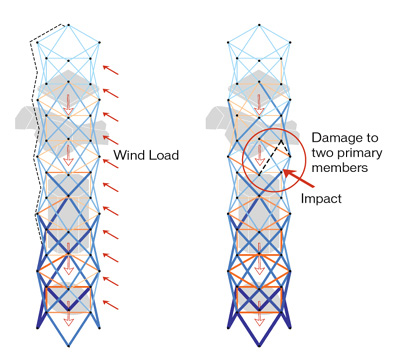 ...nothing could make it as safe as this structure:
 Good thinkin', New York!
^v^v^v^v^v^v^v^v^v^v^v^v^v^v^v^v^v^v^v^v^v^v^v^v^v^v^v^v^v^v^v^v^
2003.03.12 - Notes on Bowling for Columbine #
() The documentary attempts to answer the Question of why
American society seems to have a disproportionate amount of
violence, but employs no trace of scientific or rigorous
methodology to answer it. No anthropologists, sociologists,
historians, or psychologists were interviewed.
() The comparisons between American and foreign societies aren't
really valid. There are many differences between the societies
compared. For example, though Canada has violent films, it
doesn't follow that removing them from America would fail to
reduce violence here.
() Of all the answers suggested to the Question, only two are not
shot down by Moore in the above fashion: 1. Fear sells, but only
in America, which in turn breeds violence, and 2. The race of
whites that came from Europe to America during the Colonial
period are inherently paranoid and violent.
() Moore pretends to seek genuine discourse with the likes of
Clark and Heston, but really intends to grill them on camera, and
follow up with tactics meant for viewers at home, such as
speaking to a van that is driving away.
() Going into a bank and getting a gun, even without the smart-
ass comments, is not benevolent, yet it is unclear what is
supposed to be wrong with banks giving out guns.
() That gun ownership often rises in a given area while crime
goes down is presented as evidence of paranoia, but could also be
taken as evidence that arming people decreases crime.
() The Corporate Cops skit was awesome!
() All the Canadian residences with unlocked doors seem to have
people home at the time!
() The closing narration is just gobbletygook: 'it all comes down
to bowling'. WTF?
^v^v^v^v^v^v^v^v^v^v^v^v^v^v^v^v^v^v^v^v^v^v^v^v^v^v^v^v^v^v^v^v^
2003.03.03 - Cool 'bents #
Bacchetta Areo
Features: light weight, design/build quality
sh. 23"
wb. 47"
wt. 22lbs.
$4500
Lightning P-38 Ultegra
Features: light weight, space-frame
sh. 18-20"
wb. 41-45.5"
wt. 22-25lbs.
$3800
ZOX 20 S-Frame
Features: front-wheel drive
sh. 16" (40cm)
wb. 43" (1.1m)
wt. 29lbs. (13kg.)
$2388 (1800 EUR)
M5 Titanium Shock-Proof
Features: suspension that doesn't suck?
sh. ?
wb. ?
wt. ?
$4012 (3025 EUR)
^v^v^v^v^v^v^v^v^v^v^v^v^v^v^v^v^v^v^v^v^v^v^v^v^v^v^v^v^v^v^v^v^
2003.01.30 - Conjugation of y'all #
Courtesy of Adam:
y'all = you singular
all y'all = you plural
y'alls = singular possessive
all y'alls = plural possessive
^v^v^v^v^v^v^v^v^v^v^v^v^v^v^v^v^v^v^v^v^v^v^v^v^v^v^v^v^v^v^v^v^
2002.11.01 - Iridigm! #
http://www.iridigm.com
^v^v^v^v^v^v^v^v^v^v^v^v^v^v^v^v^v^v^v^v^v^v^v^v^v^v^v^v^v^v^v^v^
2002.10.11 - Disease, pathogens, and Free Lunch #
http://www.theatlantic.com/issues/99feb/germs.htm
Paul Ewald believes most disease is pathogen-related.
It occurs to me that he's made a mistake. He seems to assume
that natural selection has some method of completely removing
defects from a design. Unfortunately, no such method exists, for
natural selection or any other process.
For example, cancer may be to some extent inevitable. The idea
is that the ability to conduct epigenesis and have robust healing
in a population of largely autonomous agents must be balanced
against... cancer. Modeling this with cellular automata might
make a promising research program.
There's a myth that sharks don't get cancer. A quick google
reveals it to be false. Plants also suffer from cancer. Gary
Ostrander, Hopkins professor of biology and comparative medicine
offers...
"Cancer exists throughout the phylogenetic tree, science's system
for classifying the many forms of life. The idea that there's
some animal out there that never gets cancer and never expresses
it just really doesn't resonate well with people who work in the
field."
We might look to "No Free Lunch"-type theorems for a lead on
formal results. Here's a bunch of peripherally-related, highly
speculative but possibly interesting verbiage...
http://www.santafe.edu/sfi/People/kauffman/Lecture-3.html
""| 3.2.2 | The NO FREE LUNCH THEOREM of Macready and Wolpert
appears to have important implications about the cocreation of
natural games and players as duals of one another in self-
constructing coevolving systems of autonomous agents.
The No Free Lunch theorem considers a finite ... space divided
into a finite number of subvolumes. ...
Consider two search algorithms, say mutation and selection on the
one hand, and fully random search on the other. Let each search
algorithm sample M distinct points on the landscape.
The "No Free Lunch" theorem states that, averaged over all
fitness landscapes, no search outperforms any other search
algorithm. Averaged over all landscapes, hill descending does as
well as hill climbing or random search.
Thus, the theorem seems to imply that, if biological evolution by
mutation, recombination, and selection is "doing well," then the
landscapes searched by mutation, recombination and selection must
themselves be a subset of all possible landscapes. Namely,
biological fitness landscapes must be those that are precisely
the ones that are well-searched by mutation, recombination, and
selection!
But this suggests that the coevolutionary process is jointly and
self-consistently creating both the organisms that make a living,
and the niche ... that those very organisms can readily search by
mutation, recombination and selection. ...
This hypothesis is testable at the level of proteins by assessing
whether protein fitness landscapes, for example with respect to
receptor-ligand binding, has the character that it is well-
searched by mutation, recombination and selection in comparison
to fully random search. Recent results based on "sexual PCR" to
achieve recombination in populations of protein molecules tends
to confirm this hypothesis.""
^v^v^v^v^v^v^v^v^v^v^v^v^v^v^v^v^v^v^v^v^v^v^v^v^v^v^v^v^v^v^v^v^
2002.10.08 - Why QWERTY? #
The 'letter-frequency slowdown' story is a dud. QWERTY was
already standard by the time touch-typing was invented!
The 'typebar sequence' explanation is the best I can find...
http://home.earthlink.net/~dcrehr/whyqwert.html
http://www.mwbrooks.com/dvorak/dissent.html#ergo
Cecil Adams, however, bought the Liebowitz paper...
http://www.straightdope.com/classics/a1_248.html
...ughk...
|| (1) the research demonstrating the superiority of the Dvorak
|| keyboard is sparse and methodologically suspect;
Does not constitute an argument in favor of QWERTY.
|| 2) a sizable body of work suggests that in fact the Dvorak
|| offers little practical advantage over the QWERTY;
False. No sufficient studies have ever been done comparing the
two layouts, let alone have any results been repeated.
|| (3) at least one study indicates that placing commonly used
|| keys far apart, as with the QWERTY, actually speeds typing,
|| since you frequently alternate hands;
A visit to the efficiency calculator is in order...
http://www.acm.vt.edu/~jmaxwell/dvorak/compare.html
...Assuming by "commonly used keys" he means "letters commonly
found in sequence", which he does. The letters placed far apart
in this manner by QWERTY were inside early typewriters and are
not reflected in the layout relative to the human hands,
according to the 'typebar sequence' theory.
|| (4) the QWERTY keyboard did not become a standard overnight
|| but beat out several competing keyboards over a period of
|| years
Implies that market forces always lead to optimal solutions,
which is false.
^v^v^v^v^v^v^v^v^v^v^v^v^v^v^v^v^v^v^v^v^v^v^v^v^v^v^v^v^v^v^v^v^
2002.10.07 - Faster than a Quick Brown Fox #
Pack my box with five dozen liquor jugs.
^v^v^v^v^v^v^v^v^v^v^v^v^v^v^v^v^v^v^v^v^v^v^v^v^v^v^v^v^v^v^v^v^
2002.07.11 - Frozen Accidents #
It's been much harder than I thought it would be to come up with
bulletproof, demonstrated examples, such that it is impossible to
defend the frozen thing in any way.
thing frozen thawed
keyboard layout QWERTY Dvorak
retina design vertebrate cephalopod
laundry machines upright front-loading
disposable cup lids snap-on puncture-anywhere adhesive film
Actually, I'm not able to fully defend retina design, so it
shouldn't be on the list, but I couldn't find a refutation of it
on the web or usenet...
I've been working on power distribution | grid | microgeneration,
but still can't find enough data to say one way or the other.
^v^v^v^v^v^v^v^v^v^v^v^v^v^v^v^v^v^v^v^v^v^v^v^v^v^v^v^v^v^v^v^v^
2002.07.09 - Definitive assessment of the HID situation #
. The Kinesis Contoured keyboard is a gimmick.
. The Half Keyboard seems to be the best chord keyboard
around -- since it is as close to not being a chord keyboard as
possible. :) Still useful for applications where you must have a
keyboard in a small space.
. New typists should on average reach higher speeds with the
Dvorak layout, while relearning issues may interfere with
potential speedups in QWERTY converts. And Dvorak probably isn't
faster in the limit, since finger travel distance doesn't appear
to limit fast typists. Dvorak does seem to reduce hand strain
and typos, though, 'across the board'.
. The Dvorak layout is apparently very close to optimal, if you
agree with Dvoark's original criteria for good keyboards
. A major cause of strain is "pronation". To reduce it,
Microsoft introduced their 1995 (or '94?) Natural keyboard. Even
current incarnations of this design are big and klunky, and don't
go nearly far enough in the perpendicular direction. And many of
them have annoying, gummy actions. It looks like the new
SafeType keyboard has it right. It's $300, though, which seems
excessive.
. The ultimate in expense and perhaps in design appears to be
the DataHand. Finger travel must be near minimal, and there are
separate units for each hand, which can be presumably be mounted
in any position one likes.
. But for reduced finger travel in a compact form factor at a
reasonable price, the winner must be TypeMatrix. Here, the keys
are simply placed in straight (as opposed to staggered) rows.
This makes considerable sense for computer keyboards, which lack
physical key arms extending behind the keys. The TypeMatrix
keyboard also has a handy built-in Dvorak mode, freeing the user
from annoying software config. The only drawback is the lack of
a native USB version.
. For me, the mouse causes at least as much stress as the
keyboard. The 3M Renaissance Mouse again addresses pronation.
It isn't optical, though, and there's no excuse for that. Any
advantage in design would be outweighed by the general suckiness
of mechanical tracking. I'm qualified to say this because I used
the Renaissance Mouse for two months.
. I've pretty much used every mouse on the market. The best two
are the Logitech Cordless Trackman FX and the Microsoft Wheel
Mouse Optical. The original Logitech Trackman Marble (the first
optical pointing device, now called the Trackman Wheel) was
great, but the updated version saw its buttons moved too close
together and the addition of a scroll wheel. Scroll wheels are
good, but Logitech's is stiff and obnoxious (unlike Microsoft's
excellent one). MS' Wheel Mouse Optical has the benefit of being
Right/Left symmetrical (unlike their more expensive Explorer
optical mouse or any of Logitech's devices save the Marble Mouse,
which I don't like anyway).
. With some getting-used-to, a graphics tablet (such as a Wacom
Intuos) could be a contender. Though it's my guess that tablets
are ultimately not as good as the mice above for everyday GUI
control. I wonder if this would still hold for tablets with with
relative positioning, instead of the absolute positioning used on
Wacom tablets...
. If you're on the road, your choices are basically trackpad or
pointing stick. I personally prefer the pointing stick, as it
allows me to be very fast by keeping my hands over the keyboard.
The new 'scroll area' feature on trackpads seems like a great
thing, though.
. One of the most exciting input developments is Fingerworks'
MultiTouch technology. Taking the pointing stick idea to the
max, they allow you to perform both pointing and keystroke
gestures over a single area.
. If you work at a desk, footpedals are a natural idea. If they
work as well as the worst mouse, they would blow any hand-
operated pointing device away.
^v^v^v^v^v^v^v^v^v^v^v^v^v^v^v^v^v^v^v^v^v^v^v^v^v^v^v^v^v^v^v^v^
2002.06.16 - Kurzweil's kalculations #
http://www.kurzweilai.net
Kurzweil equates ops/sec on a Turing machine with a number of
synapses in a brain, but says nothing about why he can do this.
Here's a alternate version of his argument...
() Today's PCs can simulate about 100 neurons in real time with
enough detail to give rise to intelligence in larger networks.
() PCs are getting faster exponentially. In particular, they
double in speed every 18 months.
() There are 2 * 10^10 neurons in the cerebral cortex. Neurons
outside the cortex are comparatively trivial to model.
() To within an order of magnitude, PCs must get no more than
2 * 10^8 times faster to support human intelligence.
() That's about 2^28 times, or 28 Moore periods, or 42 years.
() Assuming software will not be the limiting factor, which is
not unreasonable if you believe that intelligence just emerges
from complex networks and/or that neuroscience also gets better
exponentially, then human-level AI will be commonly available no
later than the year 2044.
^v^v^v^v^v^v^v^v^v^v^v^v^v^v^v^v^v^v^v^v^v^v^v^v^v^v^v^v^v^v^v^v^
2002.04.13 - Things I'd like to do more regularly #
sleep in the woods
sleep with a girl
sing in a choir
play go
play chess
lift weights
practice yoga
chop wood
^v^v^v^v^v^v^v^v^v^v^v^v^v^v^v^v^v^v^v^v^v^v^v^v^v^v^v^v^v^v^v^v^
2002.02.17 - Link-density Spider Daemon #
Starting from a target html document, the LSD builds a tree by
following links. To each node it assigns a link density by
measuring the portion of words which are external links. The
user specifies the target page and says something like, "I want
to read 15K about this, below 5%". The LSD returns 15K of text,
formatted on a single page, of pages nearest to the starting page
in the tree with more than 95% non-linking text.
This automates the process of browsing. What do you need to do
when you're reading a page with a link? Follow it, of course.
And you keep following links until you've read enough on the
topic you're reading about. Thus, a page which is all links
contains very little information -- you could skip it entirely.
That's what the LSD does. It also lets you choose how much to
read on a given topic before you start, which might help you
manage your time online.
Variant: Rather than preferring pages with fewer links, links may
simply be treated as text substitution.
Additional features:
() A parameter allows the user to trade view depth (on the tree)
against excerpting of the pages (say, in percent).
() Center excerpts around keywords.
() A heuristic that looks ahead of the given K return limit to
see where the link density function changes abruptly. Rather
than fixed depth, it could then allocate return K so that as
many nodes which are local minima of the link density function
are returned as possible.
() Consider PageRank as well as link density.
^v^v^v^v^v^v^v^v^v^v^v^v^v^v^v^v^v^v^v^v^v^v^v^v^v^v^v^v^v^v^v^v^
2001.11.17 - Microsoft anti-trust #
The points agreed upon in the recent settlement with Microsoft
(MS) are meaningless -- merely the collected bitterness of those
who've had products 'ruined' because MS used Windows to promote
competing products. As if getting users to run installers that
convert their desktops into billboards was too much of a burden.
If advertising were the issue, users ought to be able to charge
for their desktop space (before you get caught thinking this is
far-fetched, consider that such a system has already evolved in
the shareware industry). But anti-trust legislation is not meant
to compensate vanquished competition. It's meant to ensure a
climate conducive to future competition.
The present settlement is so vague and difficult to enforce that
it is effectively harmless to MS and useless in supporting a
competitive marketplace. The Justice Department, that takes
three years and three judges to get a settlement, would have us
imagine they can enforce such an ambiguous policy in market-time?
An enforceable, fair, and effective sanction that could be placed
on MS is: a good-till-canceled moratorium on exclusionary
licensing.
Is exclusionary licensing against the law? It isn't. It is a
practice grandfathered in soda fountains and newspaper routes.
But to the extent MS has been found to abuse monopoly power, we
are justified in meddling with its most aggressive trading
practices.
But is MS really a Monopoly? Aside from Jackson, let's consult
Linus Torvalds. He asks if there is any other company that is
profitable on the basis of EULA software binaries. With the
forgettable (if not dubious) exceptions of Adobe and Corel, "no"
would have to be the answer, and it isn't for a want of attempts.
Sun and Apple have excellent software products but were unable to
market them outside of a hardware-based model. Even MS, with the
help of exclusionary deals, depends on licenses pre-installed on
hardware products.
How would such a moratorium be enforced? By creating an open
market through which all pre-installed and corporate MS licenses
must be bought and sold. Microsoft places asks, corporations
place anonymous bids, and (optionally) independent market-makers
oil the gears.
^v^v^v^v^v^v^v^v^v^v^v^v^v^v^v^v^v^v^v^v^v^v^v^v^v^v^v^v^v^v^v^v^
2001.07.18 - A brief history of CG in Hollywood #
year film footage notable tech who
2001 Monsters, Inc. (all) --- ? --- Pixar
2001 Final Fantasy (all) human characters Square
2001 Shrek (all) detail level PDI
2000 Toy Story 2 (all) detail level Pixar
* 1999 Star Wars TPM (majority) major character ILM
1999 ANTZ (all) number effects PDI
1998 A Bug's Life (all) texture mapping Pixar
* 1998 Small Soldiers ? --- ? --- ILM
1995 Toy Story (all) detail level Pixar
* 1994 Jurassic Park ? texture mapping ILM
1992 The Lawnmower Man 23 ray tracing (various)
* 1991 Terminator 2 6 min. liquid metal ILM
* 1989 The Abyss 3 min? liquid metal ILM
* 1988 Willow ? morphing ILM
1982 Star Trek 2 ~ 1 min. fractal landscape ILM
1980 TRON 30 min. ray tracing (various)
* Digital footage composited with live action.
^v^v^v^v^v^v^v^v^v^v^v^v^v^v^v^v^v^v^v^v^v^v^v^v^v^v^v^v^v^v^v^v^
2001.04.25 - Selected Fugues from the Well Tempered Clavier #
Book I (5 Major, 5 minor)
1- No. 4 in C# minor
2- No. 7 in Eb Major
3- No. 8 in D# minor
4- No. 12 in F minor
5- No. 13 in F# Major
6- No. 19 in A Major
7- No. 21 in Bb Major
8- No. 22 in Bb minor
9- No. 23 in B Major
10- No. 24 in B minor
Book II (6 Major, 6 minor)
1- No. 5 in D Major
2- No. 8 in D# minor
3- No. 9 in E Major
4- No. 13 in F# Major
5- No. 14 in F# minor
6- No. 16 in G minor
7- No. 19 in A Major
8- No. 20 in A minor
9- No. 21 in Bb Major
10- No. 22 in Bb minor
11- No. 23 in B Major
12- No. 24 in B minor
-`._-`._-`._-`._-`._-`._-`._-`._-`._-`._-`._-`._-`._-`._-`._-`._-
clumma@gmail.com
Good thinkin', New York!
^v^v^v^v^v^v^v^v^v^v^v^v^v^v^v^v^v^v^v^v^v^v^v^v^v^v^v^v^v^v^v^v^
2003.03.12 - Notes on Bowling for Columbine #
() The documentary attempts to answer the Question of why
American society seems to have a disproportionate amount of
violence, but employs no trace of scientific or rigorous
methodology to answer it. No anthropologists, sociologists,
historians, or psychologists were interviewed.
() The comparisons between American and foreign societies aren't
really valid. There are many differences between the societies
compared. For example, though Canada has violent films, it
doesn't follow that removing them from America would fail to
reduce violence here.
() Of all the answers suggested to the Question, only two are not
shot down by Moore in the above fashion: 1. Fear sells, but only
in America, which in turn breeds violence, and 2. The race of
whites that came from Europe to America during the Colonial
period are inherently paranoid and violent.
() Moore pretends to seek genuine discourse with the likes of
Clark and Heston, but really intends to grill them on camera, and
follow up with tactics meant for viewers at home, such as
speaking to a van that is driving away.
() Going into a bank and getting a gun, even without the smart-
ass comments, is not benevolent, yet it is unclear what is
supposed to be wrong with banks giving out guns.
() That gun ownership often rises in a given area while crime
goes down is presented as evidence of paranoia, but could also be
taken as evidence that arming people decreases crime.
() The Corporate Cops skit was awesome!
() All the Canadian residences with unlocked doors seem to have
people home at the time!
() The closing narration is just gobbletygook: 'it all comes down
to bowling'. WTF?
^v^v^v^v^v^v^v^v^v^v^v^v^v^v^v^v^v^v^v^v^v^v^v^v^v^v^v^v^v^v^v^v^
2003.03.03 - Cool 'bents #
Bacchetta Areo
Features: light weight, design/build quality
sh. 23"
wb. 47"
wt. 22lbs.
$4500
Lightning P-38 Ultegra
Features: light weight, space-frame
sh. 18-20"
wb. 41-45.5"
wt. 22-25lbs.
$3800
ZOX 20 S-Frame
Features: front-wheel drive
sh. 16" (40cm)
wb. 43" (1.1m)
wt. 29lbs. (13kg.)
$2388 (1800 EUR)
M5 Titanium Shock-Proof
Features: suspension that doesn't suck?
sh. ?
wb. ?
wt. ?
$4012 (3025 EUR)
^v^v^v^v^v^v^v^v^v^v^v^v^v^v^v^v^v^v^v^v^v^v^v^v^v^v^v^v^v^v^v^v^
2003.01.30 - Conjugation of y'all #
Courtesy of Adam:
y'all = you singular
all y'all = you plural
y'alls = singular possessive
all y'alls = plural possessive
^v^v^v^v^v^v^v^v^v^v^v^v^v^v^v^v^v^v^v^v^v^v^v^v^v^v^v^v^v^v^v^v^
2002.11.01 - Iridigm! #
http://www.iridigm.com
^v^v^v^v^v^v^v^v^v^v^v^v^v^v^v^v^v^v^v^v^v^v^v^v^v^v^v^v^v^v^v^v^
2002.10.11 - Disease, pathogens, and Free Lunch #
http://www.theatlantic.com/issues/99feb/germs.htm
Paul Ewald believes most disease is pathogen-related.
It occurs to me that he's made a mistake. He seems to assume
that natural selection has some method of completely removing
defects from a design. Unfortunately, no such method exists, for
natural selection or any other process.
For example, cancer may be to some extent inevitable. The idea
is that the ability to conduct epigenesis and have robust healing
in a population of largely autonomous agents must be balanced
against... cancer. Modeling this with cellular automata might
make a promising research program.
There's a myth that sharks don't get cancer. A quick google
reveals it to be false. Plants also suffer from cancer. Gary
Ostrander, Hopkins professor of biology and comparative medicine
offers...
"Cancer exists throughout the phylogenetic tree, science's system
for classifying the many forms of life. The idea that there's
some animal out there that never gets cancer and never expresses
it just really doesn't resonate well with people who work in the
field."
We might look to "No Free Lunch"-type theorems for a lead on
formal results. Here's a bunch of peripherally-related, highly
speculative but possibly interesting verbiage...
http://www.santafe.edu/sfi/People/kauffman/Lecture-3.html
""| 3.2.2 | The NO FREE LUNCH THEOREM of Macready and Wolpert
appears to have important implications about the cocreation of
natural games and players as duals of one another in self-
constructing coevolving systems of autonomous agents.
The No Free Lunch theorem considers a finite ... space divided
into a finite number of subvolumes. ...
Consider two search algorithms, say mutation and selection on the
one hand, and fully random search on the other. Let each search
algorithm sample M distinct points on the landscape.
The "No Free Lunch" theorem states that, averaged over all
fitness landscapes, no search outperforms any other search
algorithm. Averaged over all landscapes, hill descending does as
well as hill climbing or random search.
Thus, the theorem seems to imply that, if biological evolution by
mutation, recombination, and selection is "doing well," then the
landscapes searched by mutation, recombination and selection must
themselves be a subset of all possible landscapes. Namely,
biological fitness landscapes must be those that are precisely
the ones that are well-searched by mutation, recombination, and
selection!
But this suggests that the coevolutionary process is jointly and
self-consistently creating both the organisms that make a living,
and the niche ... that those very organisms can readily search by
mutation, recombination and selection. ...
This hypothesis is testable at the level of proteins by assessing
whether protein fitness landscapes, for example with respect to
receptor-ligand binding, has the character that it is well-
searched by mutation, recombination and selection in comparison
to fully random search. Recent results based on "sexual PCR" to
achieve recombination in populations of protein molecules tends
to confirm this hypothesis.""
^v^v^v^v^v^v^v^v^v^v^v^v^v^v^v^v^v^v^v^v^v^v^v^v^v^v^v^v^v^v^v^v^
2002.10.08 - Why QWERTY? #
The 'letter-frequency slowdown' story is a dud. QWERTY was
already standard by the time touch-typing was invented!
The 'typebar sequence' explanation is the best I can find...
http://home.earthlink.net/~dcrehr/whyqwert.html
http://www.mwbrooks.com/dvorak/dissent.html#ergo
Cecil Adams, however, bought the Liebowitz paper...
http://www.straightdope.com/classics/a1_248.html
...ughk...
|| (1) the research demonstrating the superiority of the Dvorak
|| keyboard is sparse and methodologically suspect;
Does not constitute an argument in favor of QWERTY.
|| 2) a sizable body of work suggests that in fact the Dvorak
|| offers little practical advantage over the QWERTY;
False. No sufficient studies have ever been done comparing the
two layouts, let alone have any results been repeated.
|| (3) at least one study indicates that placing commonly used
|| keys far apart, as with the QWERTY, actually speeds typing,
|| since you frequently alternate hands;
A visit to the efficiency calculator is in order...
http://www.acm.vt.edu/~jmaxwell/dvorak/compare.html
...Assuming by "commonly used keys" he means "letters commonly
found in sequence", which he does. The letters placed far apart
in this manner by QWERTY were inside early typewriters and are
not reflected in the layout relative to the human hands,
according to the 'typebar sequence' theory.
|| (4) the QWERTY keyboard did not become a standard overnight
|| but beat out several competing keyboards over a period of
|| years
Implies that market forces always lead to optimal solutions,
which is false.
^v^v^v^v^v^v^v^v^v^v^v^v^v^v^v^v^v^v^v^v^v^v^v^v^v^v^v^v^v^v^v^v^
2002.10.07 - Faster than a Quick Brown Fox #
Pack my box with five dozen liquor jugs.
^v^v^v^v^v^v^v^v^v^v^v^v^v^v^v^v^v^v^v^v^v^v^v^v^v^v^v^v^v^v^v^v^
2002.07.11 - Frozen Accidents #
It's been much harder than I thought it would be to come up with
bulletproof, demonstrated examples, such that it is impossible to
defend the frozen thing in any way.
thing frozen thawed
keyboard layout QWERTY Dvorak
retina design vertebrate cephalopod
laundry machines upright front-loading
disposable cup lids snap-on puncture-anywhere adhesive film
Actually, I'm not able to fully defend retina design, so it
shouldn't be on the list, but I couldn't find a refutation of it
on the web or usenet...
I've been working on power distribution | grid | microgeneration,
but still can't find enough data to say one way or the other.
^v^v^v^v^v^v^v^v^v^v^v^v^v^v^v^v^v^v^v^v^v^v^v^v^v^v^v^v^v^v^v^v^
2002.07.09 - Definitive assessment of the HID situation #
. The Kinesis Contoured keyboard is a gimmick.
. The Half Keyboard seems to be the best chord keyboard
around -- since it is as close to not being a chord keyboard as
possible. :) Still useful for applications where you must have a
keyboard in a small space.
. New typists should on average reach higher speeds with the
Dvorak layout, while relearning issues may interfere with
potential speedups in QWERTY converts. And Dvorak probably isn't
faster in the limit, since finger travel distance doesn't appear
to limit fast typists. Dvorak does seem to reduce hand strain
and typos, though, 'across the board'.
. The Dvorak layout is apparently very close to optimal, if you
agree with Dvoark's original criteria for good keyboards
. A major cause of strain is "pronation". To reduce it,
Microsoft introduced their 1995 (or '94?) Natural keyboard. Even
current incarnations of this design are big and klunky, and don't
go nearly far enough in the perpendicular direction. And many of
them have annoying, gummy actions. It looks like the new
SafeType keyboard has it right. It's $300, though, which seems
excessive.
. The ultimate in expense and perhaps in design appears to be
the DataHand. Finger travel must be near minimal, and there are
separate units for each hand, which can be presumably be mounted
in any position one likes.
. But for reduced finger travel in a compact form factor at a
reasonable price, the winner must be TypeMatrix. Here, the keys
are simply placed in straight (as opposed to staggered) rows.
This makes considerable sense for computer keyboards, which lack
physical key arms extending behind the keys. The TypeMatrix
keyboard also has a handy built-in Dvorak mode, freeing the user
from annoying software config. The only drawback is the lack of
a native USB version.
. For me, the mouse causes at least as much stress as the
keyboard. The 3M Renaissance Mouse again addresses pronation.
It isn't optical, though, and there's no excuse for that. Any
advantage in design would be outweighed by the general suckiness
of mechanical tracking. I'm qualified to say this because I used
the Renaissance Mouse for two months.
. I've pretty much used every mouse on the market. The best two
are the Logitech Cordless Trackman FX and the Microsoft Wheel
Mouse Optical. The original Logitech Trackman Marble (the first
optical pointing device, now called the Trackman Wheel) was
great, but the updated version saw its buttons moved too close
together and the addition of a scroll wheel. Scroll wheels are
good, but Logitech's is stiff and obnoxious (unlike Microsoft's
excellent one). MS' Wheel Mouse Optical has the benefit of being
Right/Left symmetrical (unlike their more expensive Explorer
optical mouse or any of Logitech's devices save the Marble Mouse,
which I don't like anyway).
. With some getting-used-to, a graphics tablet (such as a Wacom
Intuos) could be a contender. Though it's my guess that tablets
are ultimately not as good as the mice above for everyday GUI
control. I wonder if this would still hold for tablets with with
relative positioning, instead of the absolute positioning used on
Wacom tablets...
. If you're on the road, your choices are basically trackpad or
pointing stick. I personally prefer the pointing stick, as it
allows me to be very fast by keeping my hands over the keyboard.
The new 'scroll area' feature on trackpads seems like a great
thing, though.
. One of the most exciting input developments is Fingerworks'
MultiTouch technology. Taking the pointing stick idea to the
max, they allow you to perform both pointing and keystroke
gestures over a single area.
. If you work at a desk, footpedals are a natural idea. If they
work as well as the worst mouse, they would blow any hand-
operated pointing device away.
^v^v^v^v^v^v^v^v^v^v^v^v^v^v^v^v^v^v^v^v^v^v^v^v^v^v^v^v^v^v^v^v^
2002.06.16 - Kurzweil's kalculations #
http://www.kurzweilai.net
Kurzweil equates ops/sec on a Turing machine with a number of
synapses in a brain, but says nothing about why he can do this.
Here's a alternate version of his argument...
() Today's PCs can simulate about 100 neurons in real time with
enough detail to give rise to intelligence in larger networks.
() PCs are getting faster exponentially. In particular, they
double in speed every 18 months.
() There are 2 * 10^10 neurons in the cerebral cortex. Neurons
outside the cortex are comparatively trivial to model.
() To within an order of magnitude, PCs must get no more than
2 * 10^8 times faster to support human intelligence.
() That's about 2^28 times, or 28 Moore periods, or 42 years.
() Assuming software will not be the limiting factor, which is
not unreasonable if you believe that intelligence just emerges
from complex networks and/or that neuroscience also gets better
exponentially, then human-level AI will be commonly available no
later than the year 2044.
^v^v^v^v^v^v^v^v^v^v^v^v^v^v^v^v^v^v^v^v^v^v^v^v^v^v^v^v^v^v^v^v^
2002.04.13 - Things I'd like to do more regularly #
sleep in the woods
sleep with a girl
sing in a choir
play go
play chess
lift weights
practice yoga
chop wood
^v^v^v^v^v^v^v^v^v^v^v^v^v^v^v^v^v^v^v^v^v^v^v^v^v^v^v^v^v^v^v^v^
2002.02.17 - Link-density Spider Daemon #
Starting from a target html document, the LSD builds a tree by
following links. To each node it assigns a link density by
measuring the portion of words which are external links. The
user specifies the target page and says something like, "I want
to read 15K about this, below 5%". The LSD returns 15K of text,
formatted on a single page, of pages nearest to the starting page
in the tree with more than 95% non-linking text.
This automates the process of browsing. What do you need to do
when you're reading a page with a link? Follow it, of course.
And you keep following links until you've read enough on the
topic you're reading about. Thus, a page which is all links
contains very little information -- you could skip it entirely.
That's what the LSD does. It also lets you choose how much to
read on a given topic before you start, which might help you
manage your time online.
Variant: Rather than preferring pages with fewer links, links may
simply be treated as text substitution.
Additional features:
() A parameter allows the user to trade view depth (on the tree)
against excerpting of the pages (say, in percent).
() Center excerpts around keywords.
() A heuristic that looks ahead of the given K return limit to
see where the link density function changes abruptly. Rather
than fixed depth, it could then allocate return K so that as
many nodes which are local minima of the link density function
are returned as possible.
() Consider PageRank as well as link density.
^v^v^v^v^v^v^v^v^v^v^v^v^v^v^v^v^v^v^v^v^v^v^v^v^v^v^v^v^v^v^v^v^
2001.11.17 - Microsoft anti-trust #
The points agreed upon in the recent settlement with Microsoft
(MS) are meaningless -- merely the collected bitterness of those
who've had products 'ruined' because MS used Windows to promote
competing products. As if getting users to run installers that
convert their desktops into billboards was too much of a burden.
If advertising were the issue, users ought to be able to charge
for their desktop space (before you get caught thinking this is
far-fetched, consider that such a system has already evolved in
the shareware industry). But anti-trust legislation is not meant
to compensate vanquished competition. It's meant to ensure a
climate conducive to future competition.
The present settlement is so vague and difficult to enforce that
it is effectively harmless to MS and useless in supporting a
competitive marketplace. The Justice Department, that takes
three years and three judges to get a settlement, would have us
imagine they can enforce such an ambiguous policy in market-time?
An enforceable, fair, and effective sanction that could be placed
on MS is: a good-till-canceled moratorium on exclusionary
licensing.
Is exclusionary licensing against the law? It isn't. It is a
practice grandfathered in soda fountains and newspaper routes.
But to the extent MS has been found to abuse monopoly power, we
are justified in meddling with its most aggressive trading
practices.
But is MS really a Monopoly? Aside from Jackson, let's consult
Linus Torvalds. He asks if there is any other company that is
profitable on the basis of EULA software binaries. With the
forgettable (if not dubious) exceptions of Adobe and Corel, "no"
would have to be the answer, and it isn't for a want of attempts.
Sun and Apple have excellent software products but were unable to
market them outside of a hardware-based model. Even MS, with the
help of exclusionary deals, depends on licenses pre-installed on
hardware products.
How would such a moratorium be enforced? By creating an open
market through which all pre-installed and corporate MS licenses
must be bought and sold. Microsoft places asks, corporations
place anonymous bids, and (optionally) independent market-makers
oil the gears.
^v^v^v^v^v^v^v^v^v^v^v^v^v^v^v^v^v^v^v^v^v^v^v^v^v^v^v^v^v^v^v^v^
2001.07.18 - A brief history of CG in Hollywood #
year film footage notable tech who
2001 Monsters, Inc. (all) --- ? --- Pixar
2001 Final Fantasy (all) human characters Square
2001 Shrek (all) detail level PDI
2000 Toy Story 2 (all) detail level Pixar
* 1999 Star Wars TPM (majority) major character ILM
1999 ANTZ (all) number effects PDI
1998 A Bug's Life (all) texture mapping Pixar
* 1998 Small Soldiers ? --- ? --- ILM
1995 Toy Story (all) detail level Pixar
* 1994 Jurassic Park ? texture mapping ILM
1992 The Lawnmower Man 23 ray tracing (various)
* 1991 Terminator 2 6 min. liquid metal ILM
* 1989 The Abyss 3 min? liquid metal ILM
* 1988 Willow ? morphing ILM
1982 Star Trek 2 ~ 1 min. fractal landscape ILM
1980 TRON 30 min. ray tracing (various)
* Digital footage composited with live action.
^v^v^v^v^v^v^v^v^v^v^v^v^v^v^v^v^v^v^v^v^v^v^v^v^v^v^v^v^v^v^v^v^
2001.04.25 - Selected Fugues from the Well Tempered Clavier #
Book I (5 Major, 5 minor)
1- No. 4 in C# minor
2- No. 7 in Eb Major
3- No. 8 in D# minor
4- No. 12 in F minor
5- No. 13 in F# Major
6- No. 19 in A Major
7- No. 21 in Bb Major
8- No. 22 in Bb minor
9- No. 23 in B Major
10- No. 24 in B minor
Book II (6 Major, 6 minor)
1- No. 5 in D Major
2- No. 8 in D# minor
3- No. 9 in E Major
4- No. 13 in F# Major
5- No. 14 in F# minor
6- No. 16 in G minor
7- No. 19 in A Major
8- No. 20 in A minor
9- No. 21 in Bb Major
10- No. 22 in Bb minor
11- No. 23 in B Major
12- No. 24 in B minor
-`._-`._-`._-`._-`._-`._-`._-`._-`._-`._-`._-`._-`._-`._-`._-`._-
clumma@gmail.com